
Caregiver decision guide
How to Choose Accessible Airport Transportation for Seniors
The right accessible airport ride for an older adult depends on transfer ability, booking lead time, and what services your city reliably offers. This criteria-based comparison covers WAV rideshare, accessible taxis, ADA paratransit, medical transport, and volunteer driver programs, then gives a fallback path for cities where none are available.
Before comparing accessible airport transportation options for seniors, answer three questions in this order: Can the older adult transfer out of a wheelchair into a regular vehicle seat? How soon is the trip? What services actually operate at that city and airport today?
That order matters. A rideshare app that looks simple on a phone is not useful if wheelchair-accessible vehicles are not offered at the airport. A paratransit service that works beautifully for local errands may not cross the boundary to the terminal. A medical van may be the wrong tool if the trip is not medical. And if the senior cannot transfer safely, a standard sedan with a folded wheelchair in the trunk is not an accessible ride; it is a risk waiting at the curb.
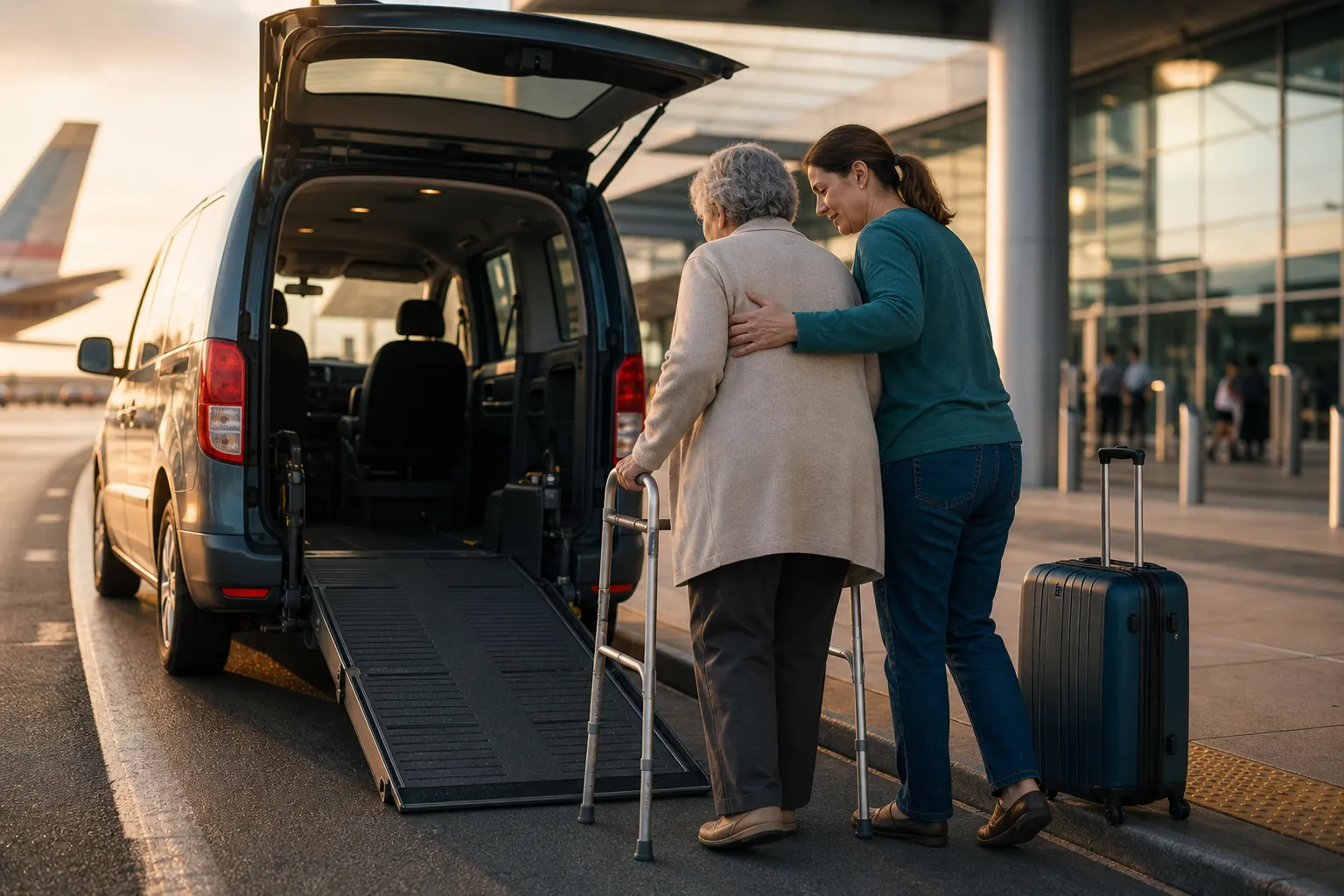
This is not a niche inconvenience. In the United States, 79% of 63 million family caregivers provide transportation for an older adult or person with a disability, which means airport rides are part of a much larger, recurring job: getting someone safely from one place to another when driving, walking long distances, or navigating alone is no longer reliable.[1]
Start with transfer ability, timing, and local proof

The cleanest comparison chart in the world will still fail if it starts with brands instead of constraints. For an airport trip, the ride has to match the senior’s body, the clock, and the city.
| Question | Why it changes the ride | What it usually rules in or out |
|---|---|---|
| Can the senior transfer into a regular vehicle seat? | If yes, a standard car, taxi, shuttle, or volunteer ride may work if the wheelchair or walker can be stored. If no, the ride needs a ramp- or lift-equipped wheelchair-accessible vehicle. | No-transfer riders usually need WAV rideshare, accessible taxi, paratransit, wheelchair van, NEMT when eligible, or a volunteer program with appropriate vehicle access. |
| How much advance notice do you have? | Some options are on-demand in name only. Others require previous-day booking, eligibility approval, or several hours of notice. | Same-day trips tend to depend on local WAV rideshare, accessible taxis, or private transport. Paratransit, volunteer programs, and Medicaid NEMT often need more lead time. |
| Does the service actually operate at this airport? | City availability and airport pickup rules are the weak point in many plans. | Every option needs local verification: service area, airport permission, pickup location, hours, booking window, and whether wheelchair-accessible vehicles are actually dispatching. |
Airport wheelchair assistance can help inside the terminal, at check-in, security, gates, and boarding. It does not solve the ground leg from home to the airport or from baggage claim to home. That boundary is where many otherwise careful plans fall apart.
The option menu, with the failure points left in
The usual transportation categories are worth knowing, but none of them deserves blind trust. Treat each one as a conditional option.
| Option | Best fit | Lead time | Verify before relying on it | Common failure point |
|---|---|---|---|---|
| WAV rideshare, such as Uber WAV or Lyft Wheelchair | A rider who must stay in a wheelchair and is traveling in a city where wheelchair-accessible rideshare is genuinely active | Often requested through an app, but availability can still be limited | City, airport pickup rules, vehicle supply, hours, and whether the app shows the accessible ride type for the actual trip | The platform may offer the category somewhere, but not at this airport or not with available vehicles when needed |
| Accessible taxi | A rider who needs a ramp- or lift-equipped cab, especially in cities with a regulated wheelchair taxi fleet | Can require hours of notice, depending on the city | Dispatch phone number, airport pickup process, fare rules, wait time, and whether accessible taxis are actually available on the travel day | The city may technically have wheelchair taxis, but waits can be long |
| ADA complementary paratransit | Eligible riders taking trips within the local transit service area | Often previous-day booking after eligibility is approved | Eligibility, service-area boundary, airport inclusion, hours, fare, companion rules, and local booking rules | Airport may be outside the service area, or the traveler may not be enrolled before the trip |
| Accessible shared shuttle | A rider who can use a scheduled airport shuttle and whose provider can confirm an accessible vehicle | Usually advance booking | Current operating status, ADA vehicle availability, pickup zone, luggage help, and whether the service is shared or private | Shuttle brands and routes change; a live website is not enough proof of an accessible airport ride |
| NEMT or medical transport | Medicaid-covered medical trips or private-pay medical transportation when appropriate | Often scheduled in advance through a broker or provider | Whether the trip qualifies, payer rules, medical purpose, vehicle type, pickup assistance, and cancellation rules | Medicaid NEMT is for medical trips, not general airport travel |
| Volunteer driver program | Older adults who need personal help beyond curbside drop-off, especially where door-through-door service exists | Usually advance arrangement | Service area, eligibility, airport trips, vehicle access, escort level, luggage help, and volunteer availability | Programs vary sharply by region and may not have a wheelchair-accessible vehicle |
WAV rideshare is useful only where it is real
Wheelchair-accessible rideshare is tempting because it looks like the same booking habit many families already use. Uber describes Uber WAV as wheelchair-accessible transportation in select markets, with drivers completing a third-party certification course, and says WAV pricing is comparable to UberX.[2] Those are useful details when the service exists. They are not a national guarantee.
Lyft’s wheelchair-accessible ride type has the same problem: the label travels farther than the vehicles. As of 2026-08-25, Lyft Help listed WAV rides in Boston, Chicago, Dallas, Los Angeles, New York City, Philadelphia, Phoenix, Portland, San Francisco, and Toronto, with riders enabling the option in settings.[3] That list should be re-checked at booking, because market lists and airport rules change.

The geography gap is not theoretical. Wheelchair Travel’s city tracking reports no Uber WAV at Boston Logan, even though Lyft lists Boston as a WAV market, and reports that Houston airports have no WAV rideshare at all. The same source notes that Houston wheelchair taxi waits can exceed two hours.[4] That is the difference between a category existing on a platform and a ride arriving for an older adult after a flight.
For a senior who cannot transfer, check WAV rideshare in the actual app for the actual airport pair before building the rest of the plan around it. Look for the accessible vehicle option, not just “assist,” “comfort,” or a driver note. Then confirm airport pickup rules: some airports use designated rideshare zones, and not every zone is easy for a wheelchair user, a walker user, or a caregiver managing luggage.
Accessible taxis can be the right answer in one city and a dead end in another
Accessible taxis deserve more attention than they usually get because they are often handled locally, not nationally. A city may have a wheelchair taxi fleet, a special dispatch number, a regulated airport queue, or a handful of vans that must be ordered well ahead of time. Those differences matter more than the word “taxi.”
Atlanta is a useful single-market example, not a national price guide. Wheelchair Travel reports that Atlanta ADA-compliant wheelchair taxi vans charge the same meter rates as regular cabs, with an airport-to-Downtown flat rate of $32 plus a $2 fuel surcharge, and that they must be ordered hours in advance.[5] That tells the reader what to look for locally: fare parity, airport flat rates, dispatch rules, and realistic lead time.
The call to taxi dispatch should be blunt and specific: “We need a wheelchair-accessible van for a passenger who will remain in the wheelchair. The pickup is at the airport. What is the earliest confirmed pickup time, where exactly should we wait, and what happens if the flight is delayed?” If the answer is vague, keep looking.
Paratransit is strong local mobility, not always an airport solution
ADA complementary paratransit is one of the most important transportation tools for people whose disabilities prevent them from using fixed-route transit. Under federal ADA paratransit requirements summarized by the National Aging and Disability Transportation Center, complementary paratransit is generally curb-to-curb, operates within three-quarters of a mile of a fixed route, runs during the same days and hours as the fixed-route service, and costs no more than twice the fixed-route fare.[6]
The practical catch is that paratransit is not an instant airport shuttle. AARP notes that ADA paratransit usually requires an eligibility application, often including an assessment, and is generally booked the previous day.[1] Local rules also determine whether the airport is inside the service area and how return trips are handled when flights are delayed.
For an older adult who is already paratransit-eligible, it may be worth checking whether the local agency serves the airport. Ask whether the pickup is curb-to-curb or door-to-door, whether a companion may ride, how much luggage is allowed, what pickup window applies, and what happens if the plane lands late. For someone not yet enrolled, paratransit is usually not the answer to a flight leaving tomorrow morning.
Shared shuttles need a live verification call
Accessible shared shuttles sound tidy: book a van, share the ride, get to the airport. In practice, they need careful verification because airport shuttle brands, routes, contractors, and vehicle fleets change. SuperShuttle, for example, has a live ADA page describing accessible transportation accommodations, but operating status and local availability should be verified directly before relying on it for a wheelchair-accessible airport trip.[7]
A shuttle is more plausible when the senior can transfer, tolerate a shared route, manage a pickup window, and sit upright for a longer ride. For a wheelchair user who cannot transfer, the booking question is not “Do you accommodate disabilities?” It is “Will a ramp- or lift-equipped vehicle be assigned to this exact reservation, from this address to this airport, at this time?”
NEMT belongs inside the medical-trip boundary
Non-emergency medical transportation can be the right vehicle type for a wheelchair user, but the purpose of the trip matters. AARP describes Medicaid NEMT as a benefit for medical trips, typically using wheelchair-accessible vans booked through brokers.[1] That does not make it a general airport transportation benefit.
If the airport trip is connected to medical care, confirm the payer rules, broker process, pickup assistance, escort policy, vehicle type, and documentation requirements. If the trip is a family visit, vacation, relocation, or ordinary travel, do not assume Medicaid NEMT applies. Benefits and eligibility vary by state and plan, and this article is not legal, financial, or benefits advice.
Volunteer programs may solve the handoff that curbside services ignore
Some older adults do not mainly need a vehicle category. They need a person who will come to the door, steady an elbow, help with the walker, wait while the lock is checked, and make sure the handoff at the terminal is not just “dropped at departures.” AARP points to volunteer transportation programs, including the ITNAmerica network, that may offer door-through-door, “arm through arm” service, depending on the region.[1]
That phrase is worth taking literally. Door-through-door service can matter for a senior with low vision, balance problems, mild cognitive impairment, or anxiety in crowded spaces. It can also matter after a family has had to ask whether driving is still safe; once driving is off the table, dependable rides become part of daily independence, not a special travel perk. Families already wrestling with that threshold may also find it useful to review dementia and driving safety questions before the next transportation crisis.
The limits are real. Volunteer programs are region-dependent, may require membership or advance scheduling, and may not have wheelchair-accessible vehicles. They are strongest when matched to the older adult’s actual support needs: not just “Can someone drive?” but “Can someone help from the door, past the curb, to the right airport handoff?”
Verify by city, not by transportation category
The city is not a background detail. It is the operating system. A large airport may have poor accessible rideshare coverage. A mid-sized city may have a responsive wheelchair taxi dispatcher. A paratransit agency may serve the terminal in one metro area and stop short of it in another. This is why broader questions about senior-friendly cities and transportation infrastructure show up in daily caregiving decisions long before anyone calls them urban planning.
For an airport ride, local verification should happen in a specific order:
- Open the rideshare apps for the exact pickup and drop-off pair and check whether a wheelchair-accessible ride type appears. Do not rely on a national provider page.
- Search the airport’s ground transportation page for accessible taxis, taxi dispatch rules, rideshare pickup zones, and paratransit information.
- Call accessible taxi dispatch directly and ask for a confirmed wheelchair-accessible airport pickup, the expected wait, fare rules, and flight-delay handling.
- If the senior is already paratransit-eligible, call the local paratransit agency and ask whether the airport is inside the service area for the needed date and time.
- For any shuttle, ask whether an accessible vehicle will be assigned to the reservation, not whether the company “accommodates” wheelchair users in general.
- For medical trips, check Medicaid NEMT or plan-specific transportation rules through the broker or benefits administrator.
- For seniors who need help beyond the curb, ask local aging and disability organizations about volunteer driver programs, escorted rides, and door-through-door service.
The call script does not need to be polished. It needs to be exact: “The passenger uses a wheelchair and cannot transfer,” or “The passenger can transfer with help and uses a folding walker.” “The flight lands at 8:40 p.m.” “We need pickup at baggage claim or the accessible rideshare area.” “What is the backup if no accessible vehicle is available?” The answers will tell you more than the brochure.
If the normal menu disappears
Some cities will not give you a neat answer. There may be no reliable WAV rideshare at the airport, no accessible taxi you can confirm, no paratransit eligibility in place, no shuttle with an accessible vehicle, no qualifying medical trip, and no volunteer program with airport capacity. That is not a planning failure by the caregiver. It is a local service gap.
When that happens, move from provider shopping to referral routing:
- Call the local mobility manager, if the region has one. Mobility managers often know the informal transportation map: which providers actually take wheelchair users, which programs cross city lines, and which airport trips are realistic.
- Contact the Area Agency on Aging for the older adult’s home area and the airport destination area if they are different. Ask specifically about accessible airport transportation, escorted rides, and wheelchair van providers.
- Use the Eldercare Locator at 800-677-1116 to find local aging-service referrals.
- Call 211 and ask for disability transportation, senior transportation, wheelchair van, and volunteer driver referrals.
- If the trip is medically related, separately verify Medicaid NEMT, Medicare Advantage supplemental transportation, or other plan benefits through the proper administrator.
- If no accessible public or nonprofit option is available, ask referral agencies for private wheelchair van companies and confirm price, pickup assistance, cancellation terms, and whether the vehicle fits the senior’s wheelchair.
Keep notes while calling: name of agency, phone number, date, person spoken to, exact service boundary, booking deadline, vehicle type, and what they said about airport pickups. This is not bureaucracy for its own sake. It is how a family avoids discovering at the curb that “accessible” meant something different to the person who answered the first call.
Accessible airport transportation is chosen less by brand preference than by transfer ability, lead time, and local proof. Once those three are clear, the ride menu gets smaller, but it gets more honest.
References
- Transportation Services for Older Adults: What Caregivers Should Know, AARP
- Uber WAV – Wheelchair Accessible Transportation, Uber
- WAV rides, Lyft Help
- 17 Cities with Wheelchair Accessible Uber or Lyft, Wheelchair Travel
- Atlanta Wheelchair Taxis, Wheelchair Travel
- ADA & Paratransit, National Aging and Disability Transportation Center
- Americans with Disabilities Act, SuperShuttle
Questions to bring to a clinician or OT
This is not medical, legal, or a family's final decision — only a framework. Bring these questions to a clinician, occupational therapist, or your local Area Agency on Aging.
Find Local HelpRelated reading
Noticed something outdated or inaccurate on this page? Flag a correction. We review every report against CDC, NIA, and AARP HomeFit guidance before updating a page.