
Caregiver decision guide
How to Talk to a Senior About an ALS Diagnosis
The first conversation about an ALS diagnosis should not be one big speech. This step-by-step playbook covers how to prepare, what to say and avoid saying, handling shock and denial, and closing the talk so the senior stays in control and knows they are not alone.
The first talk after an ALS diagnosis does not have to carry the whole future. It should not try to decide care, housing, feeding tubes, finances, home changes, or who will do what when things get harder. In the first few days, the more urgent job is smaller and more humane: help the senior understand what was said, make it clear that decisions still belong to them, and show that the family will not disappear because everyone is frightened.
That matters because shock is not a character flaw. Practical Neurology describes bewilderment, denial, distress, and sadness as typical responses when ALS is diagnosed, and notes that people often retain little of what was said at the diagnostic visit.[1] A senior who says, “I don’t believe it,” asks the same question again, or stares at the clinic folder without opening it may be overwhelmed, not refusing to cooperate.
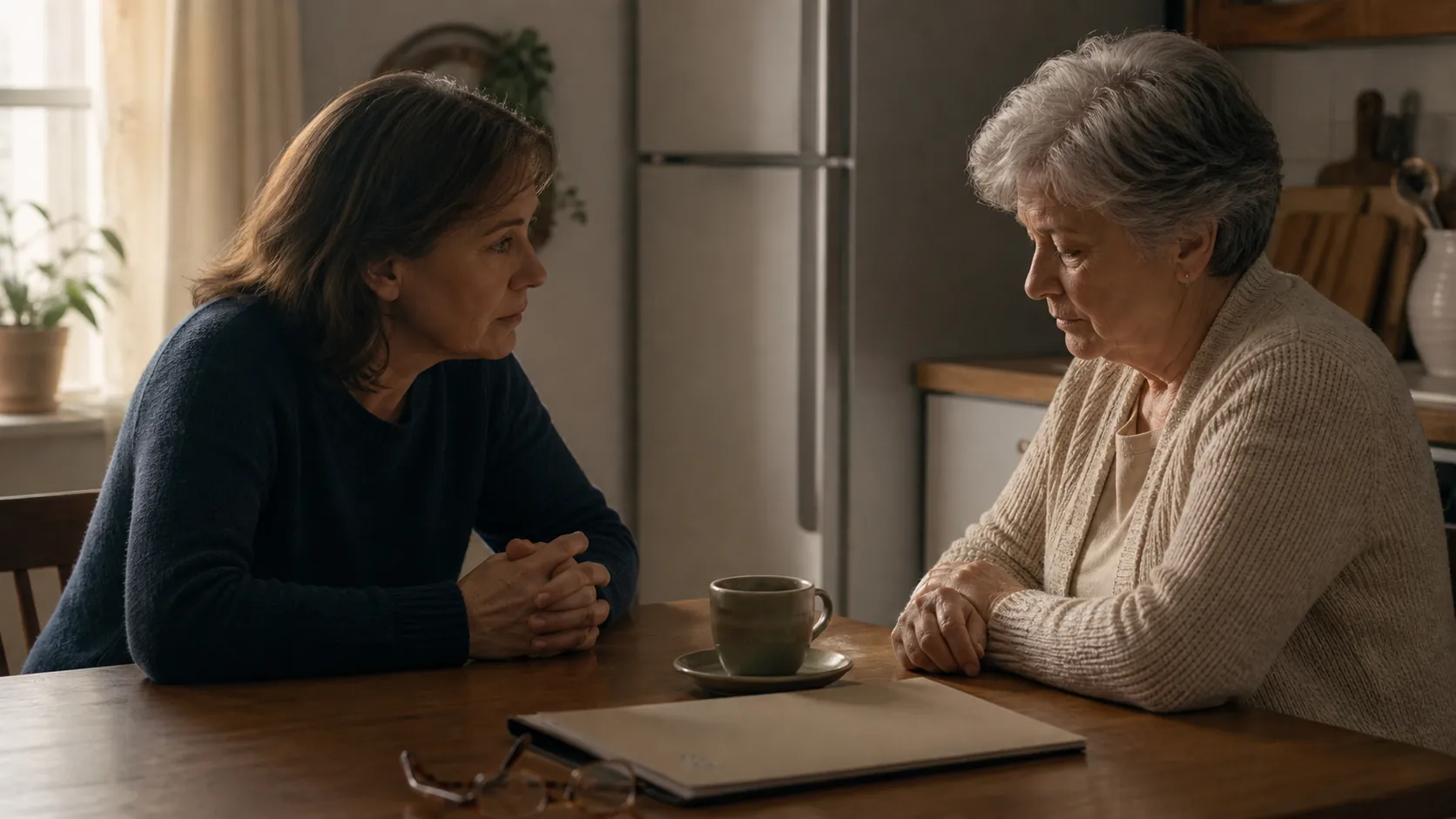
This guide is about family communication, not medical advice. For diagnosis, treatment, symptom changes, medication questions, breathing concerns, swallowing problems, falls, depression, or urgent safety issues, use the ALS clinician, primary care clinician, neurologist, or emergency services as appropriate.
Start by making the conversation smaller
ALS is often diagnosed in later adulthood. The National Institute of Neurological Disorders and Stroke says ALS is most commonly diagnosed between ages 55 and 75, so a senior-centered conversation is not a special exception; it is close to the center of the disease’s usual diagnostic window.[2]
Still, “senior” should not be treated as permission to take over. The diagnosed person may need help hearing, remembering, writing things down, getting to appointments, or sorting choices. None of that means the family gets to make the first conversation into a committee meeting while the person with ALS sits there as the subject.
A useful first goal sounds more like this: by the end of the talk, the senior can say, in their own words, what the doctor said; they know the family will come back to the topic gently; and they know no one is going to rush them into major decisions that day.
| Part of the first talk | What it is for | What to avoid |
|---|---|---|
| Before the talk | Confirm the basic facts, choose the right person or people, and prepare one or two plain sentences. | Building a full care plan before the senior has had a chance to speak. |
| Opening words | Name the diagnosis clearly and say that you will take this in pieces. | Softening the truth so much that the senior cannot tell what is being said. |
| Middle of the talk | Listen, repeat, pause, and answer only the question being asked. | Filling silence with predictions, advice, or forced reassurance. |
| Closing | Write down what was heard, one next step, and who may be told. | Ending with a list of decisions or a demand for optimism. |
Before you sit down: get clear, not comprehensive
Panic loves a binder. It wants printouts, tabs, phone calls, opinions, and a schedule by dinner. Some of that work will matter later. For this first conversation, too much preparation can become a way to avoid the harder task: sitting with the person who has to live inside the diagnosis.
Prepare enough to avoid confusion. If you were at the appointment, review the after-visit summary and write down only the essentials: the exact diagnosis as the clinician stated it, what follow-up is already scheduled, which clinician to call with questions, and any urgent instructions. If you were not at the appointment, ask the senior for permission before calling the clinic, reading portal messages, or speaking with the care team. Help should not begin with trespassing.
If the family is still trying to understand whether the current clinician is the right fit for ongoing care, that belongs in follow-up planning, not the first emotional conversation. Later, it may help to use a more deliberate process for choosing a doctor who asks the right functional and safety questions.
Decide who should be present with restraint. The best person is not always the loudest adult child or the relative who “knows medical stuff.” It is the person the senior trusts enough to be quiet with. If several relatives want to join, ask whether that will help the senior or help the relatives manage their own fear. One or two people is often kinder than a room full of concerned faces.
Then plan only the first few sentences. Not a speech. Not a lecture. Not a full explanation of ALS progression. A senior who retained little at the clinic is unlikely to absorb a family member’s twenty-minute summary any better. The preparation should make you calmer and plainer, not more forceful.
- Check the diagnosis wording from the clinic papers or portal.
- Write down the next known appointment or call.
- Choose a quiet time when no one is rushing to work, dinner, or another obligation.
- Decide what you will not discuss yet, such as housing, finances, or future equipment, unless the senior asks.
- Bring a notepad, not a stack of research.
Set the room up so the senior does not have to fight to follow you
The physical setup is not a courtesy detail. It changes how much the senior can take in. The National Institute on Aging’s communication guidance for older patients emphasizes sitting face-to-face and at eye level, speaking slowly, using plain language, accounting for hearing loss, and writing down key points.[3]
Do not call from another room. Do not stand over the table with your coat still on. Do not read from your phone while the senior watches your forehead. Sit where they can see your face. Turn down the television. Put the clinic folder within reach, but do not push it toward them as if the papers can do the emotional work.
Hearing deserves special attention. NIA notes that about one-third of older adults have hearing loss.[3] In this conversation, a missed word can become a frightening misunderstanding. Make sure hearing aids are in, glasses are nearby, lighting is good, and only one person speaks at a time.
- Sit close enough for normal conversation, not across a noisy room.
- Keep your face visible so lip-reading and facial cues are possible.
- Use the senior’s usual name for the doctor or clinic if that helps orient them.
- Pause after each important sentence.
- Write down the few points that matter, large enough to read.
The first words: clear, brief, and not falsely cheerful
The first words should not circle the diagnosis so carefully that the senior has to guess what you mean. They also should not unload every fear the family has been carrying since the appointment.
Try something like:
- “The neurologist said the diagnosis is ALS. I know that is a lot. We do not have to figure everything out today.”
- “I want to go slowly and make sure I understand what you heard, not talk over you.”
- “You are still the person who decides what gets discussed and who gets told. I’m here with you.”
If the senior already heard the diagnosis directly from the clinician, do not perform a second announcement. Start with what they remember: “Can you tell me what you heard the doctor say?” Then listen for gaps. The point is not to test them. It is to find out what needs repeating.
If you are reading this because an older parent or relative needs to be told about someone else’s ALS diagnosis, the same principles apply: be plain, go in stages, and avoid making them manage your emotions. But the main concern here is the senior who has been diagnosed, because their control over information and decisions matters from the first conversation onward.
Say less than you want to say
Families often over-explain when they are trying not to cry. They repeat the doctor’s phrases, add statistics they found online, describe a specialist they plan to call, and then ask, “Does that make sense?” The senior may nod because stopping the flood of words is easier than sorting it.
A better rhythm is one fact, one pause, one invitation. For example: “The doctor said ALS affects nerve cells that control voluntary muscles. I’m going to stop there for a minute. What are you thinking?” If the senior asks for more, give more. If they look away, wait.
Use the same ordinary words each time. Changing the phrasing every round can make repetition feel like new information. If the senior asks again, “What did the doctor call it?” say, “ALS,” and then, if helpful, “amyotrophic lateral sclerosis.” Do not act surprised that the question came back.
When they cry, go quiet first
Crying does not require an immediate rescue. Hand over a tissue, move the tea closer if they want it, and stop talking. The instinct to say “We’ll beat this” or “Don’t think that way” usually serves the person saying it. It asks the senior to comfort the family by appearing hopeful.
More useful responses are small and truthful:
- “I’m here.”
- “This is a terrible thing to have to take in.”
- “We can stop talking for a while.”
- “You don’t have to make any decisions right now.”

There may be nothing elegant to say. Silence can be respect when it leaves the senior room to feel what has happened without being managed.
When they go silent
Silence after an ALS diagnosis may mean grief, disbelief, fatigue, anger, or simply too much information. Do not fill it with a forecast. Do not start listing care options because quiet makes you uncomfortable.
After a while, offer a choice that returns control:
- “Would you rather sit for a bit, ask questions, or stop for today?”
- “Do you want me to stay here, or would you like a little time alone?”
- “Would it help if I wrote down the one thing we know is next?”
If they choose to stop, stop. Ending the conversation before you feel finished is not failure. It may be the first sign that the senior still trusts you not to take more than they can give.
When they argue or say they do not believe it
Denial can frighten relatives because it sounds like delay. But arguing the senior into acceptance rarely works. It often teaches them that any mention of ALS will turn into a debate they are expected to lose.
AgingCare includes a caregiver’s account from the day after an ALS diagnosis: the caregiver wrote that her mother “does not believe it” and had retained almost nothing from the doctor’s visit.[4] That forum post is only one family’s account, but the scene is recognizable: a diagnosis has been spoken, the family is already alarmed, and the person diagnosed is still somewhere back in the exam room trying to understand what happened.
You can hold the medical fact without demanding instant emotional agreement:
- “I hear that this does not feel real.”
- “The neurologist did use the word ALS. We can ask them to explain again.”
- “You do not have to be ready to talk about all of it today.”
- “Would you like me to write down the clinic number so we can call with questions?”
There is a difference between honoring disbelief and pretending there is no diagnosis. Do not say, “Maybe they’re wrong,” unless the clinician has actually said the diagnosis is uncertain or more testing is pending. If the senior wants a second opinion, that can be a reasonable next step to discuss with the care team. But false doubt is not kindness; it can leave everyone stranded when practical needs appear.
When they ask the same question again
Repeated questions are one of the places where family impatience can do the most damage. The senior may ask, “What did he say this was?” or “Am I going to die from this?” more than once. Your face matters here. If your expression says, “We already covered this,” the senior learns that needing repetition is a burden.
Answer the question asked, not the ten questions underneath it. If they ask the name, give the name. If they ask whether ALS is serious, say yes. If they ask what happens next, name the next appointment or call, not the whole possible course of the disease.
A written note helps because it does not get tired. NIA’s guidance to write down key points is especially useful after a diagnosis visit, when memory and attention may be strained.[3] Keep the note short enough that it can actually be used.

For example, a first note might say: “The neurologist said ALS. Next step: call the ALS clinic tomorrow to confirm the appointment. We will talk again Saturday morning. No big decisions today.” That is enough.
What not to say, even if you mean well
Most harmful phrases are not cruel. They are shortcuts around discomfort. They rush the senior toward a feeling the family would rather see.
| Avoid saying | Why it can land badly | Try instead |
|---|---|---|
| “You have to stay positive.” | It makes the senior responsible for protecting everyone from grief. | “You can feel however you feel. I’m here.” |
| “We’re going to fight this.” | Some people like fight language; others hear it as pressure to perform bravery. | “We’ll face each step with you.” |
| “I already looked up everything.” | It can make the conversation about your research instead of their experience. | “I wrote down a few questions for the doctor, if you want to see them.” |
| “At least…” | It usually minimizes the loss before the person has named it. | “This is hard news.” |
| “Don’t worry about that now.” | It can dismiss a fear that took courage to say out loud. | “We may not have the answer today, but we can write that question down.” |
Brain & Life, published by the American Academy of Neurology, offers language for setting boundaries after a diagnosis, including: “I don’t need advice... I just need you to listen. If I need help, I’ll ask for it.” It also suggests, “Please respect my wish not to talk about it, but please do check in with me within the month.”[5] Those lines are written for the person sharing a diagnosis, but family members can learn from them: listening is not passive, and checking in later can be more respectful than forcing a full conversation now.
If the senior asks, “How long do I have?”
This question should not be dodged with cheerful fog. It also should not be answered with a statistic tossed into the room like a verdict.
NINDS says most people with ALS die from respiratory failure within 3 to 5 years from when symptoms first appear, while about 1 in 10 live 10 years or more.[2] ALS News Today frames survival differently, stating that more than half of people with ALS live more than 3 years after diagnosis.[6] Those figures use different starting points, so they should not be blended into one homemade timeline.
A careful answer might be: “ALS is serious, and people’s timelines vary. The doctor is the right person to talk with about what your symptoms and test results mean. We do not have to answer every future question tonight, but we should write this down for the next visit.”
Survival information can help pace the family away from frantic same-day decision-making. It should not be used to smooth over fear. “Some people live longer” is true in some contexts, but if it is said to stop the senior from crying, it becomes another way of asking them to be easier to comfort.
Let the senior decide who else gets told
A diagnosis does not become family property just because the family is scared. Before calling siblings, cousins, church friends, neighbors, or old coworkers, ask the senior what they want shared and with whom.
You can make the question concrete:
- “Who do you want to know right now?”
- “Do you want to tell them yourself, have me sit with you, or have me make the call?”
- “What words do you want me to use?”
- “Is there anyone you do not want told yet?”
If the senior wants privacy, respect it unless there is an immediate safety or care reason someone must know. If the family needs support, they can seek it without broadcasting details the senior has not agreed to share. “Mom received a serious diagnosis, and I’m having a hard time” is different from giving a full medical update without permission.
Close the talk before it turns into a planning meeting
The end of the first conversation is where families often lose the thread. Relief that the diagnosis has finally been spoken can open the gate to every next problem: stairs, driving, bathing, money, meals, medical equipment, advance directives. Those questions are real. They do not all belong at the kitchen table tonight.
A better closing has four parts: say what was heard, write down the next small step, ask about sharing, and set a time to return.
- Say what was heard: “We talked about the doctor saying ALS, and that you are not ready to talk about everything yet.”
- Write one next step: “Tomorrow I’ll call the clinic to confirm the appointment, if you still want me to.”
- Ask about privacy: “Who, if anyone, do you want told this week?”
- Set a return time: “Can we sit down again Saturday morning for 20 minutes?”
Notice the permission built into the wording: “if you still want me to.” ALS may take away abilities over time. The family does not need to start early by taking away decisions that still belong to the senior.
When to bring in professional help
Bring in help sooner when the conversation is no longer just emotionally hard but practically unsafe, medically confusing, or too heavy for the family to hold alone. That may mean asking the neurologist or ALS clinic for another explanation, requesting a social worker, involving a counselor or chaplain if the senior wants that, or contacting the primary care clinician about mood, sleep, appetite, falls, breathing symptoms, swallowing concerns, or medication questions.
Professional help is also useful when family roles are already tense. If one adult child dominates, another avoids the topic, and the senior withdraws, a clinician, social worker, or counselor can slow the room down and return the focus to the person diagnosed.
There will be a time to talk through home support, in-home care, assisted living, nursing home care, hospice, and other practical options. When the senior is ready for that next layer, use a planning guide such as Choosing Care Options for Seniors Living with ALS. The first conversation does not have to become that guide.
A good first conversation is measured less by how much information was delivered than by what the senior is left holding afterward: some truth, some control, and a clear reason to believe the family will come back to the subject gently.
References
- Advance Care Planning in Amyotrophic Lateral Sclerosis, Practical Neurology
- Amyotrophic Lateral Sclerosis (ALS), National Institute of Neurological Disorders and Stroke
- Talking With Your Older Patients, National Institute on Aging
- Where do I go from here? ALS diagnosis yesterday., AgingCare
- How to Share a Diagnosis with Friends and Family, Brain & Life
- ALS Facts and Statistics, ALS News Today
Questions to bring to a clinician or OT
This is not medical, legal, or a family's final decision — only a framework. Bring these questions to a clinician, occupational therapist, or your local Area Agency on Aging.
Find Local HelpRelated reading
Noticed something outdated or inaccurate on this page? Flag a correction. We review every report against CDC, NIA, and AARP HomeFit guidance before updating a page.