
Caregiver decision guide
How to spot activities director burnout in senior living
Activities director burnout shows up in a community's daily rhythm before families notice. Learn the warning signs, engagement benchmarks, and questions to ask that reveal whether a senior living activity program is genuinely healthy.
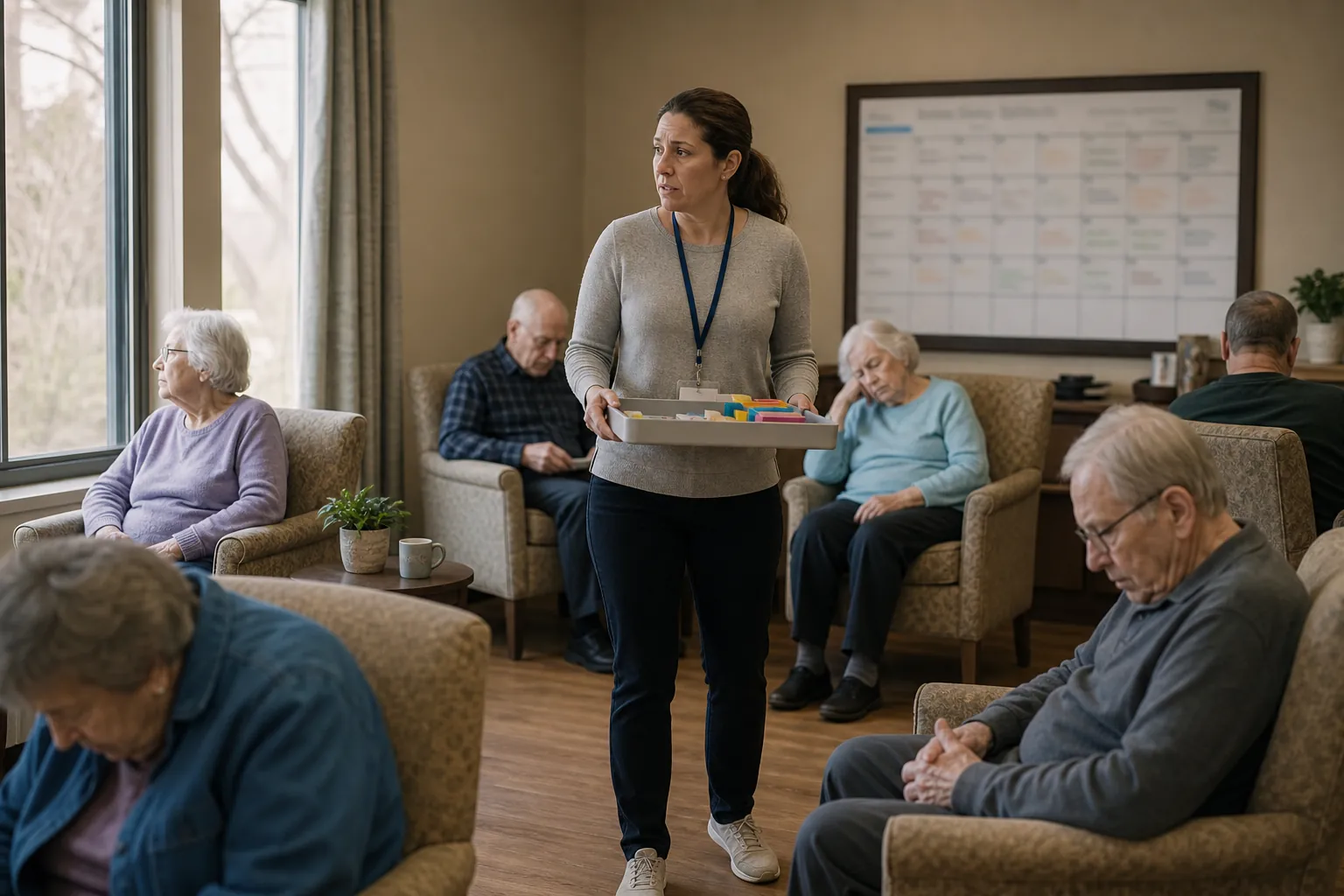
Activities director burnout in senior living rarely announces itself as burnout. Families usually notice something smaller first: the music social is canceled again, the craft room is set up but only one resident has been brought in, or the same three residents are watching television while the activity calendar promises a full afternoon.
That uneasy feeling matters. In many assisted living and memory care communities, the activities director is the person most responsible for turning a resident’s day into something more than meals, medications, and waiting. When that role is stretched too thin, daily social contact, movement, choice, and stimulation are often the first things to shrink.
Start with the room, not the calendar
A posted calendar can look healthy even when the program is not. It is easy to print “chair fitness,” “bingo,” “music,” “trivia,” and “crafts” into neat boxes. It is harder to get residents out of apartments, adapt the activity for memory loss or low vision, notice who has stopped coming, and keep the room warm enough that people actually want to stay.
The stronger clues are in the daily rhythm. A healthy program does not have to look fancy. Three residents folding napkins while talking about their former kitchens may be more meaningful than a polished event that half the room cannot follow. Bingo is not automatically a lazy choice. A singalong is not automatically childish. The question is whether residents are being reached, included, and adjusted for as real people.
On a tour or visit, watch for these signals:
- Repeated cancellations or last-minute substitutions, especially when they are blamed vaguely on “staffing” without explanation.
- The same passive activity filling large parts of the day, such as television in the common room while the calendar lists something more active.
- Residents sitting near an activity but not being invited into it by name.
- One staff member trying to lead the program, redirect a confused resident, answer a family’s question, find missing supplies, and manage transportation at the same time.
- Activities that are never adapted for residents who cannot hear well, see well, stand for long, follow multi-step directions, or tolerate a large group.
- A calendar that is full of words but thin on actual variety: little movement, little outdoor time, few small groups, few one-on-one options, and no visible connection to resident preferences.
- Frequent changes in the activities director role, or staff who seem unsure who is currently responsible for the program.
None of those signs proves that an individual activities director is burned out. Families are outside the building for too much of the day to diagnose a staff member’s condition. But those signs do tell you the engagement system may be fragile, and that is a legitimate quality-of-life concern.
The small number that should change how families look at “activities”
Engagement sounds like a soft word until you put minutes beside it. One industry discussion of daily engagement cited a CDC 2016 baseline of about 11 minutes per day of engagement in long-term care and about 20 minutes per day in assisted living. The same source contrasted those figures with a 2022 industry client average of 25.61 minutes per day and used a rough staffing reference of one engagement staffer per 60 residents. [1]
| Reference point | What it measures | How a family should use it |
|---|---|---|
| About 11 minutes per day | A cited 2016 baseline for engagement in long-term care | A reminder that residents can spend most of the day unengaged even in ordinary operations |
| About 20 minutes per day | A cited 2016 baseline for engagement in assisted living | A scale for asking whether the community’s actual day matches its calendar |
| 25.61 minutes per day | A 2022 industry client average reported in the same discussion | A comparison point, not proof that a program is excellent |
| Roughly one engagement staffer per 60 residents | A staffing reference used in the same source | A prompt to ask who covers engagement when the activities director is unavailable |
Families do not need to stand in the hallway with a stopwatch. The useful point is scale. If the normal range of measured engagement can be counted in minutes, then a canceled morning program, a missed small group, or an unfilled activities director position is not a harmless gap. For a resident who needs help getting out of the apartment or joining a group, that gap may be the difference between having contact and having none.
It is also important not to overread the 25.61-minute figure. It is an industry client average reported in a specific context, not an independent guarantee that 26 minutes is “good,” and not evidence that every community using a calendar-heavy model is engaging residents well. The number is useful because it gives families permission to ask more concrete questions than “Do you have lots going on?”
What burnout looks like from a resident’s side of the door
From the resident’s side, the issue is not whether the activities director feels tired, overworked, or underappreciated. Those may all be true, but families usually cannot verify them fairly. What families can see is whether the program still has enough human attention to notice individual residents.
A stretched program often becomes narrower. Large-group activities replace smaller ones because one person can supervise them. The residents who are easy to engage get most of the attention. People who need cueing, wheelchair assistance, hearing support, or one-on-one reassurance gradually disappear from the room. The calendar remains full because the calendar has to be full, but the lived day gets smaller.

The opposite is not necessarily a room packed with people. Sometimes the best sign is a small adjustment: a staff member kneeling beside someone instead of calling across the room, a large-print trivia sheet, a resident being asked to help set the table because she used to host every holiday, or a group continuing even when only a few people come. Those details show that engagement is being treated as care, not decoration.
Questions to ask when the program feels thin
The best questions are specific enough that leadership cannot answer with “robust,” “vibrant,” or “we have something every day.” Ask them on a tour, at a care conference, in family council, or directly to the executive director if the activities role has been vacant or turning over.

Ask about participation, not just offerings
- How do you track which residents attend activities?
- Do you track residents who used to attend but have stopped?
- Who follows up when a resident spends most of the day alone?
- Can you show me how my parent’s interests would be added to the activity plan?
A strong answer does not have to involve expensive software. It should show that someone notices patterns. If leadership can only point back to the calendar, they are measuring what was offered, not whether residents were actually reached.
Ask about one-on-one engagement
- What happens for residents who do not join groups?
- How often are room visits or one-on-one activities attempted?
- Who documents whether those visits worked?
- How do you adapt engagement for residents with dementia, low vision, hearing loss, pain, or fatigue?
This is where a community’s values become visible. Residents who cannot independently arrive at an activity are still residents of the program. If the answer is essentially “They can come if they want,” the community may be placing too much responsibility on people who need support.
Ask who covers the program when the activities director is out
- If the activities director is sick, on vacation, or pulled into another task, who runs the scheduled programs?
- Are aides, dining staff, or volunteers trained to help with engagement, or is everything dependent on one person?
- How often are activities canceled because no one is available?
- Who makes sure supplies, transportation, and room setup are ready before the activity starts?
One-person programs are vulnerable even when that one person is excellent. The rough staffing reference of one engagement staffer per 60 residents helps explain why coverage matters: if engagement depends almost entirely on a single employee, absences and turnover can quickly become resident isolation. [1]
Ask directly about turnover
- How long has the current activities director been here?
- How many people have held that role in the past year?
- If the role is vacant, who is responsible for the activity calendar and resident engagement right now?
- What changed after the last activities director left?
Rapid activities-director churn deserves more attention than families often give it. Administrative turnover can be frustrating, but activities turnover touches the resident’s actual day: who knows her music, who remembers that he refuses crafts but loves sorting baseball cards, who notices that she has stopped coming to lunch trivia since her friend moved out.
How to read the answers
A community does not need a perfect answer to every question. Senior living is full of imperfect days. What matters is whether leadership can describe a working system rather than relying on personality, luck, or a cheerful calendar.
| What you hear | What it may mean | What to ask next |
|---|---|---|
| “Our activities director knows everyone.” | This may be true, but it may also mean the program depends on one person’s memory and emotional labor. | “What happens when that person is out or leaves?” |
| “Residents can choose whether to attend.” | Choice is important, but some residents need cueing, encouragement, transport, or adaptation before choice is meaningful. | “How do you support residents who want to participate but cannot get there independently?” |
| “We have activities all day.” | The calendar may be full, but attendance and engagement may still be low. | “How do you track participation and missed residents?” |
| “Families are always welcome to join.” | This can be positive, but family presence should not be the main engagement plan. | “What does engagement look like on days when families are not here?” |
| “We are between activities directors right now.” | A vacancy is not automatically a crisis, but it should have a coverage plan. | “Who owns resident engagement this week, and how are cancellations being monitored?” |
| “Some residents just don’t like activities.” | Sometimes true, but it can become an excuse for not adapting the format. | “How do you learn what those residents do enjoy?” |
The weakest answers tend to stay abstract. The better answers name a process: who invites residents, who records attendance, who reviews nonparticipation, who changes the approach, and who covers the program when the activities director cannot.
If your parent already lives there
If the program has started to feel hollow, begin with observations rather than accusations. “My mother has been in her room during the last three afternoon visits” is easier for a director to act on than “No one here cares about activities.” Specific patterns make it harder for leadership to dismiss the concern and easier for good staff to respond.
Bring the concern to the care plan meeting or family council and connect it to quality of life. Ask what the community is doing for residents who are not self-starters, what happens after repeated refusals, and whether the activity program has enough coverage. If there has been recent turnover in the activities role, ask what the interim plan is and when leadership expects a stable replacement.
It is fair to request a practical next step for your parent: a trial of a smaller group, a walking partner, a music preference list, a one-on-one visit after lunch, an invitation from a familiar aide, or a modified version of an activity that used to be too difficult. The request should be concrete enough that someone can report back on whether it happened.
Also watch whether staff respond defensively or curiously. A community under strain may still be honest and workable if leaders acknowledge the gap and explain how they are covering it. A community that insists everything is “vibrant” while residents sit uninvited beside an empty activity table is asking families to trust the poster instead of the day.
References
- Can you live with 26 minutes of daily engagement? — McKnight's Long-Term Care News / Linked Senior
Questions to bring to a clinician or OT
This is not medical, legal, or a family's final decision — only a framework. Bring these questions to a clinician, occupational therapist, or your local Area Agency on Aging.
Find Local HelpRelated reading
Noticed something outdated or inaccurate on this page? Flag a correction. We review every report against CDC, NIA, and AARP HomeFit guidance before updating a page.