
Caregiver decision guide
Gardening Tips for Seniors with Mobility Limitations
Learn how to set up a garden that matches your specific mobility limitation — from raised bed heights and pathway widths to ergonomic tools. This guide provides measured, safe setups for seniors using walkers, wheelchairs, or dealing with arthritis and balance concerns.
A raised bed sounds like one simple answer until you stand beside the person who will use it. The bed that helps someone with sore knees may still be useless to a wheelchair user if there is no knee clearance underneath. A tall box that saves bending can be too high for arthritic shoulders. A beautiful path can still be a fall risk if a walker has to be angled sideways over loose gravel.
The better starting point is not “make the garden senior-friendly.” It is: what movement is becoming hard? Bending, gripping, turning a walker, rising from a kneel, reaching from a seated position, and staying steady when tired all call for different fixes.
Match the Garden to the Movement That Is Hard
For gardening tips for seniors with limited mobility to be useful, they have to sort the problem before naming the product. A “raised bed” is not a single solution. Neither is a “comfortable tool.” The setup should remove the strain that is actually causing the person to stop gardening.
| Main limitation | Better garden setup | What the setup should make easier |
|---|---|---|
| Bending or kneeling is painful | Raised beds, elevated planters, tabletop herb gardens | Planting, watering, and harvesting without repeated stooping |
| Wheelchair use | Beds with open knee clearance underneath and reachable planting depth | Rolling close enough to work without twisting or overreaching |
| Walker or cane use | Wide, firm, level paths with room to turn | Moving through the garden without sideways maneuvering |
| Arthritis or weak grip | Long-handled, enlarged-grip, ratchet-action, or easy-grip tools | Reducing squeezing force, wrist bending, and hand fatigue |
| Balance or stamina concerns | Seating, short work intervals, shade, water access, and stable transitions | Stopping before fatigue changes gait or balance |
That table is not meant to put anyone in a category forever. It is a way to look at the garden the way you would look at a bathroom or front entry: can the person get there, work there, pause there, and get back safely?
Get the Bed Height Right Before Buying Anything
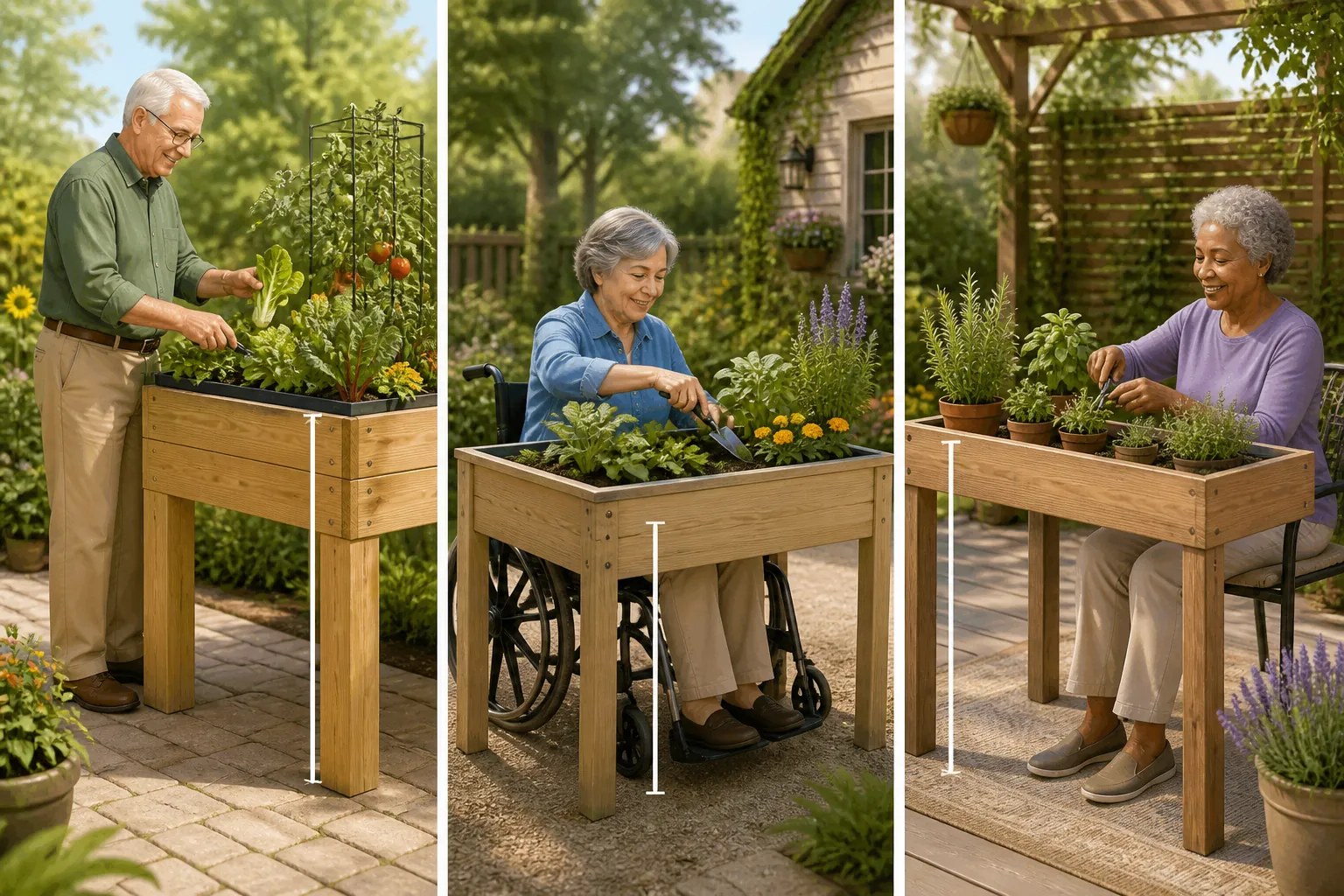
Raised beds are useful because they bring soil up toward the gardener. The common working range in adaptive gardening sources clusters around 24 to 32 inches high. Gardenary recommends 24 to 30 inches for many raised-bed users, while noting that wheelchair users often need the lower arm-range area, roughly 27 to 30 inches, depending on the person’s reach and chair position.[1] Other adaptive-gardening sources also cite a 24-to-32-inch raised-bed range.[2]
Those numbers matter because they decide whether the gardener can work with shoulders relaxed instead of lifted, and whether the back has to fold forward over the bed. For a standing gardener who cannot kneel, a bed somewhere around waist height may be comfortable. For a shorter person, the same bed can force the elbows up and turn watering into shoulder work. Measure from the gardener, not from a catalog photo.
For wheelchair users, bed height alone is not enough. The underneath clearance is the part families often miss. A wheelchair-accessible bed should allow the user to roll close, with the bottom of the bed high enough for knee clearance. Accessibility sources point to about 27 to 29 inches from the ground under the bed, tied to clearance needs around a standard 24-inch wheelchair armrest height.[1][2]
Without that open space, the gardener may have to sit sideways, twist at the trunk, or reach from too far away. That is not a small inconvenience. It changes the task from gardening to balancing and stretching.
Standing, Seated, and Tabletop Beds Do Different Jobs
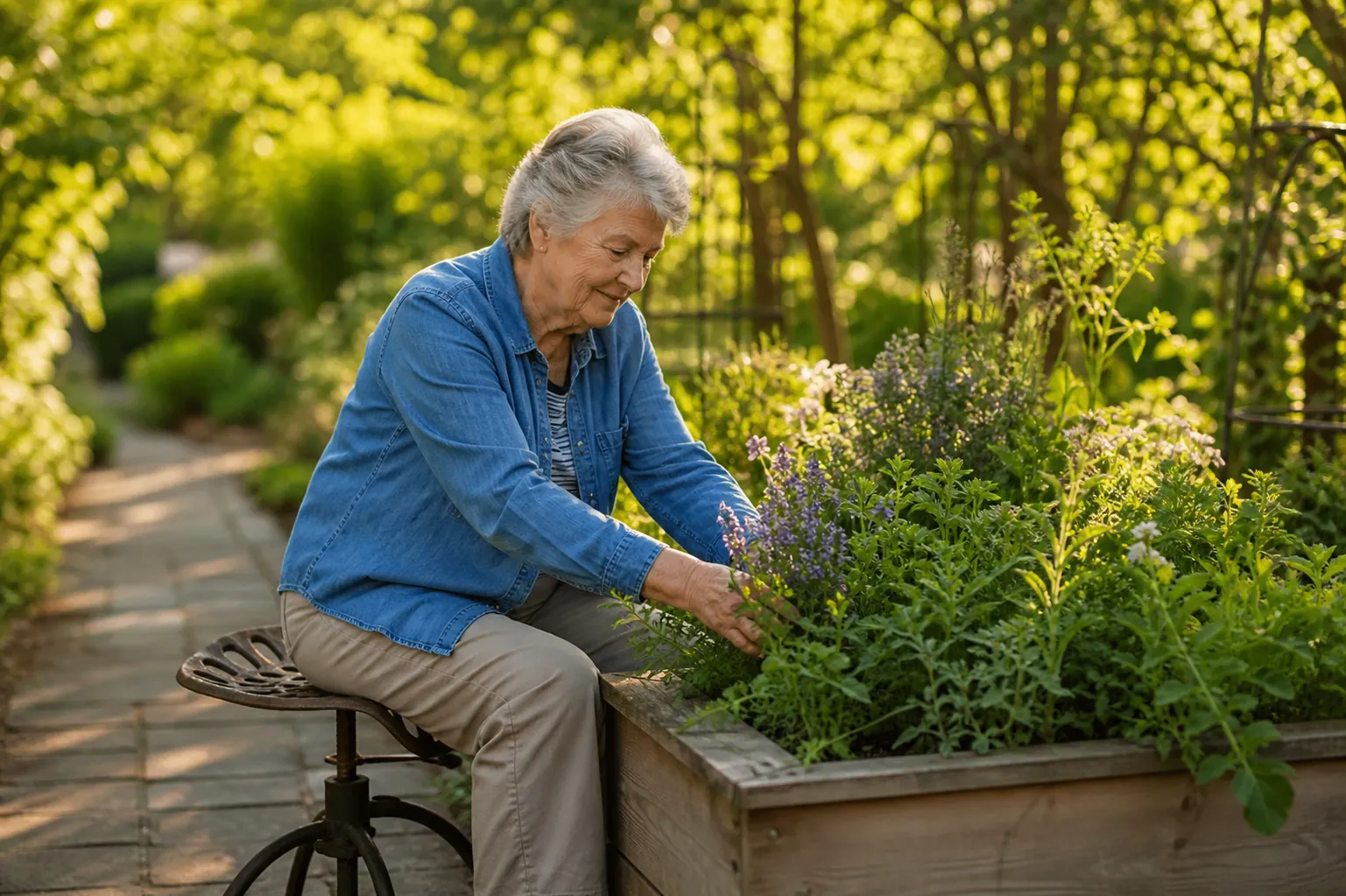
A standing-height raised bed is best when the main problem is bending or kneeling. It should be narrow enough that the gardener does not have to lean across it. If the bed can only be reached from one side, keep the planting area shallow enough for comfortable one-sided reach.
A wheelchair-accessible bed needs open space underneath, not just legs at the corners. The user should be able to approach straight on, get close to the soil, and keep the work within comfortable arm range. If the chair cannot pull in, the bed is only visually accessible.
A tabletop herb garden is often the least dramatic and most useful option for arthritic hands, poor stamina, or a person who now gardens from a chair. It keeps the work small: basil, thyme, parsley, mint in a controlled space; scissors or light snips nearby; watering without dragging a hose. It still smells like a garden. That counts.
Paths Are Safety Equipment, Not Landscaping Extras
A garden path has to be judged by the person using the walking aid. Sources used in the research brief consistently point to a minimum 4-foot path width for wheelchair and walker access.[3][2] Four feet gives space for a walker, a wheelchair, and safer turning or passing than a narrow decorative path allows.
Width is only half the test. The surface has to stay firm underfoot and under wheels. Mark Lane’s guidance for Stannah favors stable surfaces such as self-binding gravel and tarmac-style hard surfaces, while warning against loose gravel, bark, and wood chips as tripping hazards.[3] Loose material shifts exactly when a person is already managing balance, a cane tip, or a walker leg.
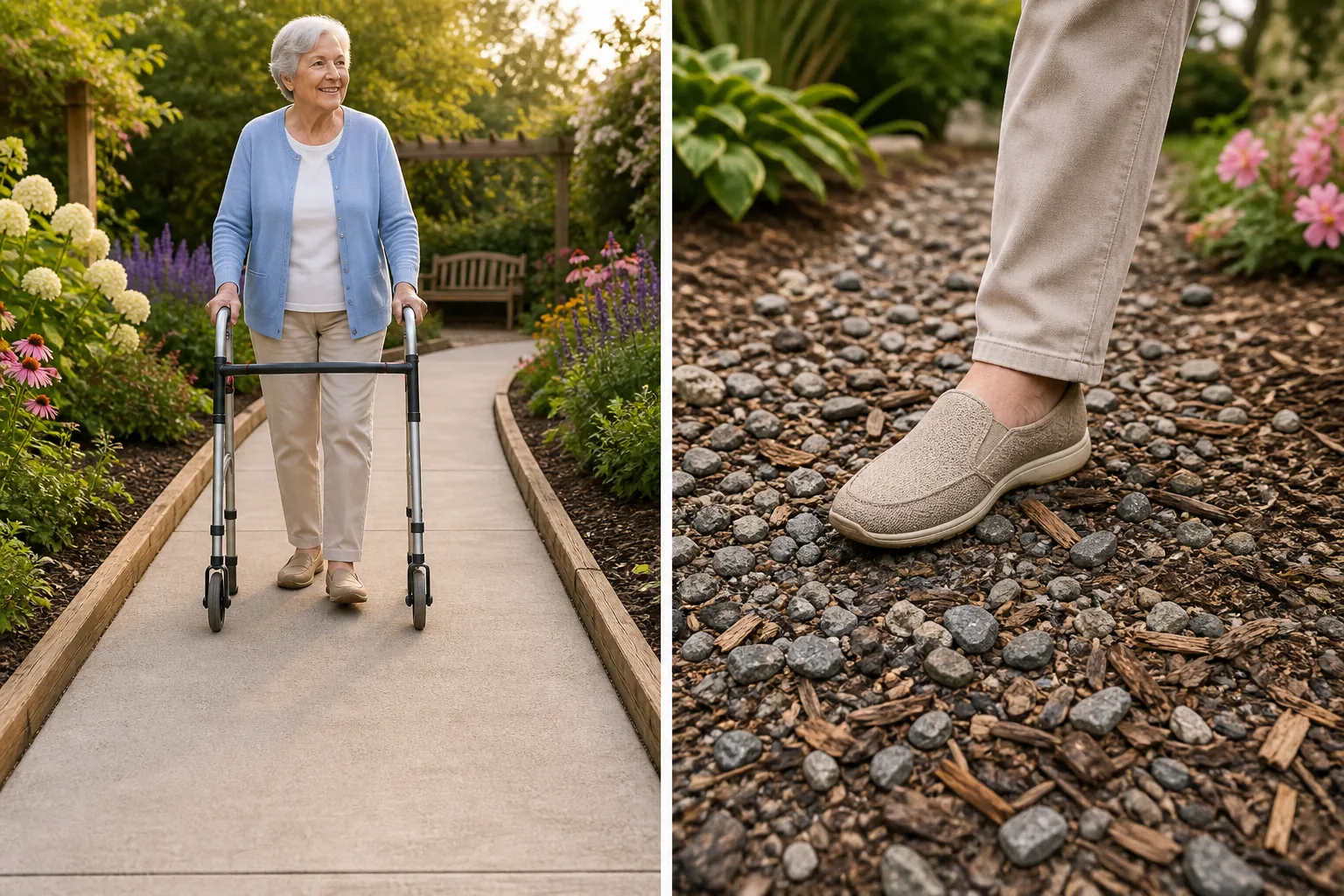
Raised path edges can also help. They give a cane, foot, or wheel a tactile boundary before the person drifts into a planting bed or soft soil.[3] The edge should guide, not trip; abrupt height changes at gates, patios, hose crossings, and shed thresholds still need to be removed or ramped.
This is where outdoor fall prevention overlaps directly with gardening. The same checks that matter after a storm—slick surfaces, uneven transitions, blocked drainage, debris on the route—also matter on an ordinary watering day. For a broader outdoor walkthrough, see the guide to how to prevent falls in heavy rain.
Choose Tools by What They Remove From the Hand
Tool recommendations get brand-heavy fast. The useful question is simpler: does the tool reduce bending, squeezing, twisting, or fine finger pressure?
The Arthritis Foundation lists Peta Easi-Grip garden tools with handles over 31 inches as meeting its Ease of Use criteria.[4] The important part is not the brand name by itself. A handle that long lets someone reach soil or plants without dropping to the ground. An easy-grip handle reduces the need to close stiff fingers tightly around a narrow shaft.
Ratchet-action pruners are worth considering when grip strength is the limiting factor. Their mechanism lets the cut happen in stages, mechanically multiplying the force of the hand instead of asking the gardener to squeeze hard all at once.[4] For roses, herbs with woody stems, or light shrub trimming, that can be the difference between pruning and quitting after three cuts.
- For arthritis: look for enlarged grips, neutral wrist position, lighter weight, and ratchet mechanisms.
- For bending difficulty: choose long-handled tools, standing weeders, and hose wands that avoid repeated stooping.
- For weak hands: avoid tiny locking tabs, stiff spray triggers, and tools that require sustained pinching.
- For balance concerns: avoid tools that require two hands while standing on uneven ground.
A garden kneeler-and-seat combination can help some people, especially when it has a foam pad and a sturdy metal frame for support during position changes.[5] It is not a cure for unsafe kneeling. If getting down is easy but getting up is frightening, the frame must be stable enough for the actual user, on the actual surface, with someone nearby the first time it is tried.
Set Up the Garden Around the Walking Aid
A cane user needs predictable footing and places to pause. A walker user needs clear width, no hose crossings, and enough room to turn without lifting the walker awkwardly. A wheelchair user needs firm surfaces, reachable beds, and a route that does not end in grass, mulch, or a tight corner.
Before adding plants, walk the route with the same aid the gardener uses. Start at the door. Check the threshold, the patio, the path, the turn into the garden, the bed edge, the water source, and the way back inside. If the person has to “just be careful” at the same spot every time, that spot needs redesign.
- Keep main paths at least 4 feet wide for walker or wheelchair use.[3][2]
- Use firm, stable surfaces rather than loose gravel, bark, or wood chips.[3]
- Store hoses off the walking route or use a fixed hose guide that does not create a trip line.
- Place chairs where the gardener naturally pauses, not only where they look nice.
- Keep frequently used tools at waist to chest height, close to the garden entrance.
The return route matters as much as the route out. Many stumbles happen when the pleasant part is over: hands are full, legs are tired, the sun has shifted, and the person is trying to carry clippers, tomatoes, or a watering can back to the house.
Use Short Work Cycles Before Fatigue Decides for You
Balance is often better at minute five than at minute twenty-five. Mark Lane’s Stannah guidance recommends a 5-minute timer approach: work for 5 minutes, rest, and repeat.[3] That may sound fussy until you watch someone push past tired legs because the last row is almost done.
Short cycles also make gardening less all-or-nothing. A senior can deadhead one container, water the herb table, or harvest a handful of lettuce without turning the job into a morning-long project. The garden stays part of the routine instead of becoming an event everyone has to supervise.
Heat changes the calculation. On warm days, keep water within reach, work earlier or later, and stop before dizziness, heavy fatigue, or confusion enters the picture. For more detailed warm-weather precautions, see these guides on summer fall-prevention essentials and extreme heat safety for seniors.
Keep the Plants Pleasant and Manageable
Once the bed, path, tools, and resting plan make sense, plant choice can do what it should do: make the garden worth visiting. Perennials and herbs are often recommended as lower-maintenance options for older gardeners because they can reduce repeated replanting and still provide color, scent, and harvestable leaves.[6]
Herbs are especially forgiving in small adaptive setups. They fit tabletop planters, do not require a deep vegetable bed, and reward even a short visit. Rosemary, thyme, mint, parsley, basil, and chives give the hands and nose something familiar to do without turning the whole yard into a chore list.
Sensory planting may also help make outdoor spaces more engaging for some people with dementia, and research has suggested potential benefits from therapeutic garden environments.[7] That evidence should not be stretched into a promise. In a home garden, the practical version is modest: recognizable plants, clear paths, safe seating, good visibility from the house, and no poisonous or thorny surprises where hands naturally explore.
Gardening Still Counts as Activity, But It Should Not Be Oversold
Gardening is not just decoration or busywork. AgingCare cites CDC physical-activity guidance for older adults in describing gardening as a form of multicomponent activity involving aerobic effort, muscle-strengthening, and balance elements.[8] A study on gardening activities and physical health among older adults also supports the broader point that gardening can be connected with physical health in later life.[9]
That does not make gardening a medical treatment, and it does not mean every garden task is safe for every person. The value is more ordinary and, in some ways, more important: standing up for a reason, reaching within a safe range, noticing weather, smelling herbs, carrying on a routine, and using the body without turning the day into an exercise session. For related movement habits that support balance, see brain-plasticity habits that also prevent falls.
A Practical Setup Check Before the Next Planting Day
Before buying soil, plants, or another tool, do one slow walkthrough with the senior who will use the garden. The person should not have to prove they can manage a poor setup. The setup should prove it fits the person.
- Can they get from the door to the garden on a firm, level route?
- Can a walker or wheelchair move and turn on paths at least 4 feet wide?
- Can they reach the soil without bending, twisting, or lifting the shoulders?
- If seated, is there enough knee clearance under the bed?
- Can they grip, squeeze, prune, and water without painful hand force?
- Is there a chair, shade, and water close enough for 5-minute work-rest cycles?
Gardening can remain part of mobility and independence when the garden is rebuilt around actual reach, grip, balance, walking aid, and stamina. Measurements are not overengineering when they keep someone doing the thing they still want to do.
References
- Raised Bed Garden Design Tips for Accessibility, Gardenary
- Accessible Raised Garden Beds, Miller Mobility
- Accessible Gardening with Mark Lane, Stannah
- Ease of Use Gardening Tools, Arthritis Foundation
- Adaptive Gardening Tools and Techniques, CareYaya
- Senior Gardening Tips, Gardening Know How
- Therapeutic Gardens and Dementia: A Systematic Review, National Library of Medicine, 2021
- Gardening as Exercise for Seniors, AgingCare
- Gardening Activities and Physical Health Among Older Adults, National Library of Medicine
Questions to bring to a clinician or OT
This is not medical, legal, or a family's final decision — only a framework. Bring these questions to a clinician, occupational therapist, or your local Area Agency on Aging.
Find Local HelpRelated reading
Noticed something outdated or inaccurate on this page? Flag a correction. We review every report against CDC, NIA, and AARP HomeFit guidance before updating a page.