
Caregiver decision guide
How Seniors with Limited Mobility Can Start Adaptive Sports
This step-by-step guide walks seniors with mobility limitations and their caregivers through medical clearance, self-assessment, sport matching, program finding, and safe progression to begin adaptive sports confidently.
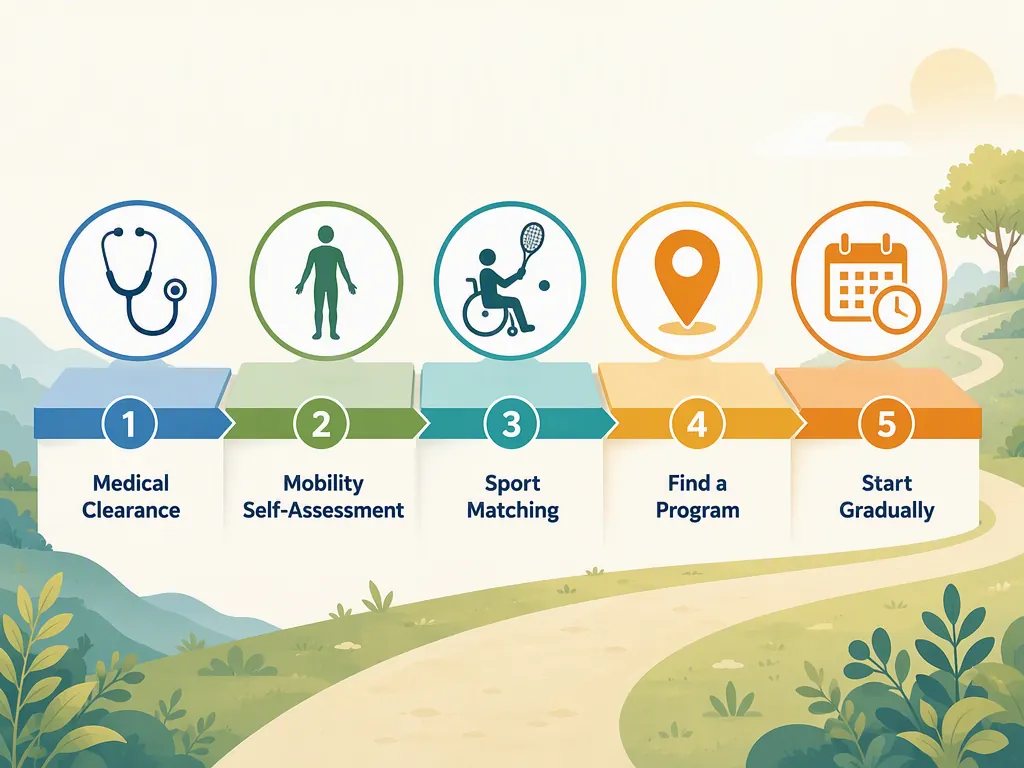
Monday morning is when adaptive sports for seniors with disabilities becomes practical. Not the medal ceremony, not the glossy chair, not the story about someone else doing something extraordinary. Monday morning is a senior at the kitchen table, maybe with an adult child beside them, asking: Is this safe for me? What could I actually do? Who do I call first?
The useful answer is a sequence. Get medical clearance. Describe current mobility honestly. Match that ability to a sport category. Find a real program before buying equipment. Start slowly enough that the first month builds trust instead of soreness, fear, or another long break.
This article is informational guidance, not medical advice. Anyone starting a new activity after a mobility change, fall, surgery, stroke, new diagnosis, medication change, or long period of inactivity should speak with a physician, physical therapist, or occupational therapist first. Harvard Health makes the same starting point plain: medical clearance comes before taking up adaptive sports, especially when a person has health conditions or has not been active recently.[1]
Start by asking what is safe, not what looks exciting
The first call is not to a tennis coach or a ski program. It is to the clinician who understands the senior’s current health, medications, balance, pain, endurance, fall risk, and recovery limits. This does not need to become a long medical project, but it should be specific enough that the answer is more useful than “try to exercise.”
- “Are there movements I should avoid right now, such as twisting, impact, overhead reaching, deep bending, or prolonged standing?”
- “Should I begin seated, in water, with support, or under supervision?”
- “How long should the first sessions be, and what symptoms mean I should stop?”
- “Do I need a physical therapy or occupational therapy referral before joining a community program?”
- “Are there blood pressure, heart, diabetes, medication, joint, or neurological concerns the instructor should know?”
A caregiver can help here by taking notes and asking for plain language. “Cleared for activity” is less useful than “cleared for seated exercise twice a week, avoid unsupervised standing balance work for now, stop if dizziness or chest pain occurs.” The clearer the answer, the easier it is to choose the first setting.
The broader reason for trying to move again is sound. The CDC describes regular physical activity for adults 65 and older as beneficial for strength, balance, chronic disease management, and the ability to do daily activities.[2] That still does not mean every sport fits every body on day one. The work is matching the activity to the person in front of you.
Write down what the body can do today
The self-assessment should be ordinary and honest. It is not a test to pass. It is a way to keep a senior from walking into a program that is too hard, too fast, too far from the parking lot, or too dependent on balance they do not currently have.
Use current ability, not last year’s ability. A former golfer who now tires after ten minutes of standing does not need to be talked into “getting back out there” immediately. A person using a rollator may still have excellent upper-body coordination. Someone recovering from a stroke may need a program comfortable with one-sided weakness, slower processing, or fatigue that appears after the session rather than during it.
| Question to answer | What it tells you |
|---|---|
| Can I sit upright for 30 to 60 minutes? | Seated sports, chair exercise, adapted rowing, seated strength classes, or wheelchair court sports may be more realistic than standing sports. |
| Can I stand safely without holding on? | Some weight-bearing activities may fit, but the program should know whether balance support is needed. |
| Can I walk across a parking lot or large facility? | Transportation, drop-off, building access, and rest areas may matter as much as the sport itself. |
| Do I have pain that changes with movement? | A clinician or therapist should help separate acceptable effort from joint, nerve, or surgical warning signs. |
| Do I fatigue later in the day or the next morning? | The first schedule should leave recovery room rather than fill the week with good intentions. |
| Do I need help transferring, dressing, showering, or managing equipment? | The caregiver role and facility accessibility need to be discussed before the first visit. |
This is also the point to check the home mobility basics. If a senior is still unsure whether a walker or rollator is fitted correctly, or if the main problem is fear of falling while turning, stepping, or standing from a chair, it may be worth preparing with resources such as CareWise’s rollator fit test, fall-prevention exercise progression, caregiver mobility guide, or balance exercise FAQ before entering a busier sports environment.
Match the limitation to a sport category, not a dream version of the sport
A beginner does not need a full catalogue of adaptive sports. They need a short list that respects how their body moves now. The easiest way to narrow the choice is to sort activities by demand: seated, weight-bearing, water-based, and mind-body.
Seated options
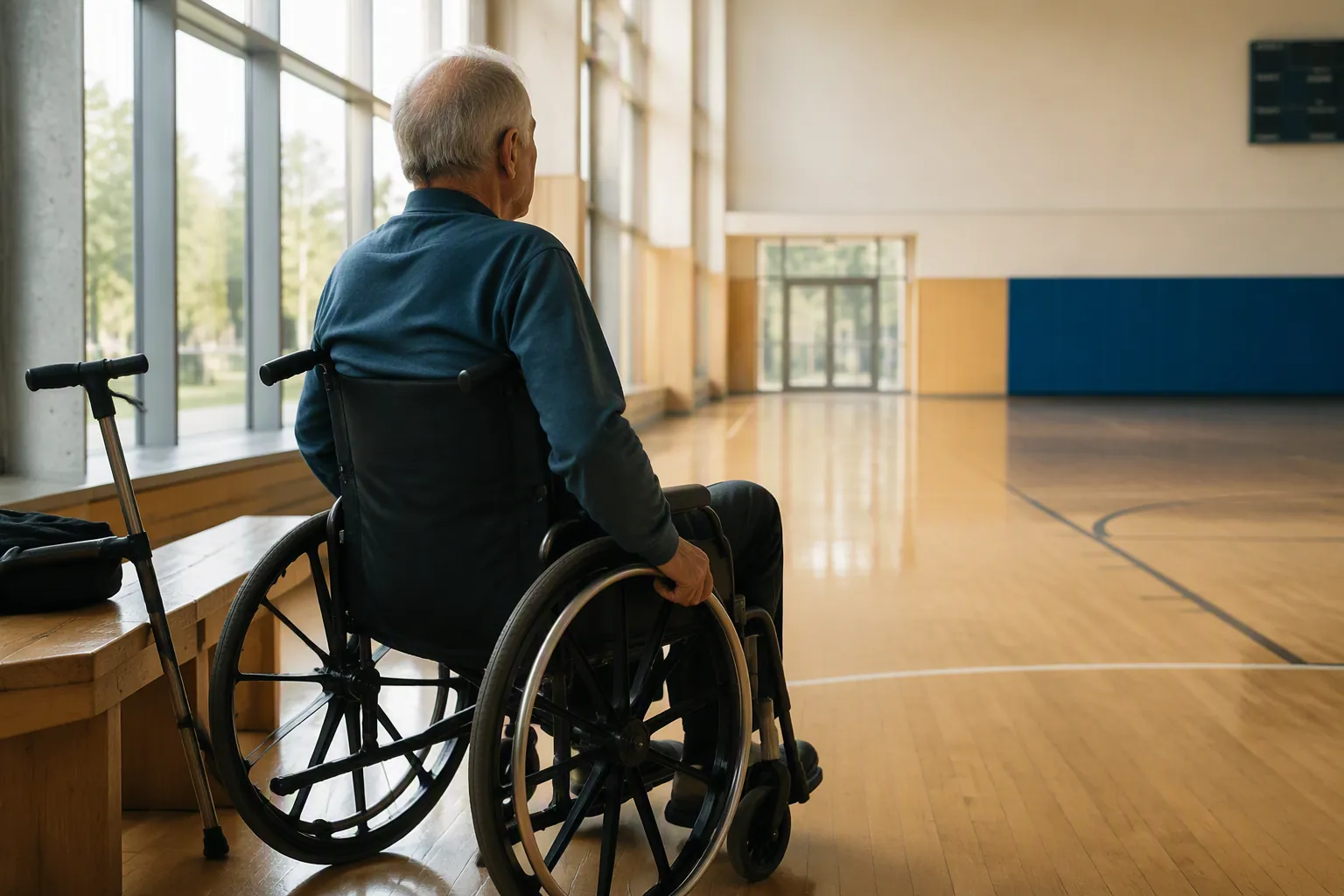
Seated options can fit seniors who cannot stand safely for long, use a wheelchair, have unpredictable balance, or need to conserve leg strength. Depending on the local program, this might include wheelchair tennis, seated fitness, adapted rowing, wheelchair basketball drills, chair yoga, or seated throwing and target games.
The word “wheelchair” can make some older adults pull back if they still walk at home. In adaptive sport, a chair can be a tool, not a verdict. A person who walks short distances may still use a sport chair to participate safely on a court. The question is not whether the chair changes someone’s identity. The question is whether it lets them participate without spending the whole session afraid of falling.
Weight-bearing options
Weight-bearing activities may fit seniors who can stand, step, and recover balance with or without light support. This could include adapted walking groups, modified pickleball or tennis drills, low-impact strength classes, golf putting practice, bowling, or track-style activities. These are not automatically safer because they look familiar. A standing sport asks for turning, reaching, stopping, and reacting to other people.
For someone with Parkinson’s, neuropathy, arthritis, post-stroke weakness, or a recent joint replacement, the better first question is often: can the activity be slowed down and supported? A beginner session with chairs nearby, predictable drills, and an instructor who accepts rest breaks is a different proposition from open play with fast direction changes.
Water-based options
Water-based programs can be a good match when joints protest on land, standing endurance is limited, or a person needs support while moving. Swimming, water walking, aquatic exercise, and adapted pool classes may reduce some weight-bearing strain. They also add practical barriers: locker rooms, pool lifts, temperature, transportation, changing clothes, continence concerns, and the courage it takes to appear in a swimsuit after the body has changed.
Those barriers are not minor. If the pool has no accessible changing space, the program may fail before the first lap. A caregiver who calls ahead about lift access, shallow-water options, and assistance policies can save the senior from an embarrassing first visit.
Mind-body and low-impact options
Tai chi, chair yoga, adaptive yoga, breath-focused movement, gentle balance classes, and slow strength work may be the right first sport-adjacent step for a senior who is deconditioned, fearful after a fall, or waiting for medical guidance on more demanding activities. These options still need competent instruction. “Gentle” does not help if the class expects floor transfers a participant cannot do.
| Current situation | More realistic first category | Ask before attending |
|---|---|---|
| Uses a wheelchair or cannot stand safely for long | Seated adaptive sport or chair-based fitness | Are sport chairs or seated modifications available for beginners? |
| Walks with a cane or rollator but tires quickly | Short, supervised weight-bearing activity or seated option | Can I rest during class, and how far is the activity from drop-off? |
| Joint pain limits land exercise | Water-based activity or low-impact seated movement | Is there a pool lift, accessible locker room, and shallow-water option? |
| Fear of falling is the main barrier | Chair yoga, seated balance, supported strength, or beginner balance class | Does the instructor work with people who need balance support? |
| Recovering from stroke, surgery, or new diagnosis | Clinician-guided or rehab-connected adaptive program | Can the instructor follow therapist restrictions and accommodate fatigue? |
The best first match is often the one that removes the fewest barriers at once. If transportation is hard, choose the closer program. If embarrassment is high, choose the smaller beginner class. If fatigue is the unknown, choose the option with the easiest exit.
Find a program before buying equipment
Equipment is where families can get distracted. A new chair, paddle, brace, glove, bike, or pool accessory may eventually matter, but most beginners should first find out what a program provides, what adaptations are actually needed, and whether the activity is worth continuing. The available evidence does not support reliable cost claims, so the safer advice is simple: do not assume you need to buy specialized equipment before a first conversation.
Start with national directories and then narrow locally. Move United maintains adaptive sports resources and a national network that can help people look for programs by location and activity.[3] The National Senior Games Association lists sports and can be useful for seniors who eventually want a competitive pathway, although a beginner does not need to begin with competition in mind.[4] Challenged Athletes Foundation is also worth checking when looking for adaptive sport resources and community connections, especially for people trying to understand what support exists beyond one local class.
The first call or email should be plain. “My mother is 76, uses a rollator for longer distances, had a fall last winter, and has clearance for seated or supported exercise. Do you have a beginner option?” That gives a coordinator something to work with. “She wants to get active” does not.
- Ask whether true beginners are welcome, not just whether the sport is “adaptive.”
- Ask what mobility levels they commonly serve: wheelchair users, cane users, people with balance problems, people with one-sided weakness, people with fatigue, or people who need caregiver help.
- Ask whether adaptive equipment can be borrowed or tried during an introductory session.
- Ask how far participants must travel from parking or drop-off to the activity area.
- Ask whether restrooms, locker rooms, pool lifts, ramps, seating, and transfer spaces match the senior’s needs.
- Ask whether a caregiver can attend, observe, assist, or help with communication during the first session.
- Ask whether the program has peer mentors, returning participants, or a beginner host who can meet the senior at the first visit.
That last question deserves more weight than it usually gets. In a study of adaptive sport participation among adults aged 50 or older with spinal cord injury or disease, peer mentorship and social support were identified as the strongest facilitators of sustained participation. The main barriers included concerns about physical capacity, travel difficulty, and lack of awareness of local programs.[5]
The study population matters. These findings come from adults 50 and older with spinal cord injury or disease, so they should not be stretched too far onto every senior with arthritis, Parkinson’s, stroke recovery, joint replacement, or general deconditioning. Still, the barriers will sound familiar to anyone who has tried to get an older adult through a new doorway: Will I be able to keep up? Can I get there? Will anyone there understand me?
Use the first visit as a test of fit
A first visit is not a promise to continue. It is a site check, a social check, and a body check. The senior should leave knowing whether the instructor listened, whether the space worked, whether the pace felt adjustable, and whether the next visit feels possible.
The caregiver’s job is not to hover over every movement. It is to notice what the senior may be too polite or overwhelmed to report: the entry door was heavy, the accessible parking was full, the restroom was far away, the instructor spoke only to the caregiver, or the group moved on before the senior understood the drill.
| During the first visit | What to watch for |
|---|---|
| Arrival | Can the senior get from the vehicle to the activity without spending all their energy? |
| Welcome | Does someone greet the senior by name and explain what will happen? |
| Instruction | Are movements demonstrated in more than one way? |
| Pacing | Are rest breaks normal, or does the senior feel like a problem for needing one? |
| Adaptation | Does the instructor adjust the activity without making a scene? |
| Social fit | Is there at least one person the senior could imagine seeing again? |
| After-effects | How does the senior feel later that day and the next morning? |
If the first visit exposes a barrier, fix the barrier if possible before changing the whole plan. A later start time may solve morning stiffness. A different entrance may solve the long walk. A seated version may solve the balance problem. A peer buddy may solve the awkwardness that no brochure mentions.
Start at a recreational pace and let consistency do its job
The first month should not be designed to prove toughness. It should be designed to make the second month likely. For many seniors, that means one or two sessions per week, with enough recovery time to see how the body responds.
The available participation data supports modest expectations. In the study of adaptive sport participants aged 50 or older with spinal cord injury or disease, 86.1% participated at the recreational level. Most reported playing one to four sessions per week, and sessions most often lasted one to two hours.[5] That is not proof that every senior should do the same amount, but it does show that recreational participation is not a lesser doorway. It is where most older participants in that sample already were.
The same study reported common individual sports among its participants, including wheelchair racing at 44.4%, sit-skiing at 27.8%, wheelchair tennis at 27.8%, and swimming at 22.2%.[5] Those numbers should be read as a description of one SCI/D sample, not as a ranking for every older adult. A senior with severe arthritis and no nearby adaptive tennis program does not need to chase wheelchair tennis because it appears in a table. They need the safest available activity they might actually attend.
A practical first month might look like this: week one, observe or attend one beginner session; week two, participate once and stop early if needed; week three, return once and note after-effects; week four, decide whether to continue once weekly, add a second session, change categories, or ask for a therapist’s input. That pace may feel unambitious to someone reading from the outside. To the person who has been avoiding the pool door or gym entrance for a year, it is plenty.
When to pause or step back
Stop the session and seek appropriate medical guidance for chest pain, faintness, unusual shortness of breath, new neurological symptoms, a fall, sharp or worsening pain, confusion, or symptoms the clinician has already flagged as warning signs. Also pay attention to quieter signals: two days of exhaustion after one class, rising fear before every session, or pain that changes how the senior walks at home.
Progression can be simple. Add minutes before adding intensity. Add a second weekly session before trying a harder class. Add social commitment before buying equipment. If the senior is willing to return, the plan is still alive.
The first good outcome is showing up again
Some people do find identity, competition, and a changed sense of self through adaptive sport. Qualitative research on adaptive sports programs has reported participant-described benefits that include confidence, social connection, and changes in how people understand their abilities.[6] That is worth respecting. It is also not something a family can schedule for Thursday at 10 a.m.
What can be scheduled is the next manageable action: get clearance, write down current mobility, choose a plausible category, call a program, ask about beginners and access, attend once, and recover before deciding what comes next. For many seniors with limited mobility, the most important first sign is not transformation. It is leaving with enough confidence, and enough support, to come back.
References
- Taking up adaptive sports, Harvard Health Blog, 2022.
- Physical Activity Benefits for Adults 65+, CDC.
- Adaptive Sports Research, Move United.
- Sports, National Senior Games Association.
- Investigating adaptive sport participation for adults aged 50 years or older with spinal cord injury or disease.
- Participant-reported benefits of involvement in an adaptive sports program: a qualitative study.
Questions to bring to a clinician or OT
This is not medical, legal, or a family's final decision — only a framework. Bring these questions to a clinician, occupational therapist, or your local Area Agency on Aging.
Find Local HelpRelated reading
Noticed something outdated or inaccurate on this page? Flag a correction. We review every report against CDC, NIA, and AARP HomeFit guidance before updating a page.