
Equipment comparison
Can Heat Vibration Therapy Prevent Falls in Seniors with Arthritis?
Heat vibration therapy can reduce arthritis pain and improve balance, which may help lower fall risk in seniors when used as part of a broader safety plan. This guide reviews the evidence, explains the difference between clinical whole-body vibration and consumer devices, and covers safe use and limitations.
| Equipment category | heat vibration therapy device |
|---|---|
| Comparison criteria | evidence strength, supervision required, pain relief, fall prevention outcomes |
| Best fit for | pain relief and stiffness reduction before movement, not a standalone fall prevention solution |
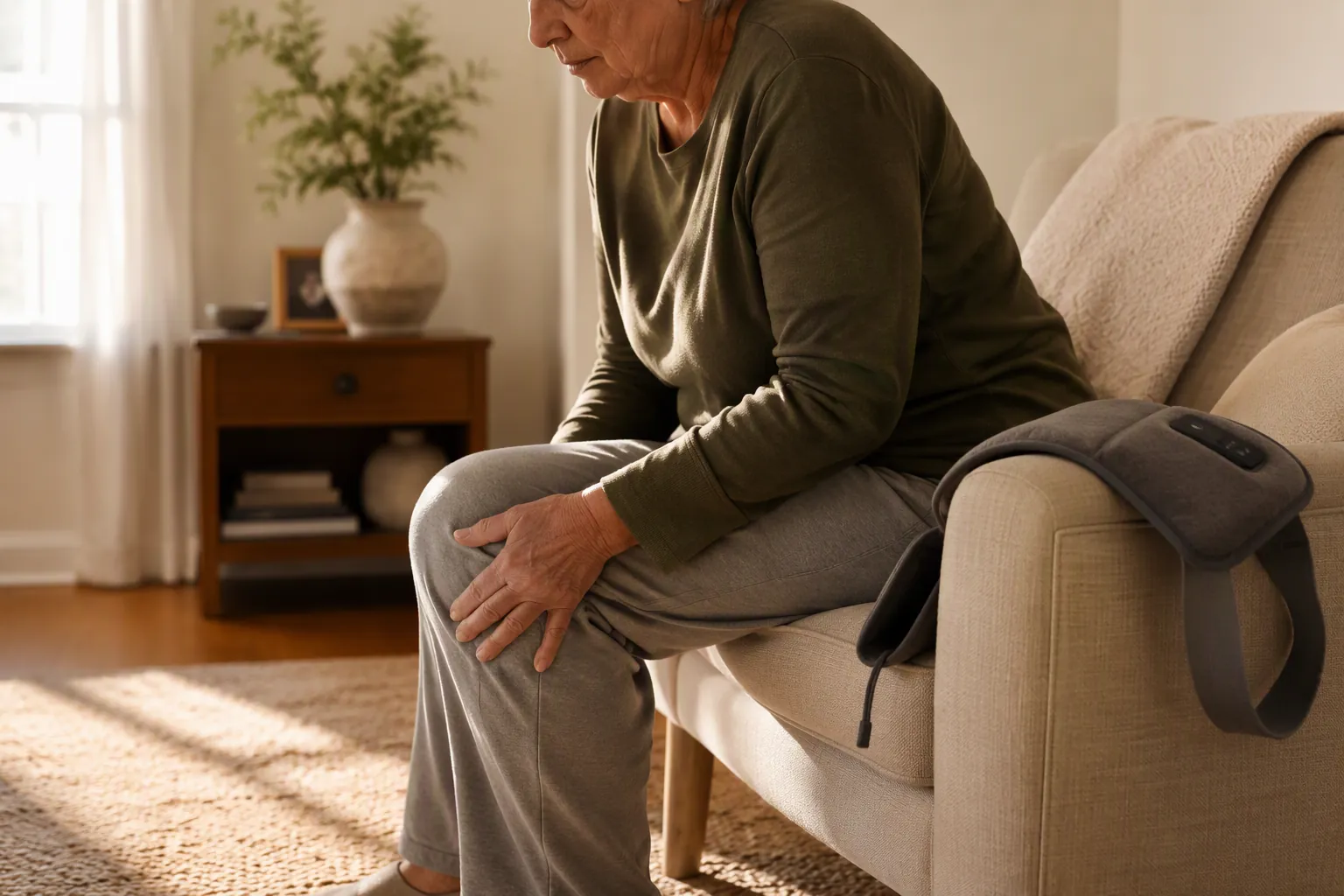
If a parent’s painful knees are making them unsteady, a heat vibration therapy device for senior arthritis pain relief may help with one part of the problem: pain and stiffness before movement. The stronger fall-prevention evidence, however, belongs mostly to supervised whole-body vibration training programs, not to consumer heated knee wraps or handheld massagers. That difference matters when the concern is not just comfort, but the next trip across the hallway at night.
The most careful answer is this: heat and vibration may make movement easier, and vibration training has promising evidence for fall-related outcomes in older adults, but a home heat-and-vibration device should be treated as a complementary tool, not as a fall-prevention device by itself.
The fall-prevention evidence starts with whole-body vibration
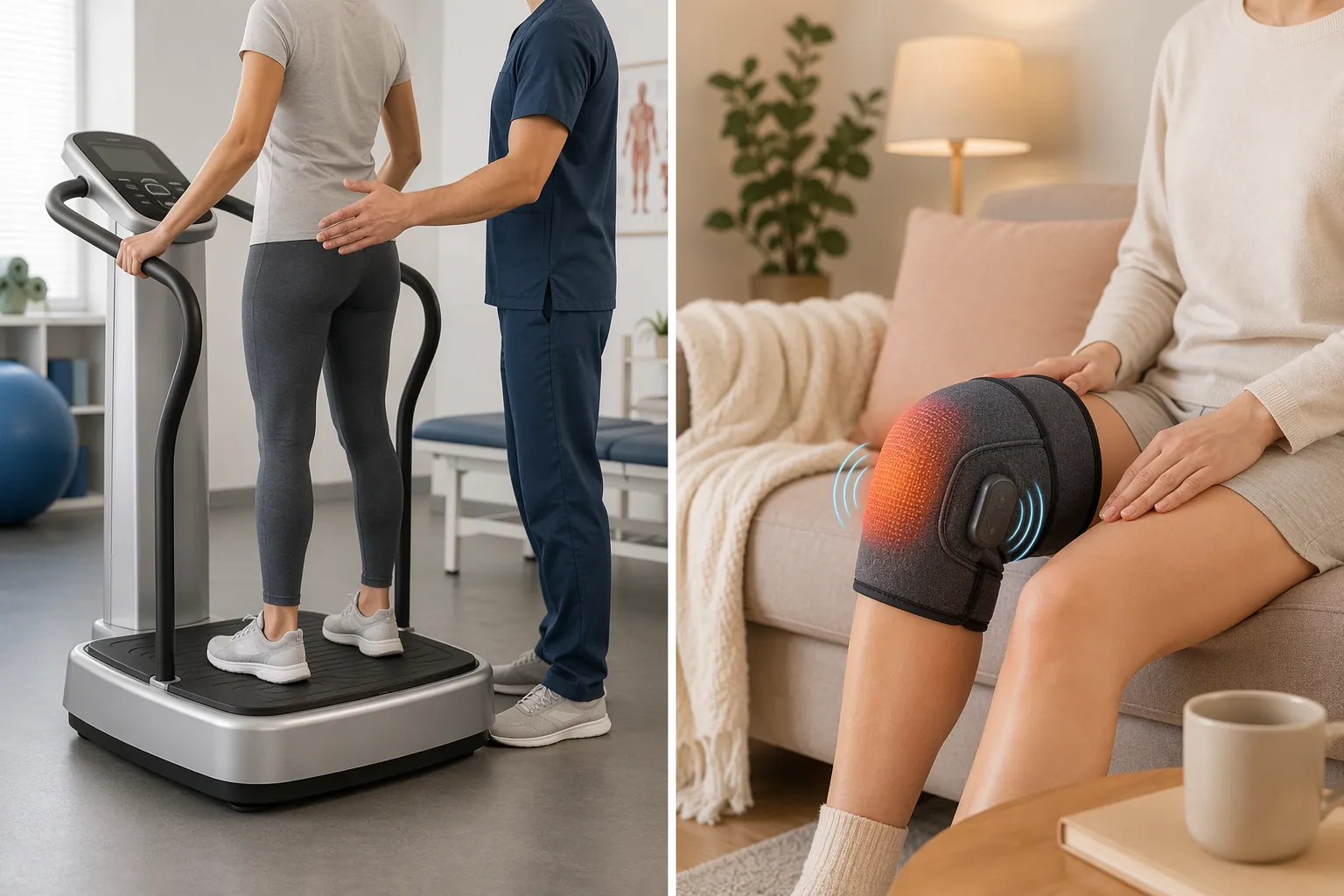
The clearest fall-related study in this area did not test a heated wrap around an arthritic knee. It tested an 8-week whole-body vibration training program in community-living older adults. Participants used vibration training 3 times per week at 20 Hz and 2 mm amplitude. After training, slip-induced falls were lower in the vibration group: 42.9% fell during the post-training slip test, compared with 81.3% in the control group. The reported relative risk was 0.528, with p=0.018.[1]
That is the kind of outcome families notice because it is not abstract. It is not only a pain score. It is whether the body can recover when the foot slips. The same trial also found significant improvements in knee strength, Berg Balance Scale scores, and chair-rise time, with reported effect sizes of Cohen’s d=0.569, d=0.744, and d=0.531 respectively.[1]
Adherence was also notable. Attrition in the vibration training group was 4.3%, while the article contrasted this with roughly 34% attrition reported for traditional exercise programs.[1] For an older adult who avoids activity because standing up hurts, a program that people will actually complete deserves attention.
The caution is just as important as the result. The study included 48 older adults.[1] It supports the promise of vibration training, especially when it is structured and supervised, but it does not prove that a consumer heat vibration wrap prevents falls at home.
Why arthritis pain can still belong in a fall-risk conversation
Pain changes how people move. An older adult with knee arthritis may shorten the step, avoid fully loading one leg, grab the wall before turning, or sit longer because standing feels uncertain. A device that reduces pain before movement could matter even if the device is not directly preventing a fall.
A 2022 meta-analysis of 14 randomized controlled trials involving 559 people with knee osteoarthritis found that whole-body vibration reduced pain, with a standardized mean difference of 0.46. Both lower-frequency vibration at 10-30 Hz and higher-frequency vibration at 30-40 Hz were associated with pain reduction, and the included trials reported no adverse events.[2]
That finding is useful, but it should be read in its lane. It says vibration can reduce knee osteoarthritis pain in studied exercise or therapy settings. It does not say every vibrating consumer product has the same effect, and it does not turn pain relief into a guaranteed fall reduction.
A 2025 scoping review of 37 studies on whole-body vibration in older adults found the strongest evidence clustered around sarcopenia and osteoarthritis, with reported improvements in muscle strength, flexibility, mobility, pain, and stiffness. The same review was more mixed on balance outcomes, with some studies showing benefit and others not.[3]
| Evidence area | What it supports | What it does not prove |
|---|---|---|
| Whole-body vibration training | Promising fall-related outcomes, strength, balance scores, and chair-rise performance in a small older-adult trial | That consumer heated wraps prevent falls |
| Whole-body vibration for knee osteoarthritis | Pain reduction across randomized trials | That pain relief alone eliminates fall risk |
| Combined heat, vibration, and CPM | Short-term knee osteoarthritis symptom improvement in one controlled crossover study | That all heat vibration devices work the same way |
| Heat before activity | Looser stiff joints and more comfortable movement when used safely | That hotter or longer treatment is safer or more effective |
The closest heat-plus-vibration study is encouraging, but narrow
The study closest to the phrase “heat vibration therapy” is a controlled crossover study of 71 patients with knee osteoarthritis. It tested a combined intervention using heat, vibration, and continuous passive motion. The study reported a net 14.4 mm reduction on a visual analog pain scale and an 8.8-point WOMAC improvement.[4]
That result is worth taking seriously because it involved people with knee osteoarthritis and used a combined approach resembling what many shoppers are looking for. But it also included continuous passive motion, not only heat and vibration. It cannot carry broad claims for every heated massager, knee wrap, or vibrating pad sold for home use.
This is where product language can get slippery. A device may feel good, help a stiff joint warm up, and make a short walk more tolerable. Those are meaningful outcomes. They are still different from showing that the device prevents falls.
Heat is practical before movement, but seniors need tighter safety limits
Heat can be useful before activity because it increases blood flow and helps relax stiff joints. The Arthritis Foundation describes moist heat in the range of 92-100°F for 15-20 minutes, and it warns that excessive heat can burn skin.[5] Harvard Health also describes heat therapy as a way to relax muscles and increase blood flow around painful joints.[6]
For an older adult, “comfortable” is not enough of a safety check. Reduced sensation, diabetes, fragile skin, or difficulty noticing temperature changes can make burns more likely. Heat should not be turned hotter or used longer simply because the joint still aches afterward.
- Use heat before a planned movement, such as gentle range-of-motion work, prescribed exercise, or a short supervised walk.
- Check the skin before and after use, especially if sensation is reduced.
- Stop if pain increases, swelling appears, the joint feels acutely inflamed, or the person feels dizzy or unsteady.
- Avoid sleeping with a heated device on.
Consumer devices and clinical vibration platforms are not the same thing
A whole-body vibration platform asks the person to stand or exercise on a vibrating surface, often with supervision and a defined protocol. A localized consumer device applies heat, vibration, or both to one area, such as the knee, calf, hip, or lower back. The first has more clinical research behind fall-related outcomes. The second may be more convenient at home but has thinner evidence for fall prevention.
Many consumer products are marketed as wellness devices rather than medical devices cleared to treat arthritis or prevent falls. A caregiver does not need to reject them for that reason, but the claim should be kept modest: pain relief, stiffness relief, and readiness to move are more defensible than fall prevention.
The useful question is not “Does it vibrate?” It is “What job are we asking it to do?” If the job is to warm a painful knee before a walk to the kitchen, a localized device may be reasonable if it is used safely. If the job is to reduce falls after a near-fall, then the device belongs inside a broader fall-risk plan.
When to ask a clinician before using vibration or heat
Medical clearance matters when the person has conditions that could make vibration, heat, or unsupervised activity risky. The more fragile the person’s balance, bones, circulation, or sensation, the less this should be treated as a casual home experiment.
- Pacemaker or implanted medical device
- Recent fracture, recent joint surgery, or severe osteoporosis
- Known or suspected deep vein thrombosis
- Acute joint swelling, warmth, redness, or a sudden arthritis flare
- Numbness, reduced skin sensation, diabetes-related neuropathy, or fragile skin
- New weakness, new instability, dizziness, or a recent unexplained fall
A physical therapist can also help separate pain-limited movement from strength, balance, gait, medication, vision, or footwear problems. That distinction is hard to make from the living room after one scary stumble.
How to place the device inside a real fall-prevention plan
A heat vibration device can be one small step before the bigger steps: warming a stiff knee before prescribed exercises, reducing pain enough to tolerate a walk, or helping an older adult participate instead of bracing against every movement. It should not become the reason to postpone balance work, medication review, or home safety changes.
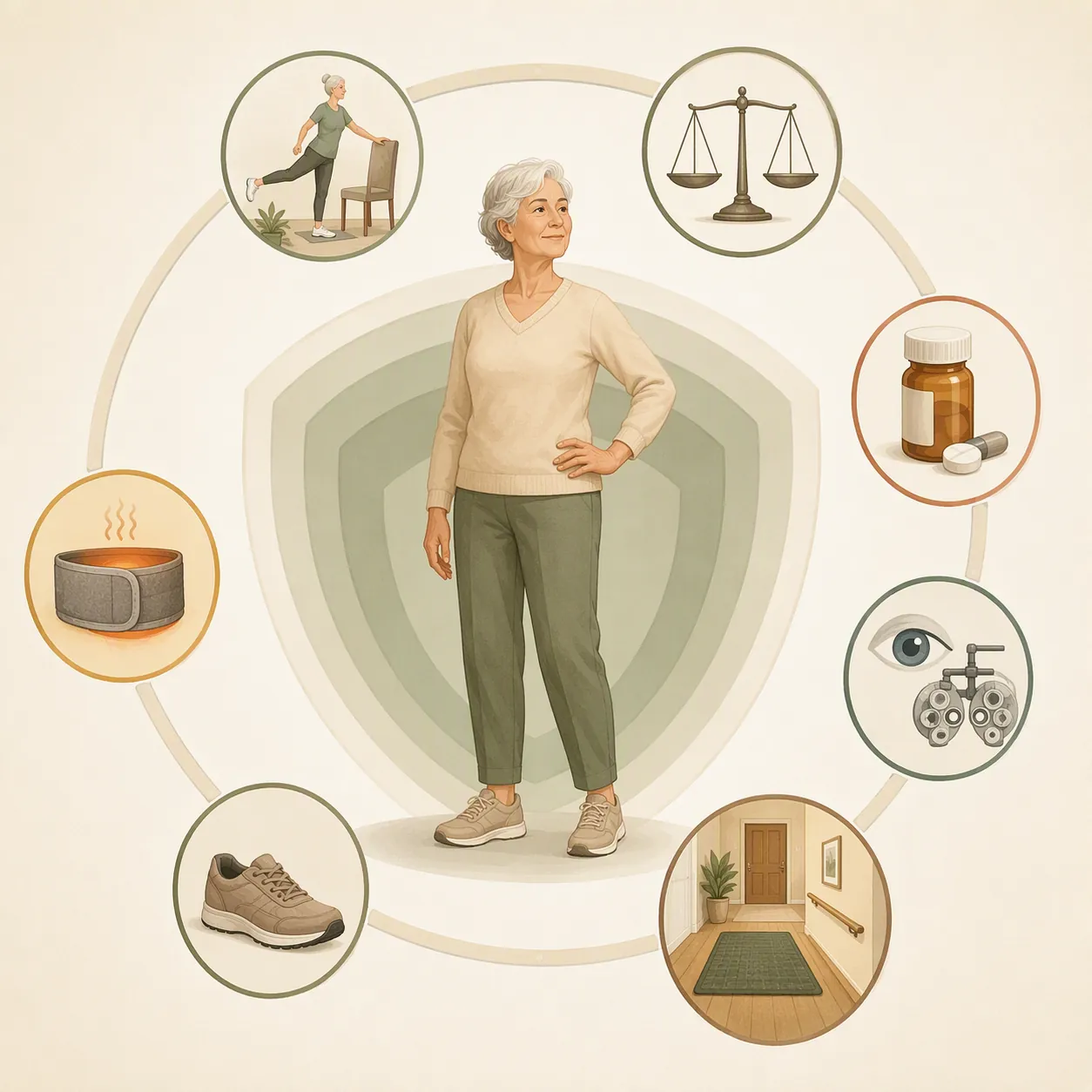
The more complete plan usually includes clinician-guided exercise or physical therapy, balance training, footwear checks, vision review, medication review, and home hazard reduction. If the person recently came home after rehab, a first-month fall prevention plan after rehab is a better organizing tool than a single device purchase.
Home conditions matter too. Loose rugs, poor lighting, no grab bar near the toilet, and unsafe footwear can erase the benefit of better knee comfort. For families weighing larger changes, aging-in-place modification decisions often deserve the same attention as pain-relief tools.
Falls also cluster around ordinary physical stressors. Heat waves, dehydration, poor sleep, medication changes, and sudden weakness can all make a usually manageable gait problem more dangerous. A parent who seems “just a little off” may need closer observation, especially when arthritis pain has already narrowed their margin for error. The same principle appears in broader fall-risk guidance, including how extreme heat raises fall risk in older adults and other caregiver-focused fall prevention frameworks.
The safest interpretation is practical and limited. Heat vibration therapy may help a senior with arthritis move more comfortably. Whole-body vibration training has promising evidence for reducing slip-induced falls and improving strength, balance scores, and chair-rise performance in a small trial. A localized consumer device may support mobility, but it should not replace a fall-risk evaluation, prescribed exercise, or changes that make the home safer when balance fails.
References
- Effects of whole-body vibration training on physical function and slip-induced falls among older adults: a randomized controlled trial. PMC. 2023.
- Effects of whole-body vibration therapy in patients with knee osteoarthritis: A systematic review and meta-analysis. Journal of Rehabilitation Medicine. 2022.
- Whole-Body Vibration in Elderly Populations: A Scoping Review. Cureus. 2025.
- Short-term efficacy of combined local mechanical vibrations, continuous passive motion and thermotherapy in treatment of knee osteoarthritis. Osteoarthritis and Cartilage. 2009.
- Heat Therapy Helps Relax Stiff Joints. Arthritis Foundation.
- Heat therapy for rheumatoid arthritis. Harvard Health Publishing.
Questions to ask your clinician or OT
This comparison doesn't decide final medical fit — bring it to a clinician or occupational therapist conversation, not a purchase decision.
Find Local HelpRelated reading
Noticed something outdated or inaccurate on this page? Flag a correction. We review every report against CDC, NIA, and AARP HomeFit guidance before updating a page.