
Caregiver decision guide
Choosing Care Options for Seniors Living with ALS
Families deciding where a senior with ALS should receive care need a clear picture of what each setting actually provides — in-home and skilled home care, assisted living, adult foster care, nursing homes, and hospice — and the functional changes that signal it is time to move to the next level.
Choosing care options for seniors living with ALS starts with a plain question: where can this care happen safely now, and what would make that answer change? The answer may be home today, assisted living or adult foster care for a time, a nursing home later, or hospice support layered onto home care. It is rarely one permanent decision.
ALS is often encountered as a later-life care issue. The ALS Association describes the average age of diagnosis as commonly between 55 and 65, and CDC prevalence data from 2015 found the highest U.S. prevalence in the 70–79 age band, at 20.2 per 100,000 people, followed by 12.8 per 100,000 among people age 80 and older.[1][2] Those numbers explain why adult children and spouses may be making senior-care decisions around ALS. They do not predict how one person’s disease will move.

The ALS Association’s living-environment guidance is a useful starting point because it does not treat “home” and “facility” as moral categories. It says most people with ALS can live at home through most or all of the disease, while also describing how help may need to escalate, sometimes toward round-the-clock support.[3] That is the tension families have to hold honestly: home may be workable and deeply valuable, but only if the actual work of care is covered.
| Care setting | What it can usually absorb | What should make the family reassess |
|---|---|---|
| Non-medical in-home care | Help with bathing, dressing, toileting support, meal preparation, light housekeeping, companionship, supervision, and some transfer assistance depending on caregiver training and agency rules. | Unsafe transfers, repeated toileting accidents without enough help, swallowing changes, breathing monitoring needs, or nights that require more awake support than the family can provide. |
| Medicare-certified home health or other skilled home care | Intermittent skilled nursing or therapy services ordered around a skilled need; often used alongside family care or paid non-medical aides. | Needs that are continuous rather than intermittent, or daily hands-on care needs that skilled visits do not cover. |
| Assisted living | A residential setting that may help with meals, housekeeping, medication reminders, social structure, and some daily activities. | Two-person transfers, complex toileting needs, unsafe swallowing, ventilator or feeding-tube care the setting cannot manage, or inadequate overnight staffing. |
| Adult foster care | A smaller residential home-like setting where supervision and hands-on assistance may be more personal, depending on the provider. | The same hands-on and skilled-care limits as any residential setting: staffing, training, overnight response, and ability to manage progressive ALS needs. |
| Nursing home care | Round-the-clock supervision, more medical oversight, and a higher capacity for complex care than most home or assisted-living arrangements. | Increasing safety risks, medical complexity, equipment needs, or caregiver exhaustion that cannot be solved by adding more home support. |
| Hospice at home | End-of-life support that can be added while the person remains at home or in another setting, when eligibility and goals of care fit. | It does not erase the need for hands-on caregiving; the family still has to know who is present for transfers, toileting, breathing worries, and overnight care. |
Home care is often the first answer, but it has two different meanings
When families say, “We’ll get home care,” they may be talking about two very different kinds of help. Non-medical in-home care means paid assistance with the daily work of living: getting washed, dressed, fed, repositioned, cleaned up, watched, and safely moved from one place to another. Skilled home health means clinical services ordered around a skilled need, such as nursing or therapy, often delivered in visits rather than all-day coverage.
That distinction matters in ALS because the most wearing parts of care are not always the parts that look medical on paper. A daughter may not be inserting a feeding tube or adjusting a ventilator; she may be trying to help a parent stand from the toilet at 1:40 a.m. without both of them falling. A spouse may not need a nurse in the room every minute; he may need another trained adult awake enough to reposition someone, respond to choking, or notice that breathing feels different.
For the non-medical side, it helps to start with the same daily-function inventory used in broader elder-care planning: bathing, dressing, toileting, transferring, eating, continence support, meal preparation, medication routines, transportation, and household management. If you need that framework before applying it to ALS, this guide to in-home care for elderly parents is the more general place to build the list.
Skilled home health has a different job. It may bring in nursing, physical therapy, occupational therapy, speech-language pathology, or other clinical support, depending on orders and eligibility. NINDS describes ALS care as multidisciplinary, often involving clinicians and therapists who help manage symptoms, mobility, communication, nutrition, and respiratory function.[4] That team can guide home adaptations and safety decisions, but it is not the same as having a paid aide available for every transfer or toileting episode.
If the terms are getting blurred by brochures or intake calls, pause and separate them: who is providing hands-on daily help, who is providing skilled clinical services, how often each person comes, and what happens outside those hours. The difference between home health care and home care is not a technicality when ALS care is becoming heavier.
Build the home plan around the hard hours
A home plan that looks fine at noon can fail at night. The most useful planning question is not “Can Dad stay home?” It is “Who is physically present, trained, and rested enough to handle the next predictable problem?”
- Map the day by task, not by sentiment: morning transfer, bathroom routine, meals, medication prompts, communication support, equipment checks, evening transfer, overnight repositioning, and emergency response.
- Name the person responsible for each task. “Family” is not a staffing plan if one person is actually doing the lifting, cleaning, and monitoring.
- Separate planned care from rescue care. A scheduled shower aide does not solve unsafe toileting at midnight.
- Ask the ALS care team which changes are likely to affect transfers, swallowing, communication, nutrition, and breathing, then decide what would trigger a new care meeting.
- Write down the point at which the home plan stops being safe: for example, when transfers require two trained people, when choking episodes increase, or when the overnight caregiver cannot sleep enough to function.
Hiring privately and using an agency involve different trade-offs in backup coverage, supervision, cost, and control. For families comparing those routes, the practical continuation is agency vs. private caregiver. For families still at the setup stage, a step-by-step starting point is how to get home care for an elderly parent.
What should make a family reassess home?
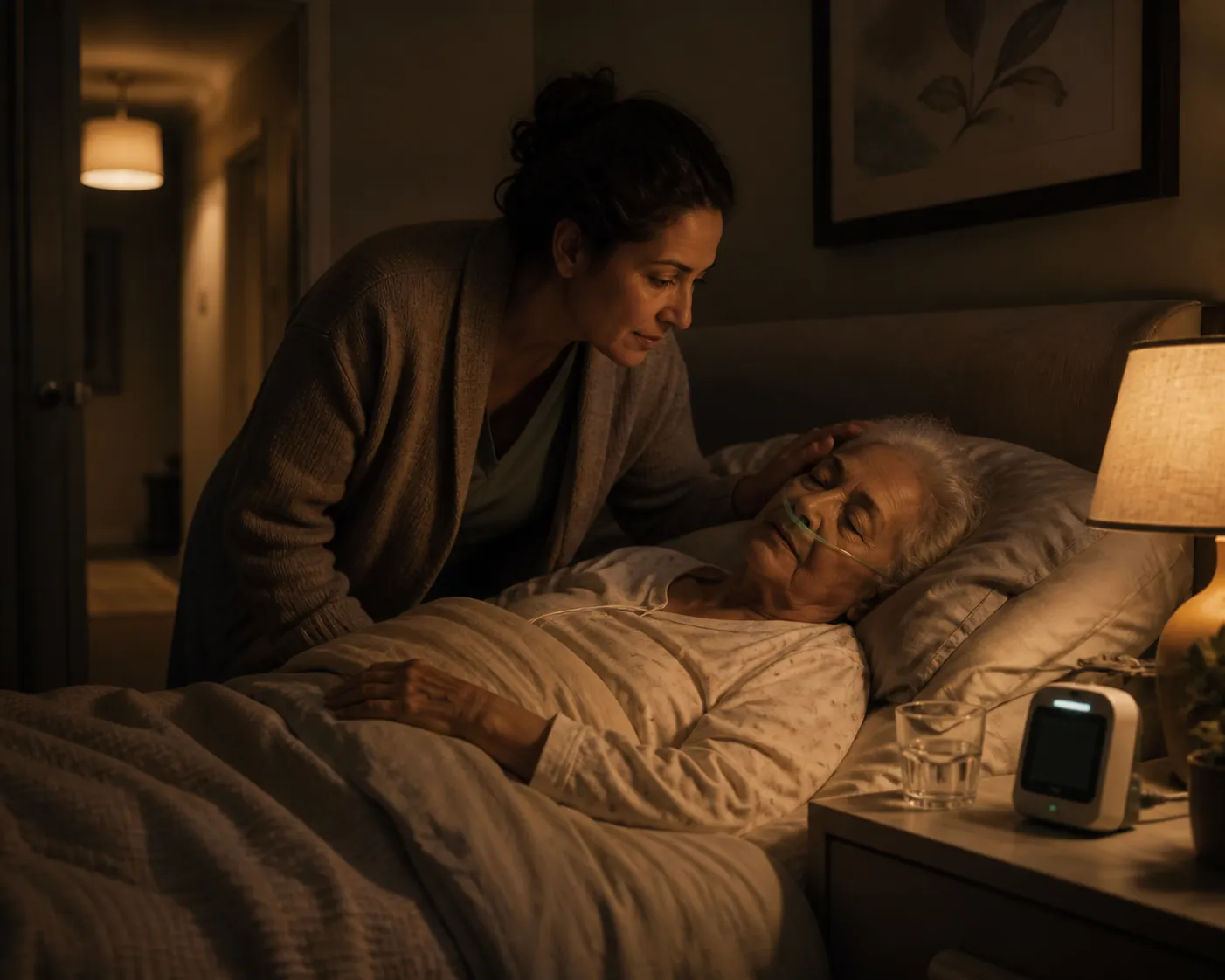
The move threshold is usually not one dramatic event. More often, the home plan starts to fray in repeated, specific places. Transfers take longer and feel less controlled. Toileting becomes urgent, messy, or dangerous. Meals require more attention because swallowing is less safe. Breathing concerns move from daytime discussion to nighttime vigilance. The caregiver begins sleeping in fragments, skipping their own appointments, or dreading the next transfer.
AARP and VOYCE both point families toward similar nursing-home triggers: the need for 24/7 supervision or medical care, feeding tubes or ventilators, rising fall or infection risk, and caregiver burnout.[5][6] The important part is that caregiver burnout belongs on the same list as equipment and medical risk. If the plan requires one exhausted person to keep doing unsafe work, the setting is no longer absorbing the care need.
| Change to track | What to write down | Why it changes the setting decision |
|---|---|---|
| Transfers | How many people are needed, whether the senior can bear weight, whether near-falls occur, and whether equipment is being used correctly. | A home can become unsafe when transfers require more trained hands than are available. |
| Toileting and continence | Accidents, cleanup time, skin concerns, urgency, nighttime bathroom trips, and whether the caregiver can manage without rushing. | Toileting is one of the first places where privacy, safety, and caregiver stamina collide. |
| Swallowing and nutrition | Coughing, choking, meal length, fatigue while eating, weight concerns discussed with clinicians, and whether someone must supervise every meal. | A setting must be able to manage meals safely and respond when swallowing becomes unsafe. |
| Breathing and sleep | Nighttime awakenings, breathing equipment routines if used, anxiety, caregiver checks, and whether anyone is awake enough to respond. | Night care can turn a daytime home plan into an around-the-clock staffing problem. |
| Falls, infections, and skin concerns | Incidents, near misses, changes after illness, pressure areas, and how quickly help arrives. | Rising medical and safety risk may require more supervision than intermittent home help can provide. |
| Caregiver capacity | Sleep loss, injuries, missed work, resentment, depression symptoms, mistakes, and whether backup caregivers actually show up. | A plan that depends on a collapsing caregiver is already unstable. |
This tracking does not have to be elaborate. A notebook by the bed may be more useful than a beautiful spreadsheet no one updates. What matters is that the ALS care team, the senior, and the family can see the pattern before the next emergency decides for them.
Assisted living and adult foster care depend on staffing, not charm
Assisted living may be useful for a senior with ALS when the main needs are meals, housekeeping, medication reminders, social structure, limited help with daily activities, and a safer environment than living alone. It becomes much less convincing if the person needs frequent two-person transfers, close meal supervision, breathing monitoring, or hands-on help that staff cannot provide quickly and reliably.
Adult foster care, sometimes called adult family care or a residential care home depending on the state, can feel more personal because it is usually smaller. That intimacy can be valuable. It can also hide the same problem as any other setting: if only one caregiver is present overnight, what happens during a difficult transfer, a choking episode, or a breathing scare? The ALS Association includes residential options along the living-environment continuum, but the fit depends on the level of care actually available, not the label on the home.[3]
Questions to ask before choosing a residential setting
- Who is awake and available at 2 a.m.?
- How many staff members can assist with a transfer, and how quickly can they respond?
- What happens if swallowing becomes unsafe or meals require one-to-one supervision?
- Can the setting manage communication changes if speech becomes difficult?
- What ALS-related equipment has the staff actually worked with?
- Which care needs would trigger discharge, a higher fee, or a required move?
- How are outside home health, hospice, or private-duty aides allowed to work in the building?
A tour can show whether the room is pleasant. It cannot show whether the night shift can safely get someone through a hard bathroom transfer. Families have to ask about the work directly.
When nursing home care becomes a serious option
Nursing home care deserves a more honest place in ALS planning than families often give it. It is not proof that home care failed because people did not love enough or organize enough. It is one setting that may be able to absorb a level of supervision, medical complexity, equipment use, and physical care that a household cannot safely carry.
The strongest reasons to consider nursing home care are practical: the senior needs round-the-clock supervision or medical care; feeding-tube or ventilator care is present or being considered; fall, infection, or skin risks are rising; or the family caregiver is exhausted, injured, or no longer able to provide reliable care.[5][6] None of those reasons has to wait for a catastrophe.
The hard part is that a nursing home still has to be evaluated, not assumed. Families should ask how the facility handles ALS, respiratory equipment, communication changes, nutrition support, therapy coordination, and hospice involvement if goals of care later shift. A nursing home with “24-hour care” on a brochure still needs enough trained staff at the bedside when the need occurs.
For some seniors, moving earlier may preserve more comfort than waiting until the caregiver is depleted and the first available bed becomes the only choice. For others, a well-supported home plan may remain the better setting. The dividing line is not pride. It is whether the current arrangement can safely do the work.
Hospice at home changes the support, not necessarily the address
Hospice is often spoken about as if it were a place people go. For many families, it is better understood first as a layer of support that may come into the current setting, including home, when the person is eligible and the goals of care have shifted toward comfort.
For ALS, hospice at home may be emotionally important because it can allow familiar surroundings at a stage when travel and transitions are difficult. It can also leave families surprised if they thought hospice meant someone else would take over all hands-on care. The same home test still applies: who turns, transfers, cleans, comforts, watches, and calls for help when symptoms change? The ALS Association’s living-environment guidance treats hospice as part of the care-setting landscape, not simply as the next building in a sequence.[3]
Hospice can also be used in a nursing home or other residential setting, depending on eligibility, goals, and local arrangements. That can matter when the senior’s comfort goals fit hospice but the household cannot safely provide the physical care anymore.
Payment should follow the care need, not hide it
Last verified: August 25, 2026. This section is educational, not medical, legal, or financial advice. Coverage rules change, state Medicaid programs differ, and individual policies matter. Confirm decisions with the ALS care team, the payer, and a qualified benefits or legal professional when needed.
Medicare-certified home health is not the same as open-ended home care. The National Academies’ 2024 report describes Medicare home health as requiring a doctor-certified skilled need and homebound status.[7] That can make skilled visits very important, but it should not be mistaken for a guarantee of all-day or overnight aide coverage. If the dispute is specifically about aide hours under Medicare home health, this guide to Medicare home health aide hours explains the advocacy angle in more detail.
Medicaid is described by the same National Academies report as the primary payer for nursing home care, with eligibility and rules varying by state.[7] That state-by-state variation is not a footnote; it can determine whether a family is planning around spend-down rules, a Medicaid bed, home- and community-based services, or private pay while waiting for eligibility decisions.
Long-term-care insurance also cannot be treated as automatic. The National Academies report notes that it pays only if the policy covers ALS.[7] Families should read the policy language, elimination period, benefit triggers, daily or monthly maximums, inflation provisions, and rules for home care versus facility care before assuming it will support a particular plan.
Costs matter, but an old national estimate is a poor substitute for a current care plan. The useful order is: identify the care that is actually needed, identify which setting can provide it, then test the payer rules and out-of-pocket exposure. Starting with a reassuring coverage phrase can leave the family discovering too late that the uncovered need is the person who must be awake at night.
A defensible care-setting decision
There is no universally correct setting for a senior living with ALS. Home may be the right answer for a long stretch, especially when the senior wants familiar surroundings and the family can combine equipment, paid help, skilled visits, and ALS-team guidance. Assisted living or adult foster care may fit a narrower window if supervision and hands-on assistance match the person’s needs. Nursing home care may become the safer and kinder option when the work becomes continuous, skilled, or too physically demanding for the household. Hospice may support comfort at home or in another setting when goals and eligibility align.
The family has a defensible reason to move care when the senior’s required assistance exceeds what the home can safely provide, or when the caregiver can no longer sustain the work without harm. That is not giving up. It is recognizing that ALS care is a sequence of setting decisions, and the next decision should be made while there is still enough time to choose deliberately.
References
- FYI: Epidemiology of ALS and Suspected Clusters — ALS Association.
- Prevalence of Amyotrophic Lateral Sclerosis — United States, 2015 — CDC MMWR.
- Living Environment — ALS Association.
- Amyotrophic Lateral Sclerosis (ALS) — National Institute of Neurological Disorders and Stroke.
- ALS Caregiving — AARP, May 29, 2025.
- St. Louis ALS Care Options — VOYCE, May 2025.
- Making ALS Livable in the Near Term — National Academies, 2024.
Questions to bring to a clinician or OT
This is not medical, legal, or a family's final decision — only a framework. Bring these questions to a clinician, occupational therapist, or your local Area Agency on Aging.
Find Local HelpRelated reading
Noticed something outdated or inaccurate on this page? Flag a correction. We review every report against CDC, NIA, and AARP HomeFit guidance before updating a page.