
Caregiver decision guide
Amtrak State Fair Travel Tips for Seniors
Take the stress out of your trip to the state fair with this step-by-step guide for seniors on Amtrak discounts, accessibility requests, packing essentials, and fairground navigation.
Before buying the ticket, decide whether Amtrak solves the hard part of this particular state fair trip. It can remove highway traffic, parking-lot walking, and the uneasy handoff where an adult child circles a crowded entrance. But the train only helps if the station, assistance request, ticket format, mobility device, and fairground plan all line up before travel day.
The New York State Fair is the cleanest 2026 example because Amtrak is scheduled to serve the seasonal NYF stop at the fairgrounds from Aug. 26 through Sept. 7, 2026, with five daily Maple Leaf and Empire Service trains stopping there.[1] That is unusual. Seniors going to other state fairs should assume they are traveling to the nearest city station first, then finishing the trip by local transit, taxi, rideshare, shuttle, or family pickup unless the fair’s own transportation page says otherwise.
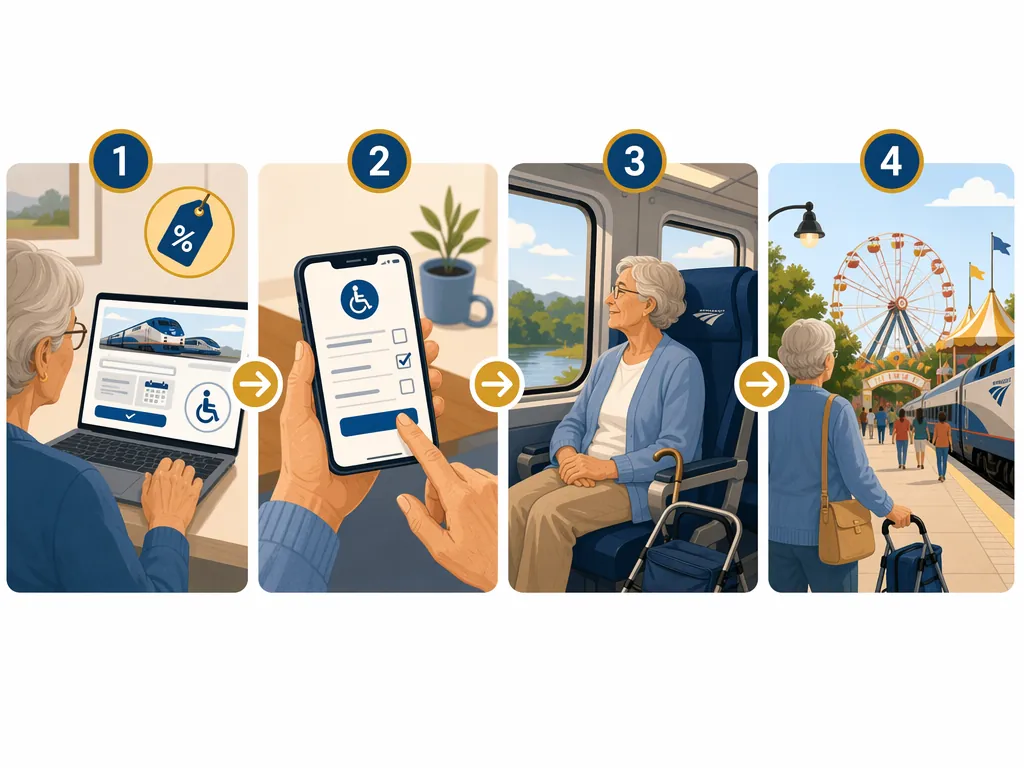
Start With The Station, Not The Fair Poster
A fair may advertise senior admission, scooter rentals, and accessible entrances, but none of that matters if the rail arrival leaves someone stranded at an unstaffed platform or a station too far from the gate. Start by writing down three places: the home station, the arrival station, and the exact fairground entrance or pickup point.
For New York, the arrival station may be NYF, the seasonal fair stop. That stop is useful because it is at the fairgrounds, but it is not a full station. Amtrak lists NYF as platform-only, with no station staff, no ticket office, no lounge, no checked baggage, and no courtesy wheelchairs; tickets must be available on a phone or printed before arrival.[2] A senior who needs someone to push a wheelchair from the train to a fair entrance should not discover that detail on the platform.
For other fairs, use the nearest Amtrak-served city as the first checkpoint, then verify the last-mile plan separately. The Minnesota State Fair, Iowa State Fair, Ohio State Fair, Texas State Fair, and Wisconsin State Fair all have their own accessibility and admission resources, but the train does not automatically place a rider at the gate. A fair day that looks simple on a map can become tiring if the final transfer involves a long curb walk, a rideshare search in heat, or a scooter rental counter on the far side of the grounds.
| Question To Confirm | Why It Matters |
|---|---|
| Does Amtrak stop at the fairgrounds or only in the nearest city? | Only the New York State Fair has the dedicated seasonal NYF Amtrak stop among the examples cited here. |
| Is the arrival station staffed at the travel time? | Staffing affects baggage help, wheelchair assistance, and how much a caregiver must handle alone. |
| How will the rider get from the station to the fair entrance? | Taxi, rideshare, shuttle, transit, or family pickup should be decided before the ticket is final. |
| Does the fair require scooter or wheelchair reservations? | Same-day rentals can sell out or require pickup at a specific gate. |
| Is there a realistic return plan after walking, heat, and crowds? | The trip home is often when fatigue makes small gaps feel much larger. |
Book The Fare Correctly The First Time
Amtrak’s senior discount is not automatic just because the passenger is older. For passengers age 65 and over, Amtrak offers 10% off most rail fares; the booking screen needs the traveler type set to “Senior,” and proof of age may be requested.[3] That small dropdown is worth checking before payment, especially when an adult child is booking on a parent’s behalf.
For New York travel, also check whether the “See NY and Save” offer applies. Amtrak’s 2026 page lists 15% off Empire Service and Maple Leaf trains within New York State using code V639, and the offer can stack with the senior discount.[4] Because promotion codes and eligible routes can change, treat this as a pre-purchase check rather than something to fix later.
Do not rush past the seating and accessibility choices. A lower fare does not help if the passenger booked a seat they cannot reach, selected the wrong mobility option, or assumed help would appear at a stop where there is no staff. If the trip involves a wheelchair, scooter, walker, cane, oxygen equipment, limited stair tolerance, or difficulty standing in a line, the fare screen is only the first part of booking.
- Choose “Senior” for each eligible passenger age 65 or older before payment.
- For New York State Fair travel, test the See NY and Save code before checkout if the route qualifies.
- Save the ticket on the passenger’s phone and keep a printed copy if phone access is uncertain.
- Write down train numbers, station names, arrival times, and the return train before the fair plan is considered finished.
- If a caregiver is traveling separately or meeting at the station, share the ticket details and arrival platform information as soon as they are available.
Make Accessibility Requests At Least 72 Hours Ahead
Accessibility help should be requested before the trip, not negotiated at the platform. Amtrak directs passengers to call 1-800-USA-RAIL or use its online accessibility request form at least 72 hours before travel.[5] Missing that window does not necessarily mean no one will try to help, but it removes the margin that older travelers and caregivers usually need most.
This is the call or form where the practical details belong: whether the passenger can climb steps, whether they need a lift or bridge plate, whether they will transfer to a train seat, whether they will remain in a wheeled mobility device, and whether they need help boarding at the origin, destination, or both. Do not describe needs vaguely as “some assistance” if the real issue is standing, stairs, balance, device width, or fatigue.
Amtrak publishes system-wide maximums for wheeled mobility devices of 27.5 inches wide by 48 inches long, 600 pounds occupied weight, and 2 inches of ground clearance; both manual and battery-powered devices are included in the policy.[6] Some equipment or routes may be able to handle larger devices, but that is exactly the sort of exception to confirm by phone before buying or treating the trip as settled.
There are also two different onboard arrangements to understand. A passenger may use an accessible transfer seat and keep a folded walker or cane nearby, or reserve a wheelchair-space area and remain seated in the device; Amtrak notes that it does not provide a lockdown device for wheelchairs in that space.[7] Those choices feel small on a website and large on a tired afternoon.
| If This Applies | Ask Or Confirm Before Travel |
|---|---|
| Uses a wheelchair or scooter | Device width, length, occupied weight, ground clearance, and whether the rider will transfer or remain in the device |
| Uses a walker or cane | Whether it can be folded and kept near the seat without blocking the aisle |
| Cannot manage train steps | Lift or bridge-plate availability at both stations |
| Needs help with bags or boarding | Whether the station is staffed and whether Red Cap or other assistance is available at that time |
| Arrives at NYF for the New York State Fair | No station staff or courtesy wheelchairs at the platform-only stop |
Red Cap service is helpful where it exists, but it is not a system-wide promise at every stop. Amtrak describes Red Cap as free baggage and wheelchair-lift assistance at major staffed stations, with staff wearing red shirts and Amtrak badges.[8] For a fair trip, call the station or Amtrak ahead if that help is part of the plan, because availability can vary by station, time of day, and staffing.
Pack For The Train Ride And The Return Trip
Packing for a senior fair trip is not about bringing more. It is about keeping the important items reachable while hands are already busy with tickets, railings, bags, and possibly a mobility aid. The bag that matters most is the one that stays with the passenger at the seat.
- Medications in original or clearly labeled containers, plus the doses needed if the train or return ride runs late.
- A printed ticket or confirmation if the passenger may have trouble finding the mobile ticket quickly.
- Phone charger or battery pack, with the phone fully charged before leaving home.
- Non-alcoholic drinks and snacks that work with the passenger’s diet and medication schedule.
- A light layer for air-conditioning on the train and sun protection for the fairgrounds.
- A small written card with emergency contacts, medication concerns, and pickup instructions.
Late-summer fairs can make a person feel fine in the morning and unsteady by late afternoon. Heat, medication timing, long lines, and uneven walking surfaces all draw from the same energy reserve. If the return train is fixed, plan the day backward from that departure time: when to stop walking, when to eat, when to refill water, and when to start moving toward the station or pickup point.
For unstaffed stations, plan to arrive about an hour early. For major stations where the rider wants Red Cap help, allow extra time and confirm where to meet the staff. The point is not to spend the day waiting; it is to avoid turning boarding into the first tiring event.
Boarding: Who Carries What, And Who Waits Where
The boarding plan should be boring on purpose. Decide before leaving home who handles the ticket, who carries the bag, who folds the walker if needed, and who speaks with station staff. If the senior is traveling alone, those jobs still exist; they just need to be simplified.
At originating stations, Amtrak says pre-boarding is available, with bridge plates used at high platforms and mobile lifts at low platforms.[6] That does not mean every rider needs to board first, but anyone who moves slowly, uses a device, or needs time to settle should ask rather than waiting until the general line is moving.
Once seated, keep the essentials within reach: ticket, phone, medication, water, glasses, and a small snack. Put anything not needed during the ride overhead or out of the way so the aisle is clear. If a walker or cane is part of the transfer plan, confirm where it will be stored before everyone relaxes.
Arrival Is Where The Plan Either Holds Or Frays
The best Amtrak state fair travel tips for seniors are usually about arrival, because that is where cheerful advice gets thin. The train has a schedule and a seat. The fairground has crowds, entrances, rental booths, security lines, heat, and distances that look shorter on a map than they feel underfoot.
At the New York State Fair, the NYF stop removes the city-station transfer, but it does not remove the need for a fairground mobility plan. NYF has no courtesy wheelchairs and no station staff, so a rider who cannot walk from the platform needs a companion, their own device, or a pre-confirmed fairground resource.[2] New York’s fair accessibility page also lists free admission daily for adults 65 and older, which can make the outing more affordable if the transportation pieces are already secure.[9]
For other fairs, treat the Amtrak arrival station as a transfer point. If the nearest station is in St. Paul, Milwaukee, Des Moines-area routing, Columbus-area routing, Dallas-area routing, or another city, the next question is not “How far is the fair?” but “How does this specific person get from the train door to the fair entrance without overusing their legs before the day starts?”
- If using rideshare or taxi, choose the pickup and drop-off point before travel day and share it with the driver or caregiver.
- If using public transit, check whether the route is accessible, how far the stop is from the fair entrance, and whether service still runs for the return trip.
- If family is picking up, agree on a specific station door or curb zone rather than “out front.”
- If renting a scooter or wheelchair, confirm reservation rules, pickup location, daily cost, and return deadline.
- If walking independently, identify the first rest point after the gate, not just the gate itself.
Check The Fair’s Senior And Mobility Rules For 2026
Fair benefits are local, seasonal, and easy to misremember from a prior year. As of the current 2026 materials, the Minnesota State Fair lists senior admission of $15 on Senior Days, Aug. 31 and Sept. 3, 2026.[10] Its accessibility information lists Scootaround scooter rentals at $65 to $80 per day and wheelchair rentals at $25 to $35 per day.[11] Those are the kinds of details to confirm before promising a parent, spouse, or neighbor that “we can just rent one there.”
The Iowa State Fair lists admission of $12 for ages 60 and older and, new for 2026, complimentary Mobility Assistance Carts that are volunteer-operated, run fixed routes, and operate from 9 a.m. to 4 p.m.[12] That is helpful, but it is not the same as a personal wheelchair or door-to-door escort. Fixed routes and limited hours should shape the day’s walking plan.
The Ohio State Fair lists a free Senior Day on Aug. 4, 2026.[13] The State Fair of Texas lists free Thursdays for visitors age 60 and older and notes scooter rentals.[14] The Wisconsin State Fair provides an accessibility page with wheelchair and scooter rental information.[15] Each of those facts is useful only after the rail station and last-mile transfer have been checked.
| Fair Resource | What To Verify Before Travel |
|---|---|
| Senior admission day or discount | Age threshold, eligible date, required ID, and whether the discount applies at the gate or online |
| Scooter or wheelchair rental | Reservation process, pickup location, cost, deposit, operating hours, and sellout risk |
| Mobility carts or trams | Routes, hours, whether service is fixed-route or request-based, and whether companions may ride |
| Accessible entrances and restrooms | Closest entrance to the station drop-off, security line layout, restroom locations, and rest areas |
| Return transportation | Pickup zone, train departure time, evening transit availability, and backup contact |
Build The Fair Day Around Energy, Not Attractions
A fair day does not have to be small to be successful, but it does need a shape. Pick the two or three things that would make the trip feel worth it, then place rest, food, hydration, and bathroom stops around them. The senior who wants to feel independent may not want every move managed, so the plan should protect choice without pretending the body has no limits.
The first hour after arrival is a good time to do the most important activity, especially if heat or crowds are expected later. If a rental scooter is part of the plan, get it before walking deep into the fairgrounds. If medication needs food, do not let a long line or delayed lunch push the schedule around. If the return train leaves at a fixed time, set an alarm for when to start leaving the fair, not just when the train departs.
Caregivers should also be honest about their own workload. Carrying bags, managing mobile tickets, watching footing, finding water, and solving transportation all take attention. If one person is doing all of that, a simpler fair route may be safer than a full-grounds itinerary.
The Week-Before Readiness Check
By the week before travel, the trip should no longer depend on “we’ll figure it out.” The ticket is only one piece. A senior-friendly Amtrak fair trip is ready when the transportation, assistance, documents, mobility plan, and return energy have all been checked against the actual stations and the actual fair.
- Station confirmed: home station, arrival station, staffing status, and whether the fair has a dedicated stop or requires a transfer.
- Ticket confirmed: senior fare selected, applicable promotion code checked, proof of age available, and ticket saved on phone or printed.
- Assistance confirmed: Amtrak accessibility request submitted or called in at least 72 hours ahead, with boarding needs described clearly.
- Mobility confirmed: wheelchair, scooter, walker, or cane fits the trip plan, and any rental has been reserved or verified.
- Fairground confirmed: senior admission rules, accessible entrances, restrooms, rentals, cart services, and rest points checked on the official fair site.
- Return confirmed: departure time, pickup point, phone battery, medication timing, and backup ride contact are written down.
If those items are confirmed, Amtrak can be a strong way to reduce driving stress and preserve energy for the fair itself. If any of them are uncertain, the trip may still work, but it needs a phone call, a station check, or a different last-mile plan before the ticket is treated as final.
References
- Governor Hochul, Amtrak and New York State Department of Transportation Announce Tickets Now on Sale for Direct Train Service to Great New York State Fair, Amtrak Media, July 2026.
- NYF New York State Fair, Amtrak.
- Seniors Travel by Train, Amtrak.
- See New York and Save 15 Percent, Amtrak.
- Accessible Travel Requests, Amtrak.
- Wheeled Mobility Device Services, Amtrak.
- Accessible Travel Services, Amtrak.
- Amtrak Red Cap Baggage Assistance, Amtrak Blog.
- Accessibility, The Great New York State Fair.
- Discounts, Minnesota State Fair.
- Accessibility, Minnesota State Fair.
- Disability Assistance, Iowa State Fair.
- Special Days, Ohio State Fair.
- Accessibility, State Fair of Texas.
- Accessibility, Wisconsin State Fair.
Questions to bring to a clinician or OT
This is not medical, legal, or a family's final decision — only a framework. Bring these questions to a clinician, occupational therapist, or your local Area Agency on Aging.
Find Local HelpRelated reading
Noticed something outdated or inaccurate on this page? Flag a correction. We review every report against CDC, NIA, and AARP HomeFit guidance before updating a page.