
Caregiver decision guide
Save on State Fairs with Senior Discounts and Accessibility Tips
Learn which U.S. state fairs offer the best senior discount days for the 2026 season and what accessibility services—wheelchair and scooter rentals, ADA shuttle buses, sensory-friendly hours—are available to make your visit comfortable and affordable.
Before buying a state fair ticket for an older adult, the useful question is not just “How cheap is admission?” It is whether the discounted day lines up with the parking route, the gate entrance, scooter or wheelchair availability, bathroom breaks, rest time, and any concert seating you are counting on. Admission deals, accessible concert details, shuttle routes, and rest stops belong in the same plan, because a free ticket can still turn into a hard day if the longest walk happens before anyone reaches the first lemonade stand.
For the 2026 season, the strongest documented senior admission offers come from New York, Wisconsin, Minnesota, Iowa, California, and Ohio. They are not a complete national directory. They are the fairs where the available public details are concrete enough to help someone choose a date, estimate the real cost, and decide whether the outing is physically realistic before leaving home.

The 2026 Senior Discount Days Worth Planning Around
New York is the easy winner on admission flexibility: seniors age 65 and older receive free admission every day of the 2026 New York State Fair, which runs August 26 through September 7.[1] That matters more than it may sound. A daily senior policy lets a family choose a cooler weekday, a lighter crowd, or the day with the right concert instead of forcing the whole outing into one narrow discount window.
The other good deals are real, but they are more date-sensitive. Wisconsin offers $7 admission for ages 60 and older on Senior Day, Monday, August 10, 2026, from 10 a.m. to 4 p.m.[2] Minnesota lists $15 admission for seniors 65 and older on specific discount days during its August 27 through September 7, 2026 fair.[3] Iowa lists $12 admission for ages 60 and older on Senior Day during its August 13 through August 23, 2026 fair.[4] California offers $10 admission for ages 62 and older on Senior Savings Fridays during its July 17 through August 2, 2026 fair.[5] Ohio lists free admission for seniors on its designated Senior Day during the July 29 through August 9, 2026 Ohio State Fair.[6]
| State fair | 2026 senior admission offer | Planning catch |
|---|---|---|
| New York State Fair | Free admission every day for ages 65+ | Best flexibility; still check equipment rental, ADA shuttle, and show seating before choosing a date. |
| Wisconsin State Fair | $7 admission for ages 60+ on Monday, August 10, 2026, 10 a.m.–4 p.m. | Excellent price, but the discount is tied to one date and time window. |
| Minnesota State Fair | $15 admission for ages 65+ on specific discount days | Good savings if the discount day matches your stamina, transportation, and crowd tolerance. |
| Iowa State Fair | $12 admission for ages 60+ on Senior Day | Pair the discount with the fair’s disability assistance details, especially ADA shuttle use. |
| California State Fair | $10 admission for ages 62+ on Fridays | Friday pricing gives more than one possible date, but it is still not an everyday senior rate. |
| Ohio State Fair | Free admission for seniors on designated Senior Day | Strong price, but confirm the exact Senior Day details and accessibility schedule before travel. |
That table is the beginning of the decision, not the finish. If a parent can walk comfortably for half an hour but not across a giant parking lot in heat, the admission price is only one line of the budget. The practical budget also includes scooter or wheelchair rental, parking, food, shaded pauses, and the cost of changing plans if the rented equipment is unavailable.
Match the Discount Day to the Mobility Plan
Start with the fair date, then immediately move to distance. Where is accessible parking? Is there a dedicated ADA shuttle from accessible parking to the gate? Where are scooters or wheelchairs picked up? If the senior discount is only good on one weekday, those answers decide whether the bargain is usable.
New York’s daily free admission for seniors 65 and older gives the most room to adjust. The fair also lists accessibility information including accessible parking and shuttle service, wheelchair and scooter rental through Scootaround, and accessibility details for fairgoers who need mobility support.[7] Scootaround’s listed New York State Fair rental pricing is $35 for a wheelchair and $75 for a scooter, with a half-day refund available if the equipment is returned within four hours.[7] Because the admission discount is available every day, the smarter move is to pick the date after checking rental availability, weather, the event schedule, and transportation.
Wisconsin’s $7 Senior Day is the kind of deal that deserves a circle on the calendar, but not a blind one. The Wisconsin State Fair accessibility page lists mobility equipment rental through HomeTown Mobility, accessible parking information, accessible restrooms, and other guest services.[8] Available fair rental details generally put scooters in the $65–$80 per day range and manual wheelchairs in the $25–$35 per day range; the same details note a 24-hour advance booking requirement, a $10 phone-reservation surcharge, and a 48-hour cancellation policy that refunds less a $5 fee for HomeTown Mobility reservations.[8] On a one-day senior discount, reserving equipment ahead is not fussiness. It protects the only discounted window.
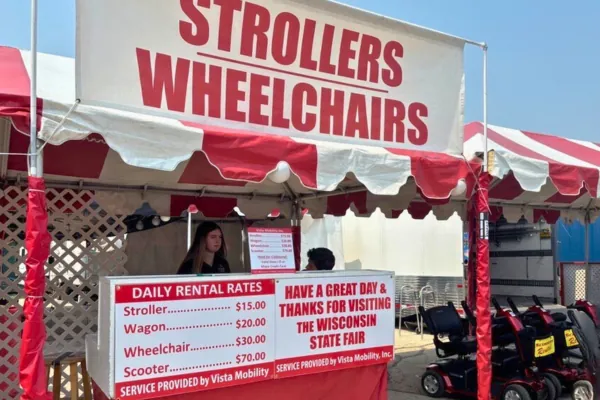
Minnesota is another case where the discount and access details should be read together. The fair lists $15 senior admission for ages 65 and older on specific discount days, and its accessibility guide includes mobility equipment rental information, accessible park-and-ride and transportation details, ASL interpreting information, companion seating, and sensory resources.[3][9] If the plan includes a Grandstand show or another seated event, companion seating matters. It is the difference between attending together and having the person using a wheelchair treated as if the chair is the whole social plan.
Iowa’s $12 Senior Day admission for ages 60 and older also belongs with the fair’s disability assistance page, not in a separate mental folder.[4] Iowa lists free ADA shuttle buses from accessible parking lots to gate entrances, along with mobility equipment rental information and other disability assistance details.[10] That shuttle detail is not a small courtesy for many older fairgoers. It can remove the most punishing part of the day: the long exposed walk from parking to the first place to sit.
California’s Friday senior pricing is useful because it gives more than one possible Friday during the fair’s July 17 through August 2, 2026 season, but the available documentation confirms the admission detail, not enough for a broader accessibility comparison. Treat that as a prompt to check the official California State Fair access and transportation pages directly before buying.
Ohio’s free designated Senior Day is a strong offer, especially for someone who wants a full fair experience without starting with the admission cost.[6] The planning still needs one more pass through accessibility and schedule details, particularly if sensory-friendly programming or reserved seating is part of the day. Ohio is among the documented fairs that offer reduced-stimulation hours or related sensory resources, and it publishes special-day information that should be checked against the current 2026 schedule before travel.[6]
What to Confirm Before You Leave Home
A fair outing does not need to feel like a medical appointment. Still, the comfortable version usually depends on a few calls or clicks made before the day starts. The goal is to avoid turning the first hour into a problem-solving session at the gate.
- Confirm the senior age rule and exact discount window. A policy for ages 60+, 62+, or 65+ is not interchangeable, and some discounts apply only on a particular weekday or during a set time.
- Reserve scooters or wheelchairs early where reservations are available. Available 2026 details note that HomeTown Mobility requires 24-hour advance booking for fairs it serves, and day-of availability can be limited.
- Price the equipment separately from admission. A $7 or free ticket may still sit beside a scooter rental in the $65–$80 per day range or a wheelchair rental in the $25–$35 per day range.
- Find the accessible parking and ADA shuttle pickup before driving. Minnesota, Iowa, New York, and Texas are documented as operating free dedicated ADA shuttles from accessible parking lots to gate entrances.[7][9][10][11]
- Check sensory-friendly mornings, quiet hours, or social narratives if crowds, noise, lighting, or cognitive load may affect the visit. Minnesota, New York, Texas, and Ohio are documented as offering reduced-stimulation hours, downloadable sensory guides, social narratives, or similar resources.[7][9][11][6]
- Confirm companion seating for concerts, grandstand shows, or reserved events. Available fair details note that multiple fairs allow one companion to sit with a person using a wheelchair at no additional charge.
If you already use a pre-visit accessibility checklist for hotels, restaurants, or day trips, the same habit works here: separate the pleasant part of the outing from the friction points that can derail it. CareWise Guide’s glamping accessibility checklist is a useful parallel because it asks the same kind of practical questions about distance, surfaces, bathrooms, and backup plans before a reservation is made.
The Phone Call That Saves the Most Trouble
Official fair websites often have the discount on one page, accessibility on another, and concert policies somewhere else. If the information is scattered, call or email with a short, specific script instead of asking a general “Is the fair accessible?”
- “My parent qualifies for the senior discount on this date. Which gate should we use if we need accessible parking and the ADA shuttle?”
- “Can we reserve a scooter or wheelchair in advance, and where is pickup compared with the entrance?”
- “If we attend a concert or show, how do wheelchair seating and companion seating work?”
- “Are there sensory-friendly hours, quiet areas, or a social narrative available for this year’s fair?”
- “What is the cancellation or refund rule if heat, illness, or weather changes our plan?”
For more general venue-screening habits, the same approach used to evaluate a restaurant for senior accessibility applies nicely to a fairground: ask about the route, the seating, the restroom, the waiting area, and the backup if something is unavailable.
Concerts, Grandstands, and the Social Part of Accessibility
Concerts are often the reason a senior wants to go to the fair in the first place. That means accessibility planning should not stop at the front gate. Minnesota’s accessibility guide includes companion seating information, and available fair details note that multiple fairs allow one companion to sit with a person using a wheelchair at no additional charge.[9] That detail is worth checking before buying reserved seats, because the outing changes if the older adult sits in one section and the daughter, spouse, friend, or grandchild sits somewhere else.
For accessible concerts, look for four things before purchase: whether wheelchair-accessible seating is available for the specific venue, whether a companion seat is included or must be reserved separately, how far the seating area is from the drop-off or shuttle point, and whether the route out after the show will be crowded or dark. None of that takes the fun out of the night. It keeps the concert from becoming a long exit strategy.
Sensory planning belongs in the same conversation. Minnesota, New York, Texas, and Ohio are documented as offering sensory-friendly mornings, reduced-stimulation hours, social narratives, or similar resources.[9][7][11][6] These are not only for children. They can help older adults with sensory sensitivities, cognitive conditions, autism-spectrum needs, or simple fatigue from lights, crowds, and overlapping sound.
A Simple Way to Choose the Best Fair Day
Put the admission deal and the access plan on one page. If they do not match, keep looking at dates. A workable fair day usually has most of these boxes checked:
- The senior qualifies by age for that fair’s 2026 discount.
- The discount applies on the date and time you plan to attend.
- Scooter or wheelchair rental is reserved or intentionally not needed.
- Accessible parking, ADA shuttle pickup, and the gate entrance are identified.
- Restrooms, rest areas, food stops, and shade breaks are placed along the route.
- Concert seating, companion seating, and exit plans are confirmed if attending a show.
- Sensory-friendly hours or social narratives are reviewed if noise, lights, or crowds may be difficult.
Caregivers who are trying to keep an older parent active without making every outing feel supervised may also find it useful to read more broadly about helping an aging parent stay mobile and independent. The fair is only one outing, but the planning principle is the same: preserve choice by removing the predictable obstacles early.
For 2026, the best fair day is not automatically the cheapest ticket day. It is the day when the senior discount, equipment reservation, parking shuttle, sensory or rest needs, and companion seating all line up. Every plan should still be verified on the official fair site before travel, because dates, prices, rental availability, and accessibility procedures can change.
References
- Special Fair Days, The Great New York State Fair
- Senior Day, Wisconsin State Fair
- Discounts, Minnesota State Fair
- Deals & Discounts, Iowa State Fair
- Senior Savings Fridays, California State Fair
- Special Days, Ohio State Fair
- Accessibility, The Great New York State Fair
- Accessibility, Wisconsin State Fair
- Accessibility, Minnesota State Fair
- Disability Assistance, Iowa State Fair
- Accessibility, State Fair of Texas
Questions to bring to a clinician or OT
This is not medical, legal, or a family's final decision — only a framework. Bring these questions to a clinician, occupational therapist, or your local Area Agency on Aging.
Find Local HelpRelated reading
Noticed something outdated or inaccurate on this page? Flag a correction. We review every report against CDC, NIA, and AARP HomeFit guidance before updating a page.