
Caregiver decision guide
How Long Does Back Surgery Recovery Take at 65+?
What back surgery recovery actually looks like after 65: a stage-by-stage timeline from discharge through the first year, how timelines differ for discectomy, laminectomy, and fusion, and how to tell a normal plateau from a sign that warrants a call to the surgeon.
At 65 and older, back surgery recovery is best planned as a months-long return to a workable life, not a quick countdown to “back to normal.” The first two weeks are about getting home safely, controlling pain well enough to move, and preventing avoidable setbacks. Weeks two through six are when small independence returns but help is still useful. The bigger gains usually show up over the first three to six months. In one cohort of 457 older adults with a mean age of 76.0 undergoing surgery for spinal stenosis, most improvement happened in the first three to six months, with little or no additional improvement measured at 12 months.[1]
Fusion needs its own lane in the timeline. The incision can feel much better before the spine is finished healing. After lumbar fusion, light housework is often expected around four to six weeks, but the back may take six months to a year to fully improve.[2] The bone graft itself does not become mature bone at surgery; solid bone formation is commonly described over about three to six months, with maturation continuing for 12 to 18 months.[3]
Use the ranges below for planning rides, meals, stairs, pet care, laundry, and backup supervision. Use your surgeon’s discharge instructions as the rulebook. If the two disagree, the discharge papers win.

A practical recovery map for the first year
| Time window | What life may look like | Procedure notes |
|---|---|---|
| Weeks 0–2 | Short walks, bathroom trips, medication timing, incision care, and safe transfers are the main work. Someone else may still need to handle meals, errands, driving, pets, laundry, and stairs. | Older adults often have a longer recovery timeframe and may be more likely to need a rehabilitation facility stay before going home.[4] |
| Weeks 2–6 | Movement usually expands, but the home still needs to be arranged around fatigue, bending restrictions, lifting limits, and transportation help. | Discectomy patients often resume limited activities in about 2–3 weeks. Many people recover from minimally invasive laminectomy in 4–6 weeks. After lumbar fusion, light housework is commonly expected around 4–6 weeks.[4][5][2] |
| Weeks 6–12 | Walking distance, sitting tolerance, and basic household function often become more reliable. This is also when some people hit their first frustrating plateau. | Discectomy patients may regain a fuller activity range by up to 6–8 weeks. Fusion patients may need 6–8 weeks for daily-activity function. Physical therapy after laminectomy may begin around 3–6 weeks, depending on the surgeon’s plan.[4][5] |
| Months 3–6 | This is a major improvement window for many older adults, especially in stamina and confidence with ordinary routines. | In the older-adult spinal stenosis cohort, most measurable improvement occurred within the first 3–6 months.[1] For fusion, this is also the period when the graft is commonly described as forming solid bone.[3] |
| Months 6–12+ | The story may be quieter: less dramatic week-to-week change, more gradual conditioning, and continued limits for heavier tasks if the surgeon says so. | Fusion recovery can continue long after the incision feels healed; the back may take 6 months to a year to fully improve, and bone maturation may continue for 12–18 months.[2][3] |
Weeks 0–2: the job is safe movement, not independence
The first two weeks after back surgery are not a test of toughness. They are a test of whether the house, the caregiver schedule, and the medication plan are organized enough for the person to move safely without improvising.
A reasonable early goal is simple: get in and out of bed, reach the bathroom, take short walks as instructed, eat enough to support healing, and avoid the movements the surgeon restricted. For an older adult, this may still be a full day’s work. Soreness, slow starts, and needing more rest than expected do not automatically mean the operation failed. They often mean the early stage is doing what early stages do.
This is also the window when adult children and spouses tend to underestimate the household load. “Home” still includes meals, dishes, trash, shower setup, clean clothes, prescriptions, follow-up rides, and a clear walking path. If the patient normally cares for someone else, drives a partner, feeds animals, or manages stairs several times a day, those jobs need a temporary owner before discharge day.
A fall-first setup matters here. Clear the route from bed to bathroom, move loose cords and rugs, place frequently used items between waist and shoulder height, and make sure nighttime lighting is boringly reliable. Families who have already used a post-hospital checklist may recognize the same logic used in a stroke recovery checklist for elderly parents: the first win is not doing more; it is making the necessary movements safer.
- Plan a clear walking loop inside the home before the patient arrives.
- Put a firm chair with arms in the room where the patient will spend the day.
- Move toiletries, clothing, phone chargers, and water within easy reach.
- Schedule medication reminders so pain does not have to become severe before anyone notices.
- Decide who handles driving, groceries, laundry, trash, and pets for at least the first stretch.
If discharge is to a rehabilitation facility instead of directly home, that is not a failure. Older adults may be more likely to need that intermediate step, especially when walking, stairs, or self-care are not yet safe enough for the home setup.[4]
Weeks 2–6: small independence returns, but the house still needs support
Weeks two through six are where many families get fooled. The patient may look better than they feel. They may be walking more, taking fewer naps, and wanting to “just do a few things.” That is exactly when laundry baskets, low cabinets, wet bathroom floors, grocery bags, and long car rides become recovery problems.
The procedure matters. After a discectomy, some people resume limited activities in about two to three weeks, with a fuller range taking up to six to eight weeks.[4] After a laminectomy, many people recover in four to six weeks when the operation is minimally invasive, though the actual timeline depends on the surgical approach and whether fusion was also done.[5] After lumbar fusion, light housework may be realistic around four to six weeks, but that does not mean the spine is fully healed.[2]
For an older adult, “limited activity” should be taken literally. A person may be able to make a sandwich but not stand long enough to cook dinner. They may be able to walk down the hall but not manage a crowded clinic parking lot. They may tolerate one set of stairs but not several trips because a forgotten item is upstairs.
What progress can look like in this stage
- Walking a little farther or more often without needing a long recovery afterward.
- Getting up from a chair with less help.
- Using pain medication more predictably rather than chasing severe pain.
- Sitting for meals or short visits without being wiped out for the rest of the day.
- Needing reminders about restrictions less often, while still following them.
This is not the time to measure success by whether the person can run the household alone. A better measure is whether each day contains safer movement, less scrambling, and fewer situations where the patient has to choose between breaking restrictions and getting a basic task done.
Weeks 6–12: the first plateau often appears
By six to twelve weeks, many people expect recovery to become obvious every week. Sometimes it does. Walking may feel steadier, transfers may be easier, and basic outings may take less planning. But this is also when progress can become uneven: a good morning followed by a poor afternoon, a longer walk followed by more soreness, or a week that feels the same as the week before.
That kind of plateau is especially frustrating because the emergency feeling has passed. The incision may look calm. Visitors may assume the person is nearly recovered. The patient may be tired of needing help. Still, the body may be moving from “recovering from surgery” into “rebuilding capacity,” and that change is slower than most people want.
Procedure differences show up clearly here. A discectomy patient may be moving toward a fuller activity range by six to eight weeks.[4] A laminectomy patient may be building tolerance and may begin physical therapy around three to six weeks if that is the surgeon’s plan.[5] A fusion patient may be functioning better in daily activities around six to eight weeks, but the underlying bone-healing process is still early.[4][3]
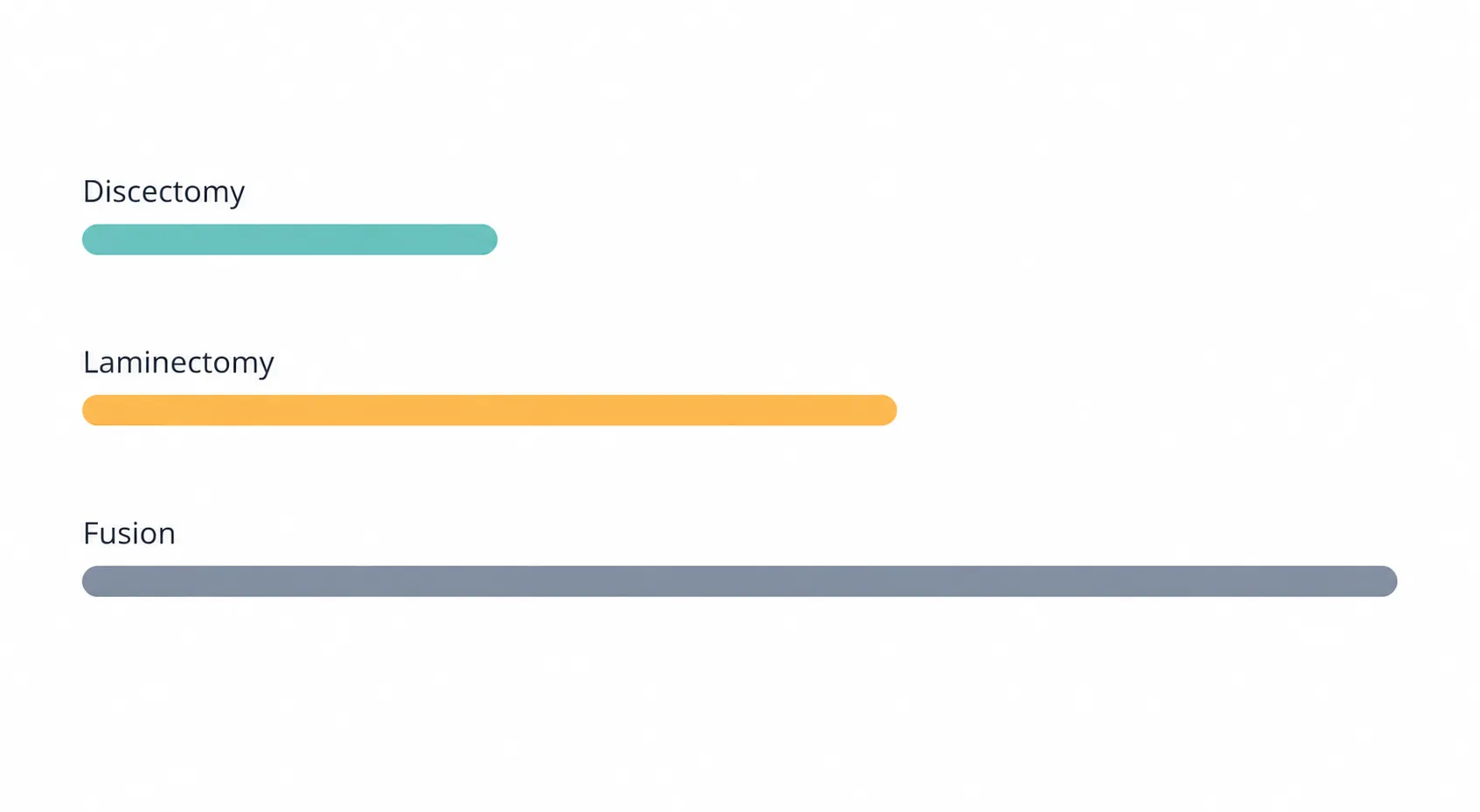
The three common procedure runways
| Procedure | Typical recovery shape | Planning consequence |
|---|---|---|
| Discectomy | Often the shortest runway among the three. Limited activity may return in 2–3 weeks, with a fuller range up to 6–8 weeks.[4] | Plan for early help, but do not automatically assume months of heavy hands-on care unless the surgeon or the person’s function says otherwise. |
| Laminectomy | Often a middle runway when done without fusion. Minimally invasive recovery is often described around 4–6 weeks, and physical therapy may start 3–6 weeks after surgery.[5] | Expect the person to need help while walking tolerance and stamina rebuild, especially if stairs or transportation are hard. |
| Fusion | The longest runway. Daily-activity function may improve by 6–8 weeks, but pain-free activities may take up to 6 months, and bone healing continues beyond that.[4][3] | Do not let a better-looking incision or a better mood erase lifting, bending, driving, or activity restrictions from the discharge plan. |
A plateau in this window is more concerning when it comes with a loss of function rather than a lack of excitement. If the person was walking to the kitchen last week and now cannot manage the same distance, that is different from being annoyed that the distance has not doubled. If symptoms feel new, worsening, or outside the discharge instructions, call the surgical team rather than trying to interpret it at home.
Months 3–6: the main improvement window for many older adults
The three-to-six-month period is where many older adults and families finally see whether daily life is becoming workable again. The questions become less about getting through the day and more about range: How far can the person walk? Can they sit through an appointment? Can they manage a simple meal? Are they safe with stairs? Can the caregiver step back without the house becoming risky?
The senior spinal stenosis cohort is useful here because it gives a realistic anchor: most improvement occurred within the first three to six months, and little or no further improvement was measured at 12 months.[1] That does not mean every older adult stops changing at six months. It does mean the largest measurable gains may already have happened by then, especially for stenosis surgery, and the later work may be more about conditioning, confidence, and adapting routines.
This is also the period when expectations can split inside the same household. The patient may feel proud because they can do more than they could at discharge. The caregiver may still feel trapped because driving, heavier chores, or long errands are not back to normal. Both can be true. Recovery is not only the patient’s pain score; it is also whether the home can run without unsafe shortcuts.
Fusion at 3–6 months: better does not mean fully healed
Fusion deserves extra clarity at this stage. A person may be walking better, sleeping better, and needing less help while the bone graft is still doing its slow work. Solid bone formation is commonly described over about three to six months, and the maturation process can continue for 12 to 18 months.[3]
That is why “I feel better” should not automatically become “I can lift more,” “I can twist,” or “I can skip the brace if one was prescribed.” The surgeon’s restrictions are not based only on how the incision feels. They are meant to protect the repair while the deeper healing continues.
Months 6–12 and beyond: the quieter long tail
After six months, recovery often becomes less dramatic from week to week. That can feel disappointing if everyone expected a clean finish line. For many people, the work shifts toward stamina, confidence outside the home, and learning which activities are safe, useful, or still not worth the risk.
Fusion remains the main reason not to declare the story over too soon. Lumbar fusion aftercare guidance describes the back as potentially taking six months to a year to fully improve.[2] Spine-health describes bone maturation as continuing for 12 to 18 months.[3] Those are not minor details for planning. They affect when heavier chores, travel, yardwork, and more demanding exercise should be discussed with the surgeon instead of resumed by guesswork.
For discectomy or laminectomy without fusion, the later months may be less about surgical healing and more about whether leg symptoms, strength, walking confidence, and general conditioning are improving enough for the person’s actual life. A person who lives alone up a flight of stairs has a different recovery demand than a person with a one-level home and daily help.
How age changes the timeline
Age usually stretches the early stages more than it changes the whole recovery shape. The first walks may be shorter. Fatigue may last longer. A rehab facility stay may be more likely. Medication side effects, balance concerns, and other health conditions can make the homecoming more complicated.[4]
But age by itself should not be treated as the entire explanation for a slower start. Pre-surgery fitness, osteoporosis, diabetes, nicotine use, and prolonged opioid use can all affect the recovery runway. The American Academy of Orthopaedic Surgeons advises that quitting smoking or smokeless tobacco several months before surgery reduces the risk of wound infection and delays in bone healing.[6]
That distinction matters. If a 72-year-old is slow in week one, it may simply be week one. If a 72-year-old has diabetes, poor balance, low pre-surgery strength, and a cluttered home with stairs, the plan needs more support. The calendar alone does not tell the whole story; function does.

Ordinary plateau or reason to call?
A plateau is ordinary when the person is still within the expected stage, following restrictions, and holding roughly the same function while stamina rebuilds. It may look like walking the same distance for several days, needing an afternoon rest after a morning outing, or feeling discouraged because daily life is improving more slowly than mood and motivation.
A plateau deserves a call when it no longer behaves like a plateau. If function is going backward, symptoms feel new or clearly worse, pain control is not working as described in the discharge plan, the wound or general condition raises concern, or the patient cannot safely perform the minimum movements expected at that stage, the surgical team should be contacted. The exact thresholds belong in the discharge papers, because different procedures and surgeons have different rules.
| What you are seeing | How to think about it |
|---|---|
| The patient is tired after doing more, but returns to their recent baseline with rest. | Often a normal capacity issue. Adjust the day’s pacing and keep following restrictions. |
| Walking distance has not improved for a week, but it has not worsened either. | Often a plateau, especially in the 6–12 week or later conditioning phase. |
| The patient is doing chores because no one else is available, not because the surgeon cleared them. | A planning problem, not a recovery milestone. Reassign the task. |
| The patient has new, worsening, or unexpected symptoms compared with the discharge instructions. | Call the surgeon’s office or follow the urgent-care instructions in the discharge packet. |
| Fusion feels better, so the patient wants to resume heavier tasks before clearance. | Do not use comfort as proof of fusion maturity. Ask before increasing load. |
The back surgery recovery timeline for older adults is predictable enough to plan around, but not precise enough to run by wishful dates. In the first weeks, protect safe movement and household basics. By six to twelve weeks, watch function instead of demanding constant weekly progress. By three to six months, expect the clearest gains for many older adults. If fusion was part of the operation, keep respecting the longer bone-healing runway even after the person looks and feels more capable.
References
- Outcome of surgery for lumbar spinal stenosis in older adults, Swiss Medical Weekly, 2020
- Lumbar Spinal Fusion: What to Expect at Home, Kaiser Permanente
- Postoperative Care for Spinal Fusion Surgery, Spine-health
- Recovery Time for Back Surgery, Healthline
- Laminectomy, Cleveland Clinic
- Preparing for Low Back Surgery, AAOS OrthoInfo
Questions to bring to a clinician or OT
This is not medical, legal, or a family's final decision — only a framework. Bring these questions to a clinician, occupational therapist, or your local Area Agency on Aging.
Find Local HelpRelated reading
Noticed something outdated or inaccurate on this page? Flag a correction. We review every report against CDC, NIA, and AARP HomeFit guidance before updating a page.