
Caregiver decision guide
How to Write a Birthday Tribute for a Special Needs Sibling
Writing a birthday tribute for a sibling with special needs can feel complicated when caregiving has shifted your relationship. This guide offers a framework for crafting a message that honors your sibling bond honestly and celebrates who they are, without ignoring the reality of your caregiving role.
The hardest part of writing a birthday tribute for a special needs sibling is often not finding kind words. It is deciding how much truth belongs in the room. You want the message to sound like love, not a care report. You also may not want to pretend that nothing has changed since you became the person scheduling appointments, talking through housing options, arranging transportation, or quietly wondering what will happen when your parents can no longer manage the next piece.
That tension is real enough that it deserves to be handled directly. AARP has described sibling caregiving as more common with age: siblings account for 4% of caregivers ages 18 to 49, rising to 13% among caregivers age 75 and older.[1] For many families, that shift begins in midlife, right when aging parents, daily independence, future planning, mobility, transportation, and supported decision-making start to overlap. That is why this belongs in a mobility-and-independence conversation, even though the visible task today may be only a birthday post, card, toast, or caption.
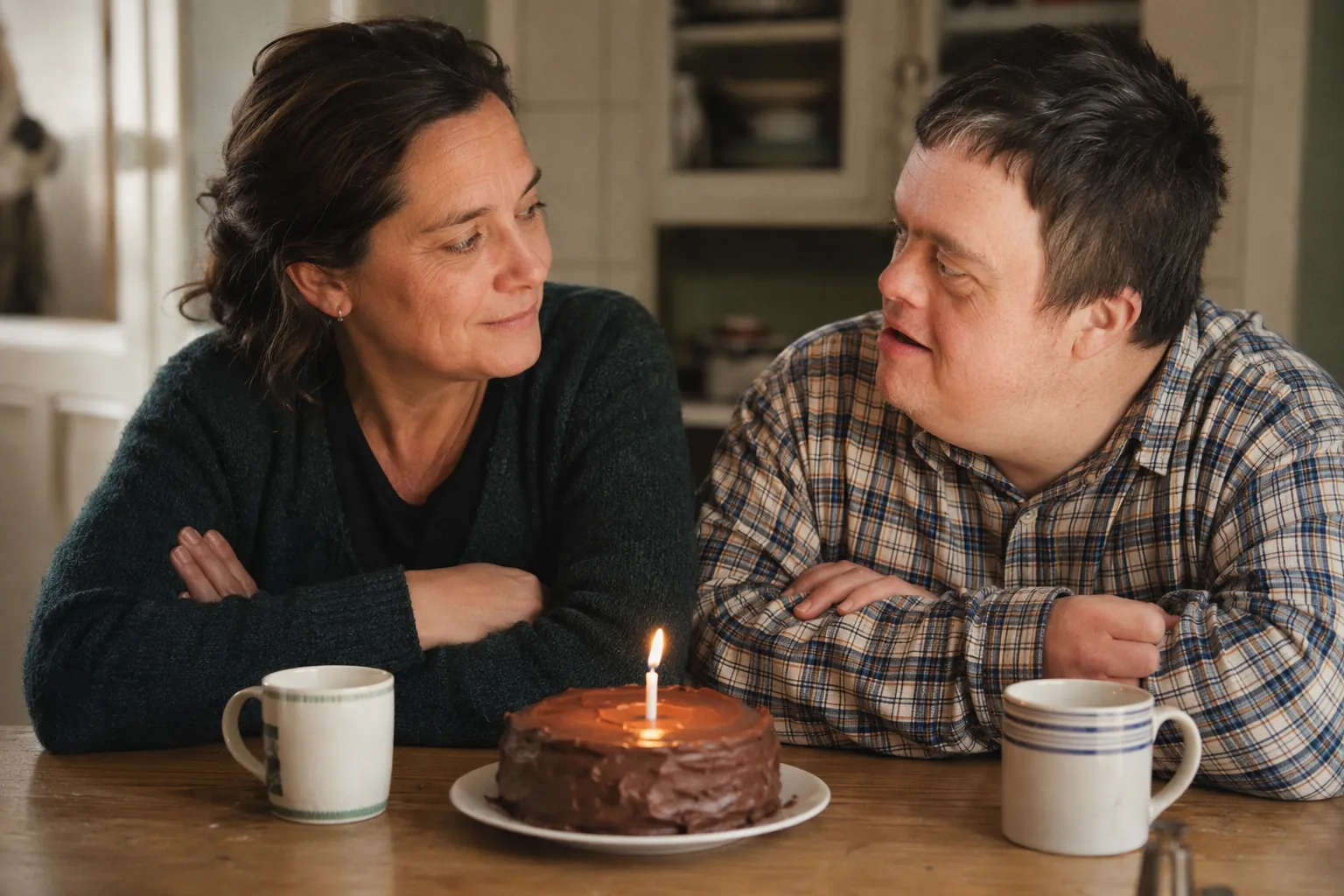
The tribute does not need to solve the whole family story. It only needs to tell the truth in proportion. Your sibling should remain the center of the birthday. The hard parts should not hijack the celebration. And the message should not become a disguised update on care needs, services, behavior, or family stress.
A Useful Model: Warmth Before Explanation
One of the more helpful direct examples is an OC Register birthday tribute written by an adult sibling to a brother with special needs. What makes it work is not that it is polished or universally applicable. It is that it speaks directly to the sibling being celebrated and uses specific warmth rather than turning him into a lesson for everyone else.[2]
That matters. A birthday tribute can easily slide into two flat versions of a person: the inspirational angel who teaches everyone patience, or the care recipient whose needs define the whole relationship. Both versions may come from love. Both can still miss the person.
A better tribute sounds as if it could only be written for your sibling. It remembers their humor, their habits, their favorite routines, their stubbornness, their taste in music, their way of greeting people, the private family phrase they use, the thing they notice before anyone else does. It lets the birthday belong to them.
The Three-Part Shape That Usually Works
If you are staring at a blank card, do not start with adjectives. Start with three parts:
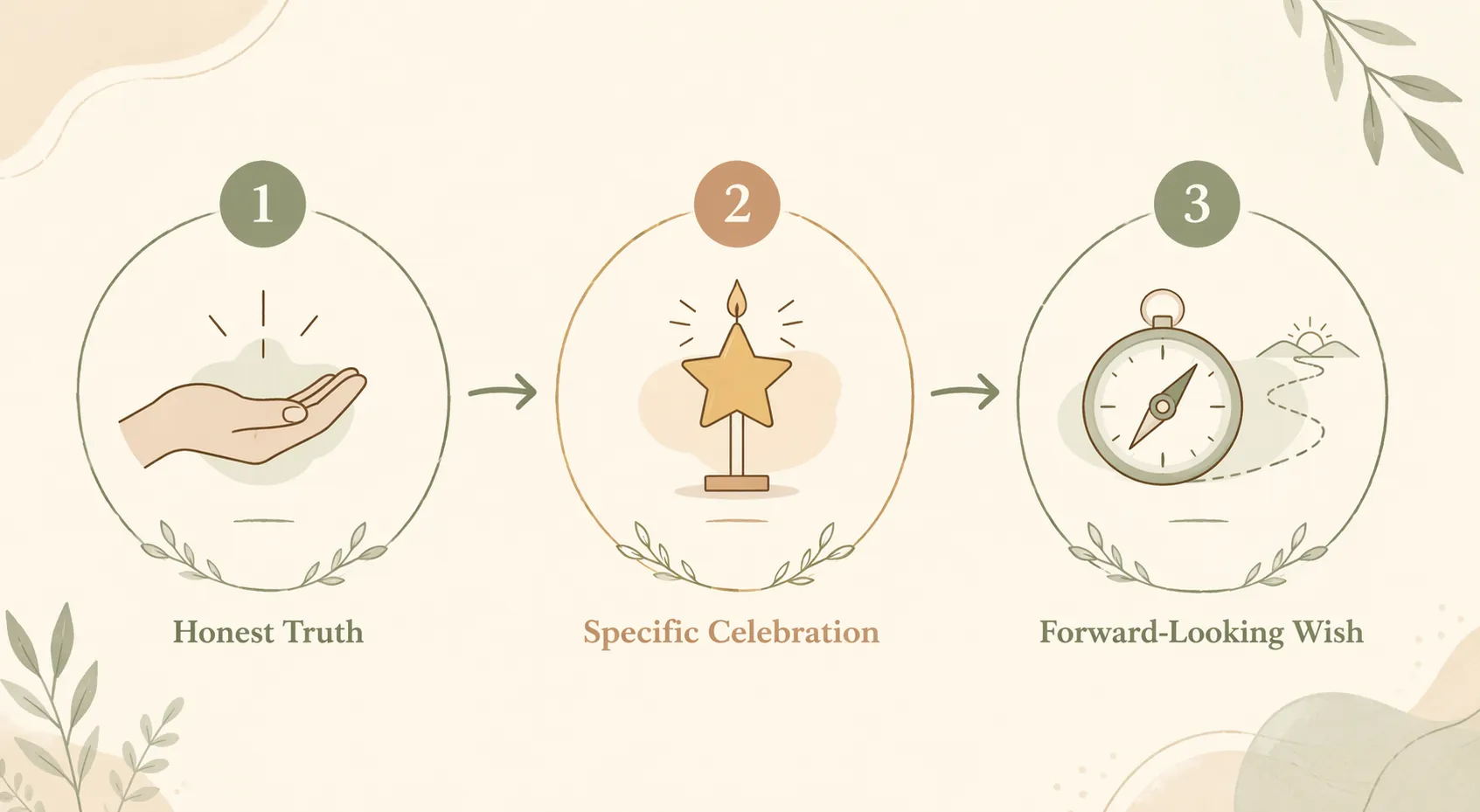
- Name one honest truth.
- Pivot to one or more specific celebrations of your sibling as a person.
- Close with a forward-looking wish that respects their agency.
That shape is useful because it gives the difficult truth a place without letting it take over. It also keeps the writer from hiding behind a long list of sweet words that never quite reaches the actual relationship.
| Part of the tribute | What it does | What to avoid |
|---|---|---|
| Honest truth | Acknowledges one real complexity, change, or emotion | Turning the birthday into a complaint, confession, or family care update |
| Specific celebration | Shows who your sibling is through details, preferences, humor, and shared history | Using only generic praise such as brave, inspiring, special, or strong |
| Forward-looking wish | Looks ahead with respect for your sibling’s choices, supports, and future | Making promises you cannot keep or speaking as if you control their whole life |
Name One Honest Truth Without Making the Birthday About Burden
This is the part many adult siblings either overdo or avoid entirely. Avoidance can sound tidy, but sometimes it feels false. Overexplaining can be worse, because the tribute starts asking the birthday person to absorb the writer’s exhaustion.
The Sibling Support Project gives language to the feeling many siblings edit out: some siblings “resent that I cannot just be her sister.”[3] That sentence is not a birthday message by itself. It is too raw to drop into a card without care. But it names the background reality: caregiving can change the sibling relationship, and pretending otherwise can make the tribute feel strangely hollow.
The trick is to name only the truth that serves the tribute. Not every true thing belongs on a birthday. A good sentence might admit that the relationship has changed, that the year has asked a lot of both of you, or that you are still learning how to be present in this new role. Then it should move back toward your sibling.
Honest lines that keep the focus in the right place
- “This year changed some of the ways I show up for you, but it has not changed how glad I am that you are my brother.”
- “We have had some hard appointments and hard conversations, and still, today, I want to celebrate the person you have always been to me.”
- “Sometimes I miss when being your sister felt simpler. I never miss being your sister.”
- “I am still learning how to support you without forgetting that first, you are my sibling.”
Those lines work because they do not ask your sibling to comfort you. They do not list everything you do. They do not imply that your sibling’s disability is the problem to be endured. They acknowledge complexity, then give the day back.
There is room, too, for apology, if apology is part of the truth. A CdLS Foundation open letter to a special needs sibling includes the kind of hard acknowledgment that can deepen a message rather than darken it, including an apology for times the sibling may have felt neglected.[4] That source is written from a family perspective rather than as an adult sibling birthday tribute, so it should be borrowed carefully. Still, it shows something important: a message does not become more respectful by pretending the hard parts never happened.
What not to put in the honest-truth sentence
- A full inventory of your caregiving tasks.
- Details about medical, behavioral, financial, or service issues your sibling has not agreed to share publicly.
- A sentence that makes you the main character of the birthday.
- Praise that depends on your sibling being easy, cheerful, grateful, or inspirational.
- A public confession that may feel cleansing to you but exposing to them.
For a public post, the honest truth usually needs to be lighter and more protective than it would be in a private card. “This year has asked a lot of us” may be enough. In a private message, you may have more room to say, “I know I have not always handled the new responsibilities with the patience you deserve.” Audience changes the level of detail.
Then Celebrate the Actual Person, Not the Role They Play in the Family
This is where many birthday tributes become too vague. “You are amazing.” “You inspire us.” “You are so loved.” None of those is wrong. They are just thin if they are the whole tribute.
Specific celebration is not decoration. It is dignity. It says: I see what makes you you. Not your diagnosis, not your service plan, not the way the family organizes itself around you, but your personality and presence.
Details worth using
- A favorite phrase, joke, song, movie, team, meal, route, shirt, or birthday ritual.
- A shared memory that belongs to the two of you, not to the whole caregiving system.
- A preference your sibling clearly expresses, whether through words, gestures, routines, devices, expressions, or choices.
- A trait that is not automatically saintly: funny, particular, dramatic, loyal, competitive, curious, stylish, mischievous, observant.
- A way your sibling affects ordinary life: who they look for first at a party, how they react when a favorite song starts, how they make their opinion known.
The best details are often small. A sibling who insists on the same diner every birthday. A brother who laughs before the punchline because he knows what is coming. A sister who notices when someone is sad and moves closer. A sibling who refuses the blue cup because everyone knows the red one is the correct cup. These are hypothetical examples, but that is the scale to aim for: ordinary, recognizable, and personal.
Try replacing broad praise with evidence:
| Instead of | Try |
|---|---|
| “You inspire everyone.” | “You still dance first when the music starts, and somehow the rest of us follow.” |
| “You are so brave.” | “You walked into another unfamiliar office this year, gave the nurse your look, and still managed to make us laugh before we left.” |
| “You are a blessing.” | “Our family table sounds different when you are not there to announce exactly what everyone should be eating.” |
| “You have taught me patience.” | “You have taught me that your timing is not always mine, and that rushing you usually means I am the one who needs to slow down.” |
Notice the difference. The second version does not use your sibling as a moral tool. It shows them doing, choosing, reacting, preferring. It lets them be funny or difficult or tender without making any one quality stand for the whole person.
If your sibling is more independent
Not every special-needs sibling birthday tribute needs a caregiving overlay. Some adult siblings live independently, make most of their own decisions, work, travel, date, manage routines, or simply do not experience you as a caregiver. In that case, do not force heaviness into the message. The same framework still works, but the honest truth may be as simple as, “I do not say it often enough, but I am proud to be your sister,” followed by details that celebrate your actual bond.
Borrow Parent-Written Models Carefully
Many available examples about birthdays and special needs are written by parents, not adult siblings. They can still be useful if you adapt the shape rather than copying the role.
A Rett Syndrome News column, for example, is framed as a birthday wish for the sibling of a child with special needs.[5] Love That Max offers a parent’s wish framework for a child with special needs.[6] Those pieces can help you think in terms of wishes, hopes, protection, and recognition. But an adult sibling tribute should not sound like a parent blessing a child, unless that is truly the role you now occupy and the birthday person would experience it as loving rather than diminishing.
A sibling-to-sibling message usually needs more equality in the language. You can care for someone without writing as if you own their future. You can name your hopes without making their birthday a performance of your devotion.
A Short Template You Can Adapt
Use this as a starting point, not a script:
“Happy birthday, [Name]. This year has changed some of the ways I show up for you, and I am still learning how to do that with the patience and respect you deserve. But before anything else, you are my [brother/sister/sibling], and I am so glad I get to know you the way I do. I love [specific detail: your laugh when ___, the way you ___, how you always choose ___, how you remember ___]. I hope this next year brings more [specific wish tied to their preferences, independence, comfort, relationships, choices, or joy]. I love you, and today is yours.”
For a shorter public post, that could become:
“Happy birthday to my brother, who still knows how to make a whole room turn toward the music. This year has asked a lot of us, but today I just want to celebrate you: your laugh, your strong opinions, your excellent taste in cake, and the way you make sure everyone knows when it is time to sing. I love you. I hope this year brings more of the people, places, and routines that make you feel most yourself.”
For a private card, you might write with more tenderness:
“Happy birthday, my sweet sister. I know I have had to handle more things lately, and I know I do not always get it right. I am sorry for the times my stress has made me rush you. You deserve better than that. What I want you to know today is that I still see you first as my sister: the person who laughs at the same scene every time, who reaches for my hand in the parking lot, who knows exactly which song should play in the car. I hope this year gives you more choices, more calm mornings, more music, and more days that feel like yours.”
Make the Forward-Looking Wish About Agency, Not Control
The closing wish is where birthday sentiment can quietly become future planning. It does not need to name every document, service, or decision. But if you are an adult sibling now thinking about long-term support, the wish can honor that reality without turning formal.
The Sibling Leadership Network’s future-planning resources point families toward planning that includes the person with a disability, not just planning around them.[7] The Sibling Support Project also emphasizes supported decision-making as a model siblings and families should understand.[3] Those ideas matter in a birthday tribute because the language of “I hope” can either respect your sibling’s agency or quietly erase it.
A controlling wish sounds like, “I promise I will always make sure you are safe and happy.” It is loving, but it may promise more than one person can guarantee. It may also make happiness sound like something delivered to your sibling rather than something built with them.
A more respectful wish might say:
- “I hope this year brings you more choices that feel like yours.”
- “I hope we keep finding ways for your voice to lead the plans we make.”
- “I hope your days include more of the places, people, and routines that help you feel at home.”
- “I hope I listen better, slow down sooner, and remember that support should not crowd out who you are.”
- “I hope the next year gives you more music, more good coffee, more Saturday drives, and more chances to decide what comes next.”
For some families, the future-facing line carries extra weight because care is already spread across generations. MassMutual has described the “club sandwich” situation of adults managing responsibilities for children, aging parents, and a sibling with special care needs at the same time.[8] A birthday tribute is not the place to unpack all of that. But it is a place to choose language that does not make your sibling sound like one more obligation in a crowded life.
Before You Send It, Read It for Proportion
After you draft the tribute, read it once as the writer and once as your sibling’s protector. If your sibling reads, understands, or participates in social media, consider how the words may feel to them directly. If they communicate in other ways, still treat privacy and dignity as real. A person does not have to process every word the way you do to deserve careful language.
Ask three quiet questions:
- Is my sibling still the center of this message?
- Did I tell the hard truth in proportion, without making the birthday about my burden?
- Did I celebrate details my sibling would recognize as theirs?
- Did I avoid sharing private care information that belongs in a family conversation, not a tribute?
- Does the closing wish leave room for my sibling’s preferences, choices, and future?
If the tribute passes those tests, it does not need to be perfect. It does not need to make caregiving look noble. It does not need to make the relationship uncomplicated. It needs to be loving, specific, and fair. Name the truth once. Celebrate the person fully. Then return the birthday to the sibling whose day it is.
References
- 5 Tips to Prepare for Caregiving for a Sibling, AARP
- Happy birthday to the best special needs sibling in the world, OC Register
- What Siblings Would Like Parents and Service Providers to Know, Sibling Support Project
- An Open Letter to the Special Needs Sibling, CdLS World
- A birthday wish for the sibling of a child with special needs, Rett Syndrome News
- 20 wishes for my child with special needs, Love That Max
- Future Planning - Sibling Leadership Network, Sibling Leadership Network
- 'Club' sandwich generation siblings and special care, MassMutual
Questions to bring to a clinician or OT
This is not medical, legal, or a family's final decision — only a framework. Bring these questions to a clinician, occupational therapist, or your local Area Agency on Aging.
Find Local HelpRelated reading
Noticed something outdated or inaccurate on this page? Flag a correction. We review every report against CDC, NIA, and AARP HomeFit guidance before updating a page.