
Caregiver decision guide
How to Care for a Sibling With Lennox-Gastaut Syndrome
This guide offers siblings practical, condition-specific training for caring for a brother or sister with Lennox-Gastaut syndrome. Learn seizure first aid, drop-seizure safety, bathing assistance, and wheelchair transfers to help safely and reduce family stress.
Your brother or sister drops without warning. One second they are standing near the couch; the next, their body has gone down hard and fast. For a sibling, that moment can freeze everything: should you move them, hold them, call for help, check the helmet, clear the floor, wait?
Caring for a sibling with Lennox-Gastaut syndrome starts there, not with a perfect definition. LGS can involve seizure types that create sudden falls, including atonic “drop” seizures. That is different from the slow, predictable fall risk people often mean when they talk about older adults losing balance. Here, the danger can arrive in the middle of a normal routine, and the safest sibling is not the bravest one. It is the sibling who has already been trained on what to do.

You can be useful without improvising. That means knowing the seizure plan before a seizure happens, following the bathing and toileting routine the way your sibling already knows it, recognizing communication cues, and respecting mobility limits. It also means knowing which tasks are not yours to do alone.
One practical place to start is the LGS Foundation’s C.A.R.E. Binder. The binder includes fillable templates for daily routines such as bathing, dressing, feeding, communication, and mobility, which turns family knowledge into instructions someone else can actually follow when the house is loud or everyone is tired.[1]
Before You Help, Know What Is Yours to Do
Helping is not the same as becoming responsible for everything. A sibling can learn care tasks, but parents, guardians, clinicians, nurses, and therapists should decide what is safe for that sibling’s age, strength, training, and relationship with the person who has LGS.
The family should write down the difference between “you may help with this” and “you should never do this alone.” That line matters most during seizures, bathing, toileting, medication routines, wheelchair movement, and transfers.
- Know the seizure action plan: what each seizure type usually looks like, when to time it, when to call a parent, and when emergency help is needed.
- Know the safe room setup: where helmets, pads, rescue instructions, emergency contacts, and the care binder are kept.
- Know the daily routine: bathing order, dressing preferences, toileting supports, feeding instructions, and signs of discomfort.
- Know the mobility rules: when your sibling may walk, when they use a wheelchair, when brakes must be locked, and which transfers require an adult.
- Know your own limit: if you are scared, injured, too small, emotionally overwhelmed, or unsure, your job is to call the trained adult, not prove you can handle it.
Many people with LGS need long-term help with daily living tasks such as mobility, toileting, feeding, and personal care.[1] That does not mean every sibling should perform every task. It means the family should stop relying on memory and start building repeatable routines.
Use the C.A.R.E. Binder Like a Safety Tool, Not a Scrapbook
A good care binder answers the questions people forget to ask until the moment is already going badly. Where is the helmet? Which bathroom is safest? Does your sibling panic if water touches their face first? Which words, gestures, or sounds mean pain? Can they bear weight today? Who should be called if a transfer fails?
The C.A.R.E. Binder is useful because it gives the family a place to put those answers in one format. For siblings, the most important pages are usually seizure response, communication, bathing, toileting, feeding, mobility, medication notes, and emergency contacts.[1]
| Binder Page | What a Sibling Needs From It |
|---|---|
| Seizure plan | What the seizure may look like, what to do first, when to get help, and what not to do |
| Bathing and dressing | Setup order, privacy expectations, equipment used, slippery-floor precautions, and when an adult takes over |
| Communication | Words, gestures, sounds, devices, facial expressions, or behaviors that signal a need |
| Mobility | Wheelchair rules, helmet use, walking limits, transfer instructions, and no-lift boundaries |
| Emergency contacts | Who to call first, who can make medical decisions, and where rescue instructions are kept |
Do not wait for an emergency to read it. A parent or trained caregiver should walk through the binder with you when everyone is calm, then watch you practice the parts you are allowed to do.
During a Seizure, Protect Before You Perform
When a seizure starts, the first task is not to fix it. It is to keep your sibling as safe as possible while following the plan your family and clinicians gave you. If you have not been trained on seizure first aid, your role is to call the trained adult immediately and stay nearby only if it is safe.
For a sibling who has been trained, the basic sequence should be simple enough to remember under stress:
- Stay calm enough to look at the clock or start a timer if your plan says to time seizures.
- Move nearby hazards away if you can do it without putting yourself in danger.
- Protect the head from hard surfaces, especially after a fall.
- Do not put anything in your sibling’s mouth.
- Do not hold them down or try to stop the movements.
- Call the adult or emergency help according to the written seizure action plan.
- Stay with them during recovery if you have been told it is safe, and speak calmly as they come back to themselves.
The plan should say who gives rescue medication, if any is prescribed. If that is not assigned to you by an adult and taught by a qualified clinician, do not guess.
Drop Seizures Need Their Own Plan
Atonic drop seizures are the part that makes generic fall-prevention advice feel thin. Your sibling may not trip, sway, or reach for support. They may simply lose muscle tone and fall. The home still needs clear pathways, soft landing zones where possible, and fewer sharp edges, but the reason is seizure-driven, not a gradual balance problem.
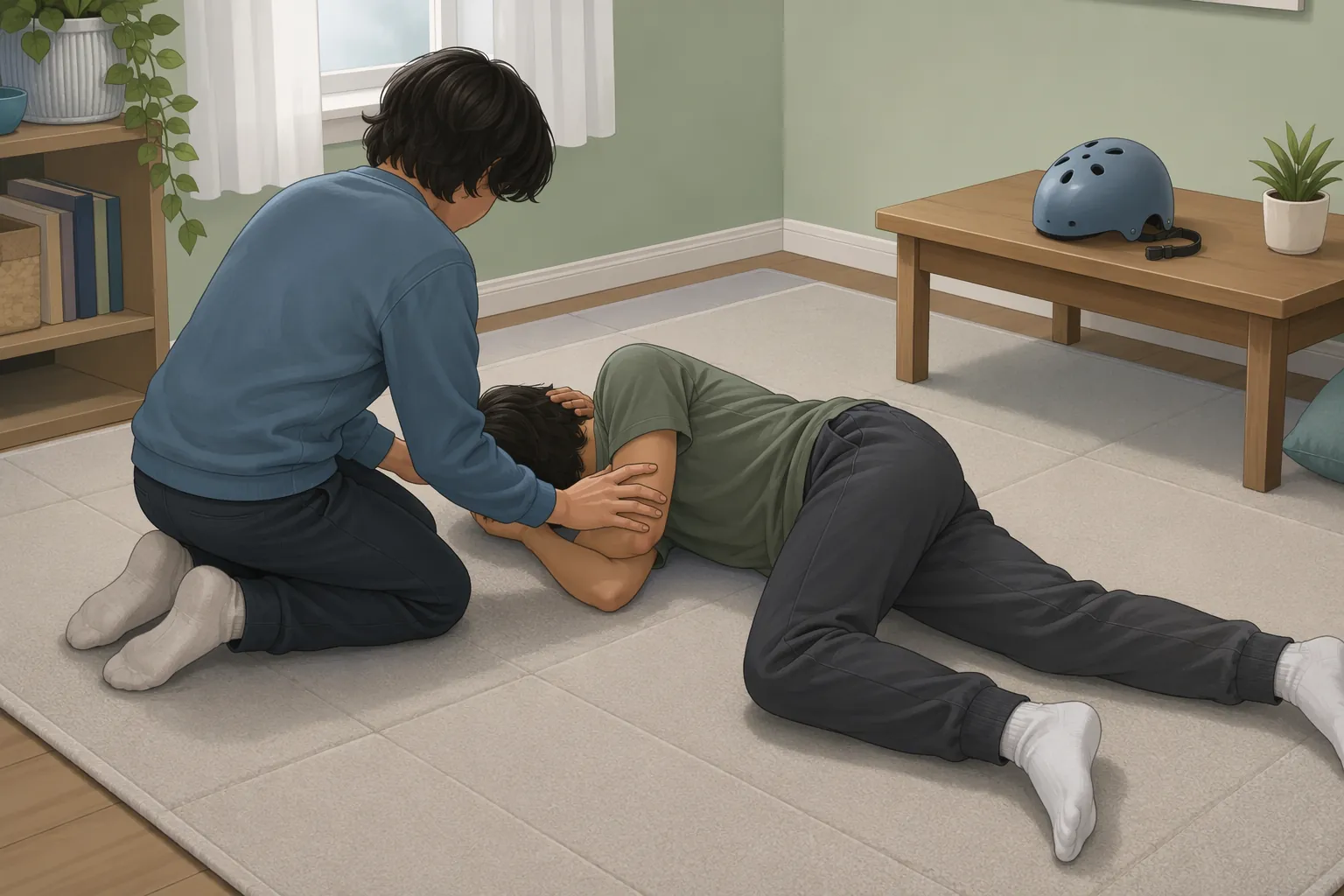
This is where mobility independence work has to be condition-specific. Helmets, padding, room layout, supervision level, wheelchair use, and recovery positioning are not signs that your sibling is being treated like a project. They are ways to reduce injury while preserving as much ordinary life as possible.
- If they are falling, do not try to catch their full weight unless your family has specifically trained you to do so safely.
- After the fall, check for immediate danger around the head, neck, limbs, furniture, stairs, water, heat, or broken objects.
- Protect the head and keep the area clear rather than dragging them across the floor.
- Follow the seizure plan for timing, recovery position, calling an adult, and emergency thresholds.
- Wait before rushing them upright. The moment after a drop seizure is when everyone wants the scene to be over, but standing too soon can create another fall.
If your sibling uses a protective helmet, the care plan should say when it is worn, where it is stored, how to check that it fits, and what to do if they resist it. A helmet sitting in another room does not help during a sudden drop.
Families who already read about fall prevention for older adults can still use the same home-safety instinct—clear floors, stable furniture, good lighting, fewer hard edges—but they should not pretend the risk pattern is the same. For LGS, the plan has to assume the fall may happen without warning.
Bathing Help Starts Before the Water Turns On
Bathing is one of the easiest places for a helpful sibling to get in over their head. The floor is wet, privacy is sensitive, seizures may still happen, and a person who can stand in the bedroom may be less steady in a tub or shower.
The C.A.R.E. Binder’s bathing and personal care instructions should be specific: what supplies are needed, what equipment is used, which body parts your sibling can wash independently, what help they accept, how they communicate discomfort, and when the task belongs to a parent or professional caregiver.[1]
- Set up first: towel, clean clothes, soap, shampoo, wipes, gloves if used, nonslip mat, shower chair or bath seat, and any continence supplies.
- Check the floor: remove loose rugs, puddles, cords, laundry, and anything that can slide underfoot.
- Protect privacy: close the door or curtain, cover what does not need to be exposed, and explain what you are doing before you do it.
- Keep the routine familiar: use the same order your sibling already knows unless an adult has changed the plan.
- Stop early if safety changes: dizziness, unusual sleepiness, seizure activity, aggression, panic, heavy leaning, or a transfer you cannot control means an adult takes over.
A shower chair or bath seat can make bathing safer, but only if it fits the person, the bathroom, and the way the caregiver actually helps. If your family is choosing equipment, use a dedicated shower chair and bath seat selection guide rather than guessing from a product photo.
The bathroom rule should be blunt: if your sibling could fall, seize, or need lifting in a way you cannot safely handle, you do not bathe them alone. You can still help by setting up supplies, staying within call range, handing items to the adult, cleaning the room afterward, or helping your sibling dress once they are safely seated.
When Communication Is Unclear, Slow the Room Down
Your sibling may use speech, gestures, sounds, facial expressions, a communication device, behavior changes, or a mix of all of them. The point is not to make them communicate the way you prefer. The point is to learn the cues your family has already seen and to leave space for your sibling to answer.
The communication page of the binder should separate common needs from warning signs. “Hungry,” “bathroom,” “too loud,” “pain,” “tired,” “scared,” and “I need a break” may look different. If pain and frustration look similar, that belongs in writing, because guessing wrong can turn a manageable moment into a medical or behavioral crisis.
- Offer choices one at a time instead of asking several questions at once.
- Use the same words, pictures, signs, or device prompts your sibling already knows.
- Watch for body cues: pulling away, guarding one side, grimacing, reaching, freezing, or becoming unusually quiet.
- Confirm what you think they mean before acting, especially with pain, toileting, food, or movement.
- Call an adult if the cue is new, intense, or connected to injury, seizure recovery, breathing, swallowing, or unusual behavior.
Good communication support protects both people. Your sibling is less likely to be handled in ways they did not agree to, and you are less likely to panic because you cannot tell what is wrong.
Wheelchairs and Transfers Are Safety Boundaries
Helping with a wheelchair can look simple until something tips, rolls, catches a threshold, or happens with the brakes unlocked. Before you push, reposition, or transfer your sibling, someone trained should show you the exact equipment and watch you practice.
For wheelchair movement at home, learn the basics first: lock the brakes before stationary tasks, move footrests out of the way during transfers if instructed, keep hands clear of wheels and pinch points, avoid rushing over thresholds, and never use the chair as a step stool, ladder, or toy. For a deeper home setup, use a wheelchair safety at home guide.
Transfers are different. Moving someone from a bed to a wheelchair, toilet, shower chair, couch, or car can injure your sibling and your back if it is done wrong. The family plan should say whether your sibling can bear weight, whether a gait belt is used, whether a lift is required, and whether one or two trained helpers are needed.
- Do not lift from under the arms unless a clinician or therapist has specifically taught that method for your sibling.
- Do not pull on wrists, hands, shoulders, clothing, or the wheelchair armrest to move them.
- Do not transfer alone if the plan says two people, a lift, or an adult is required.
- Do not continue a transfer if your sibling starts to seize, loses tone, panics, resists, or becomes too weak to help.
- Do not make a wet bathroom transfer your first practice attempt.
If your family expects you to assist with transfers, ask for hands-on training and use a step-by-step safe transfer guide alongside instruction from a parent, therapist, nurse, or trained caregiver. A diagram is not enough if the person’s knees buckle or the chair moves.
Equipment costs and coverage can become their own project. If the family is considering wheelchairs, hospital beds, walkers, lifts, or other durable medical equipment, a DME Medicare coverage guide can help with the coverage side. For this care role, the more immediate question is whether the equipment is present, working, fitted, and used the same way every time.
Being Included Can Help Siblings, but It Has to Be Supported
Families sometimes push siblings out of the room because they want to protect them. Sometimes that is right; a child should not be made to manage frightening care alone. But silence is not automatically protective either. A sibling who sees seizures, hears alarms, watches parents panic, and receives no explanation may be left with worse fears than the truth would have given them.
A sibling support page from Shine Forward With LGS, citing the Sibling Voices Study, reports that up to 76% of siblings who understood basic epilepsy information or had helped during a seizure reported better moods.[2] The same secondary summary reports distress signals among siblings, including 62% unhappiness, 58% anxiety, and, among siblings ages 9 to 12, 79% fear that their sibling might die.[2]
Those numbers should be handled carefully because they are presented through a pharmaceutical-branded educational site, and families using them for major decisions should verify the original study. Still, the pattern is believable enough to take seriously: siblings are often already affected. The choice is not between involvement and innocence. It is between supported involvement, unsupported obligation, and frightening exclusion.
The LGS Foundation also offers sibling-focused resources, including VIP Sibling Kits, for families looking for age-appropriate support materials.[3] These resources should sit beside, not replace, direct family training.
Parent burnout is part of the picture, too. The LGS Foundation’s caregiver support resources focus on the strain of caregiving and the need for support systems, while a 2024 Health Science Reports article discusses caregiver burden and sibling role adoption in this broader care context.[4][5] A trained sibling may reduce some pressure at home, but they should not become the backup plan nobody admits they are depending on.
A Family Training Plan That Actually Holds Up
The safest plan is boring in the best way. Everyone knows where the binder is. Everyone knows who calls for help. The bathroom setup is the same each time. Wheelchair brakes are checked before movement. The sibling knows which tasks are allowed, which require an adult, and which are never theirs.
- Review the C.A.R.E. Binder together and fill in missing pages for seizures, bathing, communication, toileting, feeding, and mobility.
- Practice seizure first aid when no seizure is happening, including drop-seizure response, helmet location, timing, recovery steps, and when to call for help.
- Rehearse bathing setup with a parent or trained caregiver before the sibling assists during a real bath or shower.
- Practice wheelchair safety and any approved transfers with an adult, therapist, nurse, or trained caregiver watching.
- Write down the no-alone tasks: rescue medication if not assigned, wet transfers, lifting from the floor, bathing during seizure risk, car transfers, or anything the sibling is not trained to do.
- Check in emotionally after hard events, especially seizures, injuries, emergency calls, or moments when the sibling caregiver felt responsible.
A sibling can be part of LGS care without being swallowed by it. Give them real information, real practice, and real permission to step back when the task is too much.
References
- Daily Living, LGS Foundation.
- Sibling Support, Shine Forward With LGS.
- Sibling Support / VIP Kits, LGS Foundation.
- Caregiver Support, LGS Foundation.
- Mourid & Oduoye 2024, Health Science Reports, 2024.
Questions to bring to a clinician or OT
This is not medical, legal, or a family's final decision — only a framework. Bring these questions to a clinician, occupational therapist, or your local Area Agency on Aging.
Find Local HelpRelated reading
Noticed something outdated or inaccurate on this page? Flag a correction. We review every report against CDC, NIA, and AARP HomeFit guidance before updating a page.