
Caregiver decision guide
Who becomes the caregiver for a special needs family member
If you're wondering who typically provides care for a family member with special needs, this guide maps the common patterns by relationship type—spouses, adult children, and siblings—using national caregiver data on hours, demographics, and burden.
In most families, the caregiver for a special needs family member is usually a spouse, an adult child, or eventually a sibling. The answer depends less on a formal family vote than on relationship, proximity, who has flexible work, who is already trusted by the person needing care, and who everyone quietly assumes will answer the phone.
That pattern matters because unpaid family care is not a small private arrangement around the edges of the health system. More than 50 million Americans provided unpaid care to adults age 50 and older in 2025, and the estimated annual value of unpaid family caregiving labor reached $873 billion. [1]
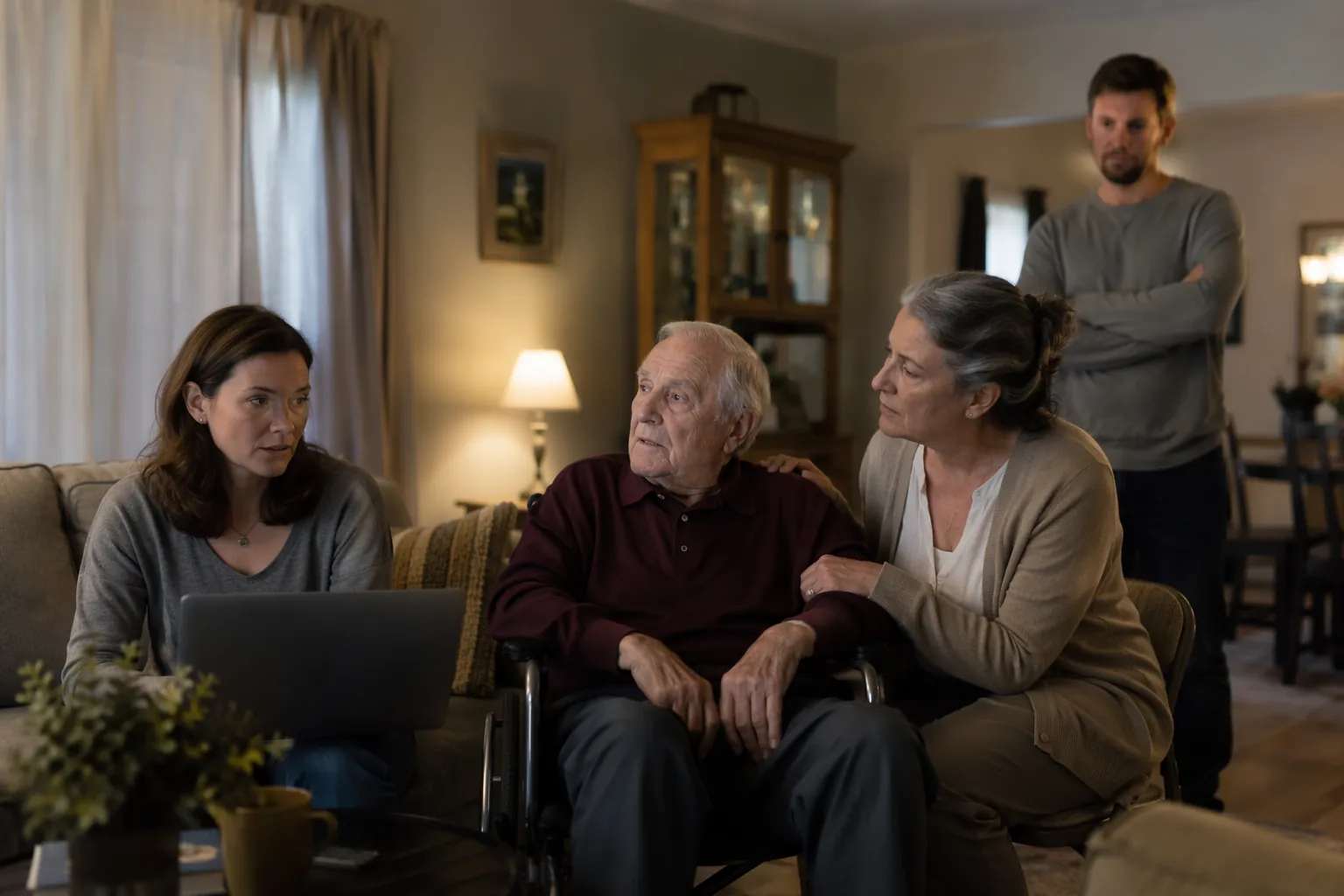
The hard part is that “family caregiver” can make the arrangement sound more shared than it is. In many households, one person becomes the practical center: the person who tracks medications, notices the decline, talks to doctors, remembers the insurance paperwork, cancels work, or sleeps lightly because a fall might happen at night.
The Main Caregiver Is Often the Person Closest to the Daily Need
Families often describe caregiving as if it begins with a decision. In practice, it more often begins with availability. A spouse is already in the home. An adult daughter lives nearby. One sibling has more flexible hours. One relative has always handled medical conversations. One person is retired, unmarried, or simply more responsive.
Those details can look incidental at first. Over time, they become the care plan. The person who takes the first appointment may become the person clinicians call. The person who fills the first pill organizer may become the medication manager. The person who “just helps on weekends” may become the backup for every gap no one else planned for.
National data does not tell any single family what it must do, but it does make the usual direction visible: spouses tend to provide the most hours, adult children make up the largest parent-care group, and siblings become more important when a person with developmental disabilities outlives parental caregiving capacity.
| Relationship to the person needing care | What the pattern often looks like | Why the role can be underestimated |
|---|---|---|
| Spouse or partner | Provides the most weekly hours and is often already in the home | Being present can be mistaken for being able |
| Adult child | Often coordinates parent care while working and sometimes raising children | Planning, calls, transportation, and emotional labor are easy to miss |
| Sibling | May become the next caregiver when aging parents can no longer continue | The handoff is often delayed until a crisis |
Spouses Provide the Most Hours, and That Can Hide the Risk
When the person needing care is married or partnered, the spouse is often the first caregiver everyone sees and the last caregiver anyone checks on. In a study of cancer caregivers, spousal caregivers averaged 44.6 hours of care per week, compared with 14.3 hours for adult children. [2]
That same study found that spousal caregivers had an average age of 62.3 and were less likely to be employed outside the home than adult-child caregivers. [2] The cancer-care context matters, so these numbers should not be treated as a universal measurement for every disability or chronic condition. Still, they describe a familiar household problem: the spouse may be doing the most time-intensive work precisely because everyone assumes that spouse is already there.
“Already there” is not the same as safely available. A spouse may be managing lifting, transfers, bathing, meals, nighttime supervision, transportation, and medical decisions while also managing their own aging body, diagnoses, fatigue, or grief. If the family’s entire plan is “Mom has Dad” or “his wife is with him,” the plan may be resting on the person least able to admit how thin the margin has become.
Spousal caregiving also disappears into ordinary marriage more easily than other forms of care. A spouse who is not employed outside the home may be treated as if time is unlimited. A retired spouse may be treated as if retirement means capacity. A partner who has always cooked or scheduled appointments may be expected to absorb medication management, mobility help, and constant monitoring without the family naming that the job has changed.
The first useful family conversation is not a tribute to devotion. It is a schedule. How many hours of supervision are happening? Which tasks require physical strength? Who covers appointments? Who can stay overnight if the spouse gets sick? Who checks whether the spouse is sleeping, eating, and keeping their own medical care?
For readers already seeing exhaustion in a partner-caregiver, especially in serious illness contexts, spouse-specific burnout deserves direct attention rather than vague reassurance. CareWise’s guide to spouse cancer caregiver burnout is a more focused next read.
Adult Children Often Carry the Logistics
When the person needing care is an aging parent, adult children are often the main caregivers or the main coordinators of care. Caregivers for a parent make up 42% of caregivers, making them the largest relationship group in the national caregiving picture described in the 2026 report. [1]
Their burden may not always show up as the most bedside hours. It may show up as interruption: leaving work for an appointment, making three calls to solve one prescription problem, arranging home modifications, checking on falls, managing siblings’ opinions, updating the family text thread, and being the person a parent calls first because the parent trusts them or because they have always been the one who handles things.
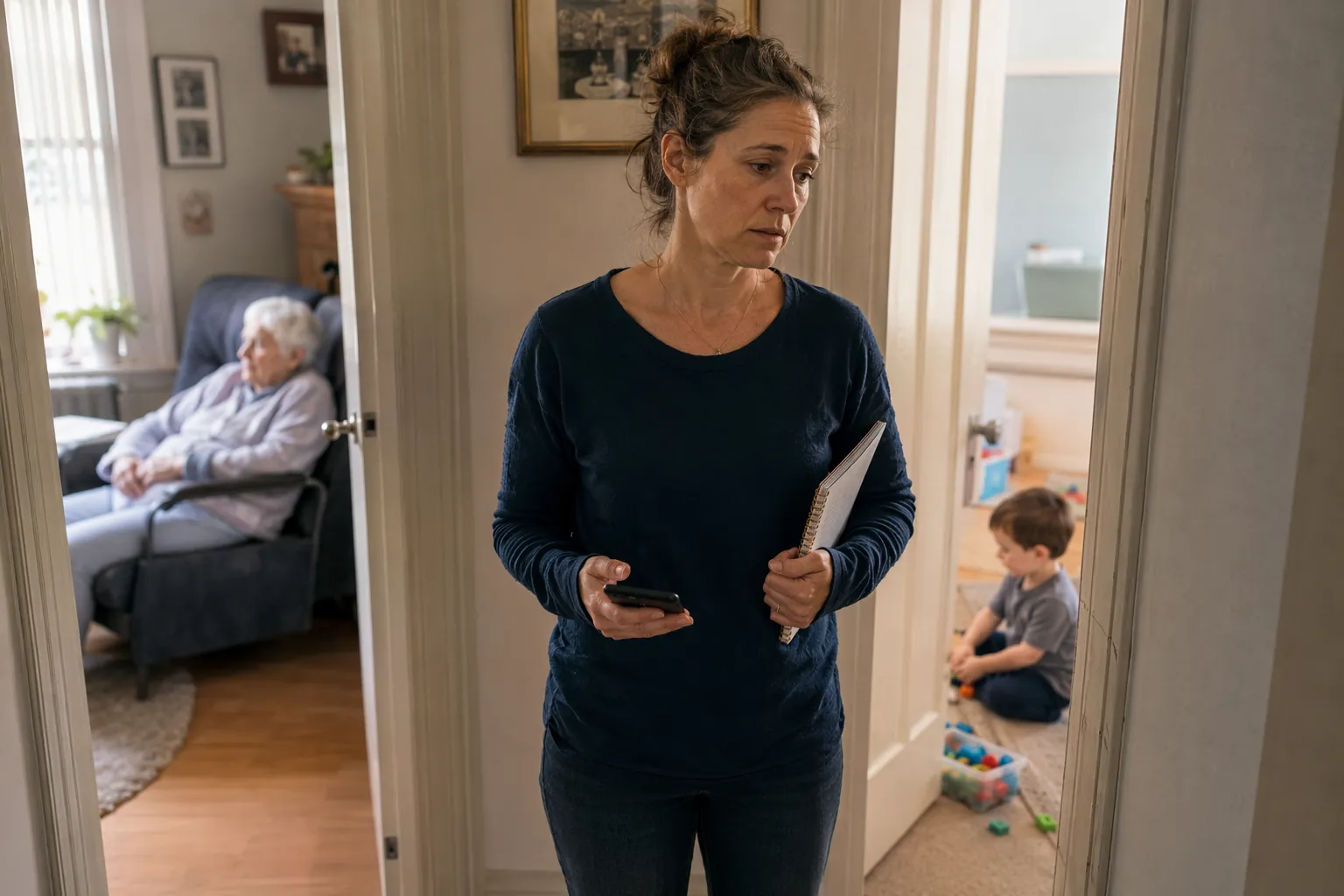
Employment is central here. The same national report found that 76% of caregivers are employed, and 48% also care for children under 18. [1] That means the adult child is often not choosing between work and care in some clean, one-time decision. They are trying to keep both from collapsing on the same Tuesday.
This is where the word “available” can become unfair. The adult child who works remotely may be treated as available. The daughter without young children may be treated as available. The adult child who lives closest may be treated as available. The one who is calm with doctors may be treated as available. None of those facts proves the person has enough hours, money, health, or emotional reserve to become the default caregiver alone.
The cancer-caregiver study adds a useful caution about hours versus burden. In that study, spouses provided more weekly hours, but adult children reported higher social and emotional burden. [2] Again, that evidence is specific to cancer caregiving. The distinction still matters: the person doing fewer hands-on hours may be carrying the calls, decisions, family conflict, worry, and schedule disruption that make life feel unmanageable.
Daughters Are Often Treated as the Natural Choice
In many families, daughters and daughters-in-law are more quickly drafted into personal care, appointment coordination, emotional support, and communication with professionals. The evidence supports a broad caregiving pattern rather than a precise universal rule about every daughter or every household. Still, families should be honest about whether “she’s better at this” is really a skill assessment or a gendered expectation that has gone unchallenged.
A fairer conversation starts with tasks, not temperament. Who can drive? Who can sit through medical appointments? Who can manage insurance calls? Who can cover evenings? Who has paid leave? Who has physical limitations? Who is already caring for children? Who is close enough for emergencies but not healthy enough to be the emergency plan?
Siblings Become More Visible When Parents Can No Longer Continue
For adults with developmental disabilities, the caregiver may be a parent for decades. That can make sibling caregiving feel far away until it is suddenly immediate. The evidence is thinner than the spouse and adult-child data, so it should be read as an emerging planning concern rather than a fully mapped national pattern.
The concern is still substantial. Secondary citations in special-needs planning materials report that 76% of adults with developmental disabilities live at home, and that in 25% of those homes the caregiver is over 60. [3] If an aging parent has been the main caregiver, the family eventually has to ask who understands the routines, benefits, housing options, medical needs, communication style, and crisis plan.
Siblings are often discussed late because the parent-caregiver arrangement has worked for so long. That delay can leave an adult brother or sister inheriting responsibility without enough information. They may love their sibling deeply and still not know the medication list, the behavioral triggers, the waiver status, the names of providers, or what the parent does every day without calling it care.
The practical question is not simply whether a sibling is willing. It is whether the family has named the future role early enough to separate love from logistics. A sibling may be able to serve as guardian, decision-maker, housing coordinator, financial overseer, weekend support, emergency contact, or full-time caregiver. Those are different jobs. Treating them as one vague promise is how families create a crisis handoff.
What Usually Decides Who Becomes the Caregiver
The person who becomes the caregiver is usually shaped by several pressures at once. Some are loving. Some are practical. Some are unfair. Most families have a mixture.
- Relationship: spouses, adult children, parents, and siblings are pulled in differently depending on the care recipient’s age and life stage.
- Proximity: the nearby relative often becomes the first responder, even when distance is the only reason.
- Gender expectations: daughters, wives, and sisters may be assumed to be more naturally suited to care.
- Employment flexibility: remote work, part-time work, retirement, or self-employment can be mistaken for open availability.
- Prior family role: the person who has always organized holidays, paperwork, or medical updates may be drafted into formal care.
- Trust and communication: the care recipient may accept help from one person more readily than others.
Those pressures do not automatically identify the right caregiver. They identify the person at risk of becoming the default caregiver before anyone has agreed on the terms.
Name the Likely Caregiver Before the Role Hardens
Once a family member needs regular support, the most useful early move is to name who is already doing the work. Not who cares the most. Not who should be grateful for the chance to help. Who is actually driving, lifting, calling, paying, supervising, remembering, and rearranging their life.
That conversation should include hours, employment, health, money, backup coverage, and limits. If the spouse is the caregiver, ask what happens if that spouse gets sick. If the adult child is the caregiver, ask what work and child-care pressures are being hidden. If a sibling is the future caregiver, ask what legal, housing, financial, and daily-care knowledge needs to be transferred before the parent-caregiver is in crisis.
Families also need to notice the home itself. If the person needing care wants to remain at home, the caregiver’s workload is shaped by stairs, bathrooms, doorways, transportation, and fall risk. CareWise’s guide to the best place to live for aging in place can help families think about whether the setting is making one caregiver’s job harder than it has to be.
If one person is already exhausted, the issue has moved beyond role assignment. Caregiver strain can become its own health and safety problem, and early signs are easy to normalize inside a family that is focused on the person receiving care. For that next step, see CareWise’s guide to caregiver burnout signs and how to recover.
The caregiver for a special needs family member is rarely chosen in a clean family vote. The role usually emerges from relationship, proximity, gendered expectation, employment flexibility, prior family roles, and the simple fact that one person stepped in first. Naming that pattern early does not make caregiving easy. It makes the work visible soon enough for the family to discuss whether one person can actually carry it.
References
- A Place for Mom 2026 Report, A Place for Mom, 2026.
- Cancer Caregiver Roles and Burden, Cancer, 2022.
- Secondary citations on sibling succession for adults with developmental disabilities, special-needs planning materials.
Questions to bring to a clinician or OT
This is not medical, legal, or a family's final decision — only a framework. Bring these questions to a clinician, occupational therapist, or your local Area Agency on Aging.
Find Local HelpRelated reading
Noticed something outdated or inaccurate on this page? Flag a correction. We review every report against CDC, NIA, and AARP HomeFit guidance before updating a page.