
Caregiver decision guide
Worried About Eye Drop Recalls? Check the Bottle Label
Worried a medicine-cabinet bottle is part of an eye drop recall? Check four label fields — product name, NDC/UPC, lot number, and expiration date — against FDA recall notices to find out whether the drops are safe to keep or should be stopped, returned, and reported.
Start with the bottle, not the headline. In an eye drop recall safety check for older adults, the product name alone is not enough to decide whether to throw drops away. A bottle is involved only when its identifying details match the recall notice — usually the product name plus the NDC or UPC, lot number, and expiration date.
That matters in a real medicine-cabinet audit. Many lubricating drops are sold under store brands, and two bottles can have the same front-label name while only one lot is recalled. If the lot or expiration range does not match the notice, that same-name bottle is not part of that recall and can be kept, as long as it is not expired, contaminated, or otherwise unsafe.
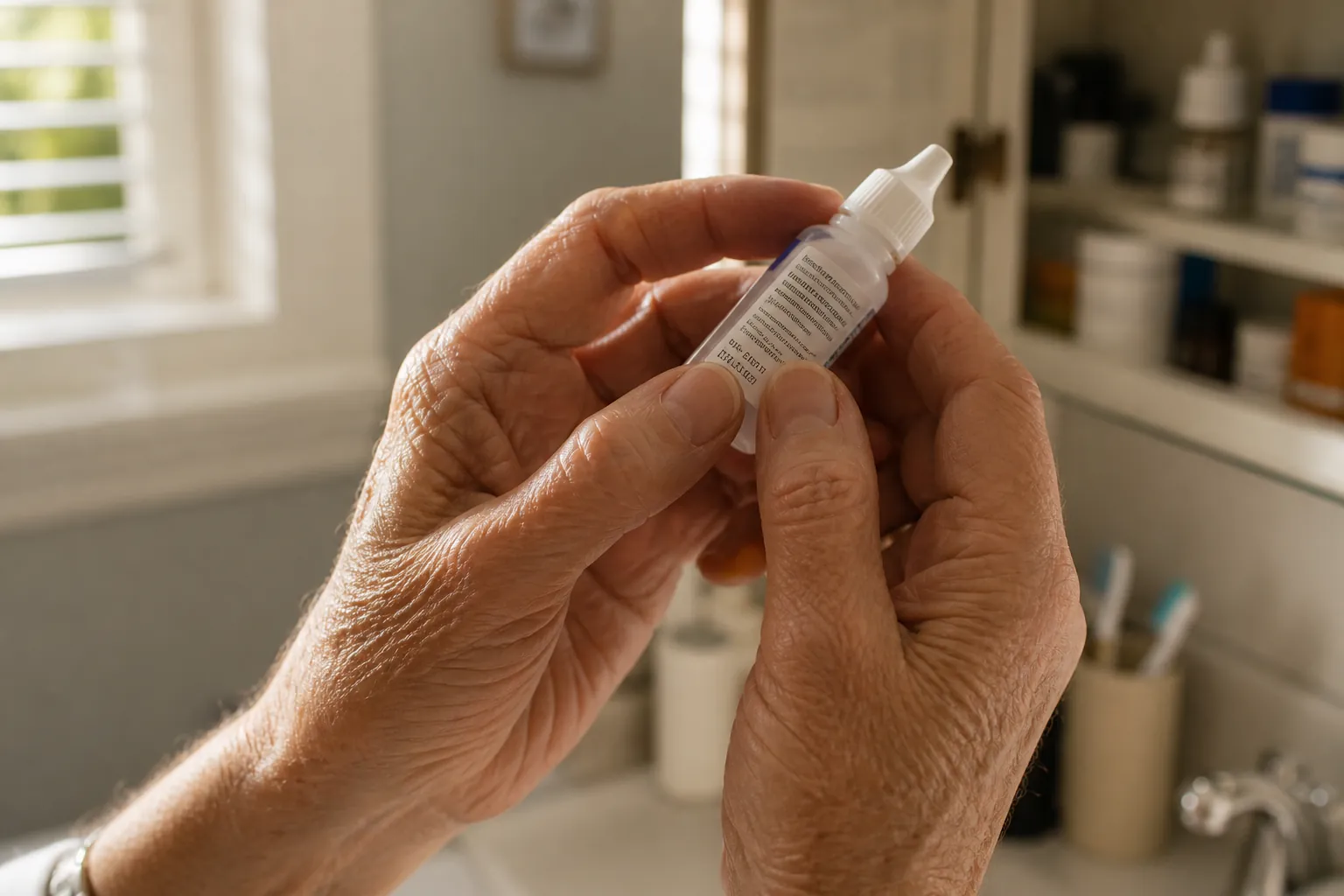
Last verified: August 1, 2026. Recall lists can change, so use the steps below with the current FDA recall notice or enforcement report for the product in your hand.
This guide is for checking a bottle against recall information. It is not medical advice. If an older adult has eye pain, worsening redness, vision changes, discharge, swelling, fever, or any symptom that worries you after using eye drops, contact an eye-care professional, prescriber, pharmacist, urgent care, or emergency services as appropriate.
The four fields to check before deciding
Put the bottle under bright light. If the print is small, use a phone camera, magnifier, or reading glasses. Do not rely on memory of where the bottle was bought; store-brand products may be distributed through several retailers.
| Field | Where to look | Why it matters |
|---|---|---|
| Product name | Usually on the front label; sometimes repeated on the side panel or carton. | The recall notice names the exact product, strength, and type. Similar wording is not enough. |
| NDC or UPC | NDC is often printed near the drug facts or side label; UPC is the barcode number on the bottle or carton. | This helps confirm the exact product identity, especially for store brands and look-alike labels. |
| Lot number | Often printed in small type near the expiration date, on the bottle neck, bottom, crimp, side label, or carton flap. | Recalls commonly apply only to specific manufacturing lots. |
| Expiration date | Often marked as EXP, Exp., or expiration date near the lot code. | Some notices identify affected bottles by expiration date or by an expiration-date range. |
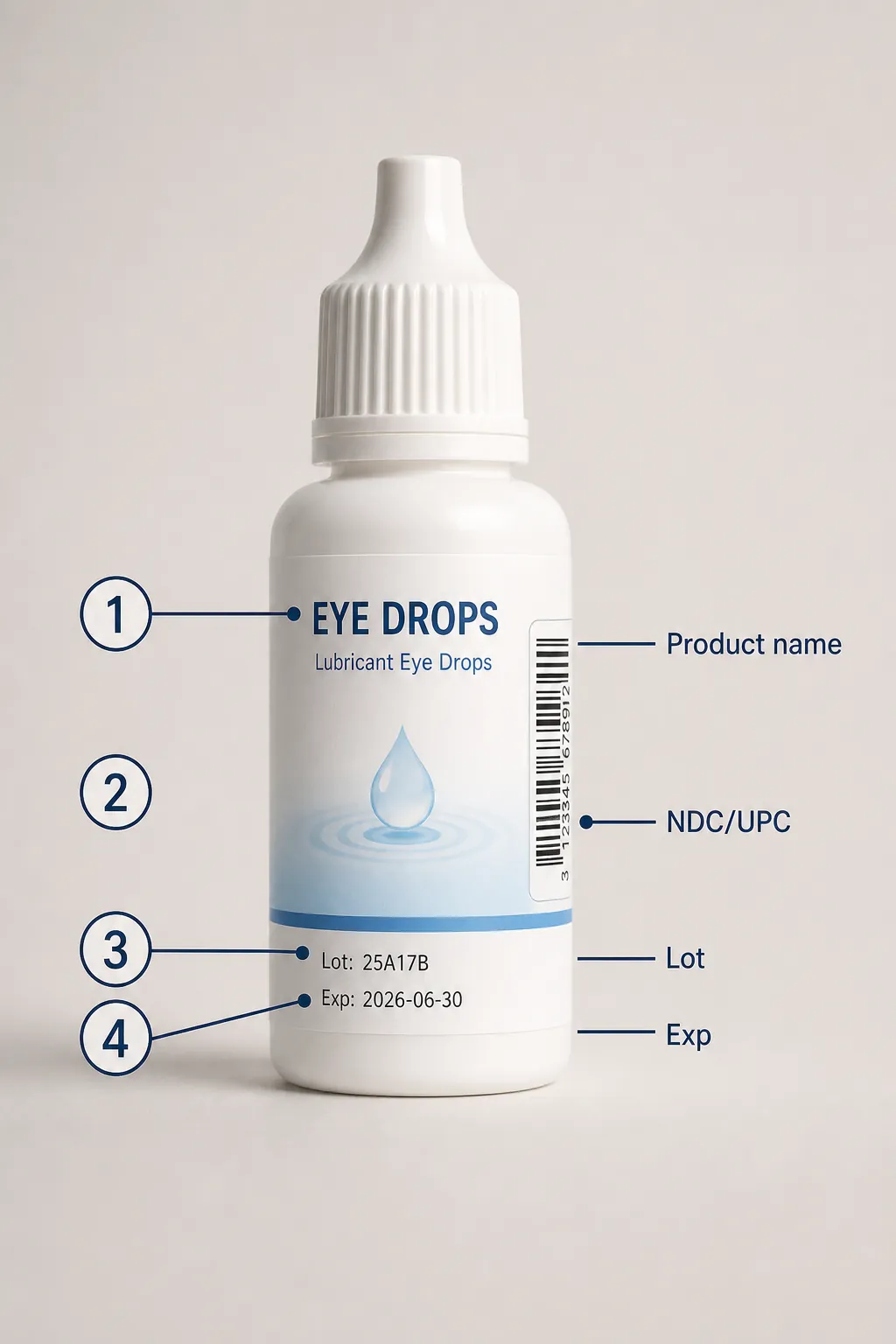
If the bottle is still in its carton, check both. Sometimes the carton is easier to read, but the bottle is what remains in the medicine cabinet after the box is gone. If the label is smudged or the lot code is missing, do not guess; move to the “cannot verify” option below.
How this works in the March 2026 K.C. Pharmaceuticals recall
The March 3, 2026 K.C. Pharmaceuticals recall is the useful model because it involved more than 3.1 million bottles across multiple lubricating eye drop products sold under store brands, including names such as Top Care, Best Choice, Good Sense, Rugby, Leader, Good Neighbor Pharmacy, Quality Choice, GeriCare, Walgreens, CVS, and Kroger. Reports on the recall identified affected products by specific label details, including lot codes such as AC24E01 and expiration dates in the April 30 to October 31, 2026 range.[1][2]
That does not mean every bottle from every listed store brand is unsafe. It means the bottle has to match the notice. A caregiver checking a Walgreens- or CVS-labeled lubricating drop, for example, should not stop at the front label. The lot number and expiration date decide whether that specific bottle belongs to the recall group.
- Find the product name on the recall notice and confirm it matches the bottle exactly enough to identify the same product.
- Compare the NDC or UPC if the notice provides one. This is especially helpful when several store brands use similar wording.
- Compare the lot number character by character. A single different letter or digit means it is not that recalled lot.
- Compare the expiration date or expiration-date range. If the notice says only certain expiration dates are affected, do not include dates outside that range.
- Write the result on a sticky note or medicine-cabinet inventory: “checked against recall notice,” the date checked, and whether it matched.
The written note is not busywork. It prevents the same bottle from being rechecked by three family members after each new headline, and it gives the older adult a clear answer: keep using this bottle, stop using this bottle, or call for help because the label cannot be verified.
What “lack of assurance of sterility” and “Class II” mean at home
Eye drops are different from many bathroom-cabinet products because they go directly onto the eye. When a recall notice says there is a “lack of assurance of sterility,” it does not necessarily mean every bottle has visible contamination or that every user will get an infection. It means the manufacturer or regulator cannot assure that the product met sterility expectations, so a matched bottle should not keep being used while everyone waits to see whether symptoms appear.[2][3]
A Class II recall also should not be read as “nothing to worry about.” In plain household terms, it is a recall category used when a product may cause temporary or medically reversible health consequences, or when the chance of serious consequences is considered remote. For a matched eye drop bottle, the practical instruction is still to stop using it and follow the recall’s return, refund, disposal, or medical-reporting directions.[4]
What to do after the bottle matches — or does not
| Your check result | What to do next |
|---|---|
| Product name, NDC/UPC, lot number, and expiration date do not match the recall notice | Keep the bottle if it is otherwise safe: not expired, not cloudy when it should be clear, not damaged, not shared, and not touched to the eye or skin. |
| Product name matches, but lot number or expiration date does not | Do not treat it as part of that recall. Keep it if it is otherwise safe, and record that the lot did not match. |
| All identifying fields match the recall notice | Stop using the bottle. Follow the specific recall instructions for disposal, return, refund, or contacting the manufacturer or retailer. |
| The bottle label is unreadable, missing, or separated from its carton | Do not guess. Ask the pharmacist, retailer, prescriber, manufacturer, or eye-care office for help identifying it. If it cannot be verified, replace it. |
| Symptoms or an adverse event occurred after use | Stop the matched product, seek appropriate medical care, and report the problem through FDA MedWatch. |
For a matched OTC bottle, the recall notice controls the next step. Some recalls instruct consumers to discard the drops safely. Others route the bottle through a return or refund process. FDA consumer guidance for eye drops also emphasizes using products safely, avoiding contaminated products, and reporting problems when they occur.[3]
The AvKARE recall notices are a good reminder that the remedy can differ by recall. Those notices directed customers through a return-for-credit process, which is not the same as simply tossing a bottle into the trash. Public counts for that recall have also been reported with varying units, so it is safer to describe it broadly as a nearly 2 million bottle/carton Class II recall rather than force a single exact number that the available materials do not consistently support.[5]
If the older adult already used drops that later turn out to match a recall, the medicine-cabinet audit is no longer the whole job. Keep the bottle or a photo of the label long enough to report the product details, write down when it was used, and watch for symptoms that should trigger same-day eye-care advice. Pair this label check with the companion act-now symptom-watch guide for recalled eye drops.
Why this should become a repeat OTC eye drop habit
OTC ophthalmic products can reach store shelves without the same kind of prior FDA review that many people assume happens before sale. Clinical explainers discussing the 2026 recall also noted that FDA inspection attention to OTC eye drop manufacturers had been limited before the 2023 outbreak drew broader scrutiny.[1][2]
That does not mean older adults should be afraid of every lubricating drop in the bathroom cabinet. It means the check has to be repeatable. When a new recall appears, pull the bottles, read the four fields, compare them with the notice, and act only on the match.
The reason sterility gets so much attention is not theoretical. In the 2023 multistate outbreak linked to artificial tears, the CDC’s archived update reported 81 patients in 18 states, including 14 people with vision loss, 4 eye removals, and 4 deaths as of May 15, 2023.[6]
That outbreak should not be used to make every current bottle sound equally dangerous. It is a reminder of why the eye deserves careful handling: do not touch the dropper tip to the eye, skin, lashes, or countertop; do not share drops; close the cap tightly; and replace products that are expired, discolored, cloudy when they should be clear, or stored in a way the label does not allow.
Prescription eye drops take a different route
Do not handle prescription eye drops as if they are just another OTC shelf check. In July 2026, Lupin recalled 2,530,182 bottles of prednisolone acetate ophthalmic suspension 1% because of a potential foreign substance. That is a prescription steroid eye drop, and the safer route is to call the pharmacist, prescriber, or eye-care office before stopping or replacing therapy on your own.[7]
For a prescription bottle, still read the label. The same identifying fields help the pharmacist confirm whether your bottle is involved. The difference is that treatment decisions should run through the clinician or pharmacy, especially when the drops are being used after surgery, for inflammation, or for another condition where stopping suddenly could cause harm.
Make the medicine cabinet easier to check next time
A cleaner eye-care shelf helps the next recall check go faster. Keep current drops together. Separate prescription drops from OTC lubricating drops. Remove expired bottles. Keep cartons until the bottle is finished if the carton carries clearer NDC, UPC, lot, or expiration information. If an older adult uses drops daily, put a small card nearby with the product name, open date, and usual dosing instructions from the label or clinician.
This is also part of fall-prevention work, even though it is not a grab bar or a night light. Vision problems are one of the factors considered in older-adult fall-risk screening, and keeping eye care safe, current, and usable supports daily mobility and independence.[8]
The news cycle can tell you that a recall exists. The bottle label tells you whether your bottle is involved. Check the product name, NDC or UPC, lot number, and expiration date; match those fields against the current notice; then keep, stop, return, report, or call for help based on that match.
If recalled drops were already used, move next to the companion symptom-watch guide. If the bottle is not recalled but the medicine cabinet is cluttered, continue with broader home-safety and fall-prevention planning so eye care stays one small, orderly part of daily independence.
References
- Massive Eye Drop Recall Reflects Ongoing Issues with Manufacturing and FDA Inspections — UConn Today — April 2026
- Eye drop recall 2026: FDA flags over 3 million bottles — UC Davis Health — April 2026
- What You Should Know about Eye Drops — U.S. Food and Drug Administration
- Eye Drops Recalled Due to Sterility Concerns — AARP — May 2025
- Recall — AvKARE
- Outbreak of Extensively Drug-resistant Pseudomonas aeruginosa Associated with Artificial Tears — CDC archive — May 15, 2023
- 2.5 million bottles of prescription eye drops recalled — UC Davis Health — July 2026
- STEADI - Older Adult Fall Prevention — CDC
Questions to bring to a clinician or OT
This is not medical, legal, or a family's final decision — only a framework. Bring these questions to a clinician, occupational therapist, or your local Area Agency on Aging.
Find Local HelpRelated reading
Noticed something outdated or inaccurate on this page? Flag a correction. We review every report against CDC, NIA, and AARP HomeFit guidance before updating a page.