
Caregiver decision guide
How to return recalled Rohto eye drops for elderly parents
When an elderly parent's Rohto Cooling Eye Drops are part of the July 2026 FDA recall, this guide walks adult children through the exact sequence: verify the lot code, return or dispose of the bottles for a full refund, and know when symptoms mean a call to the doctor or FDA. It also covers replacing the drops safely when the parent cannot read the small print or make the store trip.
Medical note: This guide is for recall logistics, not diagnosis or treatment. It is for adult-child caregivers and should be checked against your parent’s clinician’s advice, especially if your parent uses prescription eye drops or has eye disease. Last verified against the available FDA and retailer materials on August 1, 2026.
Start at the bathroom counter, not the store counter. If your parent has Rohto Cooling Eye Drops in the medicine cabinet, have them stop using that bottle until you check it. Do not throw it away yet if you may need the label, carton, receipt, or a photo for a refund.
The July 2026 Rohto recall is a Class II recall tied to sterility concerns, and the available FDA and retailer materials do not report confirmed contamination or illnesses from this recall. That matters: this is not a reason to panic, but it is a reason to keep the bottle out of use until it is verified and handled correctly. The FDA enforcement record is the anchor source to re-check because recall records can be updated after publication.[1]
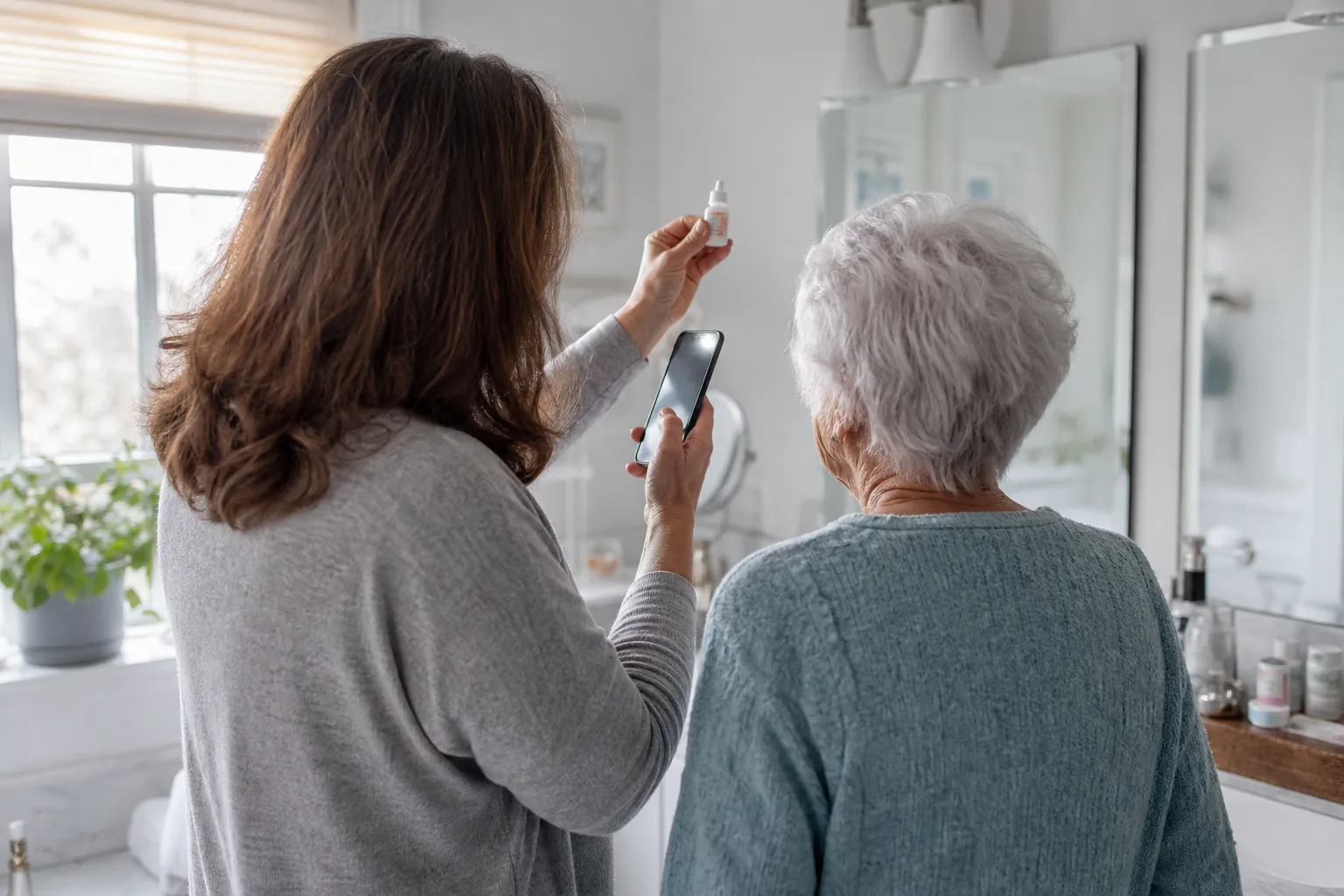
The recall was initiated on July 14, 2026, and covers eight Rohto Cooling Eye Drops products: All-in-One, Max Strength, Max Strength Twin Pack, Optic Glow, Digi Eye, Dry Aid, Dry Aid Twin Pack, and Cool Relief. Reports describe the affected scope as 11,960,623 cartons and 12,460,649 bottles, with affected lots expiring from 2025/07 through 2029/02.[2] The large bottle count is less useful at home than one question: does the bottle in your parent’s cabinet match the recalled product, lot, and date information?
The three decisions to make before anyone drives to the store
| Decision | What you are trying to settle | What to do next |
|---|---|---|
| 1. Verify the bottle | Is this exact product, lot, UPC, NDC, or expiration date part of the recall? | Photograph the bottle and carton, then compare the small-print details against the FDA recall record or retailer notice. |
| 2. Choose return, disposal, or reporting | Can you get the product back to the place of purchase, or is disposal/reporting the safer route? | Call the local store before traveling; use FDA reporting channels for recall questions or adverse reactions. |
| 3. Replace safely | What can your parent use instead without confusing recalled drops with a new bottle? | Ask a pharmacist first, especially if your parent uses prescription drops or cannot read packaging clearly. |
That order is important. Buying a replacement first can leave the recalled bottle sitting beside the new one. Driving to the store first can waste a trip if the lot is not affected or if the counter needs information your parent left at home.
Decision 1: Verify the bottle without relying on memory
Do not ask, “Did Mom buy Rohto?” and stop there. Many older adults keep the carton separate from the bottle, move drops between bathrooms and purses, or remember the store but not the exact product. Put the bottle, carton, receipt, and any pharmacy bag on a flat surface under bright light. Use a phone flashlight or magnifier if needed.
- Take a clear photo of the front label, the back label, the bottom or crimped edge, and any carton panel with the UPC, NDC, lot code, or expiration date.
- Keep the physical bottle and carton together in a zip bag or envelope until the return or disposal is finished.
- Write “Do not use — recall check pending” on a sticky note and place it over, not on, the dosing instructions so the label remains readable.
- If your parent has more than one Rohto bottle, check every bottle separately. One affected bottle does not prove the others are affected, and one unaffected bottle does not clear the rest.
Match the product name first, then the small identifiers. Coverage that pulled examples from the FDA record lists identifiers such as UPC 310742010862 for Rohto All-in-One, UPC 310742011012 for Rohto Max Strength, NDC 10742-8175-1 for Rohto Digi Eye, and a lot-code example such as 3H1V.[3] Treat those as examples of what to look for, not as the whole recall list. The FDA event page and the product’s own label are what should agree before you act.[1]
If the carton is gone, the bottle still may have enough information to verify the recall. If the print is too small or rubbed off, do not guess. Take the best photos you can, call the store where it was likely purchased, and ask whether staff can help identify the recalled product from the label, purchase history, or loyalty account.
For caregivers already managing pill bottles, refill dates, and side-effect questions, this is the same kind of tiny-detail task that makes a shared medication list useful. If your parent’s medicine cabinet is hard to audit, a broader polypharmacy caregiver review can keep future recalls from becoming a cabinet-by-cabinet search.
Decision 2: Return it if practical, but call the local store first
The baseline instruction reported for the recall is straightforward: affected products may be disposed of or returned to the place of purchase for a full refund.[2] In real caregiver life, that sentence leaves too much unsaid. Your parent may not drive comfortably, may not know which store sold the bottle, may not have the receipt, or may be embarrassed at a counter when staff are unfamiliar with the recall.
Before anyone makes the trip, call the exact local store. Ask for the pharmacy counter if the product was bought near the pharmacy, or customer service if it was bought from a front-store shelf. Keep the call practical and short:
- “I’m helping my parent with the July 2026 Rohto Cooling Eye Drops recall.”
- “The bottle appears to match the recalled product. What do you need for a refund: bottle, carton, receipt, loyalty account, photos, or all of these?”
- “If there is no receipt, can you still process a recall refund or store credit?”
- “Does my parent need to be present, or can I bring the product back for them?”
- “Is there a manager or pharmacy lead I should ask for when I arrive?”
That call is not busywork. It prevents the worst version of the errand: an older parent waiting in a line, a clerk who has not seen the recall notice, and a caregiver trying to read a lot code from a blurry phone photo while a rideshare meter runs.
If the product came from CVS
Healthline reported a CVS spokesperson saying the recalled drops “may be returned for a refund.”[4] That is useful, but it still does not answer every local-counter question. Bring the bottle and carton if available, and bring the receipt or loyalty account information if your parent has it. If your parent cannot come with you, ask the store in advance whether you can complete the return on their behalf.
If the product came from Walgreens
Walgreens’ posted general return policy says most products may be returned within 30 days with the original receipt, and that returns without a receipt may be accepted for store credit at the discretion of store management.[5] A recall return may be handled differently from an ordinary return, so do not assume the website policy is the last word. Call the store, explain that this is a recalled eye-drop product, and ask how they are handling Rohto returns that are older than 30 days or missing a receipt.
If the store is unknown or the receipt is gone
Do a quick purchase-history check before giving up on the refund. Look for a paper receipt in the medicine cabinet, a pharmacy bag, a loyalty account, a credit-card line item, an email receipt, or a delivery order. If the product was bought by another family member, ask for the store name before asking your parent to reconstruct the errand from memory.
If you still cannot identify the store, call the retailer your parent most likely used and ask what they can do with the physical product and photos. Be clear that you are not asking them to diagnose risk; you are asking how they process a recalled consumer health product. Avoid phone numbers that appear only in snippets or older unrelated pages. For this recall, the verified fallback numbers in the available materials are FDA channels, not an unconfirmed manufacturer hotline.
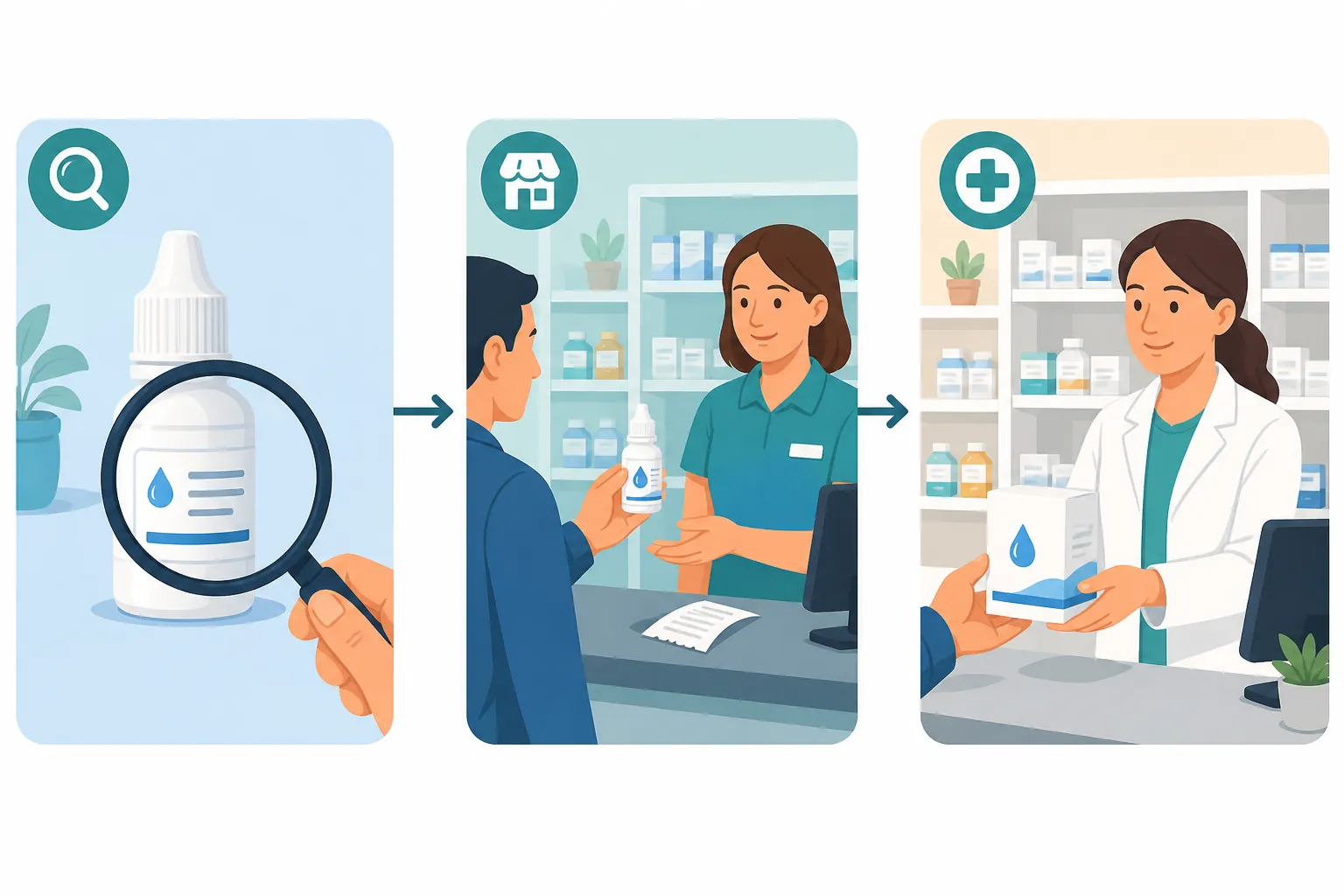
When disposal or reporting is the better path
Returning the bottle is usually the cleanest path because it can recover the refund and removes the product from your parent’s home. But if your parent lives far from the store, cannot safely travel, or the local store cannot process the return, disposal may be the practical route. Follow the recall guidance you receive from the retailer or FDA rather than keeping the bottle “just in case” in the same cabinet where it can be used by mistake.
For recall questions, the FDA can be reached at 1-888-INFO-FDA, which is 1-888-463-6332.[3] If your parent had a possible adverse reaction, FDA MedWatch is available at fda.gov/safety/medwatch or 1-800-FDA-1088.[6] Keep the bottle, photos, lot information, and the date your parent last used the drops until you know what the doctor, FDA, or store needs.
Call a doctor promptly if your parent has eye discharge, pain, redness, blurry vision, light sensitivity, or a foreign-body sensation after using the drops.[4][7] Those symptoms do not prove the recalled drops caused a problem, but they are not symptoms to troubleshoot from a recall guide. If your parent uses prescription eye drops, do not stop those prescriptions unless a clinician tells you to; ask the prescriber or pharmacist how to separate prescription treatment from the recalled over-the-counter product.
Some coverage compares the current sterility concern with the 2023 EzriCare outbreak, where CDC archived figures reported 81 infections, 14 cases of vision loss, 4 deaths, and 4 eye removals.[8] That history explains why eye-drop sterility recalls are taken seriously. It does not mean the July 2026 Rohto recall has produced the same outcomes; the available materials reviewed here do not report confirmed illnesses from this recall.
Replace the drops only after the recalled bottle is controlled
Once the suspect bottle is out of use and the return or disposal path is underway, replace it deliberately. The safest first practical resource is often the pharmacist, especially when your parent cannot read small packaging, compare “redness relief” with “dry eye,” or remember which drops a doctor wanted them to avoid. Geisinger’s eye-drop recall guidance points consumers to pharmacists as a first resource for choosing alternatives.[9]
- Bring or show the pharmacist a photo of the recalled Rohto product so they understand what your parent had been using.
- Tell the pharmacist whether your parent uses prescription eye drops, has glaucoma, had eye surgery, wears contacts, or has been told to avoid certain ingredients.
- Ask the pharmacist to point to the exact replacement on the shelf or ring it up directly if your parent cannot compare labels comfortably.
- At home, remove the recalled bottle from the cabinet before placing the replacement there.
- Write the opening date on the new bottle if that is part of your parent’s normal medication routine.
If transportation is the hard part, solve that separately from the product choice. One family member can make the return, another can place a delivery order, and the pharmacist can help identify an appropriate substitute before anyone buys the wrong product. For parents whose independence is affected by driving, walking distance, or store navigation, a broader mobility and independence plan can make these small urgent errands less improvised.
The task is finished when three things are true: you have confirmed whether the Rohto bottle is affected, you have either secured the refund or followed the disposal/reporting path, and your parent has a safe replacement if they still need eye drops. Based on the available recall facts, this is not a health emergency for most families. It is a small, physical, easy-to-delay errand where careful help can prevent continued use, a missed refund, and a confusing trip to the counter.
References
- FDA Enforcement Report Event 99440, U.S. Food and Drug Administration.
- Rohto brand eye drops recalled: See list, USA Today, July 30, 2026.
- Eye Drops Recalled Nationwide, EatingWell.
- Eye Drop Recall 2026: FDA Flags Over 3 Million Bottles, Healthline.
- Returns Help, Walgreens.
- FDA recalls millions of cooling eye drops over sterility concerns, News4JAX, July 29, 2026.
- Eye drop recall 2026: FDA flags over 3 million bottles; eye doctors explain what you should know, UC Davis Health, April 2026.
- Millions of eye drop bottles have been recalled from CVS, Walgreens and other national stores over sterility concerns. How to check if yours are safe, Yahoo/AP.
- Eye drop recalls, Geisinger, January 22, 2024.
Questions to bring to a clinician or OT
This is not medical, legal, or a family's final decision — only a framework. Bring these questions to a clinician, occupational therapist, or your local Area Agency on Aging.
Find Local HelpRelated reading
Noticed something outdated or inaccurate on this page? Flag a correction. We review every report against CDC, NIA, and AARP HomeFit guidance before updating a page.