
Caregiver decision guide
Bathroom Remodel for Elderly Safety: A Phased Room-by-Room Checklist with Costs
A practical, phased guide for adult children and caregivers on how to make a bathroom safer for an aging parent after a fall or mobility decline. Learn which modifications to prioritize, what each phase costs, and how to avoid common mistakes — starting with fixes under $1,000.
Why the Bathroom Is the Most Dangerous Room in the House
If you are reading this after your parent took a fall in the bathroom, you are not alone — and the statistics bear out just how common this scenario is. According to Age Safe America, which cites CDC data, nearly 80% of falls among older adults occur in the bathroom. The CDC itself reports that over 1 in 4 adults aged 65 and older fall each year, and falling once doubles the risk of falling again. In 2021 alone, falls caused 38,000 deaths and 3 million emergency department visits among older Americans.
The bathroom concentrates nearly every fall risk factor in a single small space: wet, slippery surfaces; hard tile and porcelain; the need to step over a tub wall; low toilet heights that strain knees and hips; and poor lighting that makes hazards invisible. The combination is lethal — approximately 235,000 Americans over 65 visit emergency rooms annually due to bathroom-related falls and injuries.
Here is the good news: you do not need to gut the entire room to make it safe. A phased approach — starting with fixes under $1,000 that address the most urgent hazards — can dramatically reduce fall risk while keeping the project manageable for both your budget and your parent's tolerance for disruption. This guide walks you through exactly what to do in each phase, what each step costs, and how to avoid the costly mistakes that send many families back to the contractor for a second remodel.
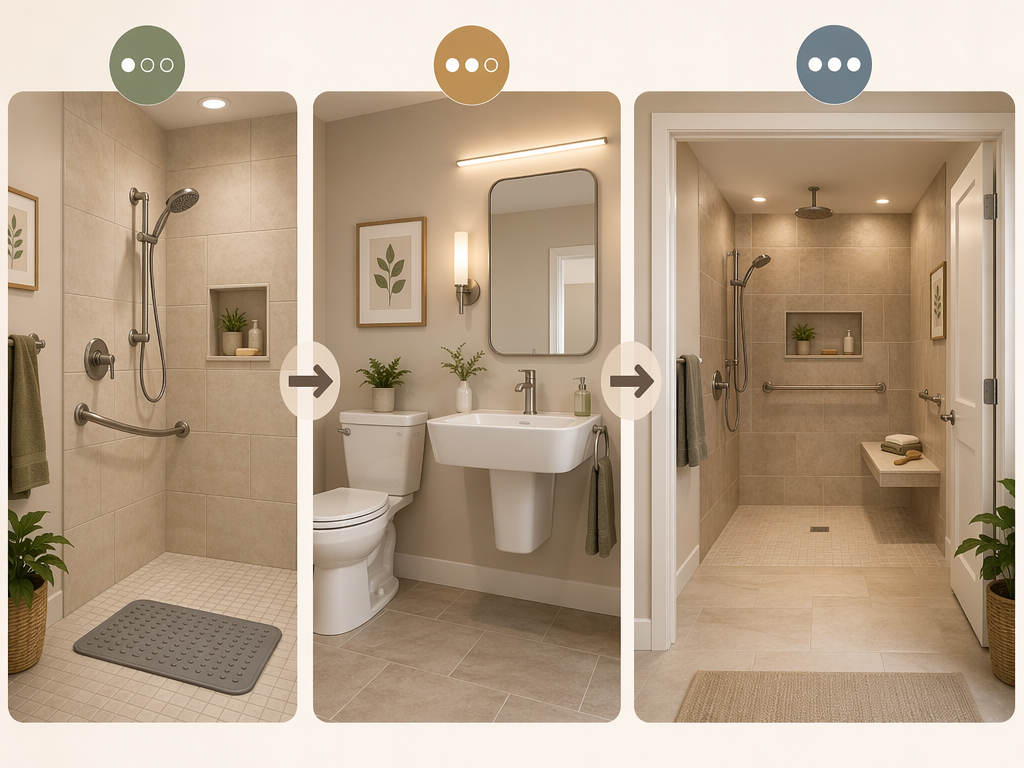
Phase 1: Immediate Low-Cost Safety Fixes ($100–$600)
These are the modifications you can complete in a single weekend, with basic tools and no contractor. They address the most common fall triggers — slipping on wet floors, losing balance while stepping out of the shower, and struggling to get up from a low toilet.
- Grab bars (3–4 bars installed into wall studs): $200–$600. This is the single most impactful safety upgrade. A 2021 study published in Human Factors found that people who had a grab bar in their shower were 75% more likely to keep their balance while stepping from a slippery shower to a dry floor than those who did not. Grab bars must support at least 250 lbs and have a diameter of 1.25–1.5 inches. They must be mounted into wall studs or blocking — not into tile alone.
- Non-slip bath mats and adhesive treads: $15–$80. Place a mat with a rubber backing outside the shower or tub, and use adhesive non-slip treads inside the shower floor. These are temporary but effective while you plan more permanent flooring solutions.
- Handheld showerhead with a 60-inch hose: $30–$100. This allows your parent to shower while seated, reducing the need to stand and turn. The ADA requires handheld spray units at all accessible showers with a hose at least 59 inches long.
- Shower chair or transfer bench: $50–$300. A sturdy, adjustable shower chair with rubber feet lets your parent sit while bathing. A transfer bench extends outside the tub so they can sit down first, then swing their legs over the tub wall — eliminating the need to step over it.
- Raised toilet seat (2–4 inch riser): $27–$85. Standard toilets are 14–15 inches high. Raising the seat to 17–19 inches (comfort height) reduces the knee and hip strain of sitting down and standing up, which is a primary fall trigger for people with arthritis or reduced leg strength.
Phase 2: Mid-Range Modifications for Daily Comfort and Safety ($600–$3,500)
Once the immediate hazards are addressed, the next tier of improvements focuses on reducing strain during daily routines and preventing the accidents that happen not from a single slip, but from cumulative physical stress. These modifications require a handyman or contractor for most installations.
- Comfort-height toilet (17–19 inch seat height): $300–$1,200 installed. A permanent comfort-height toilet is more stable than a raised seat attachment and eliminates the risk of the riser shifting. Look for models with a 16.5-inch rim height (without the seat) to meet ADA recommendations.
- Lever-handle faucet: $50–$200. Lever handles require no more than 5 lbs of force and can be operated with one hand, a closed fist, or even an elbow — critical for someone with arthritis or reduced hand strength. The ADA requires controls to be operable without tight grasping, pinching, or twisting.
- Improved lighting (brighter overhead + motion-sensor night light): $100–$400. Many bathroom falls happen during nighttime trips. A motion-sensor night light plugged into a wall outlet near the toilet provides enough illumination to navigate safely without waking the user fully. Upgrade the overhead fixture to at least 800 lumens with a warm color temperature (2700K–3000K) to reduce glare.
- Non-slip flooring (sheet vinyl or luxury vinyl tile with DCOF 0.60+): $6,400–$11,000 for a full bathroom. This is the largest Phase 2 expense, but it is critical. Glossy ceramic or porcelain tile becomes dangerously slippery when wet. The industry standard for wet-area slip resistance is a Dynamic Coefficient of Friction (DCOF) of 0.60 or higher. Luxury vinyl tile (LVT) and sheet vinyl with textured surfaces meet this threshold at a lower cost than slip-resistant porcelain.
| Modification | Cost Range | Primary Benefit | Installation Complexity |
|---|---|---|---|
| Comfort-height toilet | $300–$1,200 | Reduces knee/hip strain during sit-stand | Moderate (plumber recommended) |
| Lever-handle faucet | $50–$200 | One-hand operation, no twisting | Low (DIY or handyman) |
| Motion-sensor night light | $15–$50 | Prevents nighttime falls | Very low (plug-in) |
| Overhead lighting upgrade | $80–$350 | Reduces shadows and glare | Moderate (electrician) |
| Non-slip flooring (full bath) | $6,400–$11,000 | Eliminates primary slip hazard | High (contractor) |
Phase 3: Structural Renovation for Full Accessibility ($3,500–$25,000)
Phase 3 is for households where mobility has declined significantly — your parent uses a walker or wheelchair, has difficulty lifting their legs over a tub wall, or requires caregiver assistance for bathing. These modifications require permits, professional contractors, and often a Certified Aging-in-Place Specialist (CAPS).
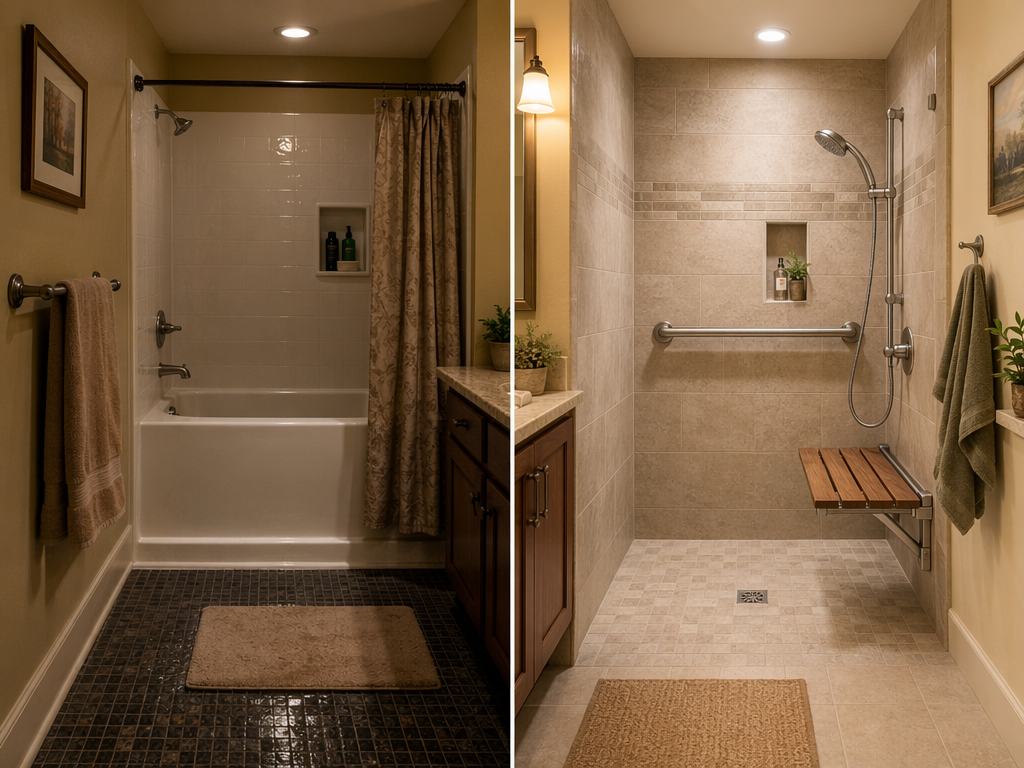
The centerpiece of this phase is eliminating the step-over barrier. The primary fall trigger in a standard bathroom is the 12–20 inch tub wall that must be crossed to enter the shower. A curbless (roll-in) shower eliminates this barrier entirely.
| Modification | Cost Range (National Avg.) | Key Specifications | When to Consider |
|---|---|---|---|
| Curbless walk-in shower (tub-to-shower conversion) | $3,000–$15,000 | Minimum 30x60 inches; threshold ≤ 1/2 inch (beveled if > 1/4 inch) | Parent uses walker or wheelchair; difficulty lifting legs over tub wall |
| Walk-in tub | $2,000–$20,000 (avg. ~$10,000) | Door opens inward; seat height 17–19 inches; handheld shower required | Parent prefers soaking baths; cannot stand for shower; limited space for curbless conversion |
| Widened doorway (32–36 inches) | $500–$2,500 | 32 inches minimum for wheelchair; 36 inches preferred for side entry | Parent uses wheelchair or wide walker; current door < 30 inches |
| Full accessible bathroom remodel | $8,000–$28,000 | Includes curbless shower, comfort-height toilet, non-slip flooring, grab bars, lever faucet, improved lighting | Multiple modifications needed; bathroom is being gutted for other reasons |
A curbless shower offers the best long-term value for accessibility. It allows a wheelchair to roll directly into the shower area, eliminates the need to lift legs over a barrier, and can be used with a shower chair or built-in bench. The ADA requires roll-in showers to be at least 30 inches by 60 inches, with a threshold no higher than 1/2 inch (and beveled if it exceeds 1/4 inch).
Room-by-Room Safety Checklist: Shower, Toilet, Sink, Flooring, Lighting, and Doorway
Use this checklist to audit your parent's bathroom zone by zone. Each entry includes what to look for and what to change. Print this section or save it for reference when you visit their home.
| Zone | Hazard to Check | What to Change | Priority | Estimated Cost |
|---|---|---|---|---|
| Shower / Tub | Step-over height > 6 inches | Install transfer bench or plan curbless conversion | High | $50–$15,000 |
| Shower / Tub | No grab bar inside shower | Install grab bar into studs at 33–36 inches above floor | High | $50–$200 per bar |
| Shower / Tub | Fixed showerhead only | Replace with handheld unit on sliding bar (60-inch hose min.) | High | $30–$100 |
| Shower / Tub | Slippery tub or shower floor | Apply non-slip treads or plan textured flooring replacement | High | $15–$11,000 |
| Toilet Area | Seat height < 17 inches | Install raised seat or replace with comfort-height toilet | High | $27–$1,200 |
| Toilet Area | No grab bar near toilet | Install grab bar on side wall (transfer side) at 33–36 inches | High | $50–$200 |
| Toilet Area | Toilet paper holder too far back | Relocate to within easy reach without twisting | Medium | $10–$50 |
| Sink Area | Twist-style faucet handles | Replace with lever-handle faucet (≤ 5 lbs force) | Medium | $50–$200 |
| Sink Area | Mirror too high for seated user | Lower mirror or add a full-length tilt mirror | Low | $30–$150 |
| Flooring | Glossy tile (DCOF < 0.60) | Replace with textured vinyl or slip-resistant porcelain | High | $6,400–$11,000 |
| Flooring | Loose bath mat without rubber backing | Replace with non-slip mat or adhesive treads | High | $15–$50 |
| Lighting | No night light between bed and bathroom | Install motion-sensor night light near toilet path | Medium | $15–$50 |
| Lighting | Overhead light < 800 lumens | Upgrade fixture or bulbs to brighter, warmer light | Medium | $30–$350 |
| Doorway | Door width < 32 inches | Widen doorway to 32–36 inches for wheelchair access | Low (unless using wheelchair) | $500–$2,500 |
| Doorway | Door swings inward into bathroom | Reverse door swing or replace with pocket door | Low | $200–$1,000 |
Common Bathroom Remodel Mistakes to Avoid
These are the most frequent — and most expensive — errors families make when modifying a bathroom for an aging parent. Avoiding them can save thousands of dollars and prevent a second remodel within two years.
- Using towel bars as grab bars. Towel bars are designed to hold 10–15 lbs of wet fabric. When a 150-lb person grabs one during a fall, it rips out of the wall, often taking a chunk of drywall or tile with it. Grab bars must support 250+ lbs and be mounted into wall studs or plywood blocking. Never substitute a towel bar for a grab bar.
- Choosing glossy floor tile. Polished ceramic and porcelain tile looks beautiful but becomes dangerously slippery when wet. Always specify a DCOF (Dynamic Coefficient of Friction) of 0.60 or higher for bathroom flooring. Textured porcelain, luxury vinyl tile, and sheet vinyl are safer and often less expensive.
- Skipping wall blocking during construction. If you are renovating the bathroom, have the contractor install 2x6 or 2x8 plywood blocking between studs at 33–36 inches above the floor — the standard grab bar mounting height. This allows grab bars to be installed anywhere later without opening the wall. Adding blocking after the tile is installed costs 3–5x more.
- Not planning for future mobility needs. Your parent may be using a walker today but need a wheelchair in two years. A bathroom that works for a walker may be unusable for a wheelchair. Plan for the widest possible doorway (36 inches), a curbless shower, and enough turning radius (60-inch diameter) for a wheelchair — even if your parent does not need it yet.
- Installing grab bars into tile without checking for studs. Grab bars mounted into tile alone — even with heavy-duty anchors — will fail under the load of a fall. Use a stud finder to locate studs, or have a contractor open the wall to install blocking. For detailed installation guidance, see our DIY Grab Bar Installation Guide, but note that professional installation is recommended for safety.
Funding Sources at a Glance
Bathroom modifications can be expensive, but several funding programs can offset the cost. Here is a quick overview of the most common options. For a complete breakdown of each program — including eligibility requirements, application timelines, and state-by-state variations — see our Funding Sources for Home Modifications: A Complete Guide to VA, Medicaid, Grants, and More.
- VA Specially Adapted Housing (SAH) Grant: Up to $126,526 (FY2026) for qualifying veterans with service-connected disabilities. Can be used for bathroom modifications including curbless showers and widened doorways.
- VA Special Housing Adaptation (SHA) Grant: Up to $25,350 (FY2026) for veterans with specific service-connected disabilities. Covers grab bars, non-slip flooring, and other bathroom safety modifications.
- Medicaid Home and Community-Based Services (HCBS) Waivers: Varies by state. Some states provide $14,000–$45,000 for home modifications including bathroom safety upgrades. Eligibility and funding amounts vary dramatically — check your state's Medicaid office.
- USDA Section 504 Home Repair Program: Grants up to $10,000 for homeowners aged 62+ in rural areas. Loans up to $40,000 at 1% interest over 20 years. Can be used for bathroom safety modifications.
- Rebuilding Together and Habitat for Humanity: Offer free or low-cost home modification services for income-qualified seniors. Programs vary by local chapter.
When to Call a CAPS-Certified Professional
A Certified Aging-in-Place Specialist (CAPS) is a contractor or designer who has completed training through the National Association of Home Builders (NAHB) on how to modify homes for aging adults. While any licensed contractor can install grab bars or replace a toilet, a CAPS professional brings specific expertise that becomes critical in Phase 2 and Phase 3 renovations.
Here is what a CAPS contractor does differently from a general contractor:
- They understand the full ADA and ANSI A117.1 accessibility standards, not just the grab bar height requirements.
- They plan for future mobility decline, not just current needs — designing turning radii, doorway widths, and shower sizes that accommodate a wheelchair even if your parent does not use one yet.
- They know how to integrate grab bar blocking into the framing before tile is installed, avoiding the need to open walls later.
- They can recommend specific products (shower bases, faucets, toilets) that meet accessibility standards without looking institutional.
You should call a CAPS professional when: (1) you are planning a curbless shower or walk-in tub installation, (2) you need to widen a doorway or reconfigure the bathroom layout, (3) your parent uses a wheelchair or is likely to need one within two years, or (4) you want to ensure the renovation meets current accessibility standards and will not need to be redone.
Remember: you do not need to do everything at once. Start with Phase 1 this weekend — install grab bars, add a shower chair, and replace that slippery bath mat. Those three changes alone can reduce your parent's fall risk significantly while you plan the larger renovations. The most dangerous bathroom is the one you have not modified yet.
Questions to bring to a clinician or OT
This is not medical, legal, or a family's final decision — only a framework. Bring these questions to a clinician, occupational therapist, or your local Area Agency on Aging.
Find Local HelpRelated reading
Noticed something outdated or inaccurate on this page? Flag a correction. We review every report against CDC, NIA, and AARP HomeFit guidance before updating a page.