
Caregiver decision guide
Do Crossword Puzzles Really Help Seniors' Brain Health?
Crossword puzzles are the best-studied leisure activity for older-adult cognition, yet they don't prevent dementia. Here's what the evidence actually shows and how crosswords fit into a broader independence plan spanning physical activity, balance, vision checks, and home fall-proofing.
Yes, crossword puzzles appear to help some aspects of seniors’ brain health, especially memory-related performance and everyday functioning in people already showing mild cognitive impairment. They are also unusually well studied for a leisure activity. No, they have not been shown to prevent Alzheimer’s disease, cure dementia, or act as a shield against the harder parts of aging safely at home.
That distinction matters. A crossword is a decent, dignified habit: quiet, inexpensive, self-directed, and easy to fit into a morning routine. The mistake is turning that habit into a promise the evidence cannot carry.
The strongest crossword evidence comes from a trial in mild cognitive impairment
The most useful place to start is the COG-IT trial, because it studied crosswords directly rather than treating them as one item in a long list of “mentally stimulating activities.” The trial included 107 adults ages 55 to 95 with mild cognitive impairment and randomly assigned them to web-based crossword puzzles or computerized cognitive games. Participants were asked to complete four 30-minute sessions per week for 12 weeks, followed by booster sessions through 78 weeks.[1]
The crossword group did better than the computerized-games group on the ADAS-Cog, a cognitive scale often used in Alzheimer’s and mild cognitive impairment research. They also showed less decline on the Functional Activities Questionnaire, which matters because it moves the discussion beyond test scores and closer to daily life: managing routines, handling tasks, and needing less help. MRI findings also favored the crossword group, with less hippocampal and cortical shrinkage reported over the study period.[1]
For families, that is not a trivial result. Mild cognitive impairment is exactly the stage when many adult children start noticing missed bills, repeated questions, medication confusion, or a parent’s growing reluctance to manage errands alone. A habit that may help preserve daily function a little longer deserves attention.
The limitation is just as important. This was not a trial of crosswords versus doing nothing. It was crosswords versus computerized brain games. So the result supports a narrower, more honest claim: in this study, web-based crosswords performed better than the selected computerized games for older adults with mild cognitive impairment. It does not prove that crossword puzzles, by themselves, broadly protect the brain or prevent dementia.
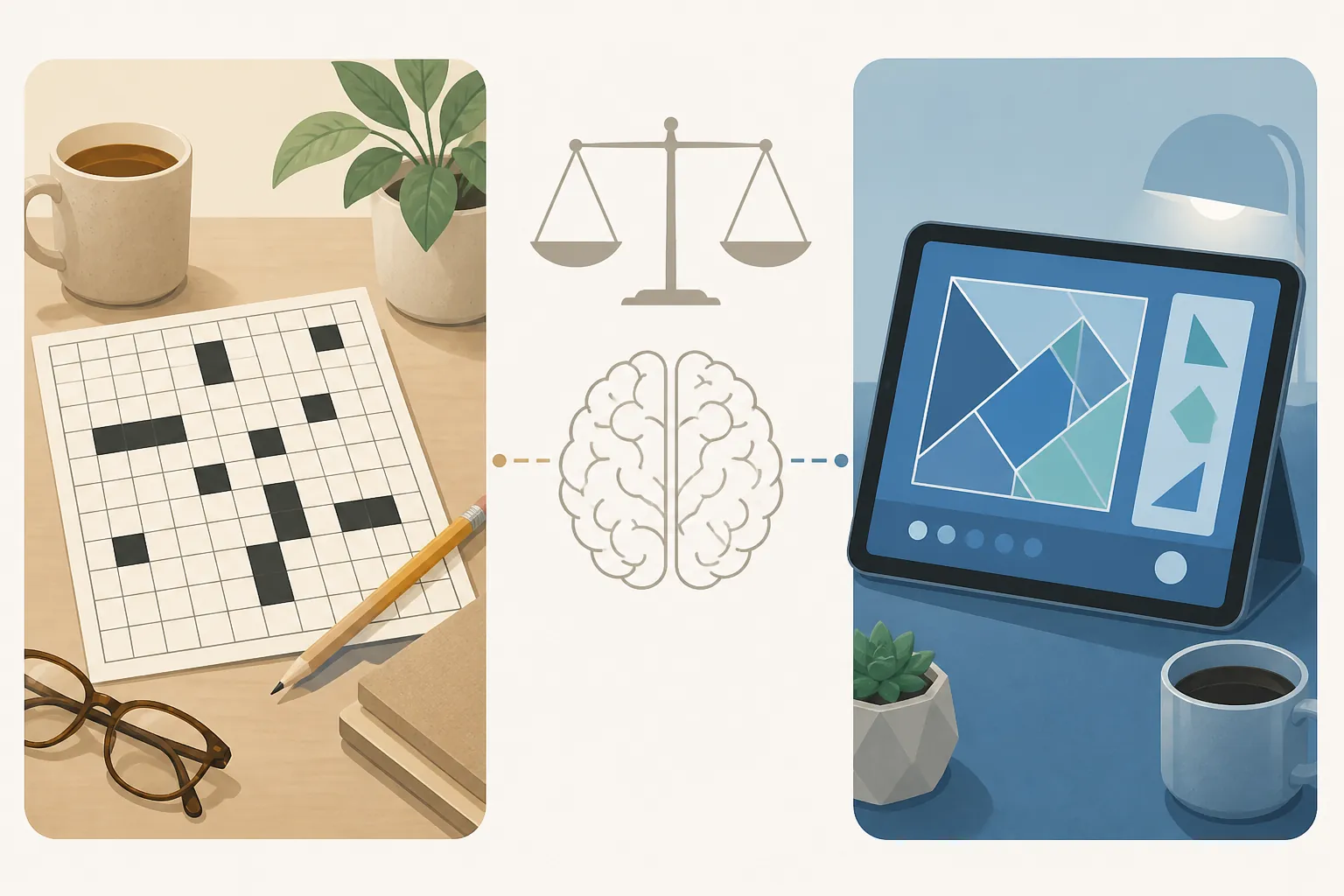
The 2.54-year finding is memorable, but it is observational
The Bronx Aging Study gives crossword puzzles another reason to be taken seriously, though with a different kind of evidence. In that study, 488 cognitively intact older adults were followed for up to 5 years. Among the 101 participants who later developed dementia, crossword participation was associated with a 2.54-year delay in the onset of accelerated memory decline.[2]
That number is easy to understand, and it is understandably attractive to families. Two and a half years of slower memory decline would feel enormous in real life. But the study was observational. People who do crosswords may differ from people who do not in education, health, routines, social engagement, or other habits that also affect cognitive aging. The study shows an association, not proof that crosswords caused the delay.
Still, the finding fits with the broader idea that structured cognitive engagement can matter for everyday functioning. The ACTIVE trial, which was not a crossword study, randomized 2,802 older adults with a mean age of about 74 to memory, reasoning, speed-of-processing training, or control. At 10 years, all three training groups reported less decline in instrumental activities of daily living, with about 60% of trained participants versus about 49% of controls at or above baseline function.[3]
A 2026 report from Johns Hopkins Medicine added longer-term interest to that same general field: boosted speed-of-processing training was linked to 25% lower dementia incidence up to 20 years later.[4] That is important context for cognitive training, but it should not be borrowed as crossword evidence. Speed-of-processing training is a specific computerized intervention, not a newspaper puzzle.
What crosswords may actually do well
The most defensible value of crossword puzzles for seniors’ brain health is not that they “stop dementia.” It is that they may support memory practice, language retrieval, attention, persistence, and routine. They also give an older adult a task with a beginning, a middle, and an end, which can matter when so much of aging involves being assessed, reminded, monitored, or helped.
For a caregiver, the practical question is not whether a parent becomes a better puzzle solver. It is whether the puzzle habit fits into a week that also supports meals, medications, movement, appointments, social contact, and sleep. A crossword that calms the morning and keeps someone engaged is useful. A crossword that becomes a source of frustration, arguments, or false reassurance needs a gentler place in the routine.
The COG-IT schedule—four 30-minute sessions per week for 12 weeks, with later boosters—was a research protocol, not a universal prescription.[1] It is reasonable to use it as a reference point if a parent enjoys puzzles, but not as a rule everyone must meet. Some older adults may like a daily puzzle over breakfast. Others may do better with a shorter puzzle a few times a week, a large-print book, or a shared puzzle at the kitchen table.
Brain health at home also means protecting the body
Crosswords belong in an independence plan, not in place of one. The same household that keeps a puzzle book by the chair still needs clear walkways, good lighting, stable footwear, vision care, medication review, physical activity, and balance practice. Those things are not as charming as a sharpened pencil beside the morning paper, but they are part of brain health because they help protect the person’s ability to live safely.
Falls are common enough that they cannot be treated as a separate issue from aging well. More than 1 in 4 adults age 65 and older falls each year, and falls are the leading cause of traumatic brain injury.[5] The Alzheimer’s Association also includes “protect your head” and preventing falls among its healthy habits for the brain.[6]
That does not mean crosswords reduce falls. The evidence above does not show that. The safer bridge is daily function: if an older adult can keep track of tasks, follow routines, stay engaged, and accept help early, the whole home-safety plan becomes easier to carry out. But the fall-prevention work itself still has to be done.
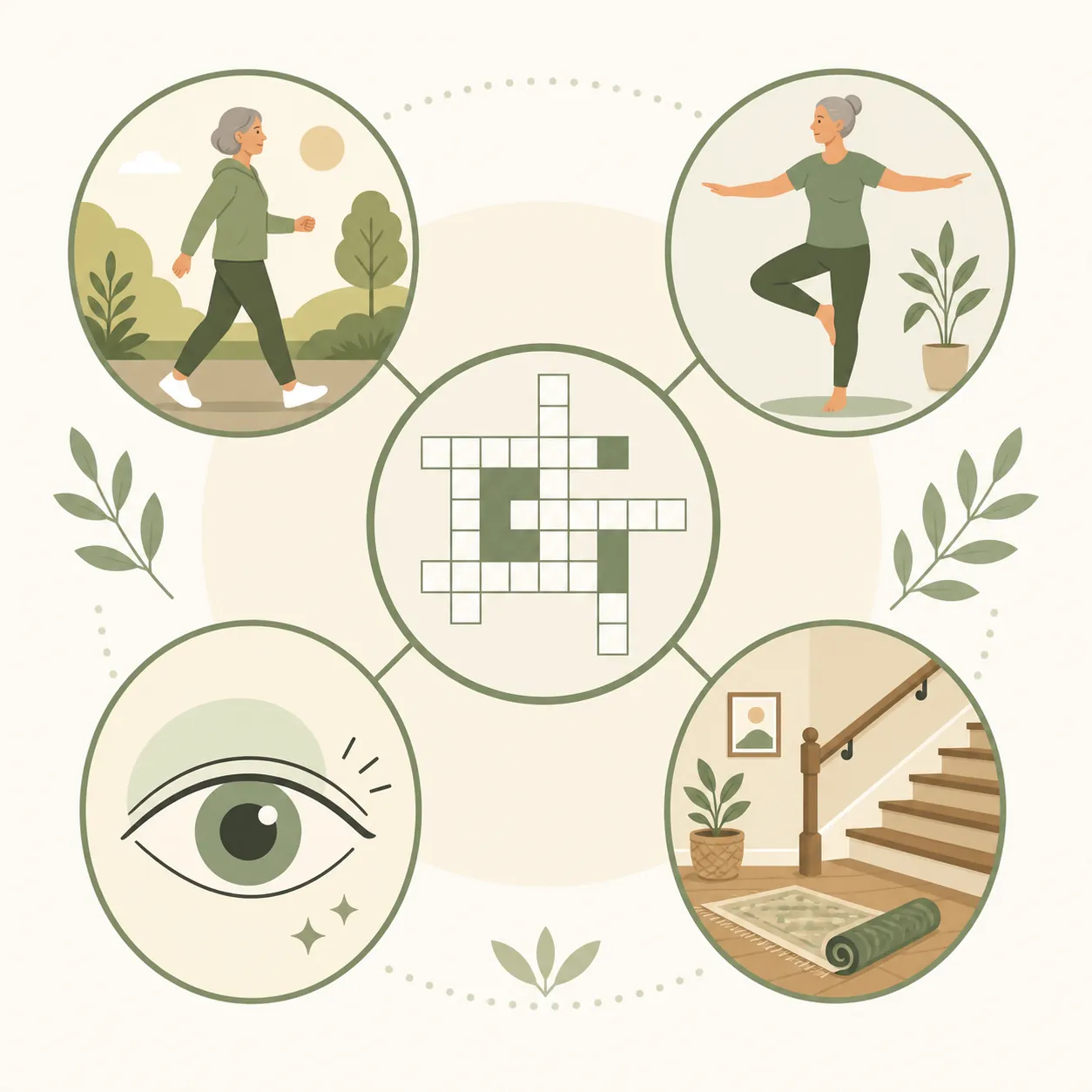
A realistic weekly routine might put the crossword beside, not above, the basics:
- A crossword or other preferred cognitive activity several times a week, adjusted for vision, frustration level, and enjoyment.
- Regular walking or other physical activity that the person can do safely.
- Balance and strength practice, especially if there has been a recent stumble, fear of falling, or reduced confidence.
- Vision checks and updated glasses, because small changes in depth perception or contrast can turn stairs and rugs into hazards.
- Home fixes: remove loose rugs, improve lighting, add railings or grab bars where needed, and keep frequently used items within safe reach.
Memory changes should not be handled with puzzles alone
If an older adult simply enjoys crosswords, there is no need to turn the habit into a medical project. But if memory changes are noticeable—missed appointments, repeated confusion, getting lost, trouble managing money, or a clear decline from the person’s usual ability—the next step is a clinical conversation, not a harder puzzle.
The CDC has reported that 11.2% of U.S. adults age 45 and older experience subjective cognitive decline, yet only 45.4% of those adults have discussed it with a health care professional.[7] That gap is too large. Some memory changes have treatable contributors, and even when they do not, families need planning time, medication review, safety guidance, and a clearer sense of what support is needed.
A crossword can be part of the week while that conversation is happening. It should not be used to postpone it.
Be careful with “brain training” promises
The phrase “brain training” often does too much work. It can mean crosswords, commercial apps, computerized laboratory tasks, memory classes, or almost any activity that feels mentally demanding. The evidence is not interchangeable across all of those activities.
The Alzheimer’s Society’s review of brain-training evidence is a useful guardrail: it notes that there is no strong evidence that brain training reduces dementia risk, and that improvements are often largely task-specific.[8] In plain terms, getting better at a puzzle may partly mean getting better at that puzzle. That can still be worthwhile, especially if the activity is enjoyable and keeps a person engaged, but it is not the same as proven dementia prevention.
This is why the best recommendation is modest. If a senior likes crossword puzzles, keep them in the routine. If they dislike them, do not force them as medicine. If cognition is changing, talk with a clinician. And if the real goal is staying safely at home, pair the puzzle habit with the less glamorous work: movement, balance, vision care, head protection, and home hazard fixes.
References
- Computerized Games versus Crosswords Training in Mild Cognitive Impairment, NEJM Evidence, 2022.
- Association of Crossword Puzzle Participation with Memory Decline in Persons Who Develop Dementia, Journal of the International Neuropsychological Society, 2011.
- Ten-Year Effects of the Advanced Cognitive Training for Independent and Vital Elderly Cognitive Training Trial on Cognition and Everyday Functioning in Older Adults, Journal of the American Geriatrics Society, 2014.
- Cognitive Speed Training Linked to Lower Dementia Incidence Up to 20 Years Later, Johns Hopkins Medicine, February 2026.
- Facts About Falls, Centers for Disease Control and Prevention.
- 10 Healthy Habits for Your Brain, Alzheimer’s Association.
- Subjective Cognitive Decline Among Adults Aged ≥45 Years — United States, 2015–2016, MMWR, Centers for Disease Control and Prevention, 2018.
- Brain training, Alzheimer’s Society.
Questions to bring to a clinician or OT
This is not medical, legal, or a family's final decision — only a framework. Bring these questions to a clinician, occupational therapist, or your local Area Agency on Aging.
Find Local HelpRelated reading
Noticed something outdated or inaccurate on this page? Flag a correction. We review every report against CDC, NIA, and AARP HomeFit guidance before updating a page.