
Caregiver decision guide
What Are the Biggest Fall Risks for Seniors on River Cruises?
Slip-and-fall injuries are the number-one medical transport reason on river cruises, yet most are preventable. This article identifies the four predictable high-risk zones—gangways, rafted-ship crossings, wet decks, and cobblestone excursions—and provides concrete pre-trip and onboard strategies to keep elderly passengers safe.
The biggest threat to elderly passenger safety on river cruises is not seasickness, buffet hygiene, or getting tired on a long tour. It is a fall in the wrong place. MedJetAssist, a medical transport membership company, reports that slip-and-fall injuries are the number-one reason for its river-cruise medical transport calls, with broken bones, spinal injuries, and severe head trauma among the predominant injuries it sees.[1] That is not a population-wide injury rate for the whole river-cruise industry, and it should not be treated as one. But as operational warning evidence, it is hard to ignore.
The consequence is different on a river ship than many families expect. River cruise vessels typically do not have an onboard infirmary; MedJetAssist describes them as carrying a first aid kit and AED rather than the medical facilities travelers may associate with large ocean ships.[1] A bad fall on a gangway or in a port town can quickly become a shore-side medical problem, in another country, with the slowest-recovering person in the family bearing the injury.
That does not make river cruises off-limits for older adults. It does mean “be careful” is too vague to be useful. Fall prevention has to name the places where balance is most likely to fail: gangways, rafted-ship crossings, wet decks, and cobblestone excursions.
The four places where fall risk concentrates
A river cruise compresses several difficult walking environments into one vacation. The ship moves. The dock height changes. Passengers cross between vessels. Shore excursions often begin immediately after breakfast, when people are carrying bags, cameras, medication, water bottles, and sometimes pride they do not want to surrender by asking for help.
The useful question is not whether an older passenger is “mobile enough” in a general sense. It is whether that passenger can safely manage these specific transitions, repeatedly, when tired, distracted, or hurried.
| Risk zone | What makes it hazardous | Most useful prevention behavior |
|---|---|---|
| Gangways | Slope changes with water level; walkway can be narrow; handrails may be rope rather than firm rails | Use both hands on rails and ask crew to carry bags before stepping onto the gangway |
| Rafted-ship crossings | Reaching shore may require crossing another ship and using stairs or sundecks | Ask in advance how passengers will disembark in each port and wait for assistance instead of rushing |
| Wet decks | Rain, river mist, cleaning, and pool-area moisture can turn a familiar path slippery | Wear closed-toe, no-slip shoes every time outside the cabin |
| Cobblestone excursions | Uneven stones, curbs, crowds, heat, and fatigue combine during walking tours | Choose gentle-walking groups, use a collapsible aid if needed, and skip outings when conditions stack up |
Gangways: the slope changes even when the itinerary does not
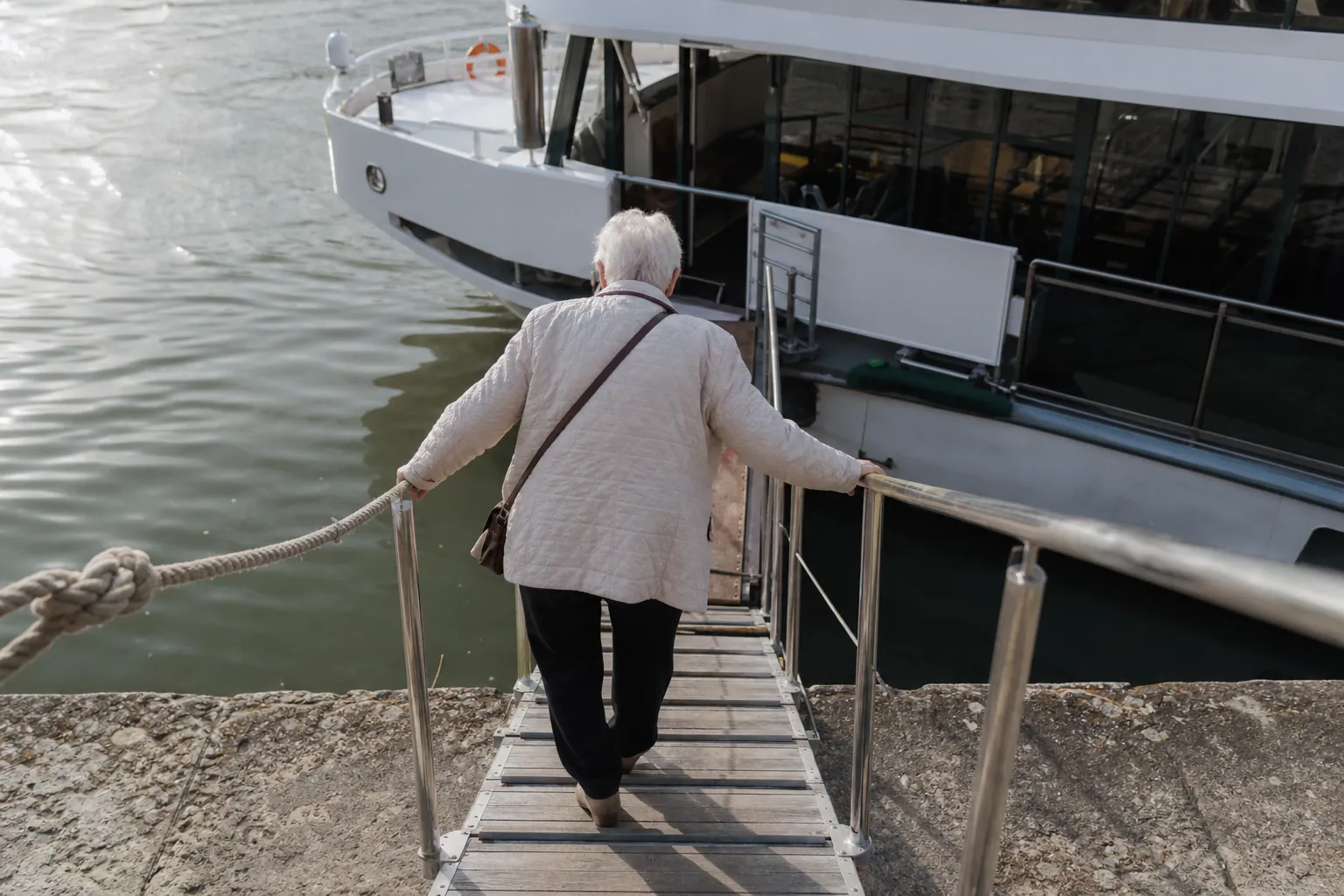
Gangways deserve more respect than they get in brochures. RiverCruiseAdvisor notes that river-cruise gangways can be narrow, may have rope handrails instead of sturdy railings, and can become steep depending on water levels.[2] That last part matters because the same port can feel manageable one day and intimidating another. A passenger may board easily in the afternoon and face a sharper angle after the river level or docking position changes.
The mechanics are simple and unforgiving. A steeper gangway shifts weight forward on descent and backward on ascent. If the older passenger is holding a tote in one hand and a phone in the other, the “handrail” might as well not be there. A rope rail may help with orientation, but it does not give the same stable grip as a fixed metal rail.
The rule is practical: no bags, no drink, no phone, no camera in hand on the gangway. Both hands are for rails. If that means asking a crew member or family member to carry the bag, ask before reaching the slope, not halfway down it. This is one of those small dignity negotiations that prevents a much larger loss of independence later.
Rafting: sometimes the route to shore crosses another ship
“Docked in town” does not always mean the ship is directly beside the pier. River ships may raft, tying side by side when port space is limited. CruiseCritic explains that this can require passengers to cross through or over another vessel, including stairs across sundecks, to reach shore.[3] For a steady adult with no mobility limits, this may be a novelty. For an elderly passenger who already uses a cane, walker, or careful pacing, it can be the most important accessibility detail of the day.
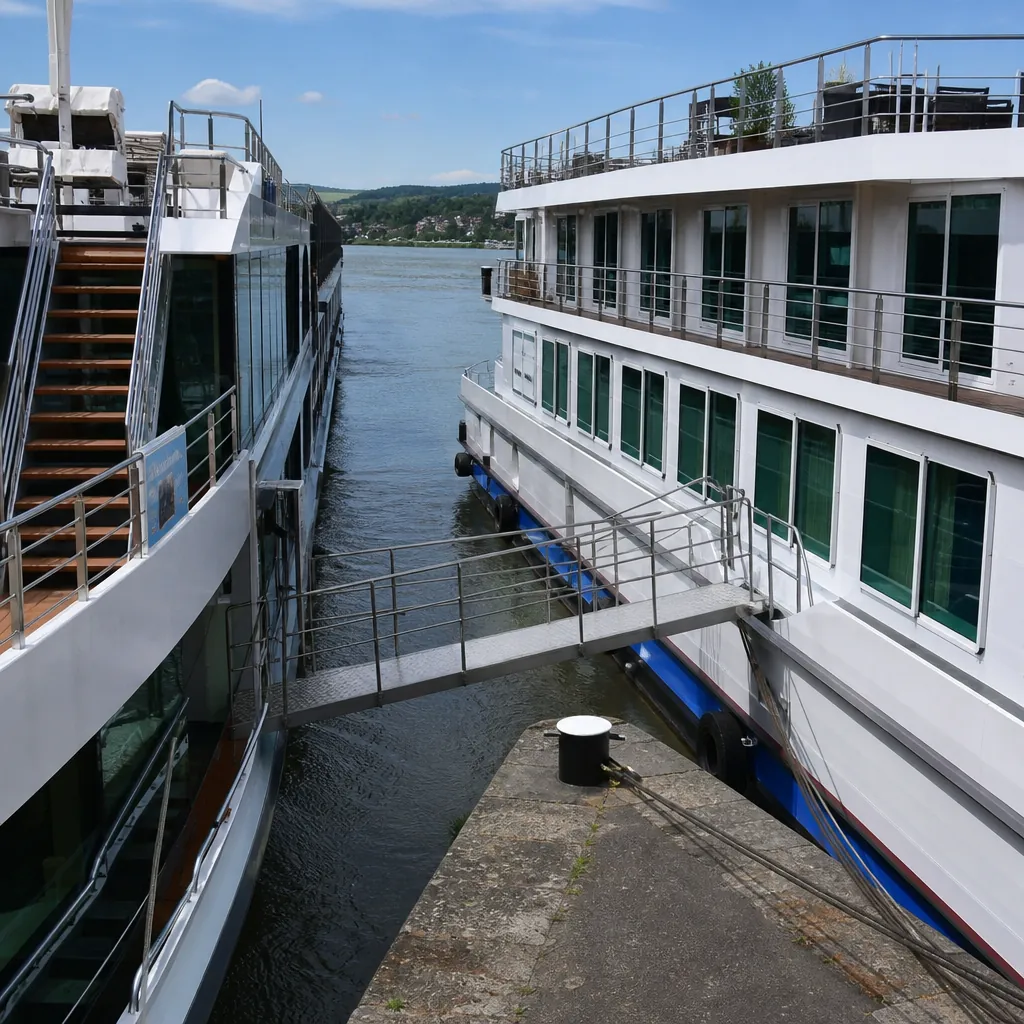
Rafting also exposes a common gap in ship accessibility. Most modern river ships have elevators, but RiverVoyages notes that the sundeck is typically accessible only by stairs.[4] An elevator to the main deck is helpful, but it does not solve a disembarkation route that sends passengers up and across a sundeck on a neighboring ship.
Before each port, the useful question at the desk is specific: “Will we be rafted, and will my parent need to use stairs or cross another ship to get ashore?” If the answer is yes, the family can decide whether to wait for a quieter disembarkation time, request crew assistance, switch to a less demanding excursion, or stay aboard without treating that choice as a failure.
Wet decks: familiar paths become different underfoot
Wet decks are less dramatic than gangways, which is why they are easy to underestimate. The path from cabin to lounge, lounge to dining room, or deck chair to stairwell can feel familiar after two days aboard. Then rain, mist, morning cleaning, or tracked-in water changes the surface.
This is where footwear stops being a packing preference and becomes safety equipment. Closed-toe shoes with no-slip soles belong on the passenger’s feet whenever walking outside the cabin. Sandals, loose loafers, and dress shoes with smooth soles may look fine at dinner and still be the wrong choice for a damp threshold or deck seam.
The home-safety habit transfers well here: treat any surface change as a cue to slow down. Thresholds, deck transitions, stairs, and shiny patches deserve a pause. It is the same logic CareWise Guide uses in fall prevention at home, extended into the travel setting under mobility and independence. It is not a substitute for the cruise line’s own medical, accessibility, or crew instructions; it is a way to notice hazards before they become emergencies.
Cobblestones: the excursion can be harder than the ship
Many European river itineraries sell the charm of old streets, market squares, cathedral lanes, and hillside views. The same features that make a port beautiful can make it hard underfoot. MedJetAssist specifically flags cobblestone streets in European ports as a source of fractured hips from falls among the river-cruise cases it handles.[1]
Cobblestones create several problems at once: uneven height, gaps, slick edges, visual distraction, and little margin for a shuffled step. Add a guide walking ahead, a group crossing streets, a warm afternoon, and a passenger trying not to slow everyone down, and the outing becomes less about sightseeing and more about balance management.
Gentle-walking groups are not a consolation prize. They are often the difference between actually seeing the town and spending the whole tour scanning the ground in panic. When a passenger already has balance problems, recent falls, neuropathy, low vision, or fatigue, choosing the slower group is a safety decision, not a personality statement.
Heat and dehydration can make the same walking route riskier, especially during summer port days. Families already thinking through fall prevention in hot weather can connect excursion planning with heat wave fall-prevention habits: water before the walk, shade when possible, medication timing checked before travel, and permission to end the outing early.
Before booking, ask about the trip as if a fall has real consequences
The best fall-prevention decisions happen before the deposit, not at the bottom of a wet gangway. Families should ask the cruise line or travel advisor about the specific ship, cabin, itinerary, and excursion style. A general reassurance that “many seniors cruise with us” is not the same as an answer about stairs, gangways, rafting, bathroom design, or mobility equipment.
Accessible cabins are limited, and the useful features are concrete: enough floor space to turn safely, a roll-in shower, grab bars, and a bathroom layout that does not force a risky step over a high threshold. The prevention strategy supported by accessibility guidance is to book these cabins early, often 6 to 12 months ahead, because waiting until final payment may mean the cabin type that would make the trip safer is already gone.
- Ask whether the ship has elevators and which decks they reach, including whether the sundeck is stair-only.
- Ask how often the itinerary uses rafted docking and whether passengers may need to cross other vessels.
- Ask what assistance crew can provide on gangways and whether they can carry bags during boarding and port stops.
- Ask whether excursions offer gentle-walking groups and whether cobblestones, hills, or long standing periods are expected.
- Ask whether the bathroom has a roll-in shower, grab bars, and enough space for the passenger’s actual mobility pattern.
Mobility equipment also needs an early reality check. RiverCruiseAdvisor reports that collapsible wheelchairs can be accommodated, while motorized scooters are discouraged or prohibited by most river-cruise lines.[2] A scooter that works well at home or in a resort may not work on a narrow gangway, in a small cabin, or during rafted disembarkation.
A collapsible cane, walker, or wheelchair should be chosen for the actual walking environments of the trip, not just for airport convenience. The question is not only “Can it fit?” but “Can the passenger use it safely when the ship is moving, the gangway slopes, or the group is waiting?”
Before boarding, plan for the boring moments
Falls often happen during transitions that nobody photographs: getting from taxi to pier, stepping from dock to gangway, unpacking in a compact cabin, turning in a bathroom at night, or hurrying to meet a tour group. Those are the moments worth planning.
The family should decide in advance who carries what. The elderly passenger should not be the one managing a shoulder bag, passport pouch, water bottle, jacket, and cane while approaching a gangway. Keep medications and essentials accessible, but distribute weight so both hands can be free whenever balance matters.
Travel insurance and medical transport coverage deserve a sober look because care abroad and evacuation can be financially complicated. For families sorting out what Medicare does and does not cover around fall prevention and related care, CareWise Guide’s Medicare fall prevention coverage overview is a useful starting point. The cruise line’s policies, travel insurer’s exclusions, and any medical transport membership should still be read directly before departure.
On board, make every exit a small safety check
A river cruise day can involve repeated exits: cabin to breakfast, breakfast to excursion, ship to dock, dock to bus, bus to town, town to ship, ship to dinner. Each exit is a chance to catch the same preventable mistakes.
- Shoes on: closed-toe, secure heel, no-slip sole.
- Hands free: bags assigned to someone else before stairs or gangways.
- Aid ready: cane, walker, or collapsible wheelchair positioned before the passenger stands.
- Route confirmed: ask about rafting, stairs, wet surfaces, and excursion pace.
- Pace protected: let the crowd go first if rushing would create risk.
The hardest part may be social rather than physical. Older passengers often do not want to be fussed over. Adult children often do not want to sound controlling. A neutral routine helps: shoes, hands, aid, route, pace. It turns the conversation away from “Are you sure you can do this?” and toward “Let’s set this up so you can do it safely.”
Changes in routine and environment can raise fall risk even when a person manages well at home. That same pattern shows up in other seasonal and family settings, including the way isolation, disruption, and unfamiliar activity can affect fall risk during holidays. The cruise version is more scenic, but the body still has to manage sleep changes, meals, medications, crowds, and uneven walking. CareWise Guide’s discussion of holiday loneliness and fall risk is a useful reminder that context can change safety, even when the person has not changed.
When skipping an outing is the safer choice
A skipped excursion can feel like wasted money. A fractured hip costs more. The decision does not have to be dramatic; it can be based on stacked risk. Cobblestones plus rain. Heat plus fatigue. Rafting plus stairs. A poor night’s sleep plus a long walking tour. Any one factor may be manageable. Several together may not be.
There is also a difference between independence and improvisation. Independence is choosing the gentle group, using the cane before balance fails, asking crew to carry a bag, or enjoying the town from a cafe near the dock instead of pushing through every street on the tour map. Improvisation is discovering at the gangway that the passenger cannot safely carry everything, cannot hold the rail, and does not know what the shore-side medical options are.
River cruises can remain possible for many older adults. They are simply not floating hotels with hospital-like backup. Families who treat gangways, rafted-ship crossings, wet decks, and cobblestone excursions as known hazards can plan around them before a fall turns the itinerary into a medical problem.
References
- Most Common River Cruise Illnesses and Injuries, MedJetAssist, April 4, 2025.
- River Cruise Accessibility, RiverCruiseAdvisor, August 2018.
- A Guide to Accessible River Cruises, CruiseCritic.
- Are River Cruises Suitable for Disabled Passengers?, RiverVoyages.
Questions to bring to a clinician or OT
This is not medical, legal, or a family's final decision — only a framework. Bring these questions to a clinician, occupational therapist, or your local Area Agency on Aging.
Find Local HelpRelated reading
Noticed something outdated or inaccurate on this page? Flag a correction. We review every report against CDC, NIA, and AARP HomeFit guidance before updating a page.