
Caregiver decision guide
Grocery Alternatives for Seniors When the Only Store Closes
When the only store in a small town closes — or a senior no longer drives — grocery delivery apps rarely fill the gap. The practical alternatives are volunteer shopping, senior vans, food-bank home delivery, and neighbor networks, all findable locally through the Eldercare Locator or 211.
This article is about the hard version of grocery access: the only store in town closes, or an older adult can no longer reach the store because they no longer drive. That is different from a delivery service ending or a named supermarket chain closing in an area that still has other retail choices; if that is your situation, start with the related guide on what to do when Stop & Shop or another local chain closes. Here, the problem is more basic: food is not reaching the kitchen table because the store and the ride are both gone.

A Pennsylvania township documented by Population Reference Bureau shows the mechanism plainly. After the township’s only grocery store closed, residents described food access becoming more difficult for older adults and people without reliable transportation. One resident said, “a dozen people I know personally don’t have a way to the grocery store.” Neighbors began filling gaps with grocery runs and food-pantry item drop-offs, but the interviews also make clear that the closure turned shopping into a transportation and coordination problem, not a preference for one store over another. The case drew on interviews with 26 residents over 8 months in 2022.[1]
That is why the real alternatives are usually local, human, and somewhat patched together. A grocery app may help in some suburbs and cities. In a rural township, on a gravel road, or in a small town where the only full grocery has closed, it often does not solve the part that failed. Someone still has to know which store is reachable, who can shop, how payment is handled, what happens with substitutions, and who can get the food inside the house.
Build a local food-access stack, not a single replacement
When the last store closes, the safest plan is rarely one perfect program. It is a stack: one way to get groceries purchased, one way to get the senior to a store when that is possible, one or more food programs that can cover meals or pantry staples, and a neighbor arrangement that fills the gaps without becoming the only lifeline.
| Layer | What it solves | What to verify locally |
|---|---|---|
| Volunteer grocery shopping or delivery | Someone shops for the older adult and brings groceries home | Service area, age or disability eligibility, fees, payment process, waitlist, and delivery day |
| Senior transportation to a store | The older adult rides to a supermarket on a scheduled van or shuttle | Pickup area, wheelchair access, shopping time allowed, reservation rules, and whether help carrying bags is available |
| Food-bank delivery, mobile pantry, or CSFP box | Pantry staples reach the household while grocery logistics are being rebuilt | Eligibility, pickup versus delivery, box contents, frequency, and waiting list |
| Home-delivered meals | Ready-to-eat nutrition support for a homebound older adult | Assessment process, meal days, cost or suggested contribution, and whether the program is full |
| Neighbor or church coordination | Flexible help for urgent or odd-day gaps | Privacy, payment handling, backup person, and whether the arrangement is sustainable |
The order matters. If a senior can cook and wants normal groceries, start with shopping and transportation. If the refrigerator is already empty, add food-bank and meal-program calls immediately. If a neighbor is helping, keep that help, but do not leave the whole arrangement balanced on one person’s availability.
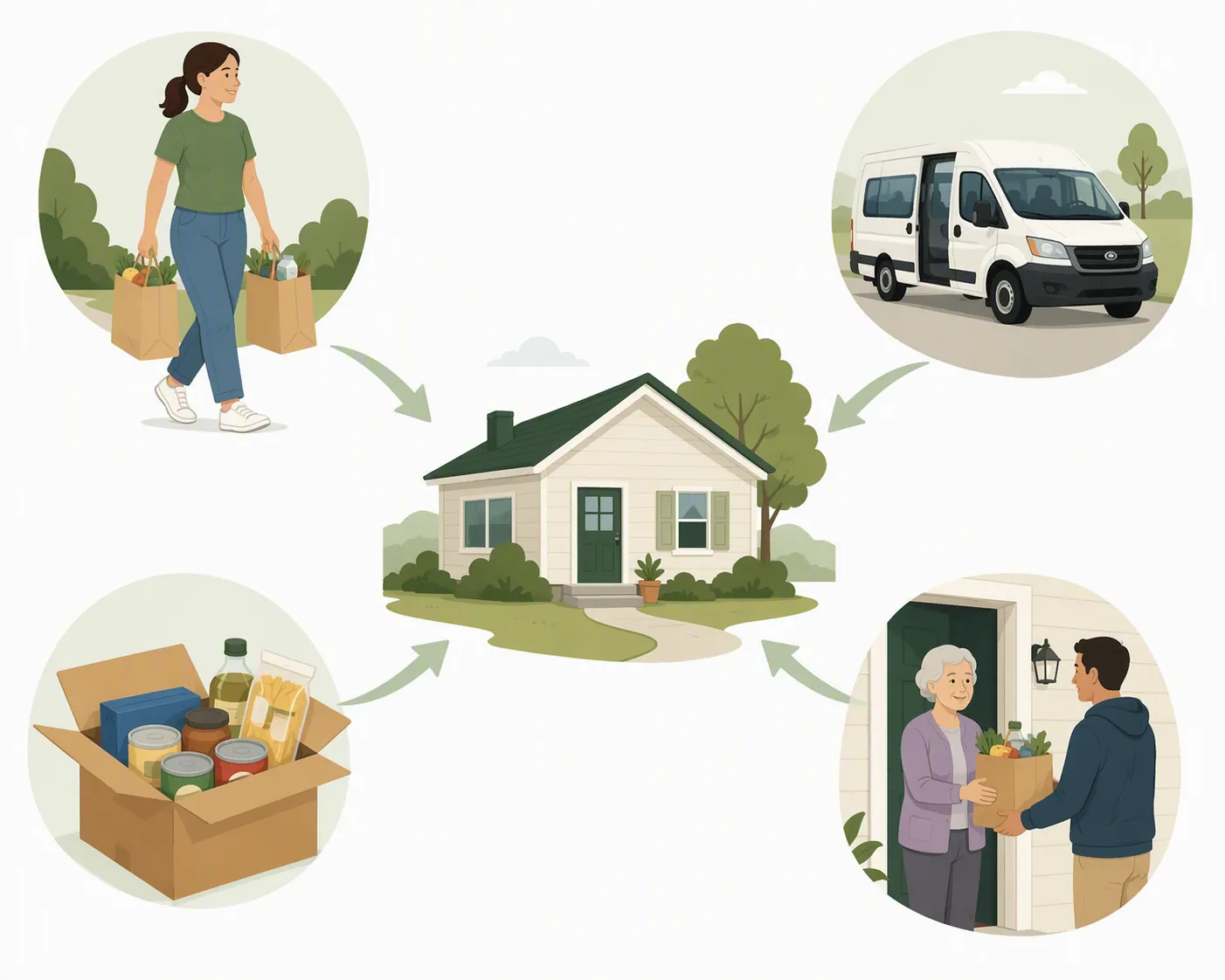
First look for a volunteer grocery-shopping program
A strong volunteer grocery model does not just drop food at the curb. It usually has a repeatable process: the older adult makes a grocery list, a trained volunteer or staff member shops, the organization handles delivery, and the program has rules for payment, substitutions, and eligibility. That is the local equivalent to look for.
Store to Door of Oregon is one concrete example, not a national option. It is a nonprofit serving the Portland metro area that has provided volunteer grocery shopping and delivery for seniors and adults with disabilities since 1989.[2] Meals on Wheels Central Texas runs a “Groceries To Go” volunteer program in which volunteers shop for older adults and adults with disabilities.[3] Those two programs are useful because they show what to ask for locally: not simply “delivery,” but volunteer shopping for seniors or adults with disabilities.
When calling local agencies, use plain wording. Ask: “Is there a volunteer grocery shopping program for an older adult who no longer drives?” Then ask the questions that decide whether it will actually work next week:
- Do you serve this exact address or township?
- Is the program for adults over a certain age, adults with disabilities, or homebound residents?
- How does the senior submit a grocery list — phone, paper form, email, or online?
- Who pays the store, and how is payment handled safely?
- Can the shopper choose substitutions, or does the senior need to approve each one?
- Will the volunteer bring bags inside, or only to the door?
- How often can groceries be delivered, and is there a waitlist?
Payment handling deserves more attention than it usually gets. A neighbor taking a debit card to the store may be kind, but it creates risk for both people. A formal program may have a safer process, such as billing, a prearranged account, or clear receipt handling. If no formal program exists, write down the arrangement, keep receipts, avoid sharing PINs, and make sure another trusted person can review what is happening.
If the senior can still shop, transportation may be the missing service
Sometimes the older adult does not need someone else to choose food. They need a ride to a supermarket that is now 15, 20, or 30 miles away. That points to a different set of calls: the senior center, Council on Aging, county transportation office, Area Agency on Aging, disability transit provider, or community action agency.
Caregivers looking for grocery transportation often report being directed to senior-center shopping vans, Council on Aging rides, or “senior shopper” arrangements through local agencies such as Jewish Family Services.[4] Treat that as a clue about where to ask, not as proof that every town has a van. In some counties the van runs one supermarket trip a week. In others it may be demand-response transit with advance reservations. In some places, there is no practical ride unless a volunteer driver program exists.
The details decide whether transportation is usable. A van that drops riders at the store for 45 minutes may work for an active older adult with a short list. It may fail for someone using a walker, someone who needs help reading labels, or someone who cannot carry bags from the curb to the kitchen. Ask whether the driver can assist with bags, whether an aide or family member can ride along, and whether the ride can accommodate a rollator, wheelchair, oxygen, or other mobility equipment.
For a distance caregiver, the reservation rules are just as important as the route. Find out who is allowed to book the ride, how far ahead it must be scheduled, whether the senior must answer a confirmation call, and what happens if weather cancels the trip. A grocery plan that depends on one monthly van ride needs a backup for snow, illness, and missed calls.
Use food-bank and senior nutrition programs to cover the gaps
Food banks and senior nutrition programs are not the same as ordinary grocery shopping. They may not provide every preferred brand, fresh item, or special diet. Still, they can keep pantry shelves from going bare while a shopping or transportation plan is being rebuilt.
Feeding America describes several senior food supports that may be available through local food banks or partner agencies, including mobile pantries, home delivery, and the Commodity Supplemental Food Program, or CSFP, which provides monthly food boxes to adults age 60 and older.[5] The important word is “may.” CSFP availability varies by state and area, and local programs can have eligibility rules, distribution schedules, or waiting lists.
When calling the food bank, do not stop at “Do you deliver?” Ask more specifically: “Do you have home delivery for seniors, a mobile pantry near this township, CSFP boxes for adults 60 and older, or a partner church that distributes food?” The person answering may know the county route better than a national website does.
Home-delivered meals belong in the stack too, especially for a homebound senior or someone who can no longer cook safely every day. Meals on Wheels and similar programs are often funded through the Older Americans Act. NCOA’s caregiver guide cites ACL data describing a network of about 5,000 organizations providing up to 900,000 meals a day, and notes that there is no federal income test for Older Americans Act home-delivered meals for people age 60 and older.[6]
That does not mean every eligible person gets immediate daily meals. Local programs may assess need, prioritize homebound residents, request a voluntary contribution, operate only on certain days, or have capacity limits. The practical use is to ask for an assessment and, if there is a waitlist, ask what emergency food, frozen meals, shelf-stable meals, or partner referrals are available in the meantime. Benefits-adjacent program details such as CSFP and Older Americans Act meal access should be verified locally because rules and capacity can change by place; this article was prepared with information available as of August 1, 2026.
Neighbor help is real help, but it needs guardrails
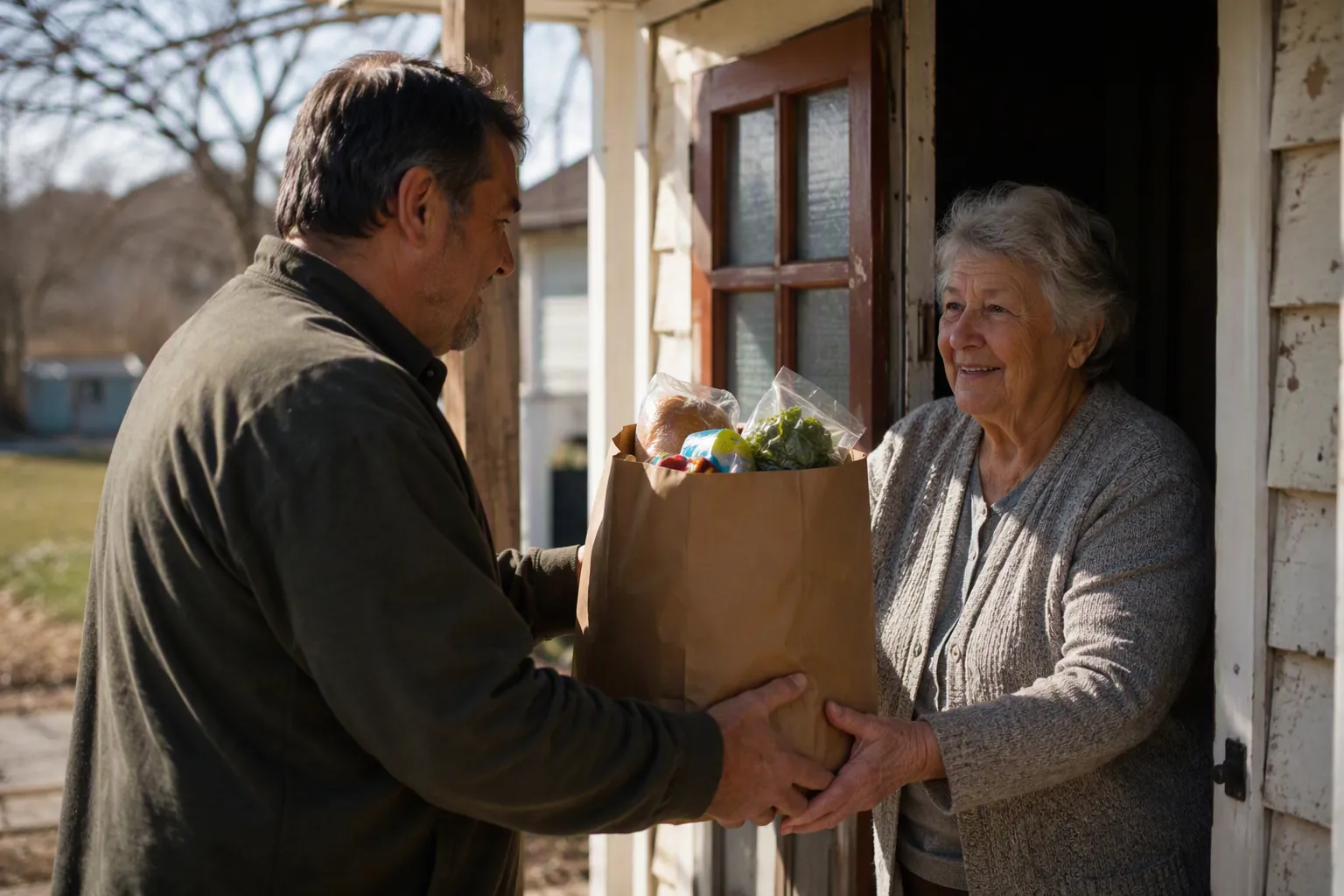
In the Pennsylvania township case, neighbors did exactly what neighbors often do when the formal system is thin: they picked up groceries and dropped off food-pantry items for people who could not get to the store.[1] That help counts. It may be the reason someone eats normally during the first week after a closure.
It is still not a complete system. The helpful neighbor can get sick, go out of town, lose access to a car, or become overwhelmed. The older adult may be embarrassed to ask for certain items. Payment can become awkward. A well-meaning helper may end up seeing medical supplies, mail, financial papers, or other private details inside the house.
A safer neighbor arrangement is simple and visible. Keep the grocery list written down. Keep receipts. Decide ahead of time whether the neighbor is reimbursed by check, cash in a sealed envelope, a store gift card, or another method that does not require sharing a debit-card PIN. Name a backup person. If an adult child is coordinating from a distance, ask the senior’s permission before turning one neighbor into the main contact for every problem.
Churches, township staff, volunteer fire departments, senior centers, and food-pantry volunteers often know the informal network before it appears on a website. They may know who already drives to the larger supermarket every Tuesday, which pantry has extra produce, or which road the county van will not travel in winter. That local knowledge is useful precisely because it is local. It still needs backup.
What not to make Plan A
A grocery delivery app is worth checking only if it truly serves the address, can deliver from a store with the foods the senior needs, and has a reliable payment and communication setup the senior can use. If the app has no shoppers nearby, cancels frequently, does not cover the road, or requires smartphone coordination the older adult cannot manage, it is not an alternative. It is a distraction.
Commercial delivery may still be a backup for shelf-stable goods, bulk paper products, or an adult child placing an occasional order. But it should not replace calls to the county aging office, food bank, senior center, and local transportation provider. Those are the places that know whether anyone is actually delivering to that house this week.
The call path when you do not know where to start
Start with the Area Agency on Aging. The federal Eldercare Locator can connect callers to local aging services at 800-677-1116 or through eldercare.acl.gov.[7] Give the full address, not just the town name, because service boundaries can change by county, township, ZIP code, or transit zone.
- Call the Eldercare Locator at 800-677-1116 or search eldercare.acl.gov for the local Area Agency on Aging.
- Ask the Area Agency on Aging for grocery shopping help, senior transportation to grocery stores, home-delivered meals, CSFP boxes, food-bank delivery, and volunteer driver programs.
- Call 211 and ask the same questions, using the senior’s exact address.
- Call the senior center, Council on Aging, or county transportation office and ask whether there is a shopping van, demand-response ride, or senior-shopper program.
- Call the regional food bank and ask about home delivery, mobile pantries, CSFP distribution, and partner churches or pantries near the senior.
- Call a nearby church, township office, community action agency, or volunteer fire department if formal programs are thin; ask who locally coordinates rides, pantry pickup, or grocery runs.
Write down names, not just phone numbers. Ask each person, “If you cannot help, who usually can?” In small towns and rural counties, the second referral is often the useful one: the church pantry that delivers on Thursdays, the senior center van that takes two riders at a time, the volunteer shopper with a waitlist, or the food bank staff member who knows which mobile pantry is closest.
There is rarely one universal substitute when the only store closes. There is often a county-specific patchwork. The work is to find the pieces, check the rules, and layer them so the older adult is not depending on one fragile ride, one neighbor, or one app that may not come.
References
- When the Grocery Store Closed, a Town Lost More Than Food, Population Reference Bureau
- Store To Door of Oregon
- Groceries To Go, Meals on Wheels Central Texas
- Any transportation help options for mom for groceries shopping?, AgingCare
- Senior Food Programs, Free Senior Meals, Feeding America
- Can Seniors Get Free Meals Delivered at Home?, NCOA
- Eldercare Locator, ACL
Questions to bring to a clinician or OT
This is not medical, legal, or a family's final decision — only a framework. Bring these questions to a clinician, occupational therapist, or your local Area Agency on Aging.
Find Local HelpRelated reading
Noticed something outdated or inaccurate on this page? Flag a correction. We review every report against CDC, NIA, and AARP HomeFit guidance before updating a page.