
Caregiver decision guide
How the Full Moon Affects Seniors' Sleep and What to Check
The full moon's effect on sleep is real but modest, and the strongest effect shows up a few days before the full-moon night. For older adults, sleep habits and the middle-of-the-night bathroom path matter more than the moon for fall risk, and the monthly moon is a practical reminder to check both.
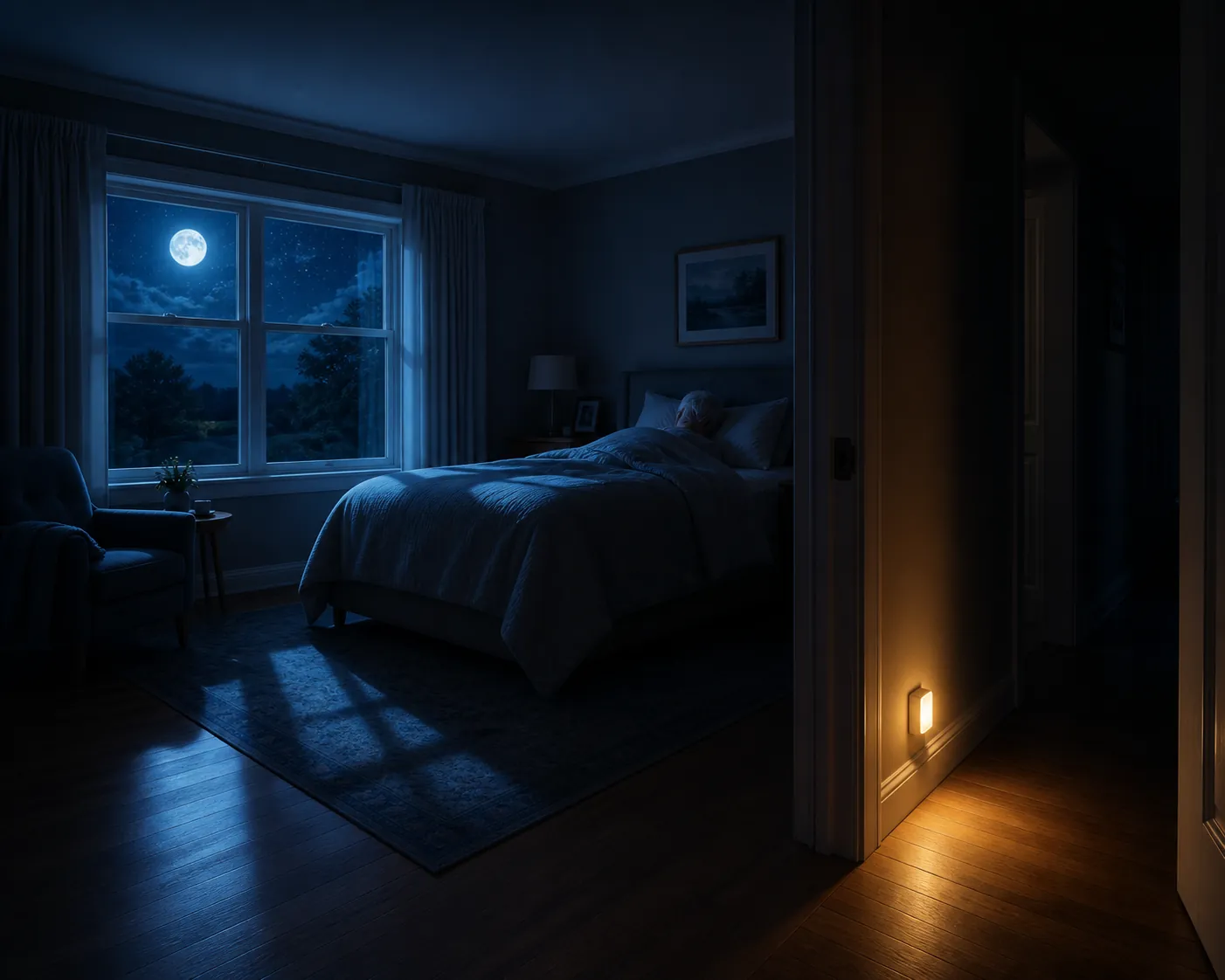
Does the full moon really affect seniors’ sleep? The most honest answer is: it may affect sleep, but the measured effect is usually modest, the timing is often a few nights before the full moon rather than on the full-moon night itself, and the evidence is mixed. Just as important, the main lunar-sleep studies were not designed specifically around older adults, so it is too much to say that the moon has a proven, senior-specific effect.
That does not make a caregiver’s observation useless. If an older parent repeatedly has restless nights near the full moon, the useful question is not only “Did the moon cause it?” It is also “What happens when this person gets up at 2:30 a.m. after a poor night of sleep?” For many households, the answer depends less on moonlight than on the bed-to-bathroom route, the hallway light, the rug edge, the toilet area, and whether poor sleep is part of a larger medical pattern.
What the lunar-sleep studies actually found
The best-known controlled laboratory study found that, around the full moon, participants slept about 20 minutes less, took about 5 minutes longer to fall asleep, had about a 30% reduction in EEG activity associated with deep sleep, reported poorer sleep quality, and had lower melatonin levels. [1]
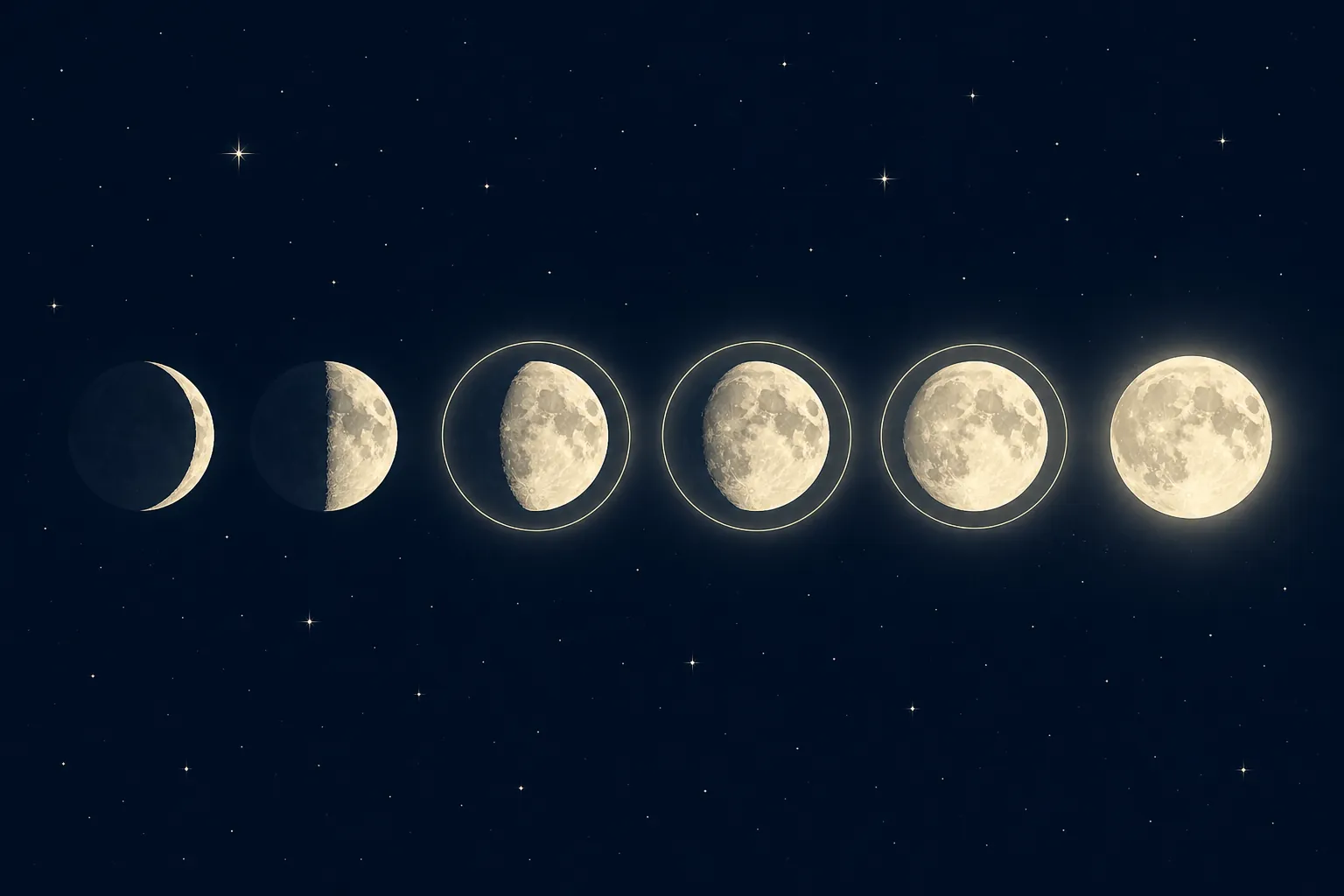
A later field study complicated the familiar story in a helpful way. It found that sleep onset shifted 30 to 80 minutes later and sleep duration shortened by 20 to more than 90 minutes depending on the group, but the strongest change appeared 3 to 5 days before the full-moon night. That pattern appeared in communities with and without access to electric light. [2]
That timing matters. If a family says, “She never sleeps well on the full moon,” it may be worth looking at the few nights before it, too. A calendar that marks only the bright round moon in the sky may miss the window where some studies saw the strongest sleep shift.
The evidence also has to be kept in proportion. Other studies have not found a meaningful lunar association with sleep. A population-based Swiss study reported no lunar effect, and a longitudinal sleep-diary study likewise found no clear relationship between lunar phase and sleep. [3][4]
So the answer is not “the full moon ruins sleep,” and it is not “families are imagining everything.” A reasonable middle ground is that some studies show small-to-moderate sleep changes around the full moon, especially before it, while other studies do not. None of these studies proves that the lunar cycle is a major sleep disruptor in seniors specifically.
Why older adults deserve extra caution anyway
Older adults are already more likely to have sleep that is lighter, more fragmented, and shifted earlier than it used to be. A Sleep Health report on aging notes that sleep in later life often includes more awakenings, less deep sleep, and earlier sleep timing, and that about half of older adults report sleep problems. [5]
That is where a modest lunar effect can still matter in a practical household. Twenty fewer minutes of sleep in a lab study is not dramatic by itself. A few nights of later sleep, shorter sleep, stiffness, urgency, poor lighting, and a trip to the bathroom can add up in a way that is very real for the person walking half-awake.
The safer way to use the moon is as a predictable monthly prompt. If rough sleep tends to cluster near the full moon, mark the 3 to 5 nights before it and check the ordinary hazards before those nights arrive. The moon does not need to be the proven cause for the reminder to be useful.
The stronger evidence is about poor sleep and falls
For fall prevention, sleep quality is the sturdier part of the evidence. In the MrOS Sleep Study of 3,101 community-dwelling older men, sleeping 5 hours or less was associated with higher odds of recurrent falls, with an odds ratio of 1.79. Sleep efficiency below 70% had an odds ratio of 1.32, excessive daytime sleepiness had an odds ratio of 1.52, and nocturnal hypoxemia—defined in the study as at least 10% of sleep time with oxygen saturation below 90%—had an odds ratio of 1.62. [6]
A much larger population study of 201,700 adults also found that poor sleep quality, measured as a Pittsburgh Sleep Quality Index score above 5, was associated with falls, with an odds ratio of 1.30. The association held across adult age groups, including people age 60 and older. [7]
These findings do not mean that one bad night causes a fall. They do mean that short sleep, poor sleep efficiency, daytime sleepiness, and breathing-related oxygen drops during sleep are not just “normal aging” details to wave away. They are signals worth noticing, especially when an older adult is already unsteady, wakes often to use the bathroom, takes medications that cause dizziness, or lives with low lighting and loose flooring.
| If the pattern is... | Take it seriously as... |
|---|---|
| A few restless nights before the full moon | A reason to prepare the home route and protect sleep opportunity, not proof that the moon is the main cause |
| Regularly sleeping 5 hours or less | A fall-risk clue, especially if the person is also getting up at night or feels unsteady |
| New or worsening daytime sleepiness | A reason to ask about sleep quality, medications, nighttime awakenings, and possible medical causes |
| Loud snoring, gasping, or suspected pauses in breathing | A reason to discuss possible sleep-disordered breathing with a clinician |
| Confusion, agitation, or wandering at night | A different safety problem that may need a dementia-aware nighttime plan |
What to check before the rough nights arrive
Start with the trip the person is most likely to make when sleep is worst: bed to bathroom. This is not the glamorous part of fall prevention, but it is often the part that decides whether a sleepy person can move safely without fully waking up.
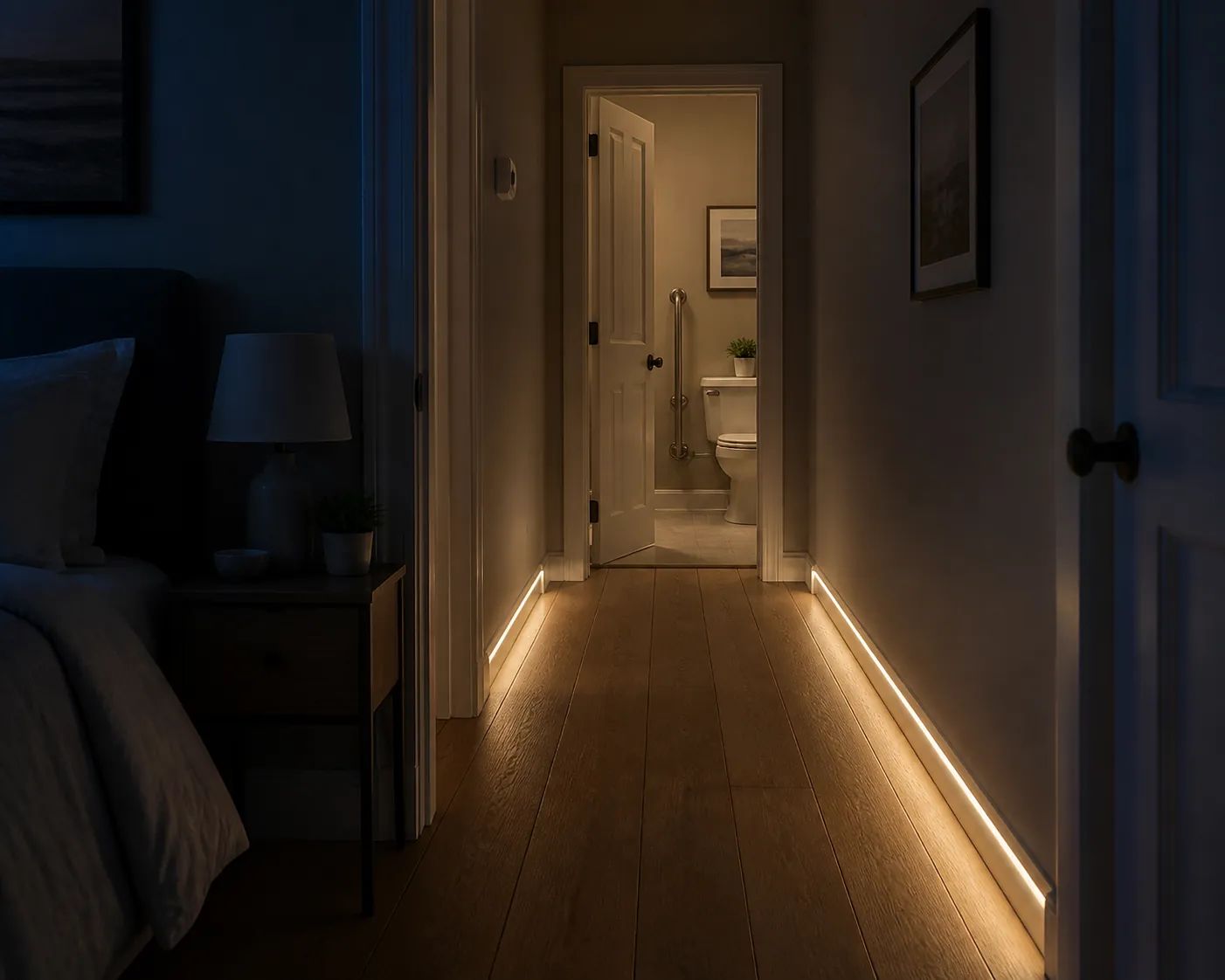
- Clear the exact path from bed to bathroom. Walk it at night-level lighting, not in bright daytime conditions. Remove shoes, baskets, charging cords, pet beds, laundry, and furniture corners that narrow the route.
- Use low-level night lighting instead of relying on memory. A floor-level or motion-sensing light can help without flooding the room with glare. CareWise Guide’s night-lighting and bed-to-bathroom route guide covers this kind of dark-hours setup.
- Remove loose rugs and mats, especially small bathmats that slide. A mat that seems harmless in the afternoon can become a trip point when someone is urgent, sleepy, and trying not to turn on a bright light.
- Check the toilet area. If the person pushes off the towel bar, wall, sink edge, or door frame, that is a sign the support is improvised. A properly placed grab bar is safer than asking a towel bar to do a grab bar’s job. For dimensions and placement concepts, see the guide to ADA standards and grab bars for aging in place.
- Make the first step out of bed predictable. Keep glasses, cane or walker, slippers, and a reachable light in the same place every night.
If the home has other dark-hours hazards—stairs, a cold entryway, a long hall, a cluttered laundry area—the same idea applies room by room. The winter room-by-room fall-prevention checklist is useful even outside winter because it looks at what changes when lighting, footing, and routine get worse.
Do a short sleep check, not a moon investigation
A moon calendar can help you notice timing, but it should not become the whole explanation. The more useful sleep check is plain and specific:
- What time does the person usually go to bed and get up?
- How many hours are actually available for sleep?
- How often are they awake during the night?
- Do they feel sleepy during the day?
- Is there loud snoring, gasping, choking, or morning headache?
- Do they drink caffeine late in the day or alcohol near bedtime?
- Do medications, pain, urinary urgency, anxiety, or caregiving interruptions explain the awakenings?
The basic sleep-environment targets are not exotic: enough sleep opportunity, consistent bed and rise times, a dark, quiet, cool bedroom, daytime light and activity, and avoiding late caffeine or alcohol. The Sleep Health report describes 7 to 8 hours, consistent timing, and a bedroom temperature range of 60°F to 67°F among its practical sleep-health recommendations for older adults. [5]
If the person has dementia and the “full moon” pattern is really nighttime agitation, wandering, or sundowning, treat that as a different safety problem rather than a lunar sleep problem. A dementia-aware plan may need simpler lighting, secured exits, calmer evening routines, and caregiver backup. CareWise Guide’s article on supporting a parent with dementia and emotional changes may be a better fit for that situation.
Why the mechanism is still uncertain
Moonlight is an obvious suspect, but it does not explain everything. The Sleep Foundation notes that moonlight is only about 7% as intense as sunlight, and the controlled lab findings are hard to reduce to ordinary outdoor brightness alone. [8][1]
Lunar gravity is not a tidy answer either. Harvard Health notes that gravitational effects are essentially similar at the full moon and the new moon, which makes gravity a poor explanation for a sleep effect that is described as full-moon-related. [9]
That leaves several possibilities: light exposure, behavior, expectation, biology that is not yet well understood, or some combination. For a caregiver, the uncertainty is a warning against both overconfidence and dismissal. The mechanism is not settled enough to diagnose the moon as the problem, but the pattern can still be useful if it gets you to check sleep and safety before a predictable rough stretch.
When to bring it up with a clinician
A single restless night near the full moon is usually not the point. Repeated short sleep, worsening insomnia, new daytime sleepiness, falls or near-falls, dizziness when getting up, loud snoring, gasping, or suspected breathing pauses during sleep are worth discussing with a clinician.
If the older adult has Medicare, the Annual Wellness Visit can be one place to ask for a fall-risk discussion and a broader review of sleep, medications, mobility, vision, and home hazards. CareWise Guide’s Medicare Wellness Visit fall-prevention guide explains how that conversation can fit into a prevention plan.
Use the full moon as a calendar cue, not a diagnosis. If sleep gets rough on a monthly rhythm, look 3 to 5 nights before the full moon, protect the person’s sleep opportunity, and make the nighttime bathroom route boringly safe before the bad night arrives.
References
- Evidence that the lunar cycle influences human sleep — Current Biology, 2013
- Moonstruck sleep: Synchronization of human sleep with the moon cycle under field conditions — Science Advances, 2021
- Lunar cycle and sleep: A population-based study — Sleep Medicine, 2015
- Sleepless night, the moon is bright: longitudinal study of lunar phase and sleep — Journal of Sleep Research, 2006
- Sleep Health and Aging: Recommendations for Promoting Healthy Sleep among Older Adults — Sleep Health, 2023
- Actigraphy-measured sleep characteristics and risk of falls in older men — Journal of the American Geriatrics Society, 2014
- Association between sleep quality and falls: A nationwide population-based study — 2021
- Do Moon Phases Affect Your Sleep? — Sleep Foundation
- Moonlight may affect sleep cycles — Harvard Health
Questions to bring to a clinician or OT
This is not medical, legal, or a family's final decision — only a framework. Bring these questions to a clinician, occupational therapist, or your local Area Agency on Aging.
Find Local HelpRelated reading
Noticed something outdated or inaccurate on this page? Flag a correction. We review every report against CDC, NIA, and AARP HomeFit guidance before updating a page.