
Caregiver decision guide
How to Decide if a Dementia Patient Can Go Out Today
This decision guide helps family caregivers evaluate five key factors — including their own readiness and sundowning risk — to decide whether a public outing with a loved one who has dementia is safe, and provides structured in-home alternatives when the answer is no.
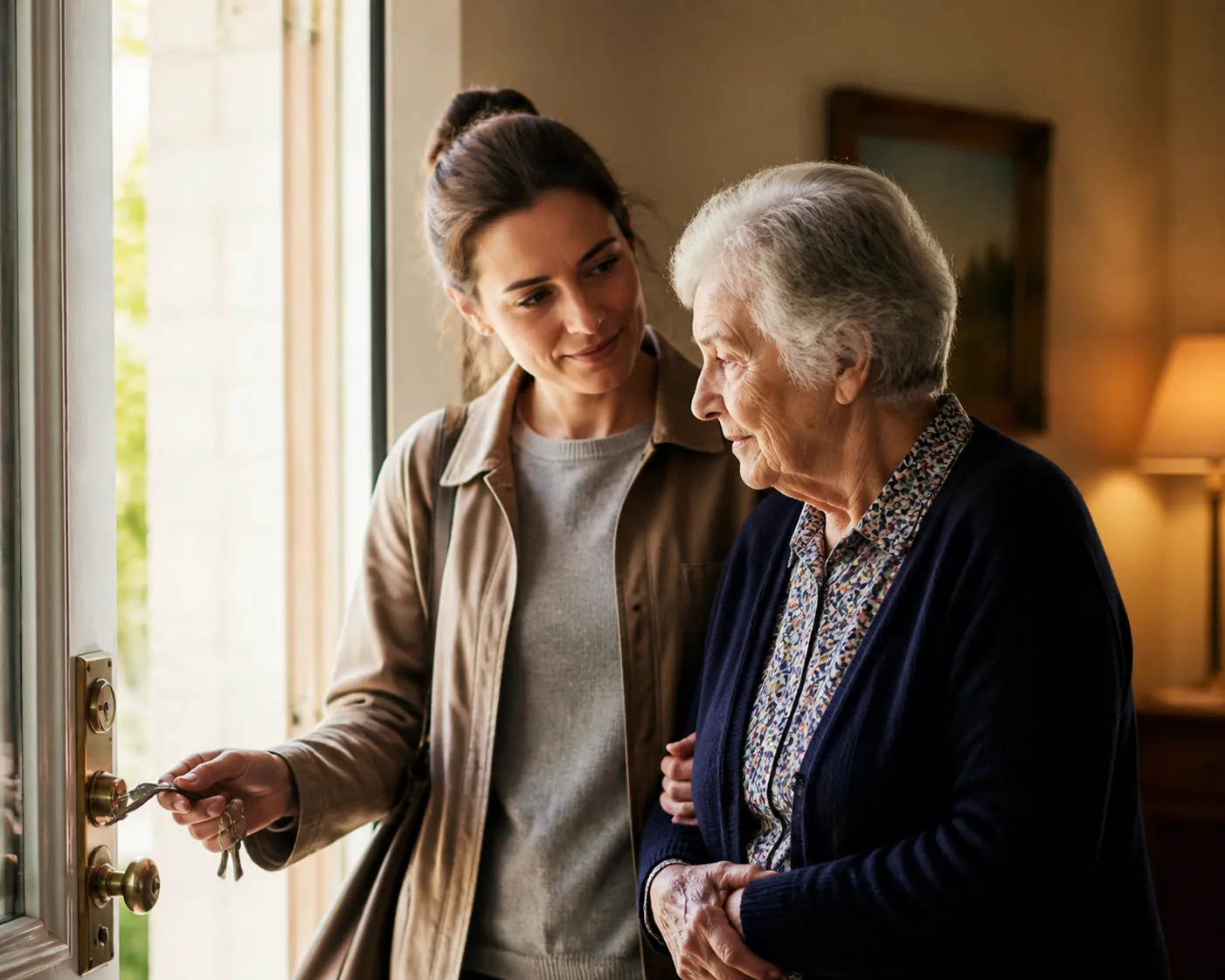
The keys are in your hand, and you are already doing the math. They seemed fine after breakfast, then paced for a few minutes near the hallway. You need milk, they might enjoy the café, and staying inside again feels like another small surrender. At the same time, you know exactly who will watch the exits, answer the repeated questions, smooth over a tense moment with a stranger, and decide whether to abandon the trip halfway through.
That pressure is real. More than 40% of dementia caregivers report at least moderate loneliness and social isolation, according to RTI International, and the slow shrinking of daily life can affect both the caregiver and the person receiving care.[1] But a public outing is not automatically kind just because it gets someone out of the house. The wrong hour, the wrong setting, or the wrong caregiver headspace can turn a well-meant trip into distress that follows everyone home.
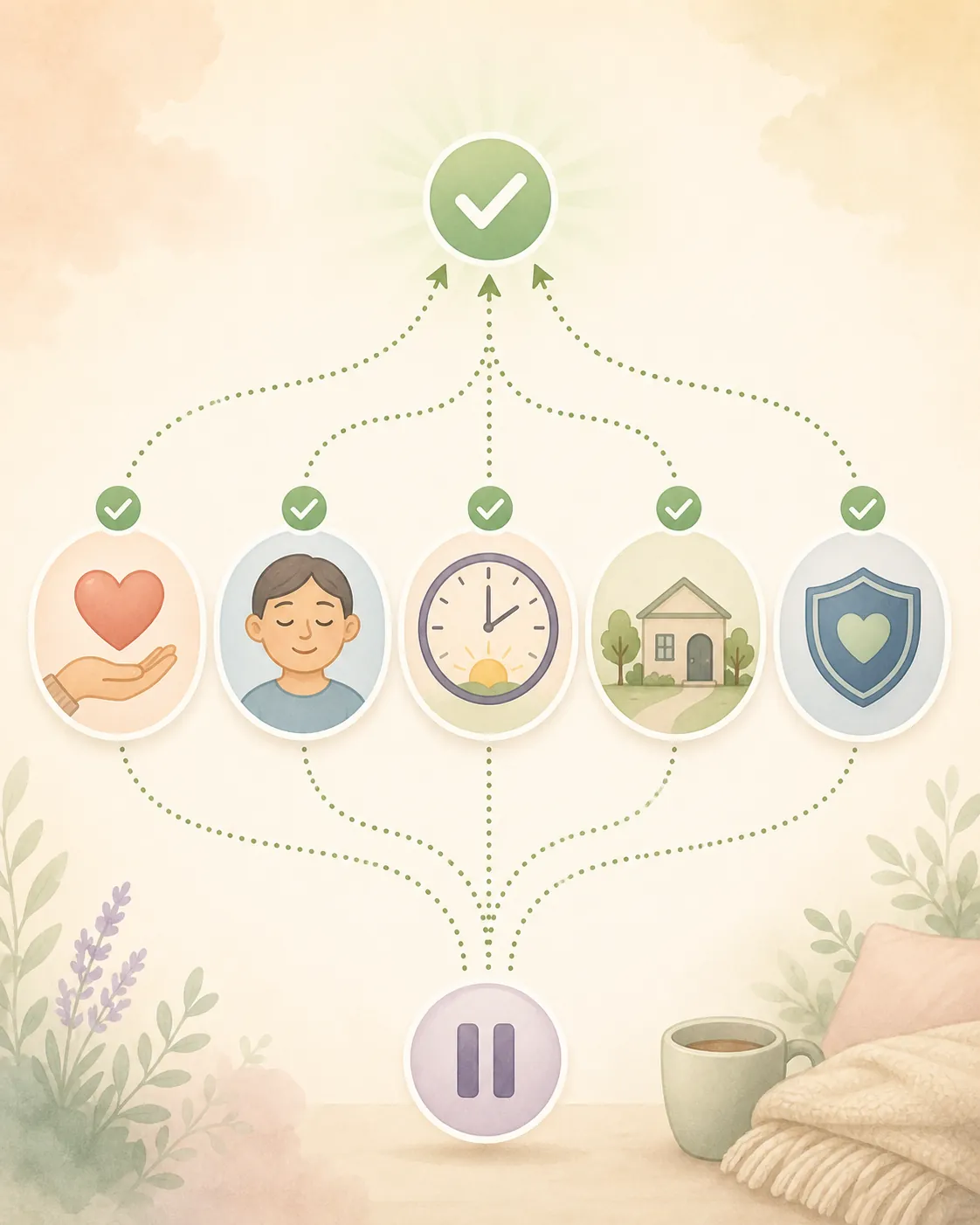
So the better question is not simply, “Should we go out?” It is: “Does today pass the five-factor check?” The answer may be yes, no, or yes with a shorter plan. Any of those can be good caregiving.
The five-factor go/no-go check
Before you pick up the bag, start the car, or promise a destination, run through these five factors in order. This is general caregiving guidance, not medical advice; sudden changes in agitation, walking, alertness, breathing, pain, or confusion deserve a call to a clinician.
| Factor | Green light | Pause or no-go |
|---|---|---|
| Caregiver readiness | You can stay patient, repeat yourself, leave early, and absorb a little public awkwardness. | You are rushed, resentful, overstimulated, or unable to leave without feeling defeated. |
| Person's current state | They are relatively calm, redirectable, physically comfortable, and not showing clear distress signs. | They are pacing, raising their voice, withdrawing, breathing rapidly, or already resisting the plan. |
| Time of day | Morning or early afternoon, especially if that is usually their steadier window. | Late afternoon or evening, especially if sundowning-like patterns are common. |
| Venue suitability | Quiet, familiar, short, accessible, and easy to exit. | Crowded, loud, confusing, open-ended, or full of waiting. |
| Safety preparedness | Identification, exit awareness, phone charged, companion card, and enough support for the risk level. | No exit plan, no ID, high wandering risk, or you would be managing more than one person can safely manage. |
Start with your own readiness
Amy O’Rourke, an aging expert quoted by WCAX in July 2026, put the first branch plainly: “Are you in a place of patience to go out with them?”[2] It is a bracing question because it names the piece many caregivers feel ashamed to admit. Your patience is part of the safety plan.
Not being ready does not mean you are unloving. It may mean you are already running late. It may mean you slept badly, have been answering the same question since dawn, or feel your chest tighten at the thought of one more person staring. It may mean you can manage the outing only if everything goes perfectly, which is not a fair condition to place on a person with dementia or on yourself.
The practical test is not whether you wish you were more patient. It is whether you can do the ordinary work of the outing: repeat the same reassurance without sounding punished, redirect without grabbing, let a purchase go unfinished, and leave after ten minutes without treating the day as ruined.
- Go if you can calmly shorten, simplify, or cancel the plan once you are out.
- Pause if you are depending on the outing to prove that things are still normal.
- No-go if you already know that repeated questions, slow walking, public comments, or a sudden refusal will push you past your limit.
Caregivers often override this factor because the errand seems small. But “just the pharmacy” can still involve parking, lights, aisles, waiting, payment, bathrooms, other customers, and an exit. If your nerves are already frayed, choose the version of care that does not require you to perform steadiness you do not have today.
Look at the person in front of you, not the plan you hoped for
The second factor is the person’s current state. This should be observational, not argumentative. You are not trying to diagnose the whole day. You are asking whether their body and mood are giving you enough calm to add public stimulation.
Caregiver California names warning signs such as pacing, a raised voice, withdrawal, and rapid breathing as cues that the environment or situation may already be too much.[3] In real life, those signs are easy to explain away. Maybe they always pace a little. Maybe the raised voice was only for a moment. Maybe withdrawal looks peaceful until you notice they are no longer responding to the plan.
A green light does not require a perfect mood. It means the person is reasonably comfortable, not in obvious pain, able to accept simple reassurance, and not already fighting the next transition. A pause means you slow the whole plan down: offer the bathroom, water, a snack, a familiar sweater, or a few quiet minutes before deciding again. A no-go means the distress is already present before the public setting adds more demands.
This is also where dignity matters. The person is not “being difficult” because they cannot cooperate with your schedule. Dementia can make noise, lighting, speed, choices, and unfamiliar faces harder to process. If the outing depends on them suppressing distress they are already showing, the plan needs to change.
A quick observation before leaving
- Watch their movement: settled, restless, pacing, or repeatedly heading toward a door.
- Listen to their voice: conversational, strained, louder than usual, or frightened.
- Notice their breathing and face: relaxed, tense, flushed, rapid, or blank.
- Test redirection gently: if you suggest a coat, bathroom, or snack, can they shift with you?
Take late afternoon seriously
Time of day can change the same outing. A quiet café at 10 a.m. and the same café at 4:30 p.m. are not the same caregiving task if the person becomes more confused, restless, suspicious, or upset later in the day.
Sundowning is often used loosely, so it helps to be careful. Caring Senior Service cites PubMed material indicating that about 20% of Alzheimer’s patients may experience sundowning, while noting that symptoms often intensify in the late afternoon or evening.[4] Estimates vary, and not every hard afternoon is sundowning. Still, if your loved one has a repeated late-day pattern, it should count heavily in the go/no-go decision.
For many families, morning or early afternoon is the safer planning window. That does not make it convenient; doctors’ offices, family invitations, and store hours do not always cooperate. But when you have control, schedule the public part of the day before fatigue and accumulated stimulation have had hours to build.
If you are unsure whether late-day changes fit a pattern, track them for a few days rather than relying on memory alone. A short note about the time, setting, food, sleep, pain, noise, and what helped can make the next decision less emotional. If you need a simple tool for the hard hour, keep this sundowning behavior response card nearby.
Choose a place that lets you leave well
Venue suitability is less about whether the destination is “good” and more about whether it gives you room to adjust. A quiet familiar café is different from a crowded food court. A calm park path is different from a festival. A ten-minute errand with one clear exit is different from an open-ended shopping trip through a large store.
The Alzheimer’s Association advises reducing wandering risk by meeting basic needs, avoiding busy places that can cause confusion, and being alert to exits and unfamiliar surroundings.[5] In public, that translates into ordinary choices: park close, use a smaller entrance, sit where you can leave without crossing the whole room, and avoid places where waiting is unavoidable.
- Better: the same small diner where staff know you, at a quiet hour.
- Harder: a new restaurant with loud music, a long wait, and crowded restrooms.
- Better: a short walk on a familiar loop with benches and a known turnaround point.
- Harder: a public event with announcements, crowds, lines, and multiple exits.
Think of the venue as part of the care plan, not as scenery. If the place gives you no graceful way to shorten the visit, it may be a poor choice even if the activity itself sounds pleasant.
Prepare for wandering without treating it as a catastrophe
Safety preparedness is the factor that makes many caregivers feel as if they are overreacting. They are not. Six in 10 people living with dementia will wander at least once, according to the Alzheimer’s Association.[5] Planning for that possibility is not pessimism; it is the same logic as carrying a phone or checking the weather.
A reasonable public-outing setup includes identification, a charged phone, awareness of exits, a recent photo, and a plan for who stays with the person if a payment, restroom, or conversation needs attention. If the person has a history of wandering, rapid walking, or becoming frightened in unfamiliar places, one caregiver may not be enough for certain outings.
The Alzheimer’s Association also offers printable companion cards that quietly explain, “I have dementia,” or “My companion has dementia,” which can be handed to staff or bystanders when words would only add pressure.[6] These cards are not a public announcement. They are a small friction-reducer for the moment when you need patience from someone else but do not want to explain your family’s life in the checkout line.
Home safety and outing safety belong together. If wandering risk is part of daily life, review door cues, locks, lighting, and room layout with a dementia-friendly home modification guide. If you are considering alerts, GPS tools, or sensors, compare what dementia monitoring systems can and cannot do before relying on them.
When the check says yes
A yes should still be modest. The strongest outing is often short, familiar, and easy to end. Say less before leaving, not more. Too much previewing can create anticipation, resistance, or repeated questioning. A simple “We’re going for a short drive and then we’ll come home” may be enough.
- Set the return point before leaving: one cup of coffee, one loop around the park, one item from the store.
- Bring the familiar: sweater, snack, water, music, glasses, hearing aids, medication if needed.
- Avoid unnecessary choices: offer two options at most, and be ready to decide kindly.
- Leave at the first real sign of escalation, not after the situation has become unmanageable.
Ending early deserves special protection. Caregiver California emphasizes flexibility and adjusting when a person becomes overwhelmed, and this is where that principle matters most.[3] If you leave before the coffee arrives, before the cart is full, or before the family visit feels complete, you have not failed the outing. You responded to the day you actually had.
When the check says no
A no-go decision should not leave a blank space where the outing was supposed to be. If the need was movement, connection, usefulness, or a change of scene, choose an in-home version of that need instead.
The Alzheimer’s Association’s Daily Care Plan encourages building days around personal preferences, abilities, routines, and meaningful activities rather than filling time at random.[7] The NCCDP’s Four R’s framework — reassure, routine, reminisce, and redirect — gives caregivers a simple way to respond when the original plan no longer fits.[8]
| If the outing was meant to provide... | Try at home instead |
|---|---|
| A change of mood | Play familiar music, open curtains, sit near a window, or step onto the porch if safe. |
| A sense of usefulness | Fold towels, sort socks, wipe a table, arrange napkins, or help with a simple routine. |
| Connection | Look through old photos, reminisce about a familiar place, call one calm person, or share a snack. |
| Movement | Walk a hallway loop, do gentle seated movement, water plants, or move between familiar rooms. |
| Relief for the caregiver | Use a planned quiet activity while you rest nearby, or consider structured respite if no-go days are becoming common. |
The replacement activity does not need to be impressive. Folding laundry can be better than a restaurant if it offers rhythm, familiarity, and success. Reminiscing for five calm minutes can be better than a family visit that requires the person to track names, noise, and conversation for an hour.
If “no-go” is becoming the usual answer, the problem may be bigger than today’s outing. A dementia-capable adult day care evaluation guide can help you look for structured engagement and caregiver respite. If safety, supervision, or nighttime needs are escalating, it may also be time to compare 24-hour home care or use a memory care decision guide to think through the next level of support.
The outing is not the proof of good care. The match is. On some days, the right match is a quiet café and a short drive home before anyone is worn thin. On other days, it is music, reassurance, folded towels, and the mercy of not forcing a public plan past the point where it still serves the person you love.
References
- Social isolation and loneliness in dementia and caregivers, RTI International.
- How to take loved one with dementia out in public, WCAX/Aging Untold, July 2026.
- Taking Dementia Patients Out of Their Environment, Caregiver California, January 13, 2026.
- Sundowning in Seniors with Dementia, Caring Senior Service.
- Wandering, Alzheimer’s Association.
- Alzheimer’s and Dementia Cards to Hand Out, Alzheimer’s Association.
- Daily Care Plan, Alzheimer’s Association.
- The Four R’s of Dementia Care: A Guide for Caregivers, NCCDP.
Questions to bring to a clinician or OT
This is not medical, legal, or a family's final decision — only a framework. Bring these questions to a clinician, occupational therapist, or your local Area Agency on Aging.
Find Local HelpRelated reading
Noticed something outdated or inaccurate on this page? Flag a correction. We review every report against CDC, NIA, and AARP HomeFit guidance before updating a page.