
Caregiver decision guide
Is Drone Delivery Safe for Seniors at Home?
Whether drone delivery is safe for a senior at home depends less on the aircraft's FAA certification than on ground-level factors no provider screens for — reaching the drop spot, acting on the notification, and verifying the notice is real. This decision matrix turns those checks into a clear outcome: use as-is, use with help, or skip for now, with a backup plan for weather delays.
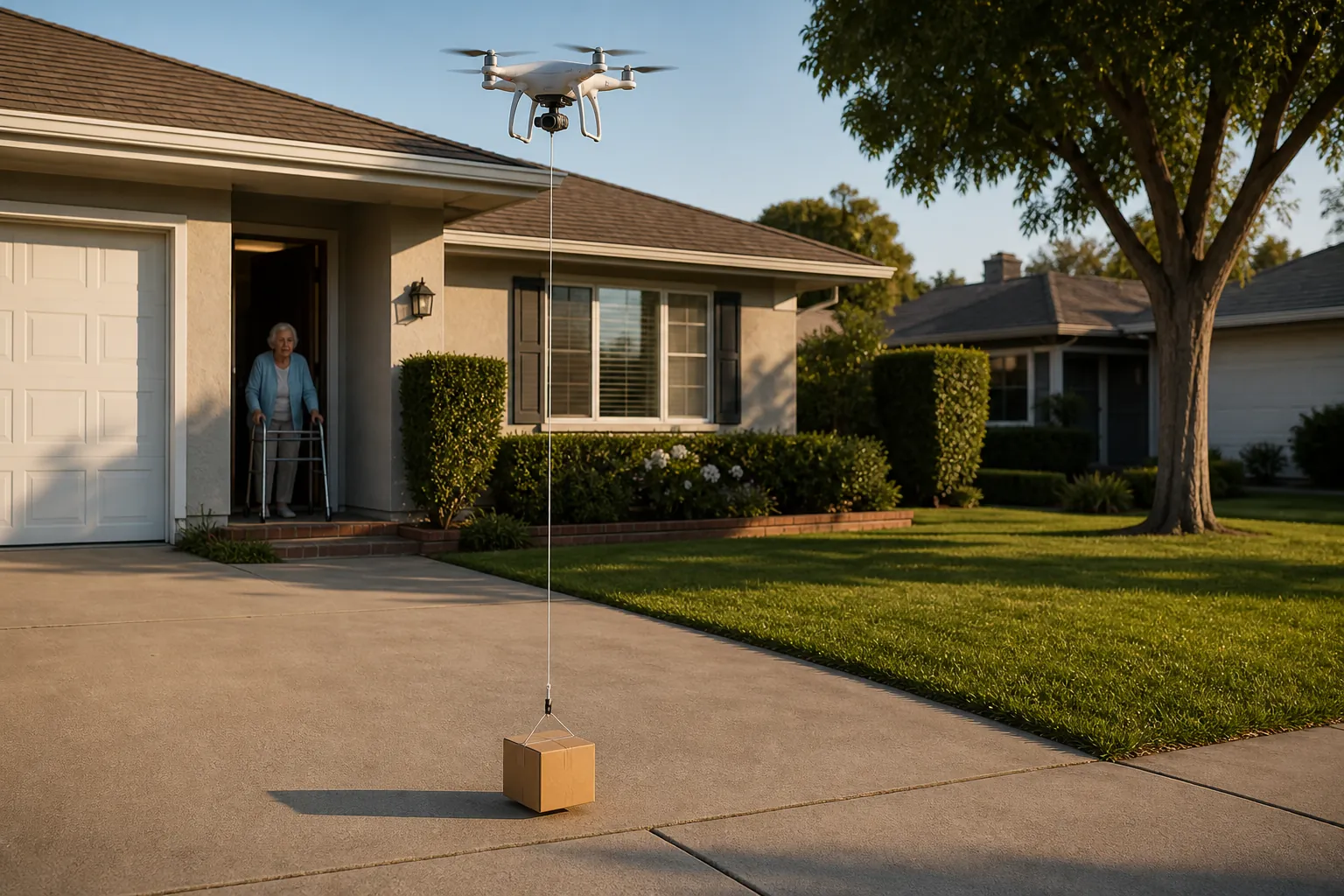
A drone delivery does not end when the aircraft does its job. In many current programs, the drone flies under 400 feet, lowers a small package to an outdoor spot such as a driveway or backyard, and leaves the recipient to retrieve it from that spot rather than handing it to someone at the door.[1]
That last part is where drone delivery safety for seniors becomes a household question. The aircraft may be certified, the route may be authorized, and the operator may have a careful safety case. None of that tells you whether your mother can cross a wet driveway with a cane, bend for a package near the grass line, read the delivery alert, and know whether the text on her phone is real.
So the useful question is not “Are drones safe?” It is: what has to be true at this address, for this person, on an ordinary day?
Separate the Aircraft Test From the Household Test
The certified side matters. In the United States, companies that conduct package delivery by drone may need FAA Part 135 air-carrier certification and airspace authorization for advanced operations.[2] That baseline is about the operator, the aircraft, the route, the airspace, and how the system manages flight risk.
It is also not the whole story. The Government Accountability Office has noted that drone deliveries are expected to increase substantially, while concerns remain around safely integrating beyond-visual-line-of-sight operations and public acceptance.[3] Those are real system-level concerns, but they still do not answer whether a particular older adult can retrieve a package safely from a particular yard.
Operators also build in aircraft-level contingencies. Amazon, for example, describes Safe Contingent Landing as a system that helps the drone identify a safe place to land if it needs to end a flight unexpectedly.[4] That kind of feature is designed around what the aircraft should do when flight conditions change. It is not a screening tool for a sloped driveway, a walker that catches on gravel, or a parent who treats every delivery text as urgent.
| Question | What the certified system can answer | What the household still has to answer |
|---|---|---|
| Can the aircraft fly the route? | FAA authorization, operator certification, aircraft systems, and operating limits. | Whether drone service is actually available at this address today. |
| Can the package be delivered to a safe spot? | The operator’s drop-zone requirements and automated delivery process. | Whether the usable spot is flat, clear, easy to see, and reachable without risky walking or bending. |
| Can the recipient complete the delivery? | The service can send an app or text notification tied to an order. | Whether the senior notices the alert, verifies it, waits when needed, and retrieves the item safely. |
| Can the item wait? | The operator may delay or cancel service in heat, wind, rain, or other unsafe conditions. | Whether the household has a backup route for medication, groceries, or supplies that cannot sit or wait. |
The Drop Spot Is the First Safety Decision
A delivery spot that works for a drone may still be a bad spot for an older adult. Customers in current delivery programs may be asked to keep the delivery area clear and choose a flat surface roughly the size of a picnic blanket with clear sky overhead.[5] That is a useful starting point, but a caregiver has to add a second standard: can the person who lives there reach that spot without turning the retrieval into an outdoor fall-risk task?
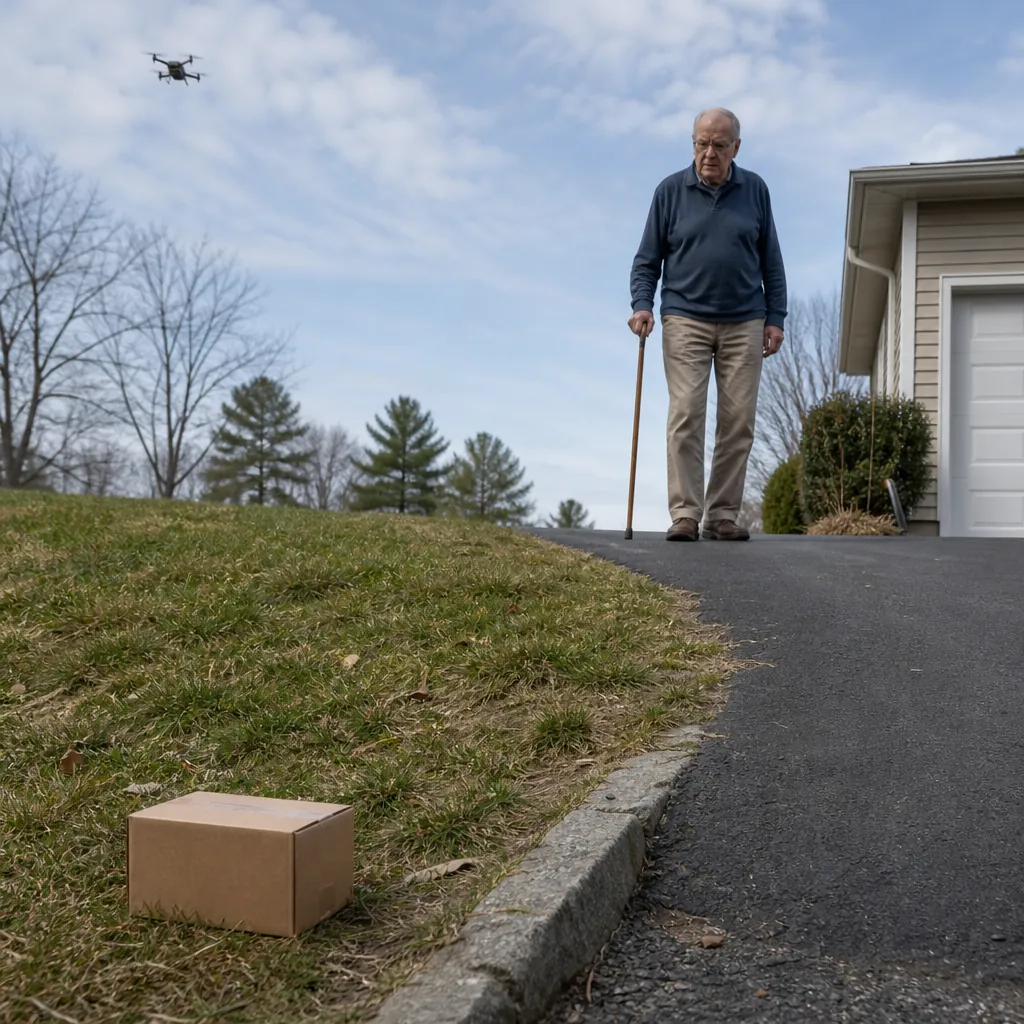
This is not a claim that drone delivery has been shown to cause falls. It is a practical mobility check. If someone already struggles with outdoor steps, uneven pavement, a sloped driveway, poor lighting, or carrying objects while using a cane or walker, then the delivery is not complete when the package lands. The hardest part may have simply moved from the store aisle to the driveway.
Walk the route the way the senior would use it. Start at the chair, kitchen, or front door where they are most likely to notice the alert. Then follow the path to the intended drop spot, including the door threshold, porch step, walkway, driveway seam, grass edge, gate, pets, hose, planters, and lighting. If they use a walker indoors but switch to a cane outside, test the outdoor version. If they normally wait for a neighbor to bring the trash cans back, do not pretend the driveway suddenly became easy because a drone is involved.
- Can the senior reach the drop spot on a dry day without stepping onto grass, gravel, mud, or a sloped edge?
- Can they do it in the shoes they actually wear at home, not the shoes they would wear to a clinic appointment?
- Can they bend, squat, or use a reacher to lift the package without losing balance?
- Can they carry the item back while still using their cane, walker, railing, or door handle safely?
- If the package lands slightly off the ideal spot, is there still a safe retrieval path?
If any answer depends on “someone will probably be around,” then the outcome is not use as-is. It may still be a good service, but only with a retrieval plan.
The Package Has to Fit the Person, Not Just the Drone
Current U.S. retail drone programs are generally built around small packages. As of August 2026, industry reporting describes many programs as capped around 5 pounds, with Wing-for-Walmart described at 2.5 pounds, and service commonly limited to about a 6-mile hub radius.[6] Those limits help explain why drone delivery is usually discussed for prescriptions, small groceries, convenience items, or light supplies rather than a full weekly order.
For a senior, weight is only one part of manageability. A light package can still be awkward if it is low to the ground, too wide to hold while using a walker, or important enough that the recipient rushes. A cold item, a medication, or a needed supply also raises the stakes if weather or operating limits delay the delivery.
Weather limits are not a defect by themselves. They are part of how operators avoid unsafe flights. But they are also why a household should not make drone delivery the only route for anything that cannot wait. Amazon’s fleet has been described as shutting down above 104°F and in high wind or rain, which is sensible for flight safety and still inconvenient if the item was expected before dinner or before a medication dose.[6]
- Good fit: light, non-urgent items the senior can lift and bring inside without changing gait or grip.
- Possible with help: small but important items that someone else can retrieve during a planned window.
- Poor fit: time-sensitive medication, temperature-sensitive food, or anything the senior may rush outside to rescue.
The Notification Is Part of the Safety System
A drone delivery usually depends on a digital signal: an app update, a text, or a message saying the order is on the way or has arrived. That sounds simple until the recipient misses the alert, misreads the timing, or treats a fake delivery text as real.
Scam verification deserves a place in the same decision matrix as the driveway. Package-delivery texts are the most-reported type of text scam, and the FTC reported $470 million in text-scam losses in 2024, according to AARP’s coverage of fake USPS and UPS messages.[7] A fake notice can create the same unsafe behavior as a real one: someone hurries outside, clicks a link, enters information, or calls a number because the message says a package is waiting.
The safer habit is narrow and boring: delivery notices should match an order the person actually placed and should be checked inside the ordering app or account, not through an unsolicited link. Health journalism guidance on drone medication deliveries also emphasizes that patients should understand the ordering and notification process before relying on the service.[8] That matters more for a parent who is already managing pharmacy reminders, appointment texts, portal messages, and family group chats.
- Ask the parent to show where the delivery status appears in the official app or account.
- Agree that no one clicks a package link from an unexpected text, even if it looks urgent.
- Use one known contact method for caregiver backup, such as a phone call or shared app notification.
- Practice one low-stakes order before using the service for anything important.
If a parent cannot reliably tell a real delivery notice from a fake one, the answer is not to lecture them into confidence. Build the delivery around a caregiver, neighbor, or staff member who verifies the order before anyone acts on it. For a broader way to match technology to a parent’s actual habits rather than to an ideal user, use this elderly monitoring system decision framework as the companion exercise.
Three Outcomes That Are More Useful Than Yes or No
Once the aircraft baseline and the household checks are separate, the decision usually lands in one of three places.
Use as-is
This is the right outcome when service is available, the operator’s drop-zone requirements can be met, the senior can reach and lift the package without unsafe walking or bending, and the notification process is familiar. The items should be light, non-urgent, and not easily spoiled by a delay.
Use as-is should still include one backup route. If wind, rain, heat, software maintenance, or local service changes interrupt delivery, the household should already know whether the backup is pharmacy pickup, store delivery by car, a neighbor, or a caregiver errand.
Use with help
This is not a failed outcome. It is often the honest one. The drone leg may remove a store trip, a pharmacy line, or a long drive, while a caregiver, neighbor, building staff member, or scheduled helper completes the last 30 feet.
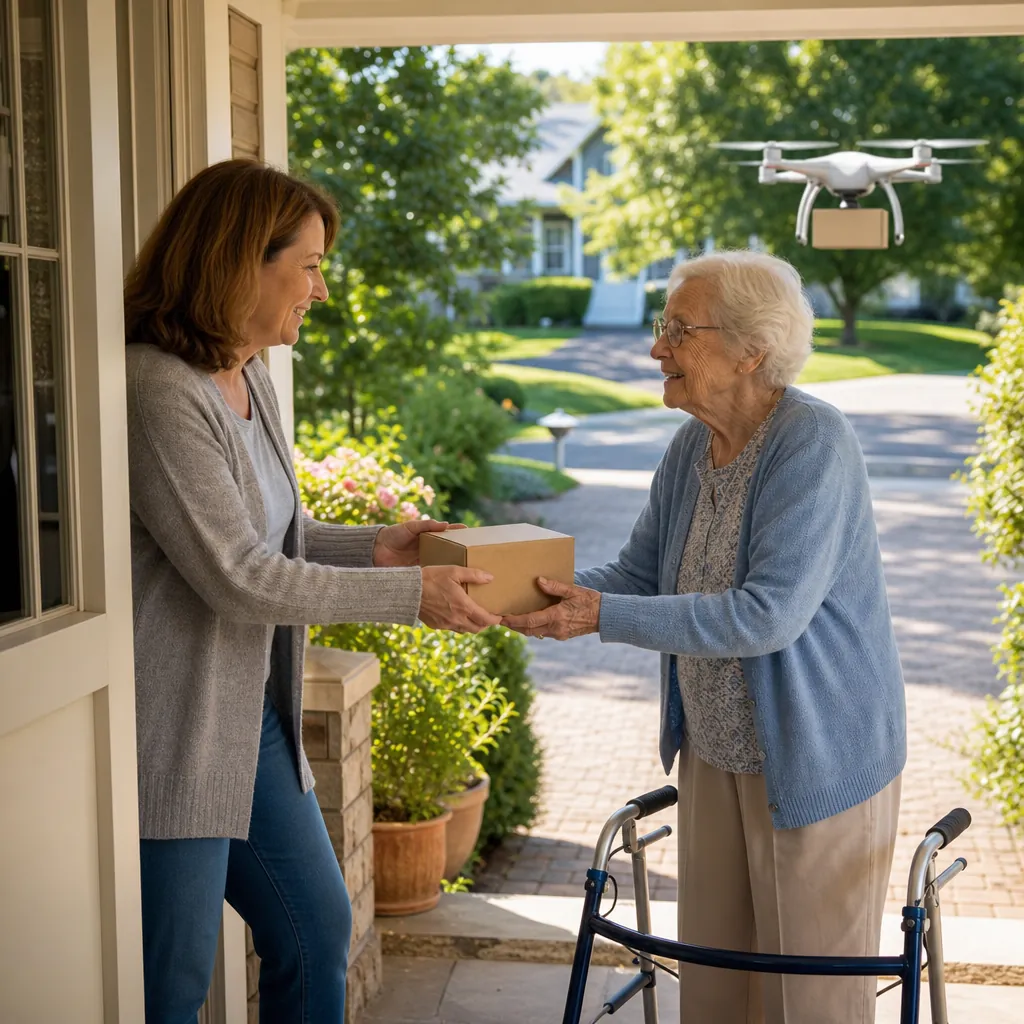
There is already a precedent for treating ground completion as part of the design rather than as an afterthought. An early UPS and CVS drone prescription program at The Villages in Florida, a retirement community of more than 135,000 residents, used a ground vehicle to complete delivery to the resident’s door after the drone leg.[9] That model matters because it admits what many families already know: the yard is not always the right final destination.
Use with help can be simple. A caregiver gets the same delivery alert and stops by during a predictable window. A neighbor brings the package from the driveway to a chair inside the entry. A senior living community routes drone drops to a staff-accessible point. The important part is that retrieval is assigned before the order is placed, not improvised after the package is on the ground.
Skip for now
Skip for now if the parent cannot safely reach the outdoor drop spot, cannot verify delivery notices, lives where the safe drop area is not actually reachable, or would be using the service for items that cannot tolerate weather delays. This is especially important if the person has known fall risk, recent hospitalization, poor balance, low vision, or a pattern of rushing to handle household tasks before asking for help.
If a recent fall or near-fall is already part of the picture, solve that first. The delivery question belongs inside the same mobility plan as porch lighting, thresholds, footwear, assistive devices, and emergency response. Readers who are already managing a fall event can start with this step-by-step guide to activating senior health services after a fall.
A Caregiver Check Before the First Order
Do the check in the order the delivery happens: service, drop spot, retrieval, notification, backup. It takes less time than rescuing a package from the rain while a parent is upset that the “easy” option made them feel dependent.
- Confirm service is currently available at the address and for the item type. As of August 2026, availability still changes quickly, so check inside the provider’s ordering flow rather than relying on last month’s announcement.
- Mark the intended outdoor drop spot and remove anything that could shift, trip, blow, or block the package.
- Have the senior walk the retrieval route using the same mobility aid, shoes, lighting, and door they would use during a real delivery.
- Test the lift: package on the ground, picked up from the likely height, carried back inside, door closed, hands free again.
- Open the official app or account together and identify exactly where a real delivery status appears.
- Name the backup person or service for bad weather, missed alerts, scam uncertainty, or items that cannot wait.
If the first trial order creates argument or embarrassment, slow down. Resistance to safety changes often comes from feeling managed rather than helped; the same pattern shows up in home fall-prevention conversations after a hospitalization. The goal is not to win the drone argument. It is to decide whether this delivery method preserves independence at this house, or whether it quietly hands the hardest part to the person least able to do it. For that conversation, these post-hospital fall-prevention strategies are useful even outside the hospital context.
This is general safety-planning guidance, not medical, legal, or aviation advice. If mobility, vision, cognition, or medication timing is part of the concern, involve the parent’s clinician, pharmacist, or an occupational therapist before relying on drone delivery.
When both tests pass, use the service as-is. When the aircraft side passes but retrieval or notification is weak, use it with help. When the parent cannot retrieve safely, cannot verify notices, or needs items that cannot wait through weather delays, skip it for now and use the backup route instead.
References
- Get delivery, Wing
- Package Delivery by Drone, Federal Aviation Administration
- Drone Deliveries Expected to Increase Substantially, but Concerns About Safety Remain, U.S. Government Accountability Office
- Prime Air: Amazon drone delivery and FAA safety, Amazon
- Drone delivery is accelerating in test programs and pilot markets, Business Insider
- FAQ on drone delivery: what retailers need to know in 2026, EMARKETER
- Fake USPS, UPS smishing texts, AARP
- What to know about drone medication deliveries, Association of Health Care Journalists
- Retirees in The Villages to get prescription drug deliveries by drone, FOX 13
Questions to bring to a clinician or OT
This is not medical, legal, or a family's final decision — only a framework. Bring these questions to a clinician, occupational therapist, or your local Area Agency on Aging.
Find Local HelpRelated reading
Noticed something outdated or inaccurate on this page? Flag a correction. We review every report against CDC, NIA, and AARP HomeFit guidance before updating a page.