
Caregiver decision guide
How Robots Help Seniors Live at Home Today
Most robotic fall-protection technology is still in the lab, yet some robot categories genuinely support independent living at home right now. Here's what's ready today, what's still in development, and what caregivers should act on now.
The honest 2026 answer to how robots help seniors live independently at home is narrower than the sales pitch: robots can add useful support, but mostly by detecting trouble, reducing household friction, or supporting mobility around the edges. The machines that catch a person mid-fall or correct balance in real time are real research projects, not dependable household products a daughter can buy this weekend and trust in a hallway at 2 a.m.
That distinction matters because the risk is not theoretical. Falls are the leading cause of injury among adults 65 and older, as cited in MIT’s report on its elder-care robot, and the Frontiers smart-walking-aid paper cites the World Health Organization estimate that roughly 1 in 3 adults 65 and older falls each year [1][2]. At the same time, the U.S. population age 65 and older is projected to reach 82 million by 2050, more than 40% above the 2022 level [3]. More people will be trying to stay at home with fewer family hours to spare.
This article is about readiness across non-humanoid and home-support categories. If you are looking specifically for humanoid machines, start with our separate guide to how humanoid robots can and cannot prevent falls. Here, the practical question is simpler: what can safely be acted on now, and what belongs on a watchlist?
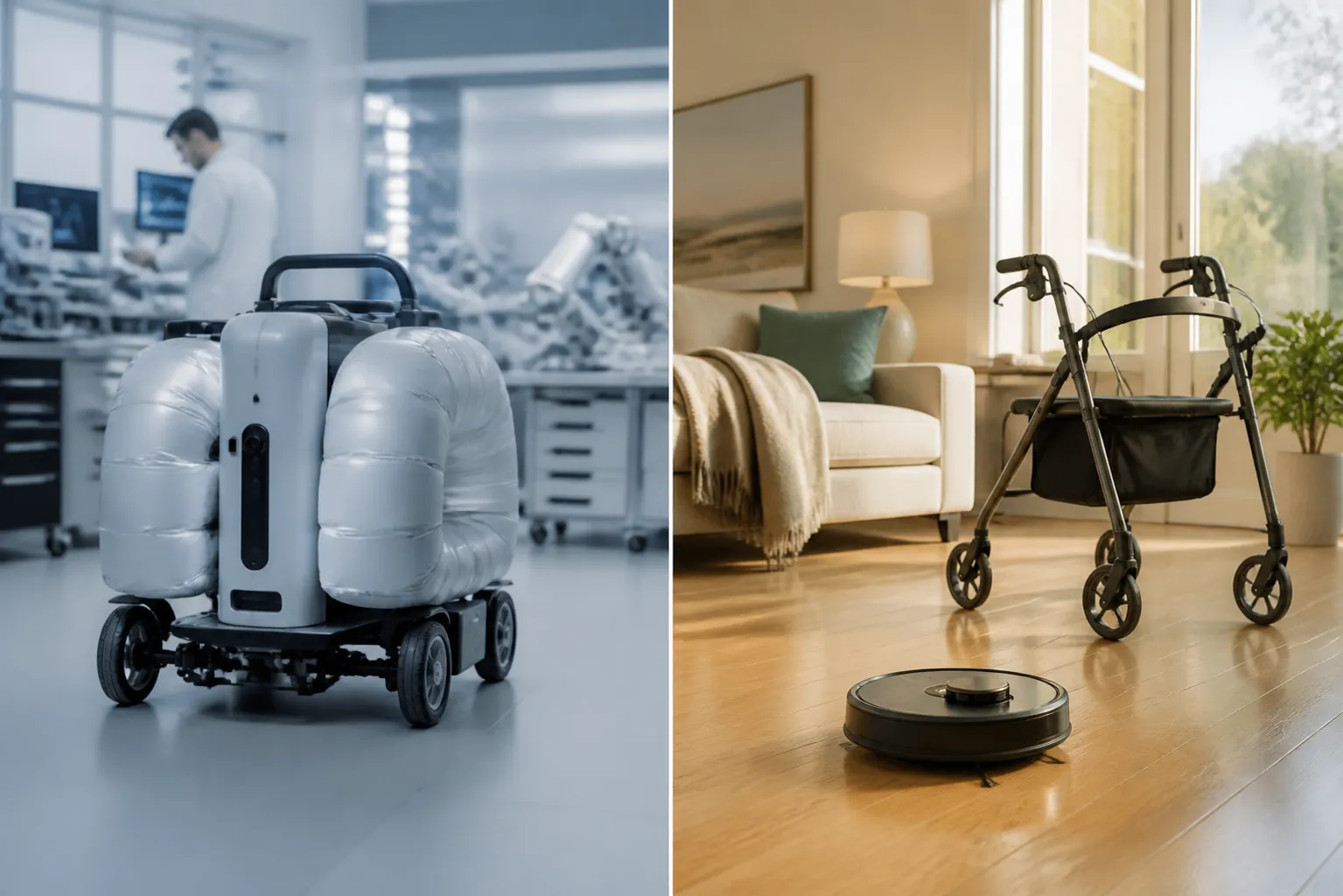
A readiness map for home robotics in 2026
| Category | Readiness in Q3 2026 | What it can do for fall prevention | Evidence or use limits | Caregiver action |
|---|---|---|---|---|
| Monitoring and computer-vision fall detection | Ready now, with caution | May detect a fall or unusual event and notify a caregiver or response pathway. Some commercially available fall-detection technologies are already on the market [4]. | Detection is not prevention. Cameras and sensors raise privacy, consent, placement, false-alert, missed-alert, and emergency-routing questions. | Consider only after deciding who receives alerts, what happens at night, and what backup exists if the system fails. |
| Smart walkers and powered mobility aids | Usable now in limited commercial forms; more advanced versions are still emerging | Can support mobility, help with gait monitoring, obstacle awareness, or motorized assistance in some products, including examples described by LeadingAge [4]. | A walker that is too heavy, too fast, poorly fitted, or confusing can add risk. Commercial availability does not prove the right fit for a particular person. | Ask a clinician or physical therapist to match the aid to strength, gait, cognition, home layout, and transfer needs. |
| Robot vacuums | Ready now as an indirect helper | Can reduce some routine floor-cleaning work and may help keep small debris, lint, and some clutter from accumulating in walking paths. | They do not fix loose rugs, poor lighting, thresholds, pets underfoot, or unsafe cords. They also need maintenance, charging, bin emptying, and product-security awareness. | Use as a housekeeping support, not as a fall-prevention plan. Check current FCC-ban context before buying. |
| Companion or activity-prompting robots | Ready now for companionship-style use, not as fall-prevention devices | May encourage routine, engagement, or activity reminders. AARP has covered robotic companion animals as a possible caregiving support [5]. | Evidence for loneliness or activity benefits is often short-term, self-reported, or program-specific. A friendly robot is not a gait assessment, exercise program, or emergency responder. | Use only with the older adult’s consent and preferences. Treat prompts as reminders, not supervision. |
| E-BAR-style fall-catching robots | Prototype/watchlist | MIT’s E-BAR has demonstrated catching a falling person without a harness or wearable device and assisting sit-to-stand and tub-transfer scenarios [1]. | Not a consumer product. The reported prototype has a 220-lb base, is currently remote-controlled, and was tested with one older adult volunteer in household scenarios [1]. | Watch the research. Do not delay ordinary fall-prevention work while waiting for this category. |
| Robotic walking aids that detect and correct imbalance | Prototype/watchlist | A Frontiers system used a chest-worn IMU to detect imbalance at ±8° and apply corrective force in 2.2–2.3 seconds while braking the wheels [2]. | Validated with a single healthy adult, not a broad older-adult home population. Not commercially available [2]. | Watch for larger trials, home testing, and clinician guidance before treating this as a household option. |
| Wearable exoskeletons | Prototype/watchlist | Stanford’s ankle exoskeleton reduced walking energy cost and increased outdoor walking speed in testing, with similar gains reported in treadmill tests among adults in their 70s and 80s [3]. | The Stanford report described a possible retail horizon of about five years, not a current purchase option [3]. | Watch for real-world older-adult trials, training requirements, comfort, fall-risk effects, and actual pricing. |
| CDC STEADI-style screening, assessment, and intervention | Not a robot; still the foundation | Identifies the person’s actual fall risks before choosing interventions. | Robots can miss medication, vision, footwear, strength, balance, blood-pressure, and home-layout causes of falls. | Do this first. Add technology only when it fits the risks already found. |
The exciting fall-protection robots are still not household equipment
There is no need to pretend the lab work is unimpressive. Some of it is remarkable. The problem is the leap from a controlled demonstration to a parent’s hallway, bathroom, bedroom doorway, and 2 a.m. routine. A fall-prevention device is not ready because it looks ready in a video. It is ready when an older adult can live with it, a caregiver can maintain it, and clinicians can understand where it fits.
MIT’s E-BAR is vivid—and very much a prototype
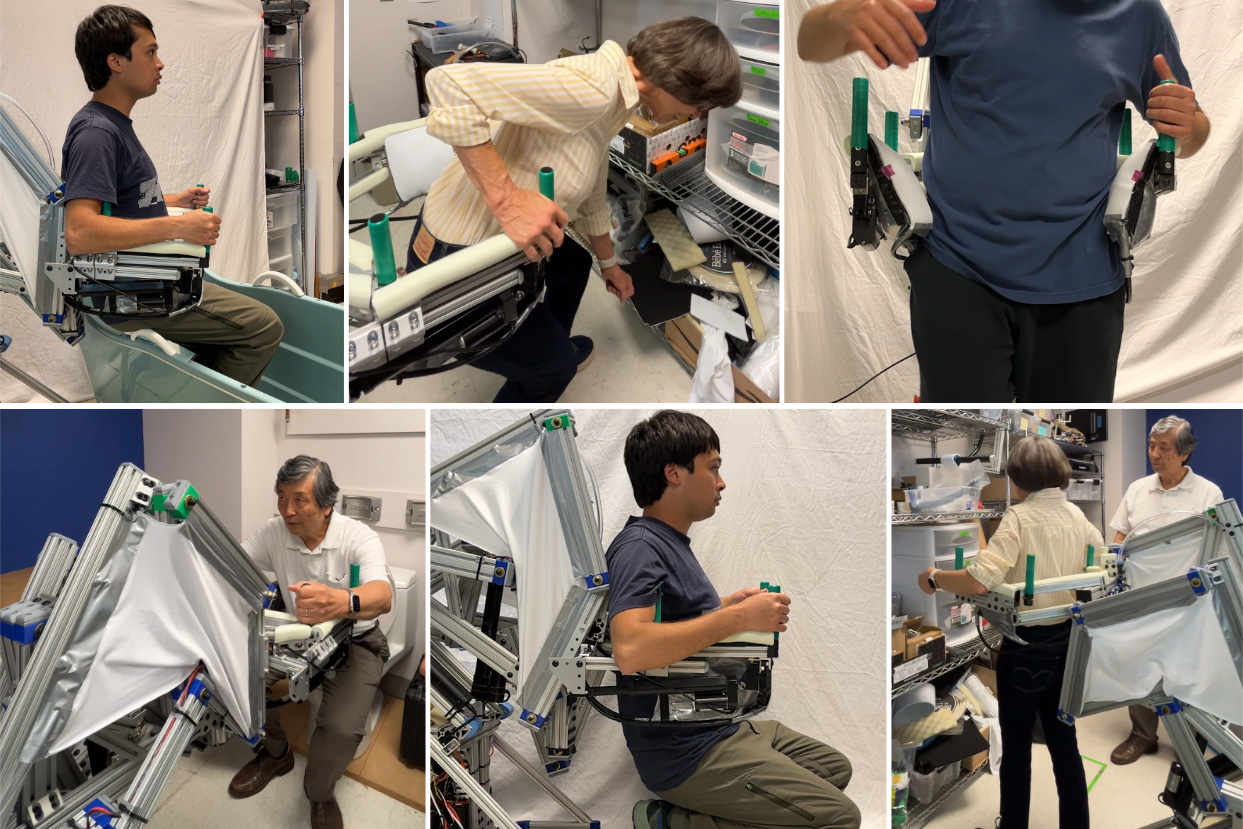
MIT’s E-BAR deserves attention because it goes after the frightening moment everyone imagines: the instant a person loses balance. The reported robot can catch a falling person without a harness or wearable, using inflatable side airbags to support the body. MIT also described it assisting sit-to-stand movement and tub transfers, two everyday situations where family caregivers often worry [1].
The limits are not footnotes. The base weighs 220 pounds, although MIT says it fits through home doorways. The current version is remote-controlled, with autonomy described as future work. The household-scenario testing included one older adult volunteer [1]. That is enough to make E-BAR a serious research development. It is not enough to make it a consumer fall-protection option.
The caregiver question is not whether the robot is clever. It is who positions it, charges it, resets it, cleans around it, handles failures, and decides whether it belongs near a bathtub. Until those answers are solved outside the lab, E-BAR belongs on the watchlist.
The imbalance-correcting walker is specific, but the evidence base is tiny
The Frontiers smart robotic walking aid is interesting because it is not just a “smart” label pasted onto a walker. The system used a chest-worn inertial measurement unit to detect imbalance at ±8°. When the user leaned beyond that threshold, the walking aid applied corrective force and braked its wheels during correction. The reported correction time was 2.2–2.3 seconds, and the transfer-function models were more than 98% accurate [2].
Those are useful engineering details. They also point to the gap. The reported validation involved a single healthy adult, not a varied group of older adults with neuropathy, stroke history, Parkinsonian gait, low vision, medication dizziness, dementia, arthritis, or fear of falling. A correction that works in a controlled setup still has to prove it can help in a kitchen turn, a crowded bedroom, a sloped driveway, or a bathroom threshold.
For now, the lesson is not “buy a robotic walker that catches imbalance.” It is “do not dismiss this line of work.” If larger trials show that automatic correction prevents falls without startling users or adding new hazards, this category could matter. It is not there yet.
Exoskeletons may help with the fear-of-falling spiral
Stanford’s ankle exoskeleton points at a different problem: not catching a fall, but preserving mobility. The Stanford report described young adults walking 9% faster with 17% less energy outdoors while using the device. It also reported similar gains in treadmill tests among adults in their 70s and 80s [3].
That matters because fear of falling can shrink a person’s world. Stanford’s reporting described resident interviews at Channing House in which decreased walking fed a cascade toward cardiovascular decline and disability [3]. A device that makes walking feel less costly could, in theory, support independence before a crisis.
Still, a five-year retail estimate is not care advice. A future “motorized pair of shoes” has to be tested for training burden, donning and doffing, balance effects, fatigue, skin issues, charging, cost, indoor use, outdoor terrain, and what happens when the power fails. Watch it closely. Do not wait for it before starting strength and balance work.
What can help at home now
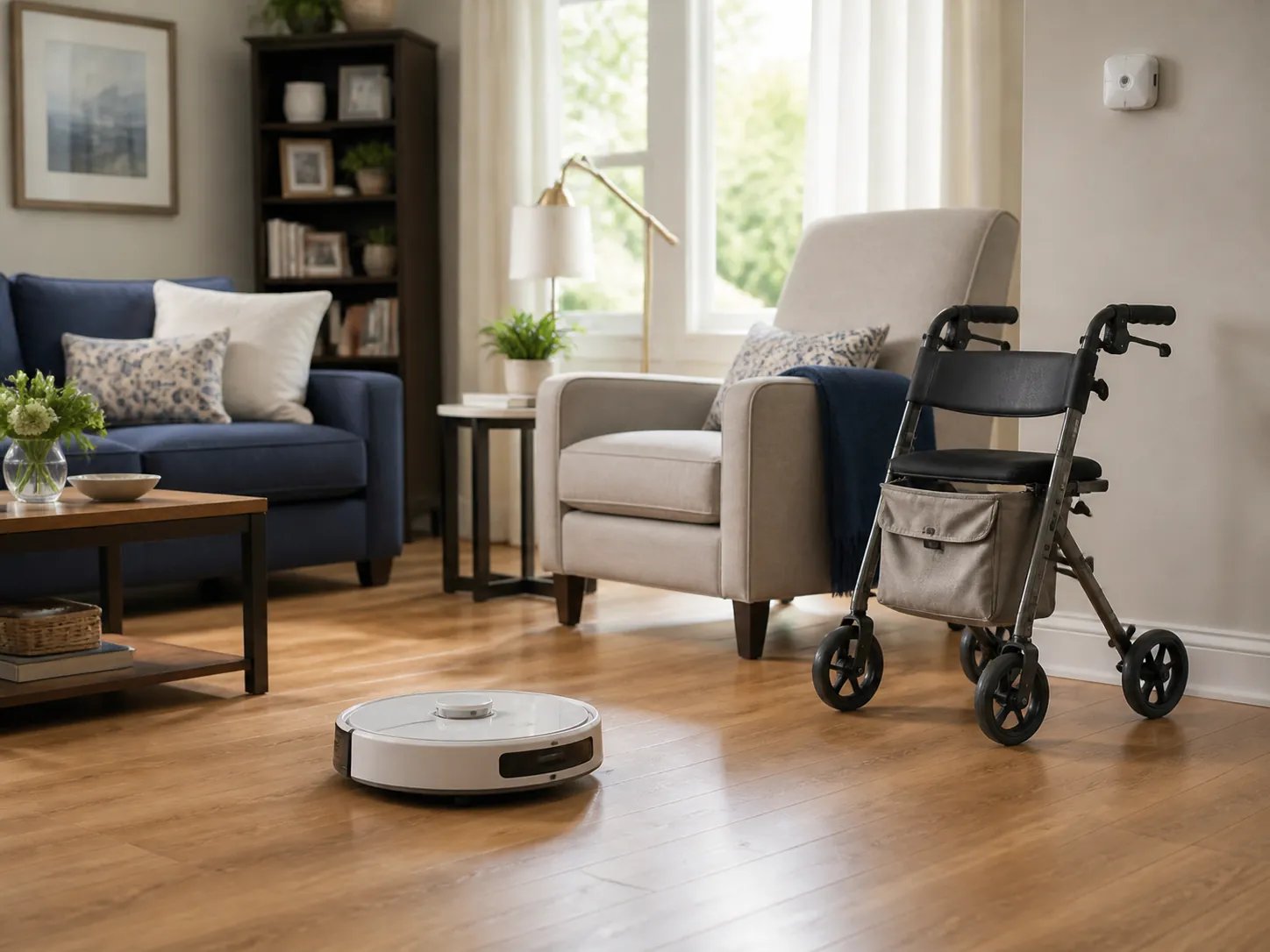
The most useful robotics layer at home is less cinematic. It is the device that notices a fall faster, keeps a walking path cleaner, or helps a person move with less effort after the right mobility assessment. These tools can be worth considering, but they need to be placed inside a real care plan rather than treated as a substitute for one.
Monitoring can add awareness, not rescue by itself
Computer-vision fall detection and other monitoring systems can help when the main problem is delayed discovery. LeadingAge describes commercially available technologies such as computer-vision fall detection and medical alert systems among current fall-prevention technologies [4]. In a home where an older adult lives alone, that can be meaningful.
But “the system detected something” is not the same as “help arrived.” Someone has to receive the alert, wake up, understand it, and act. If the device routes through a phone, cellular network, app, cloud account, or subscription service, the emergency plan depends on more than the robot. For that boundary, see our coverage of a T-Mobile outage and medical alerts and our guide to satellite direct-to-phone emergency options for seniors.
Privacy is not a decorative concern. A bedroom camera, hallway sensor, or bathroom-adjacent monitor changes how a person feels at home. The older adult should know what is being recorded or analyzed, who can see it, how long data is stored, and whether the device can be turned off. If consent is grudging or confused, the plan needs rethinking.
Smart walkers need fitting, not just features
Some commercially available smart walkers and mobility aids add gait monitoring, obstacle detection, or powered assistance. LeadingAge cites Camino as an example of an AI-powered smart walker with gait monitoring, obstacle detection, and motorized drive [4]. That does not make it the right walker for every older adult.
A mobility aid changes how a person stands, turns, transfers, and reaches. A powered feature can be helpful for one person and unnerving for another. Before adding a smart walker, ask a physical therapist, occupational therapist, or qualified clinician to look at the person’s gait, hand strength, cognition, home layout, thresholds, bathroom setup, and transfer habits.
Also ask the unglamorous maintenance questions: Who charges it? What happens if the battery dies in the hallway? Can the older adult fold it or move it into a car? Are replacement parts available? Can a visiting aide use it safely without a tutorial? A mobility aid that becomes clutter is no longer a mobility aid.
A robot vacuum is small help, and sometimes that is the point
A robot vacuum will not correct blood-pressure drops, poor vision, weak legs, or unsafe stairs. It can still help with one very ordinary home problem: floors that collect lint, crumbs, pet hair, and small debris because vacuuming is hard. It may also reduce the need for an older adult to drag a corded vacuum through a hallway or bend repeatedly to clean under furniture.
This is the kind of robotic help that rarely makes headlines but can change the surface someone walks across today. It works best after the real trip hazards are already handled: loose rugs removed or secured, cords routed away from walking paths, thresholds made visible, shoes kept off the floor, and lighting improved. For broader clutter and hazard planning, some of the same principles appear in our earthquake safety checklist for elderly parents and our hurricane preparedness checklist for seniors living alone.
Before buying, check whether the model requires app accounts, maps the home, stores video or images, or depends on a brand affected by current regulatory issues. For the July 2026 FCC-ban context, see our explainers on the robot vacuum ban and elderly users, the best robot vacuums for seniors under the FCC-ban context, and what seniors need to know about a Roomba ban.
Companion robots can support routine, but do not turn them into guards
Companion robots and robotic pets may be useful when the goal is comfort, engagement, or a gentle activity cue. AARP has covered robotic companion animals as a caregiving support, especially for social connection and soothing routines [5]. That is different from proving that a companion robot prevents falls at home.
A reminder to stand up, drink water, or take a short walk can fit into a care plan if the person likes the device. It can backfire if the older adult finds it infantilizing, noisy, or intrusive. The standard should be dignity first: the robot supports the person’s routine; it does not become a little supervisor in the living room.
Put robotics in the STEADI order
This is planning guidance, not medical advice. For an older adult with falls, near-falls, dizziness, new weakness, confusion, or a sudden change in walking, the first step is clinical care, not shopping.
Robotics makes the most sense when it follows the CDC STEADI sequence rather than replacing it. First, screen for fall risk. Has the person fallen? Are they afraid of falling? Do they feel unsteady when standing or walking? Then assess modifiable risks: medications, blood pressure, vision, feet and footwear, strength, balance, cognition, home hazards, and unsafe transfers.
Only then choose interventions. A monitoring system may fit a person who lives alone and cannot reliably press a button after a fall. A smart walker may fit someone whose gait and home layout make that aid appropriate. A robot vacuum may fit a household where cleaning has become a burden and floor debris keeps returning. A companion robot may fit someone who wants prompts or comfort. None of those choices substitutes for medication review, vision care, strength and balance exercise, home modification, or emergency-response planning.
Act now; watch the lab
- Act now on fall-risk screening, especially after any fall, near-fall, dizziness episode, or new fear of falling.
- Act now on home hazard removal: cords, loose rugs, poor lighting, unstable furniture, cluttered walking paths, unsafe bathroom transfers, and hard-to-reach essentials.
- Act now on emergency-response planning. Decide who is called, how quickly they can respond, and what happens if the first alert path fails.
- Act now on appropriate mobility aids, but have them fitted and reviewed rather than chosen only by feature list.
- Consider monitoring, robot vacuums, smart walkers, or companion robots only when they solve a concrete home problem without turning the older adult or caregiver into unpaid technical support.
- Watch E-BAR-like catch robots, imbalance-correcting robotic walkers, and exoskeletons. They are promising, but they are not dependable household fall-prevention solutions yet.
Robots can help seniors live independently at home today, but mostly in modest ways: reducing friction, detecting trouble, supporting selected mobility needs, or keeping a safer walking surface easier to maintain. The proven fall-prevention work still has to happen first.
References
- Eldercare robot helps people sit, stand, and catches them if they fall — MIT News, May 13, 2025.
- Smart robotic walking aid — Frontiers in Robotics and AI, October 2025.
- Domestic robots could support aging population — Stanford Report, April 2026.
- New Falls Prevention Technologies Are on the Way — LeadingAge.
- Can Robotic Companion Animals Help Older Adults? — AARP.
Questions to bring to a clinician or OT
This is not medical, legal, or a family's final decision — only a framework. Bring these questions to a clinician, occupational therapist, or your local Area Agency on Aging.
Find Local HelpRelated reading
Noticed something outdated or inaccurate on this page? Flag a correction. We review every report against CDC, NIA, and AARP HomeFit guidance before updating a page.