
Caregiver decision guide
Visa-Free Travel Safety Checklist for Seniors
Visa-free entry removes only the visa paperwork, not the preparation. This time-phased checklist gives seniors and the adults planning their trips clear, by-when steps for the travel-health visit, medication supply, Medicare and Medigap coverage, documents, and emergency contacts — from 4-6 weeks before departure through the return home.
Visa-free travel is a paperwork shortcut, not a safety shortcut. It may mean you do not apply for a traditional tourist visa before departure, but it does not settle whether your passport is valid long enough, whether an electronic travel authorization is required, whether your medicine is legal there, whether Medicare follows you, or whether you can get help if a fall, fever, storm delay, or lost phone interrupts the trip.
For older U.S. travelers, the useful question is not “How many countries can I enter?” It is “What has to be finished before the easy part begins?” The answer works best as a countdown, because several important tasks cannot be fixed neatly at the airport counter.
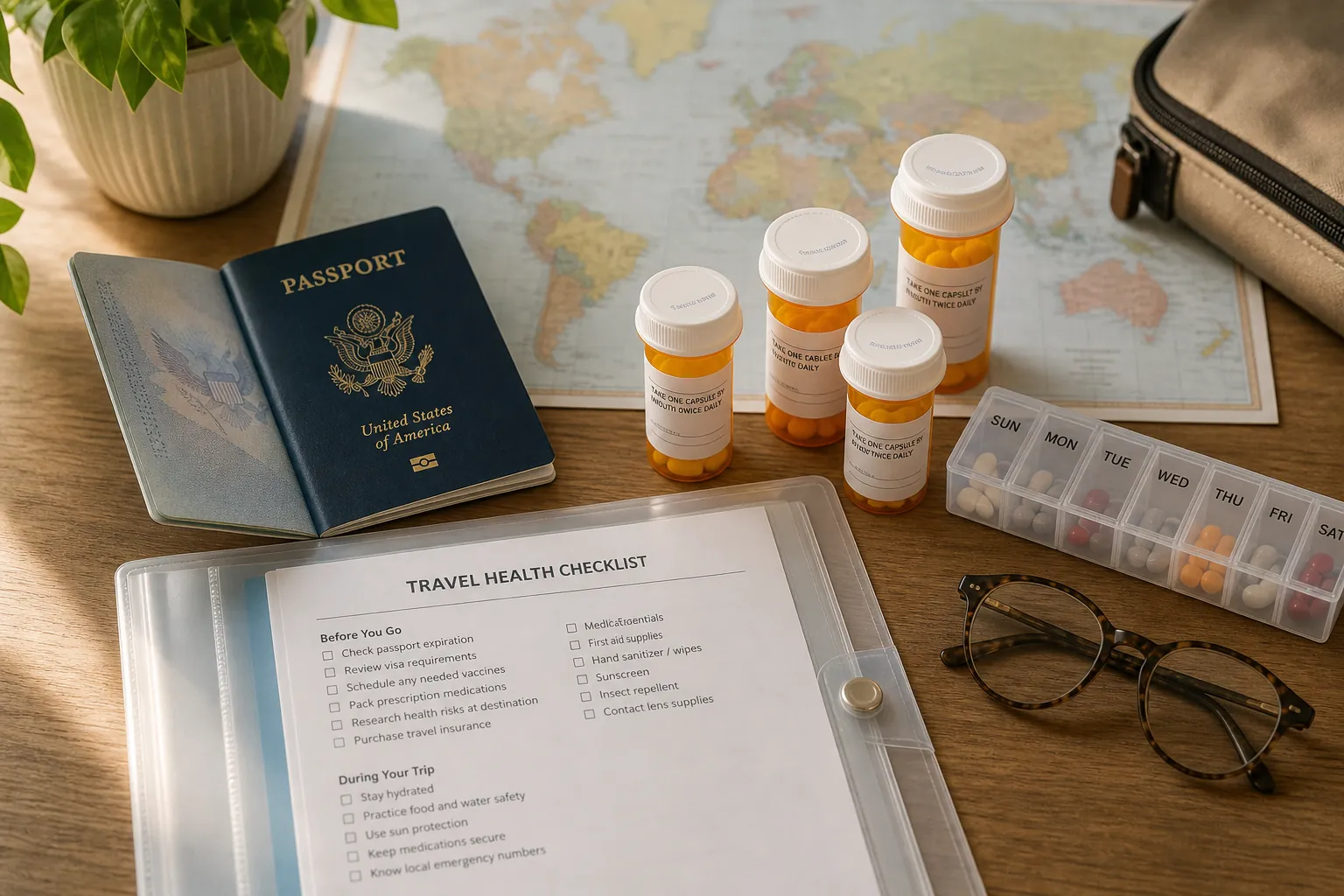
The Visa-Free Travel Safety Checklist
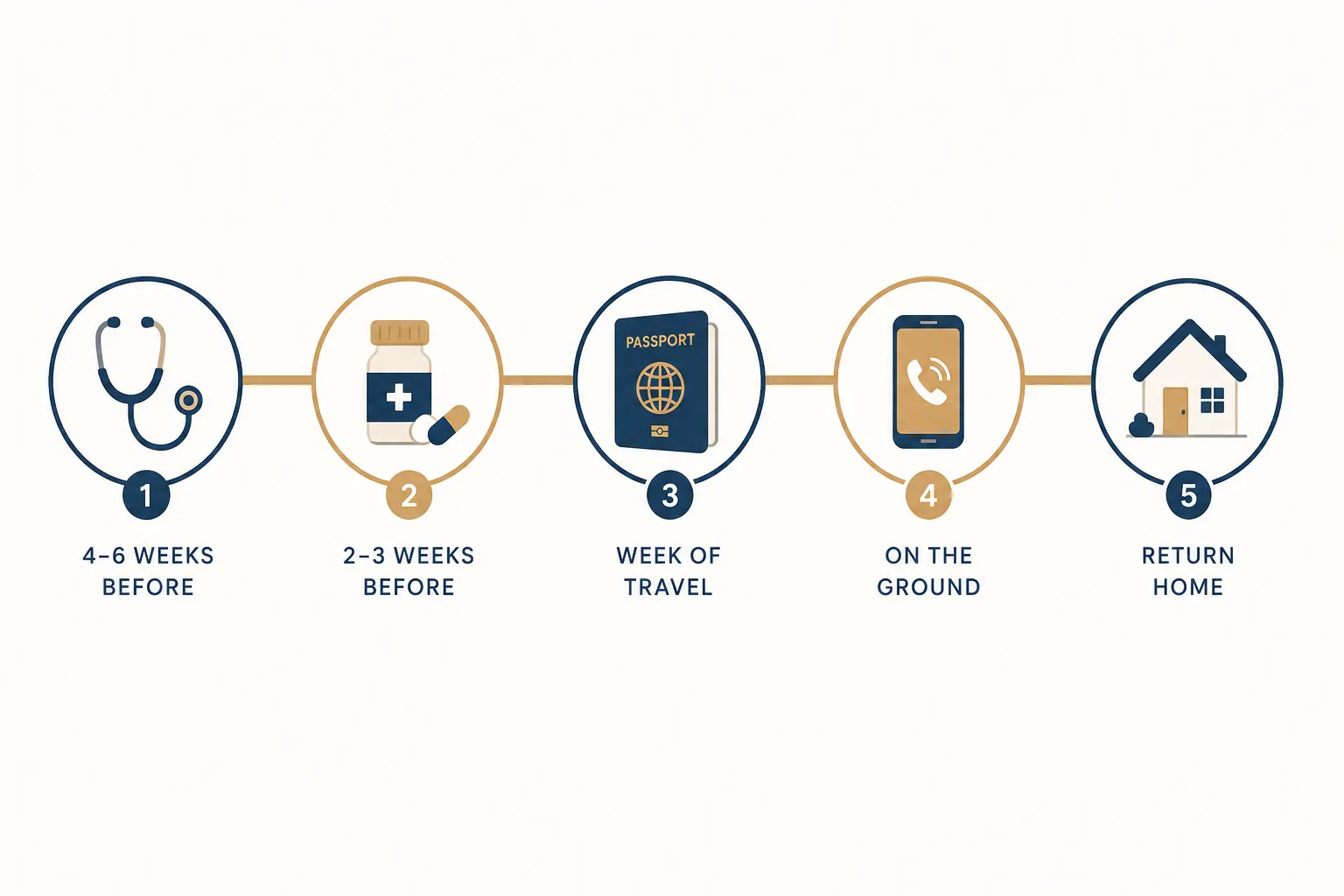
| When | What to finish | Why it cannot wait |
|---|---|---|
| 4-6 weeks before departure | Book the travel-health visit; review routine and destination vaccines; make the medication legality and supply plan. | Some vaccines and medication questions need time, and the CDC recommends a travel-health appointment at least 4-6 weeks before departure. |
| 2-3 weeks before departure | Call Medicare, Medigap, Medicare Advantage, Part D, and any travel insurer; confirm emergency medical, evacuation, vaccine, delay, and prescription rules. | Coverage varies by plan, and many travelers discover too late that domestic assumptions do not apply abroad. |
| One week before departure | Recheck passport and entry rules; make document copies; enroll in STEP; prepare emergency contacts and destination-specific proof. | Visa-free countries can still require ETAs, stay-limit compliance, insurance proof, vaccine certificates, or passport-age rules. |
| On the ground | Keep medicines accessible and secure; know local emergency numbers; scan the hotel room; keep a communication backup. | The trip is easier when the first small problem does not become a family-wide emergency. |
| After return | Reconcile medicines; note illness, falls, or near-misses; update the checklist for the next trip. | The best travel system is the one improved while the details are still fresh. |
4-6 Weeks Before Departure: Put Health and Medicines First
The first appointment to make is not the hotel dinner reservation. It is the travel-health visit. The CDC recommends that older adults see a health care provider or travel-health specialist at least 4-6 weeks before departure, with routine vaccines and destination vaccines reviewed as part of that visit.[1]
Bring the actual itinerary, not just the country name. A week in a capital city, a cruise stop, a rural family visit, and a high-altitude side trip can raise different questions. Ask about routine vaccines such as pneumococcal, shingles, and flu, then ask what the destination itself adds. If a vaccine is recommended, this window gives your clinician time to judge timing, interactions, and whether your health history changes the usual advice.[1]
Medication planning deserves the same seriousness. Nearly 9 in 10 older adults take at least one medication, so this is not a special-case chore for “complicated” travelers.[2] It is the ordinary condition of senior travel.
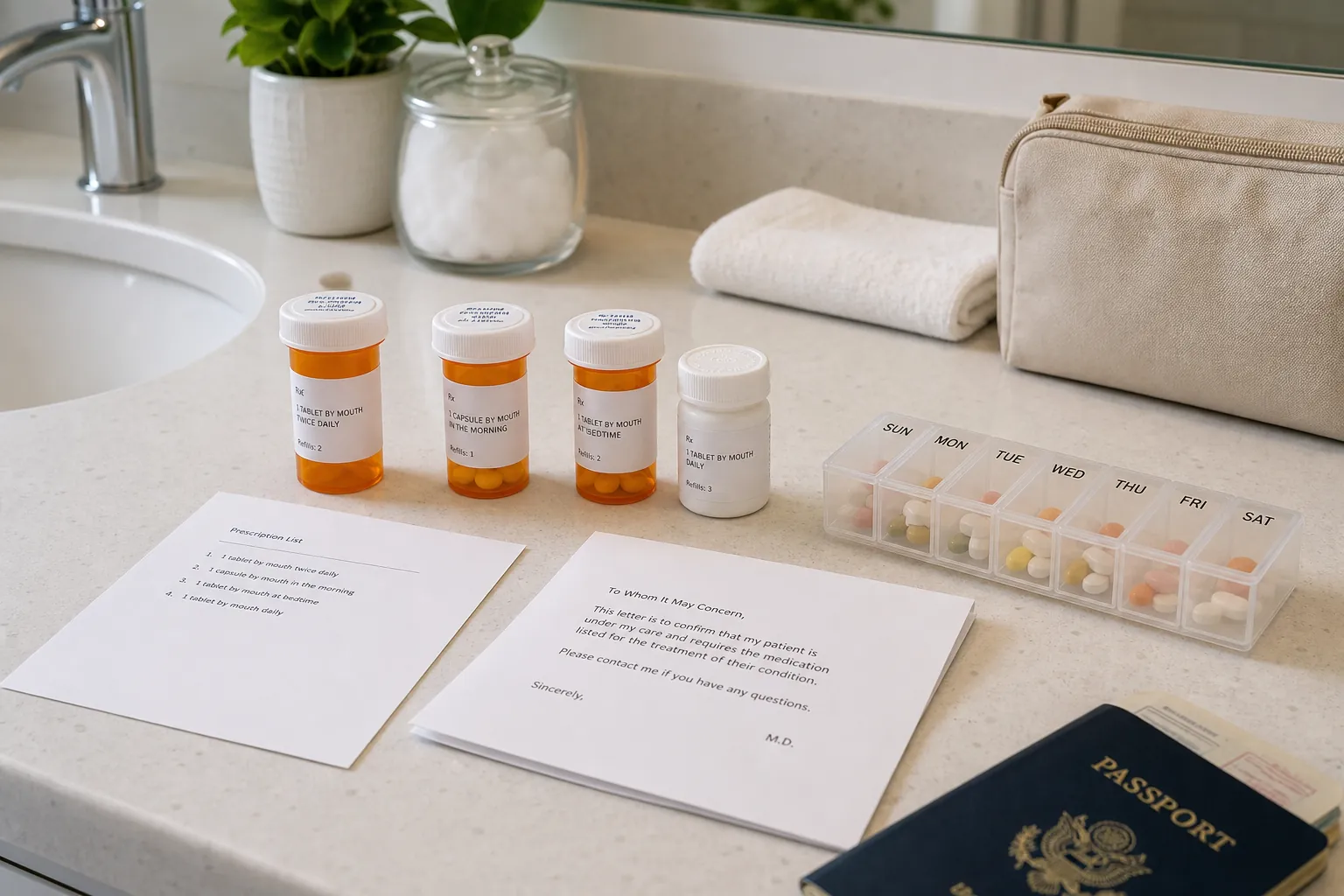
Start by making one current medication list: prescription drugs, over-the-counter medicines, supplements, inhalers, injections, eye drops, and emergency medicines. Put the generic name beside the brand name. Add the dose, timing, prescribing clinician, pharmacy, and the medical reason for taking it. Keep one copy with you and leave one with the person who would answer the phone if something went wrong.
Then check each medication against the destination’s rules. The CDC warns that many countries allow only a 30-day supply of certain medicines and may require a prescription or medical certificate. It also advises keeping medicines in their original labeled containers, carrying copies of prescriptions, and considering a provider letter for controlled substances or injectable medicines such as insulin or an epinephrine auto-injector.[3]
- Ask the prescribing clinician whether the medicine is controlled, injectable, refrigerated, sedating, or likely to raise questions at customs.
- Ask the pharmacy how early a travel refill can be processed and whether the insurer requires an override.
- Check the destination embassy or official government page for restricted medicines before packing.
- Keep medicines in a carry-on bag, not checked luggage, with labels intact.
- Pack enough from home for the full trip plus extra days for delays, if permitted by the destination’s rules.
That last item is not fussy. The CDC notes that counterfeit drugs are common in some countries, which is one reason travelers should bring enough medicine from home rather than assuming a familiar-looking replacement will be easy to buy abroad.[3] If a refill, replacement, or temperature-controlled shipment would be difficult at home, it will not become simpler after a missed connection.
A weekly pill organizer is useful once you arrive, but it should not be the only way medicines travel through customs. Use the original labeled containers for the border and keep the organizer for the hotel room, cruise cabin, or apartment once you are settled.
2-3 Weeks Before Departure: Make the Coverage Calls While There Is Still Time
This is the window for insurance calls, because “I have Medicare” is not an international medical plan. Medicare generally does not pay for health care outside the United States, with limited exceptions.[4] That is the fact to put at the top of the page before anyone buys a nonrefundable excursion.
Medigap may help, but the details are specific. As last verified on Aug. 1, 2026, many Medigap plans that include foreign travel emergency benefits pay 80% of billed charges for medically necessary emergency care outside the U.S. after a $250 annual deductible, for emergencies that begin during the first 60 days of the trip, with a $50,000 lifetime limit. Plans C and F are closed to new Medicare beneficiaries.[4][5]
Medicare Advantage needs a plan-by-plan check, not a guess based on a neighbor’s card. Review the plan’s evidence of coverage and call the plan to ask about emergency care abroad, prior authorization, network limits, reimbursement steps, medical evacuation, and whether you must pay upfront and file later. NCOA also notes that Medicare Advantage coverage varies by plan, and Part D covers ACIP-recommended travel vaccines but not drugs bought abroad.[6]
Write down the date of each call, the representative’s name or ID if provided, and the exact instruction for filing a claim from outside the U.S. If the answer is “submit documentation after you return,” ask what documentation means: itemized bill, diagnosis code, proof of payment, translation, discharge papers, or a specific claim form.
- Ask whether emergency medical care abroad is covered and whether routine care is excluded.
- Ask whether emergency evacuation or repatriation is covered; do not assume it is included with medical care.
- Ask whether travel vaccines are covered before departure and which pharmacy or clinic must administer them.
- Ask what happens if a prescription is lost, delayed, or purchased abroad.
- Ask whether preexisting-condition rules, stability periods, or purchase deadlines affect a travel insurance policy.
If weather delays are part of the worry, compare the policy language against weather-delay coverage for seniors. If the destination has an active warning or instability that could interrupt care or medication access, use this checklist alongside the site’s State Department warning travel checklist or the Go/Modify/Cancel framework for elderly travelers during warnings. Those are add-ons for riskier conditions; they do not replace the ordinary coverage call.
One Week Before Departure: Recheck the Rules That “Visa-Free” Does Not Remove
A U.S. passport is powerful. U.S. passport holders can enter 179 countries and territories visa-free or with visa-on-arrival as of 2026, according to a crowd-maintained visa-requirements table.[7] That number is impressive, and it is also the wrong place to stop reading.
Visa-free countries still set their own rules. As last verified on Aug. 1, 2026, examples included a UK Electronic Travel Authorisation fee of £16, an Australia eTA fee of AUD$20, a New Zealand eTA plus visitor levy, Schengen visa-free stays limited to 90 days in any 180-day period, and passport-age rules in most Schengen states requiring the passport to be less than 10 years old. Argentina has required health insurance for arrival since July 2025, Cuba requires insurance valid in Cuba, and several countries require a yellow-fever certificate from some travelers.[7]
Treat those as examples, not as a substitute for your own verification. Country rules change, and the State Department and destination government pages should be checked directly before booking and again before departure. If a commercial travel site says one thing and the official government page says another, plan from the official page.
- Passport: confirm expiration date, blank-page requirements, passport-age rules, and whether the country requires validity beyond the return date.
- Entry authorization: check whether an ETA, eTA, online arrival card, or visa-on-arrival fee applies despite “visa-free” status.
- Stay limit: count days carefully for regions such as Schengen, where the 90/180-day rule can be misunderstood.
- Health proof: check insurance, vaccine, yellow-fever certificate, or medicine documentation requirements.
- Transit: verify rules for connecting countries, not just the final destination.
Make two document sets. One travels with you, separate from the originals; one stays with the person helping you plan. Include the passport photo page, entry authorization, travel insurance card, Medicare and supplemental plan cards, medication list, prescriptions, provider letters, itinerary, hotel addresses, emergency contacts, and the phone numbers to call from abroad.
Enroll in STEP if you are a U.S. traveler. The State Department’s Smart Traveler Enrollment Program is free and lets the department contact travelers in an emergency, according to CDC travel guidance and State Department planning materials.[1][8]
On the Ground: Keep the Plan Where You Can Use It
Once you arrive, the checklist gets shorter. It is no longer the time to solve Medicare policy language or debate whether a vaccine was needed. It is the time to keep medicine, documents, and communication within reach.
Store the original passport securely, but do not make it impossible to retrieve. Keep daily medicines in a consistent place, away from heat, moisture, and curious hands. If a medicine must stay cold, ask the hotel about refrigeration before you need the next dose, not at bedtime. Carry essential medicines and emergency items during day trips rather than leaving everything in the room.
Know the emergency number before you need it. In the European Union, 112 is the single free emergency number from fixed or mobile phones.[9] Other destinations use different numbers, so put the local police, ambulance, fire, hotel front desk, travel insurer, U.S. embassy or consulate, and family contact into the phone and on paper.
Do a room scan on arrival: lighting, loose rugs, shower entry, grab bars or lack of them, balcony locks, medication storage, and the path from bed to bathroom. Cruise travelers can adapt the same habit from the site’s room-by-room cruise safety tips. The point is not to inspect like a building code official. It is to remove the one thing you would otherwise discover at 2 a.m.
Communication deserves a backup. Share the itinerary, but also decide what happens if the phone is lost, the roaming plan fails, or a local outage interrupts service. A printed hotel card, a written family phone number, and a meeting plan can do more good than another app no one can open offline. If the traveler relies heavily on a phone for maps, rides, translation, or medication reminders, use the site’s cell-phone outage travel prep before departure.
After Return: Close the Loop Before the Folder Goes Away
When you get home, reconcile the medicines first. Check what was used, what was lost, what needs refilling, and whether any time-zone schedule caused missed or doubled doses. If there was an illness, fall, new symptom, animal bite, injury, hospital visit, or unusual exposure, contact the appropriate clinician and say where you traveled and when.
Then update the checklist while the annoyances are still fresh: the pharmacy needed more time, the insurer required a form, the hotel fridge was too small, the passport copy was buried in the wrong bag, or the adult child had the confirmation email the traveler needed. That is not failure. That is how the next visa-free trip becomes easier without pretending it is preparation-free.
A Practical Note Before You Rely on This Checklist
This article is for general travel planning and is not medical, legal, insurance, or financial advice. Review health questions with a licensed clinician or travel-health specialist, coverage questions with Medicare, your plan representative, or a licensed insurance professional, and entry rules with official government sources for the destination and transit countries. Country rules, ETAs, vaccine requirements, insurance requirements, and Medicare plan details can change after the last verification date.
References
- Older Adults and Healthy Travel, CDC Travelers’ Health.
- Nearly 9 in 10 Older Adults Took Prescription Medication in the Past 30 Days, National Council on Aging.
- Traveling Abroad with Medicine, CDC Travelers’ Health.
- Travel outside the U.S., Medicare.gov.
- Does Medicare cover me outside the U.S.?, AARP.
- Does Medicare Cover You Anywhere?, National Council on Aging.
- Visa requirements for United States citizens, Wikipedia.
- Traveler’s Checklist, U.S. Department of State.
- 112: the EU emergency number, European Commission Your Europe.
Questions to bring to a clinician or OT
This is not medical, legal, or a family's final decision — only a framework. Bring these questions to a clinician, occupational therapist, or your local Area Agency on Aging.
Find Local HelpRelated reading
Noticed something outdated or inaccurate on this page? Flag a correction. We review every report against CDC, NIA, and AARP HomeFit guidance before updating a page.