
Caregiver decision guide
Can drone delivery help seniors with mobility issues?
Drone delivery can remove the need to drive or carry small, time-sensitive items — but for a senior with limited mobility, the deciding question is whether they can physically reach the outdoor drop zone. Here's how drone drop-offs work, where 2026 service is available, what it costs out of pocket, and when a backup prescription plan is still essential.
The useful question is not whether a drone can reach the neighborhood. It is whether this particular delivery would help your parent avoid a pharmacy or grocery trip without moving the hard part to the yard, porch, driveway, or front walk.
For a senior with mobility issues, drone delivery helps only when the receiving step is safe. The package does not appear in the kitchen. In the current services described in the available materials, the order is released outdoors, and the older adult still has to notice the alert, get to the drop-off location, identify the package, pick it up, carry it back, and re-enter the home. A 10-minute medication delivery can still be a poor fit if the final six feet include a threshold, a walker, glare, ice, a barking dog, or a package just far enough away to tempt someone to hurry.
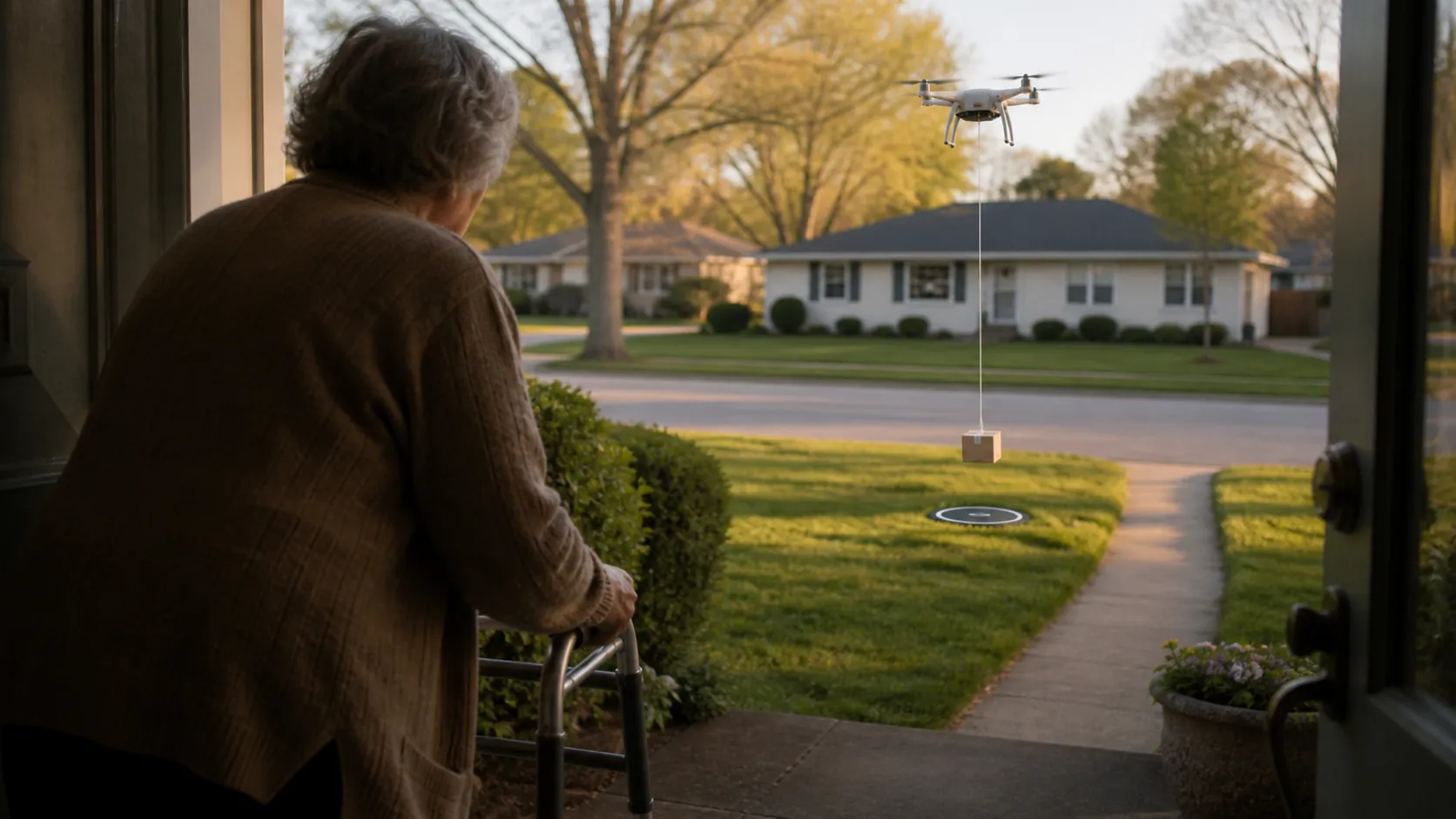
That does not make drone delivery a gimmick. It can remove two genuinely difficult tasks: driving to a store and carrying a small item home. For an older adult who no longer drives comfortably, cannot lift grocery bags, or tires quickly in a parking lot, that may be enough to matter. But the fit test starts at the door, not in the sky.
The handoff is the real mobility test
A typical drone medication delivery described by the Association of Health Care Journalists begins like a normal delivery: the recipient is alerted by email or text, selects a delivery window, and can cancel shortly before arrival. In the example AHCJ covered, the package was released with a small parachute, deliveries could be canceled up to 90 seconds ahead, and a 10-mile delivery could take about 10 minutes.[1]
Those details sound simple until you place them in an older adult’s routine. Someone has to receive or notice the message. Someone has to understand whether the delivery is coming now, later, or has been canceled. The drop zone has to be recognizable from inside the home or from a safe path outside. The package has to land somewhere the person can reach without stepping into grass, leaning over a railing, or carrying an item while also managing a cane, walker, oxygen tubing, or door lock.
A commercial safety blog aimed at older-adult use cases describes the same practical limit from a different angle: most consumer services are built around small packages, often under about 5 pounds, and the recipient still has to be notified, know where to retrieve the package, and be physically able to collect it from an outdoor location. The blog also notes that for someone with severe mobility limitations, even a doorstep package may be out of reach without help.[2] That source is not a health authority, so it should not be treated as clinical evidence. But the retrieval point is the right one to test at home.
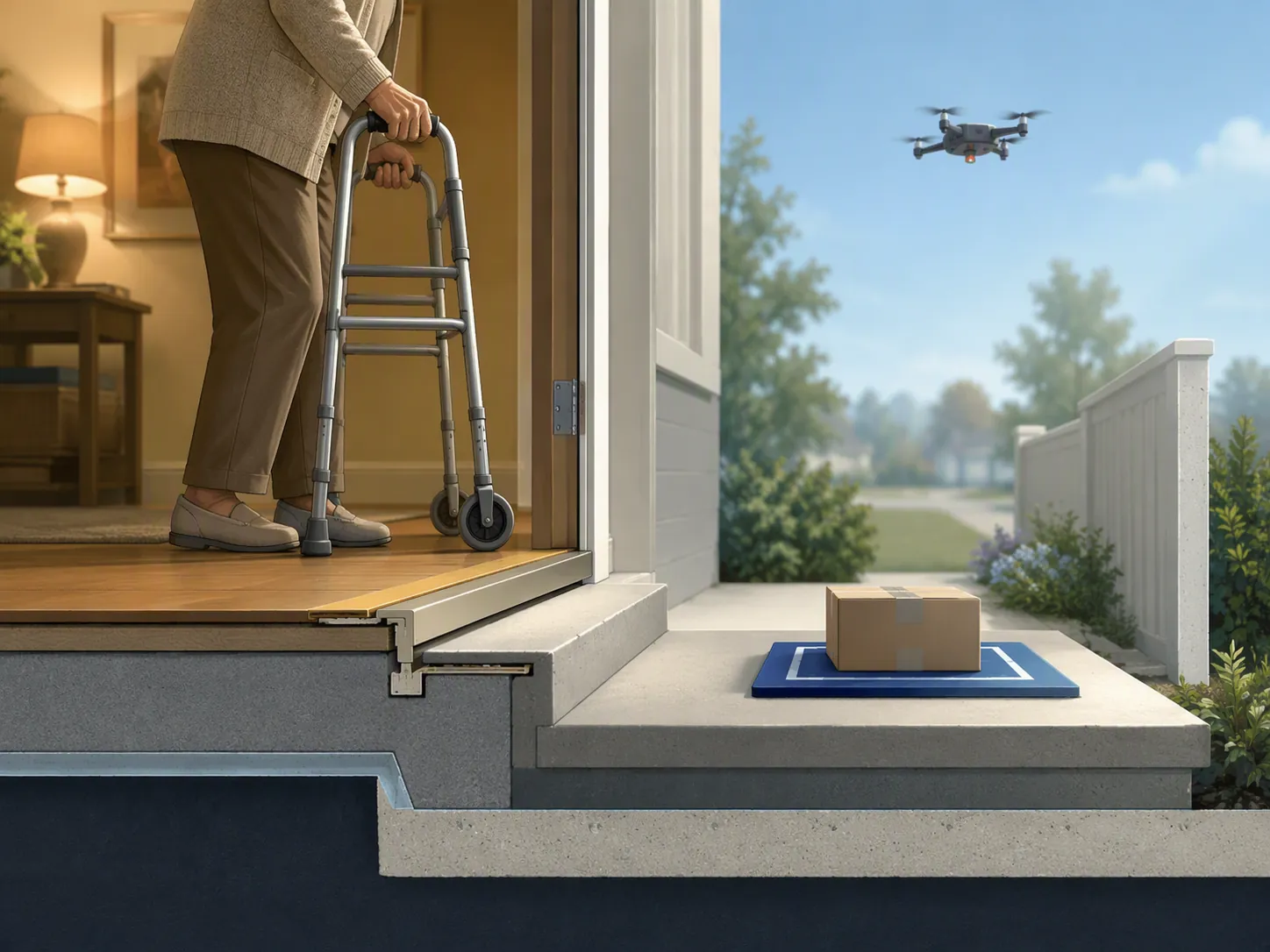
Before signing up, watch your parent do the receiving sequence without the drone. Can they open the door, step over the threshold, reach the likely drop area, bend or use a grabber, pick up a light package, turn around, and get back inside without rushing? If the answer depends on perfect weather, perfect lighting, or a caregiver being nearby, the drone is not solving the mobility problem by itself.
Drone delivery is real in 2026, but it is still local
The option is credible enough to check, especially in areas where major retailers or health systems are already operating. Walmart reported in May 2026 that it had completed more than 1 million drone deliveries across 66 stores in four states, with an average delivery time of 23 minutes, and named Wing and Zipline as partners.[3] The same Walmart page is marked as powered by generative AI, so those figures should be treated as company-reported rather than independent proof of performance.
The most relevant human example comes from Wing, which posted about the Sensmeiers, a senior couple who reportedly received more than 1,000 drone deliveries and said the service “kept them in their home longer, making it easier to get food and essentials.”[4] That story is useful because it describes the exact promise caregivers care about: fewer trips, more independence, less friction around daily supplies. It is still a company anecdote, not independent evidence that the same result is common or that the service is safe for every older adult.
Availability is the first hard yes-or-no. Check the service map before debating the rest. For many families, that means trying Wing’s delivery availability page, the Walmart app in participating markets, or a local health-system program if one is operating nearby. A city name is not enough; drone service can depend on store radius, address eligibility, airspace, weather, and the specific items allowed through that program.
What it can deliver well
The strongest use case is a small, time-sensitive item that is inconvenient to pick up in person but not so critical that a delay would be dangerous. Think of a pharmacy item ready today, a missing over-the-counter product, a few groceries, or a household essential that would otherwise require a separate trip. The package-size limit matters: if the item is bulky, heavy, refrigerated in a way the program does not support, or requires an in-person signature or consultation, the drone may not be the right channel.
This is where drone delivery can genuinely help seniors with mobility issues. It may remove a car ride, a parking lot walk, a store aisle search, and the strain of carrying a bag back inside. For an older adult who wants to remain independent, that can feel less intrusive than asking an adult child to run another errand. For the caregiver, it can turn a same-day need into a manageable check-in instead of a rushed drive across town.
The weaker use case is the one families are most tempted to overpromise: ongoing prescription access with no backup. Drone delivery may be part of a prescription plan in some local programs, but current public examples do not show a national, guaranteed medication-delivery replacement for every pharmacy, every drug, every insurance plan, or every address. It also does not remove the need to manage refills early enough that a weather delay or service outage does not become a medical problem.
The three-part fit test
A drone delivery service can look impressive on a map and still be wrong for one household. Use three checks before treating it as part of your parent’s routine.
| Fit question | What to verify |
|---|---|
| Does the service reach the exact address? | Check the provider’s app or availability page, not just the city or ZIP code. |
| Can your parent retrieve the package safely? | Test the door, threshold, path, drop zone, bending/reaching, carrying, lighting, and weather conditions. |
| Is there a backup plan? | Keep another way to get medications and essentials when drones pause, an app fails, or a refill is not ready. |
1. Confirm the address, not the idea
Start with the boring screen: “Is this address eligible?” If the answer is no, the rest is a future possibility, not a care plan. If the answer is yes, look at the available retailers, item categories, hours, fees, delivery zones, and cancellation rules. Do not assume that a pharmacy pilot, a grocery program, and a general retail drone service all operate under the same rules.
If the service is connected to a health system, ask what happens when a prescription is delayed, needs pharmacist review, or cannot be sent by drone. If it is a retail service, check whether the items your parent actually needs are eligible. A fast drone does not help if the medication is excluded or the household essential still requires standard delivery.
2. Walk the drop zone before the first order
This is the part to take slowly. Stand where your parent will stand when the alert arrives. Can they see the likely drop area? If not, can they reach it without stepping onto uneven ground? Is there a porch step, door sill, storm door, sloped walkway, gravel patch, wet leaves, snow pile, or low-contrast mat that makes the route harder than it looks?
The package may be small, but small is not the same as easy. Arthritis can make a light box awkward. Low vision can make a package hard to spot. Balance trouble can make bending risky. A walker can make it hard to carry even a few pounds unless the person has a basket, bag, or another safe method. If the safest answer is “someone should bring it inside,” then drone delivery is useful only when that someone is actually available.
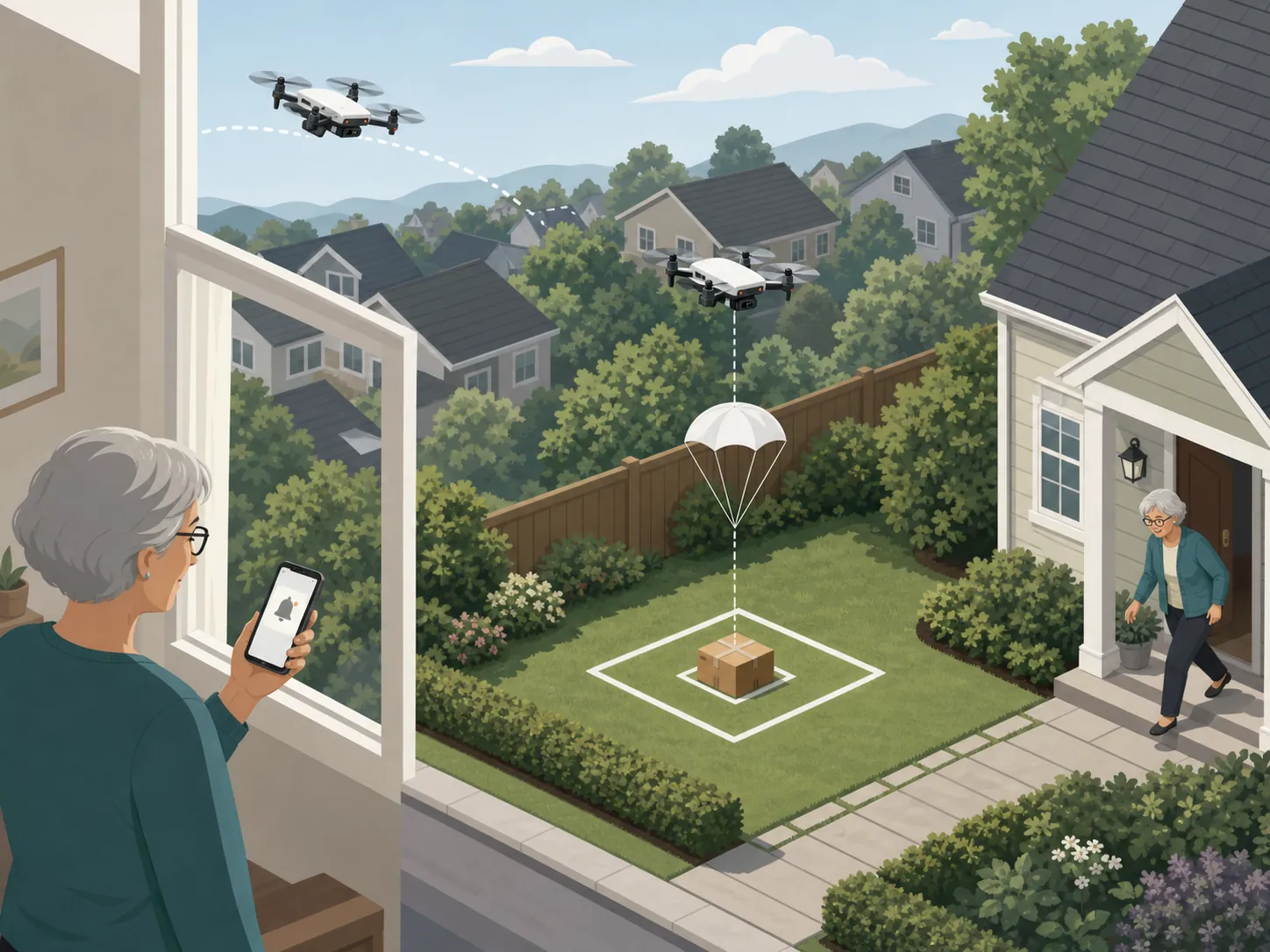
For families already working on mobility, this is the same kind of practical observation used in a broader mobility and independence plan. The question is not whether your parent is “independent” in the abstract. It is which daily actions are safe without help, which are safe with a tool or setup change, and which still require another person.
3. Keep a non-drone backup
Weather is not a footnote. AHCJ quoted Intermountain Health saying drones pause during snowstorms but resume as soon as skies clear, often faster than road delivery.[1] That may be reassuring for some delays, but it is not a reason to let critical medications run to the last dose. Snow, wind, power outages, app problems, store inventory gaps, and prescription timing can all interfere with a same-day plan.
For medications, the backup should be specific: which pharmacy can fill it, who can pick it up, whether mail order is already arranged, how early refills are requested, and what the prescriber’s office should do if the normal route fails. For weather and outages, connect drone delivery to the same household planning you would use for a 72-hour power outage checklist or a winter home safety review. The drone is one delivery method, not the emergency plan.
Phone comfort can decide the whole thing
Drone delivery is usually app- or notification-driven. That can be fine for an older adult who already orders groceries, reads texts reliably, and understands delivery alerts. It can be frustrating or unsafe for someone who misses notifications, taps through unfamiliar screens, cannot read small text easily, or worries about scams every time a message arrives.
A caregiver-managed account can help, but it may also make the older adult dependent on someone else to approve, track, or troubleshoot the order. If independence is the goal, check the phone experience honestly. Increase text size, simplify notifications, save the service contact, and practice what a real alert looks like before there is a medication waiting outside. If the phone itself is the barrier, start with senior-friendly accessibility settings before adding another delivery workflow.
Cost is likely out of pocket
Current public examples do not show Medicare or insurer coverage for drone delivery fees. Treat cost as out-of-pocket and plan-dependent unless the specific pharmacy, health system, insurer, or retailer tells you otherwise in writing.
The practical comparison is not only the drone fee. Compare it with the real alternative: a caregiver’s round trip, a paid errand service, standard pharmacy delivery, mail order, a rideshare, or the older adult driving when they should not. A small fee may be reasonable for an urgent item. It may be wasteful for routine refills that could be synchronized, mailed, or picked up once a month by someone already nearby.
When it is a good fit, and when it is not
Drone delivery is a good fit when the address is covered, the item is small and eligible, the older adult can manage alerts, and the outdoor pickup route is genuinely safe. It is especially useful for a senior who can walk short distances but should avoid driving, store navigation, parking lots, or carrying bags from a car.
It is a poor fit when the drop zone is not safely reachable, the person cannot reliably use the phone workflow, the item is medically urgent with no backup, or the household is trying to use drone delivery as a substitute for in-home help. It is also not an indoor delivery service. The sources cited here did not show packages being brought inside the home.
The careful answer is narrow, and that is what makes it useful. Drone delivery can be a helpful layer for small, time-sensitive items when the service reaches the address and the outdoor retrieval is safe. It can reduce some trips and carrying demands. It cannot, by itself, solve medication continuity, winter access, app confusion, or the last few feet between a package and a person who has to get it back inside.
References
- What to know about drone medication deliveries, Association of Health Care Journalists, November 2023.
- Elderly Safety and Drone Delivery, I'm Alive.
- Walmart Celebrates 1 Million Drone Deliveries, Marking a Major Milestone in Customer Convenience, Walmart, May 29, 2026.
- Drone delivery: lazy or helpful?, Wing.
Questions to bring to a clinician or OT
This is not medical, legal, or a family's final decision — only a framework. Bring these questions to a clinician, occupational therapist, or your local Area Agency on Aging.
Find Local HelpRelated reading
Noticed something outdated or inaccurate on this page? Flag a correction. We review every report against CDC, NIA, and AARP HomeFit guidance before updating a page.