
Caregiver decision guide
Protect Your Elderly Parent From Cruise Ship Illness Outbreaks
Before your elderly parent sets sail, use this CDC-based checklist to reduce their risk of getting sick from a cruise ship outbreak. The key step is a pre-travel healthcare visit 4–6 weeks ahead to update vaccines and plan for on-board safety.
If your elderly parent is going on a cruise, put one appointment on the calendar before you do anything else: a pre-travel healthcare visit 4–6 weeks before departure. That window is not a courtesy buffer. It is the time needed to update vaccines, review medications and chronic conditions, decide what to do if your parent gets sick before boarding, and make a realistic plan for care on a ship, where medical services are not the same as a hospital on land. CDC’s cruise travel guidance recommends that pre-travel visit 4–6 weeks before sailing, and it notes that roughly half of cruise passengers who visit ship medical centers are 65 or older.[1]
That does not mean a cruise is reckless for an older adult. It means the planning has to be more specific than “pack some Pepto” or “Dad is pretty healthy.” A stomach virus that is miserable for a younger traveler can become dangerous faster for an older parent, especially if dehydration, heart disease, kidney disease, diabetes, mobility limits, or medication side effects are already in the picture. For norovirus in particular, one review reported that 90% of norovirus-associated deaths occur in people 65 and older.[2]

The Short Pre-Cruise Checklist
Use this as the working order, not as a pile of equal errands. The healthcare visit carries the most weight because it affects nearly every other decision.
- Schedule a pre-travel healthcare visit 4–6 weeks before departure.
- Update vaccines and review chronic conditions, medications, mobility needs, and what symptoms would mean “do not board.”
- Pack a travel health kit for fever, vomiting, diarrhea, respiratory symptoms, and cleaning high-touch surfaces.
- Check the ship’s CDC Vessel Sanitation Program inspection score.
- Ask what medical care is actually available onboard and whether the ship follows recognized emergency care guidance.
- Buy travel insurance that covers illness-related cancellation and medical evacuation, and read the cruise contract deadlines before sailing.
Start With the 4–6 Week Healthcare Visit
The pre-travel visit is where vague concern becomes a plan. Bring the cruise itinerary, port list, medication list, allergies, recent hospitalizations, baseline blood pressure or glucose concerns if relevant, and the name of the travel insurance plan if you already have one. If your parent uses a cane, walker, portable oxygen, CPAP, hearing aids, compression stockings, or refrigerated medication, those details belong in the same conversation. Illness prevention is not separate from mobility and daily function; on a ship, the person who gets dehydrated may also become the person who cannot safely cross a wet bathroom floor.
The first concrete task is vaccine review. CDC travel guidance for older adults and cruise travelers points to staying current on routine and travel-related vaccines, including annual flu and updated COVID-19 vaccination; RSV, pneumococcal, and shingles vaccination may also matter depending on age, medical history, and eligibility.[1][3] The reason to do this weeks ahead is practical: some vaccines need time to produce protection, some people have temporary side effects, and some decisions require checking records rather than guessing.
The second task is deciding what would make boarding a bad idea. CDC notes that most norovirus outbreaks begin with passengers who are already infected when they board.[1] That point changes the family conversation. The question is not only whether the ship is clean. It is whether someone with vomiting, diarrhea, fever, or a sudden respiratory illness should still get in the car for the port because “we already paid.” For an older adult, the safer decision may be using the cancellation coverage you bought rather than turning the cabin into an isolation room on day one.
The third task is medication planning. Ask the clinician what to do if your parent misses doses because of vomiting, whether any medications increase dehydration risk, and which over-the-counter remedies are unsafe with their prescriptions or diagnoses. Do not assume that an anti-diarrheal, sleep aid, or motion-sickness product is harmless for an older traveler. The useful answer is not a generic cruise packing list; it is “for this parent, with these medications, here is what to take, what to avoid, and when to call the ship’s medical center.”
The fourth task is planning for limits in shipboard care. Cruise ships do have medical facilities, but they are not floating hospitals. CDC advises travelers to understand that onboard medical care may be limited compared with land-based care, and to consider medical evacuation coverage.[1] If your parent has unstable heart symptoms, recent surgery, a new oxygen requirement, complex diabetes, or a condition that could deteriorate quickly with dehydration, this is the moment to ask whether the itinerary is reasonable, not the night before embarkation.
Pack for the Illness You Are Trying to Prevent
A good cruise health kit is not a miniature pharmacy. It is a small set of supplies that helps your parent respond early to the problems most likely to turn serious: dehydration, fever, vomiting, diarrhea, contaminated hands, contaminated surfaces, and respiratory exposure in crowded indoor spaces. CDC cruise guidance and AARP’s norovirus prevention advice support packing items such as oral rehydration salts, anti-nausea medication, a thermometer, hand sanitizer with at least 60% alcohol, EPA-registered disinfecting wipes, and face masks.[1][4]
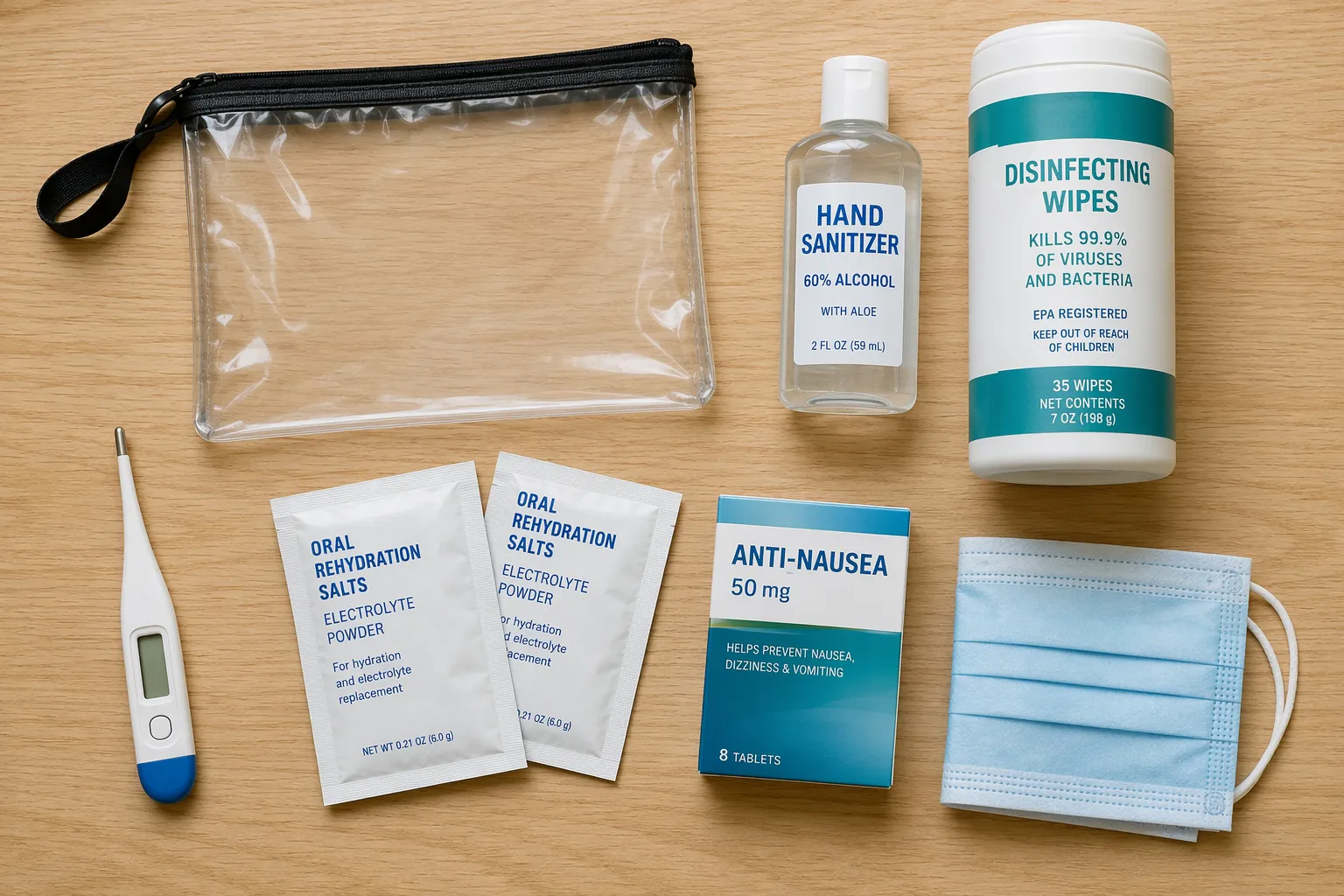
| Pack | Why it matters for an elderly parent |
|---|---|
| Oral rehydration salts | Vomiting or diarrhea can dehydrate an older adult quickly; plain water may not replace needed salts. |
| Clinician-approved anti-nausea medication | The right medication may help your parent keep fluids down, but it should be checked against their prescriptions. |
| Digital thermometer | A measured fever is more useful than “I feel warm” when deciding whether to call the medical center. |
| Hand sanitizer with at least 60% alcohol | Useful when soap and water are not immediately available, though handwashing still matters. |
| EPA-registered disinfecting wipes | Helpful for high-touch surfaces in the cabin, especially bathroom handles, remote controls, and tray surfaces. |
| Face masks | Useful in crowded indoor areas, medical spaces, embarkation lines, elevators, and tenders. |
Put the kit where your parent can actually reach it. A thermometer buried in a checked suitcase is not a plan. Oral rehydration salts packed in your bag do not help if your parent has a solo cabin down the hall and feels too weak to come find you. If your parent values independence, make the kit theirs: show them what is in it, write simple instructions, and agree in advance on which symptoms mean they call you or the ship’s medical center.
The onboard routine should be specific enough to follow without turning the trip into a surveillance operation. Wash hands with soap and water before eating and after using the bathroom. Use sanitizer when a sink is not available. Wipe the cabin’s highest-touch surfaces on arrival. Avoid sharing utensils, cups, and bites of food if someone feels unwell. If vomiting or diarrhea starts, report it promptly and stay in the cabin instead of trying to “push through” dinner, a show, or an excursion.
For some parents, the most important packing question is physical safety during illness. If your parent uses a mobility aid at home only “sometimes,” a ship is not the place to pretend they never need it. A cane or walker may matter more after a sleepless night, mild dehydration, or a dose of medication that causes dizziness. The same is true for accessible cabin features such as grab bars and roll-in showers. These are not admissions of frailty; they are ways to keep a temporary illness from becoming a fall.
Check the Ship, but Know What the Score Can and Cannot Tell You
Before departure, look up the ship in CDC’s Vessel Sanitation Program. CDC says VSP conducts unannounced cruise ship inspections twice a year for ships under its jurisdiction, and a score of 85 or higher is considered passing.[5] That score is worth checking because it gives you more than a brand promise. It can also show whether a ship has had sanitation problems serious enough to concern you before your parent boards.
Do not overread the score. A passing inspection does not mean no one will board sick next week. A poor score does not prove your parent will get sick. The practical use is narrower: if the score is low, recent, or paired with inspection details that make you uneasy, you have a reason to call the cruise line, ask more questions, change behavior onboard, or reconsider the trip while cancellation options still exist.
The same restraint applies to outbreak headlines. Cruise lines report gastrointestinal illness to CDC when at least 3% of passengers or crew report symptoms.[5] That threshold helps explain why a CDC outbreak list is not a complete log of every upset stomach at sea. It is a reporting trigger for larger GI events, not a personal risk forecast for your parent’s exact sailing.
There is also a measurement caveat in 2026. Food Poison Journal, citing CDC outbreak-list interpretation and reporting concerns, has noted that staffing cuts affecting the CDC Vessel Sanitation Program in 2025 may complicate how completely 2026 cruise illness patterns are captured.[6] That is a reason to avoid false precision, not a reason to panic. Families should use the CDC tools that exist while remembering that no public dashboard replaces preparation before boarding.
Ask About Onboard Medical Care Before You Need It
The cruise line should be able to explain what medical services are available onboard, when the medical center is staffed, how after-hours care works, and what happens if a passenger needs evacuation. CDC advises travelers to ask about onboard medical capabilities, and Johns Hopkins notes that cruise ship medical facilities are intended for urgent and emergency care but vary by ship and itinerary.[1][7]
Ask whether the ship follows the American College of Emergency Physicians’ emergency care guidance for cruise ship medical facilities. You do not need to become a maritime medicine expert. You need to know whether there is a recognized standard behind the answers you are getting, especially if your parent has a condition that could require oxygen, IV fluids, monitoring, or transfer to shore.
Write down the medical center location and phone number once you board. If your parent travels with a friend, sibling, or spouse instead of you, make sure that companion knows where the medication list is and when to seek help. Independence works better when the people nearby are not improvising in the hallway while someone is vomiting.
Keep the Risk in Proportion Without Shrinking the Stakes
Norovirus is the cruise illness families hear about most, but even here the numbers need careful reading. Cruise Critic, citing CLIA data, reports that the annual risk of lab-confirmed norovirus on a cruise is about 1 in 5,500 passengers.[8] That is useful context against the idea that every cruise is a floating outbreak. It does not cancel out the older-adult problem: when severe dehydration or complications do happen, an elderly parent has less margin.
Rare hazards deserve even more restraint. In 2026, WHO reported a hantavirus cluster associated with the expedition cruise ship MV Hondius, with 13 infections and 3 deaths, linked to a South American rodent-borne pathogen; WHO assessed the global risk as low.[9] That case is serious, but it should not be treated as the new normal for cruises. It is a reminder to match preparation to itinerary and exposure, not to convert every cruise article into disaster forecasting.
Buy Insurance While It Can Still Do Its Job
Travel insurance is boring until someone wakes up sick on embarkation morning. For an elderly parent, look for coverage that addresses medical care, medical evacuation, and trip cancellation for illness. The cancellation piece matters because one of the best outbreak-prevention decisions may be not boarding while actively ill. If the only family plan is “we paid too much to miss it,” prevention has already lost ground.
Read the cruise ticket contract before departure, not after a problem. Food Poison Journal notes that many cruise ticket contracts require written notice within six months and limit lawsuits to one year under 46 U.S.C. § 30508.[6] Most families will never need those deadlines. The point is that illness, cancellation, medical bills, and legal notices run on paperwork timelines, not on how overwhelmed everyone feels afterward.
If Your Parent Gets Sick Before Boarding
This decision should be made before anyone is standing at the terminal with luggage. Ask the clinician during the pre-travel visit which symptoms should trigger a call, a same-day evaluation, or cancellation. Vomiting, diarrhea, fever, or a sudden respiratory illness close to departure should not be waved through because the trip is special. It may be exactly the situation that spreads illness onboard and puts your parent at risk of worsening symptoms away from their usual care.
If symptoms begin on the ship, the safer move is early reporting. Waiting to see if it passes may feel polite or practical, but it delays fluids, isolation guidance, and help deciding whether symptoms are becoming dangerous. For an older adult, the line between “unpleasant” and “needs medical attention” can move quickly.
The best protection from a cruise ship illness outbreak is not refreshing CDC outbreak news in 2026 until the trip feels ruined. It is using the 4–6 week window to prepare the parent, the vaccines, the medication plan, the ship questions, the insurance, and the supplies before boarding.
References
- CDC Yellow Book 2026 — Cruise Ship Travel, CDC.
- Norovirus Infection in Older Adults, NIH/PMC.
- Older Adults and Healthy Travel, CDC.
- How to Avoid Norovirus on Cruises, AARP.
- Cruise Ship Outbreaks, CDC Vessel Sanitation Program.
- Cruise Ships in 2026: What the CDC’s Outbreak List Does and Doesn’t Tell You, Food Poison Journal.
- Cruise Ships, Johns Hopkins Medicine.
- Norovirus: What You Need to Know, Cruise Critic.
- Disease Outbreak News; Hantavirus disease — Argentina, World Health Organization.
Questions to bring to a clinician or OT
This is not medical, legal, or a family's final decision — only a framework. Bring these questions to a clinician, occupational therapist, or your local Area Agency on Aging.
Find Local HelpRelated reading
Noticed something outdated or inaccurate on this page? Flag a correction. We review every report against CDC, NIA, and AARP HomeFit guidance before updating a page.