
Equipment comparison
Why senior travelers in Paris should choose buses over Metro
Most travel guides default to the Metro, but Paris buses are 100% ramp-equipped and step-free, making them the safer, less tiring choice for senior travelers with reduced mobility. This guide covers key accessible routes, fare information, and when to use alternatives like Metro Line 14 or taxis.
| Equipment category | public transit |
|---|---|
| Comparison criteria | accessibility, stairs, speed, cost, fatigue |
| Best fit for | Senior travelers prioritizing step-free access over speed, with bus as default, taxi for fatigue and luggage |
The usual Paris advice starts with the Metro map. For a senior traveler, that is the wrong starting point. The better question is not which line is fastest from museum to hotel, but which route asks the least of your knees, balance, luggage hand, and patience at the end of the day.
The difference is not small. In the Paris Metro, only Line 14 is fully step-free across its route: 21 stations out of a 303-station network spread across 16 lines.[1] Paris buses, by contrast, are declared accessible on all lines inside the city, with low floors and automatic ramps at the middle door.[2] That single comparison should change the default plan for many older visitors: use the bus first, then choose the Metro only when the specific line and station sequence make sense.
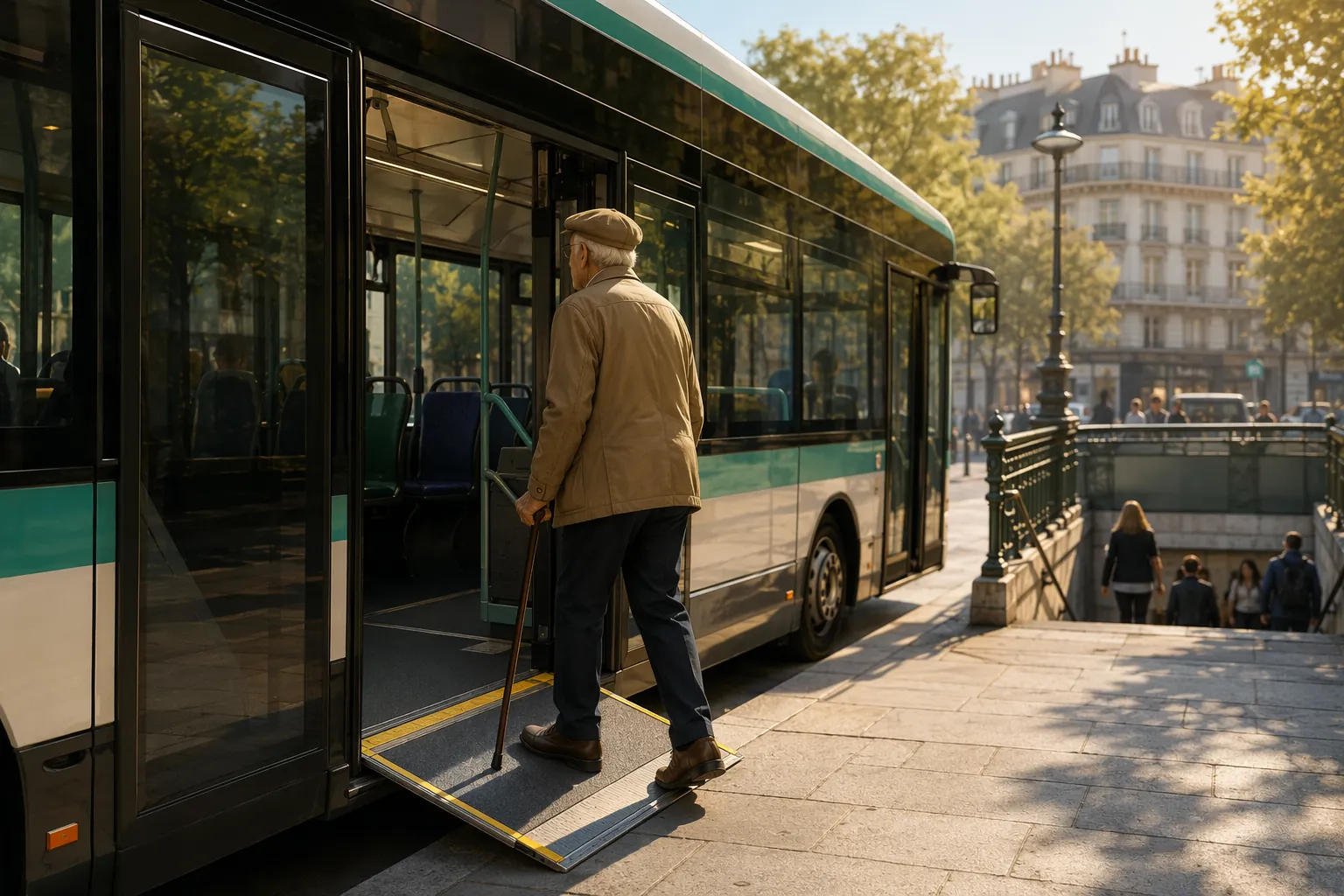
This is not an argument against the Metro. Paris has places where the Metro is exactly the right answer, especially Line 14. It is an argument against pretending that “take the Metro” is neutral advice. A staircase at the wrong moment can cost more than ten minutes. It can cost the next stop, the next museum room, or the pleasant walk back after dinner.
Make The Bus Your Ordinary Paris Default
For ordinary sightseeing days, the bus has the more forgiving physical sequence: wait at street level, board through a low-floor door, use the ramp when needed, find a seat without descending underground, and get off at curb level. That sequence matters more as the day wears on. A traveler who can manage several flat blocks may still find repeated Metro stairs punishing, especially with a tote bag, raincoat, cane, or rolling suitcase.
The bus is not magic. It can be slowed by traffic. Stops can be crowded. A driver may need a moment to deploy the ramp. But the risk is visible and recoverable: if the bus is too full, wait for the next one; if traffic is heavy, sit and arrive later. A Metro staircase is different. Once you have committed to the wrong entrance, the problem may be behind you, below you, and repeated on the way out.
Inside Paris, the bus network is broad enough that this does not have to feel like settling. The useful habit is to plan by stops and walking distance, not by transit category. A slightly slower bus that drops you within a flat block of the museum door may be the better trip than a faster Metro ride that leaves you facing two staircases and a long underground corridor.
A Bus-First Day Has A Different Shape
- Choose the stop closest to a level entrance, not only the stop closest on the map.
- Build in one missed bus without treating it as a failure.
- Sit as soon as you can, even for a short ride; saving strength is part of the itinerary.
- Avoid tight transfers late in the day, when balance and patience are both thinner.
- Keep one taxi option for the return, especially after dinner or a museum-heavy afternoon.
This approach favors staying out longer over arriving faster. That is usually the right trade for a traveler who wants Paris, not a transit endurance test.
A Few Central Routes Make The System Less Abstract
Some central bus lines are especially useful because they pass places many visitors already want to see. Paris je t’aime highlights Lines 38, 68, 28, and 96 as routes that pass major landmarks and can double as low-cost sightseeing for the price of a regular bus fare.[5] That does not mean these are the only routes worth using. It means buses can be planned as real transportation with the occasional bonus of a good view.
| Bus line | Why it can be useful |
|---|---|
| 38 | A central north-south option that can help with Left Bank and central Paris movement. |
| 68 | Useful for combining ordinary travel with views through central tourist areas. |
| 28 | A practical line to check when planning between major sights rather than defaulting underground. |
| 96 | Helpful for cross-city sightseeing days when the stop locations fit your walking limits. |
Treat these as examples, not a required checklist. The best senior-friendly route is the one that reduces stairs and leaves you near the door you actually intend to use.
Pay Before You Are Holding Up A Line
Fare confusion is tiring in a different way. In 2026, paper tickets have been phased out: bus paper tickets ended in May 2026, and rail paper tickets ended in June 2026.[3] The simplest tourist replacement is the Navigo Easy card, a reloadable card that costs €2.[3][4]
| Item | 2026 information |
|---|---|
| Navigo Easy card | €2 for the reusable card |
| Single bus/tram fare | €2.05 |
| Single Metro/RER fare | €2.55 |
| Paper tickets | Phased out in 2026: May for buses, June for rail |
Buy and load the card when you are not rushed. Do it at a station, service point, or other official sales channel before the day’s first important trip. The point is not to master every fare product in the region. The point is to avoid learning the system while people are waiting behind you and your bus is due.
Do not count on a senior tourist discount. The Navigo Senior annual pass is for residents, not visitors; Paris je t’aime lists it as an annual product costing €544.80 after a 50% reduction, but it is not a short-stay tourist pass for everyone over a certain age.[4] Forum advice can blur that point. For a visitor, the useful planning assumption is that you will pay ordinary fares.
Contactless bank-card payment should also be treated carefully in 2026. Île-de-France Mobilités describes contactless rollout as gradual, with full coverage targeted for 2030.[3] A loaded Navigo Easy card is still the calmer choice.
When The Metro Is Still The Right Choice
Metro Line 14 deserves special treatment because it is fully accessible end to end, with elevators and level boarding across its 21 stations.[1] If Line 14 connects the places you need and reduces a long surface trip, use it. This is one of the rare cases where speed and step-free access can work together.
Other Metro lines require more caution. Some stations have elevators or ground-level access; Sortiraparis lists more than 80 stations with at least one elevator or ground-level access point.[6] That is useful information, but it is not the same as a promise that your entire path from street to train to exit will be step-free. One elevator can serve one entrance, one direction, or one part of a complicated station.
Before choosing a non-Line 14 Metro trip, check the whole chain: entrance, ticket gate, platform direction, transfer, exit, and backup if the elevator is unavailable. If any part is vague, the bus may be the steadier plan even when the Metro looks cleaner on the map.
When Not To Use The Bus
A bus-first plan is strongest when it is not stubborn. There are times when another mode is safer, easier, or simply more humane.
- Use Metro Line 14 when it directly serves your route and saves a long, slow surface crossing without adding stairs.
- Use trams for outer-edge movement when the route fits; tram lines are step-free, with platform access by ramp or elevator.[1]
- Consider the RER only with planning if you need a regional connection; staff-assisted ramps may be appropriate, but this is not a last-minute, guess-at-the-platform choice.
- Use a taxi for airport luggage, late evenings, heavy rain, or the moment when fatigue has made one more transfer feel unsafe.
- Skip public transit entirely for a short segment if the fare savings are being paid for with fall risk.
The evening rule is especially plain. If you would not choose a staircase at home after a long day, do not make a Paris transit plan that depends on one after dinner. This is where a G7 taxi or another licensed taxi is not an indulgence; it is the tool that lets the rest of the day remain independent.
The Luggage Exception
Luggage changes the equation. A suitcase makes every curb, gap, and crowded aisle harder. For hotel arrival and departure, especially from a rail station or airport connection, plan more conservatively than you would for a light sightseeing day. If the accessible public-transit route requires multiple transfers, a taxi may be the less dramatic option.
How To Plan A Senior-Friendly Paris Transit Day
Start with the day’s hardest movement, not the first one. The risky trip is often the return from dinner, the transfer after three museum hours, or the ride back to the hotel when the weather has changed. Build the plan around that moment, then let the easier daytime trips fit around it.
- Mark your hotel and each main stop, then look for bus routes that keep walking flat and short.
- Check whether Line 14 solves any long cross-city segment without forcing a difficult transfer.
- Load a Navigo Easy card before the day begins.
- Choose one place to sit and recover during the day, even if the map says you could squeeze in more.
- Decide in advance which trip becomes a taxi if fatigue, rain, or luggage makes transit unattractive.
The backup plan is not pessimism. It is what keeps a missed elevator, a packed bus, or a sore knee from becoming the main event of the afternoon.
The Practical Rule
For senior travelers in Paris, public transit planning should begin at the curb, not on the Metro diagram. Use buses for most ordinary sightseeing days. Use Line 14 when it fits cleanly. Use trams where they serve the outer edges of your route. Plan RER trips with assistance rather than improvisation. Take taxis when luggage, darkness, weather, or fatigue changes the risk.
Buses may be slower. For many older travelers, fewer stairs means more Paris.
References
- Accessibility of the Paris metro — Île-de-France Mobilités
- Transport accessibility in Paris and Île-de-France — Bonjour RATP
- Transport fares 2026 — Île-de-France Mobilités
- Fares, travel passes and reductions — Paris je t’aime
- Paris public transport — Paris je t’aime
- Paris: lift-accessible metro stations — Sortiraparis
Questions to ask your clinician or OT
This comparison doesn't decide final medical fit — bring it to a clinician or occupational therapist conversation, not a purchase decision.
Find Local HelpRelated reading
Noticed something outdated or inaccurate on this page? Flag a correction. We review every report against CDC, NIA, and AARP HomeFit guidance before updating a page.