
Caregiver decision guide
How to Evaluate Community Resilience for Aging Parents
Learn how to assess whether your aging parent's community — including housing, transportation, walkability, social infrastructure, and climate resilience — truly supports safe aging in place. This guide uses WHO and AARP frameworks to help family caregivers systematically evaluate neighborhood age-readiness and identify gaps.
Start With the Neighborhood, Not the Grab Bars
A parent can have the bathroom rails, pill organizer, and emergency contacts in place and still be one icy curb cut away from trouble. Aging in place only works when the surrounding community lets an older adult reach food, care, transit, and people without a heroic workaround. By 2050, the world is expected to have about 2 billion people aged 60 and older, with about 1.5 billion living in urban areas, and the World Bank has noted that 46% of people over 60 live with at least one disability [1][2].
That is what building resilient cities for an aging population actually means: not a slogan, but a set of streets, stops, services, and emergency routines that still work when an older adult moves more slowly, drives less, or cannot tolerate heat.
A Practical Age-Readiness Audit
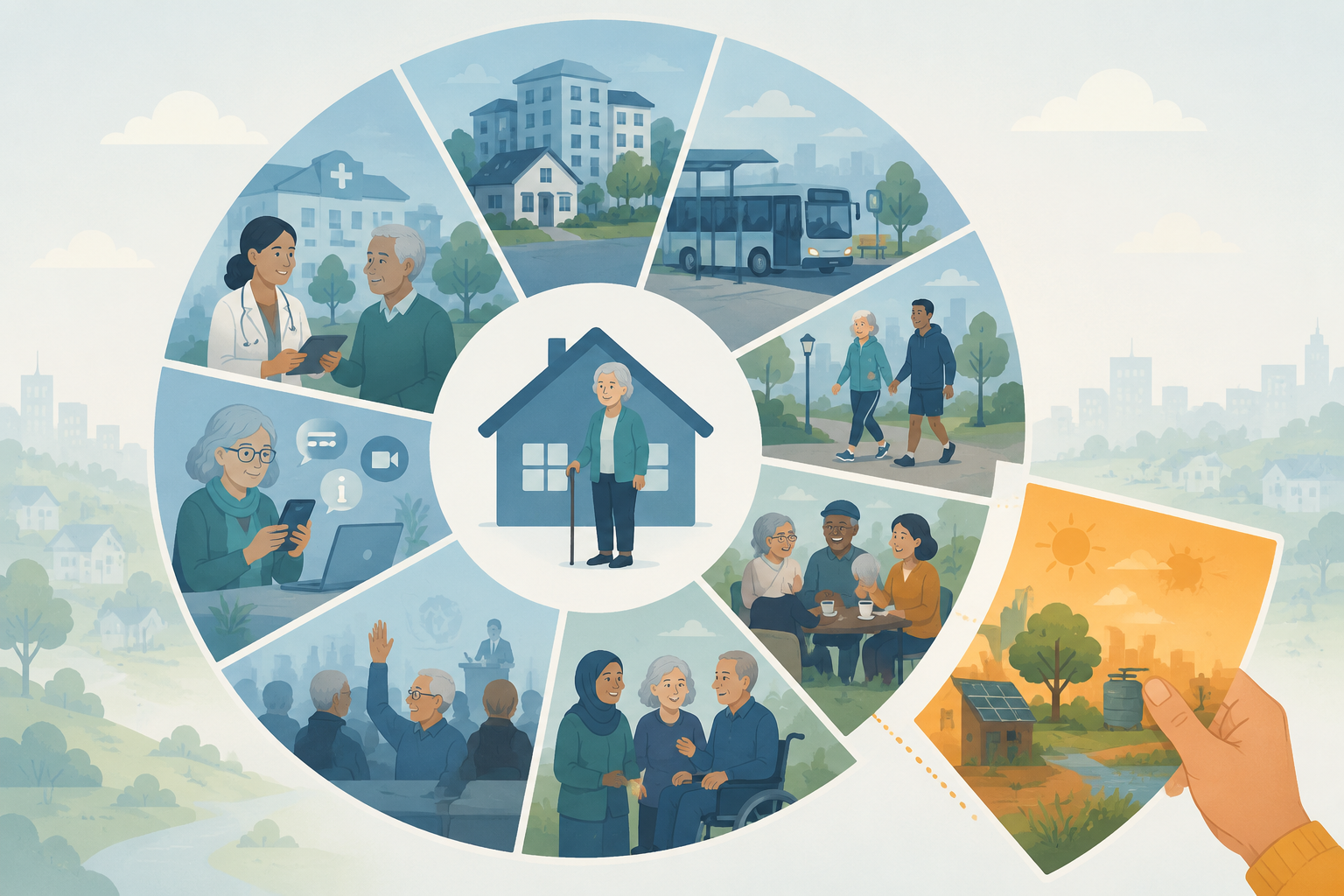
The WHO 8-domain framework and AARP livable community criteria are useful because they keep the question concrete: can your parent get through an ordinary week here? They turn a vague feeling into a shared checklist, and they are strong enough to cover the basics without pretending every neighborhood fails in the same way [3].
| Domain | Questions to verify | What a gap looks like |
|---|---|---|
| Housing | Can your parent enter without stairs or steep thresholds? Is heating and cooling reliable in extreme weather? | One difficult door, poor maintenance, or no climate-safe indoor refuge. |
| Transportation | Is there a bus or rail stop within a realistic walk? Are fares, schedules, and transfers usable without driving? | Service exists on paper but not on the trips your parent actually needs. |
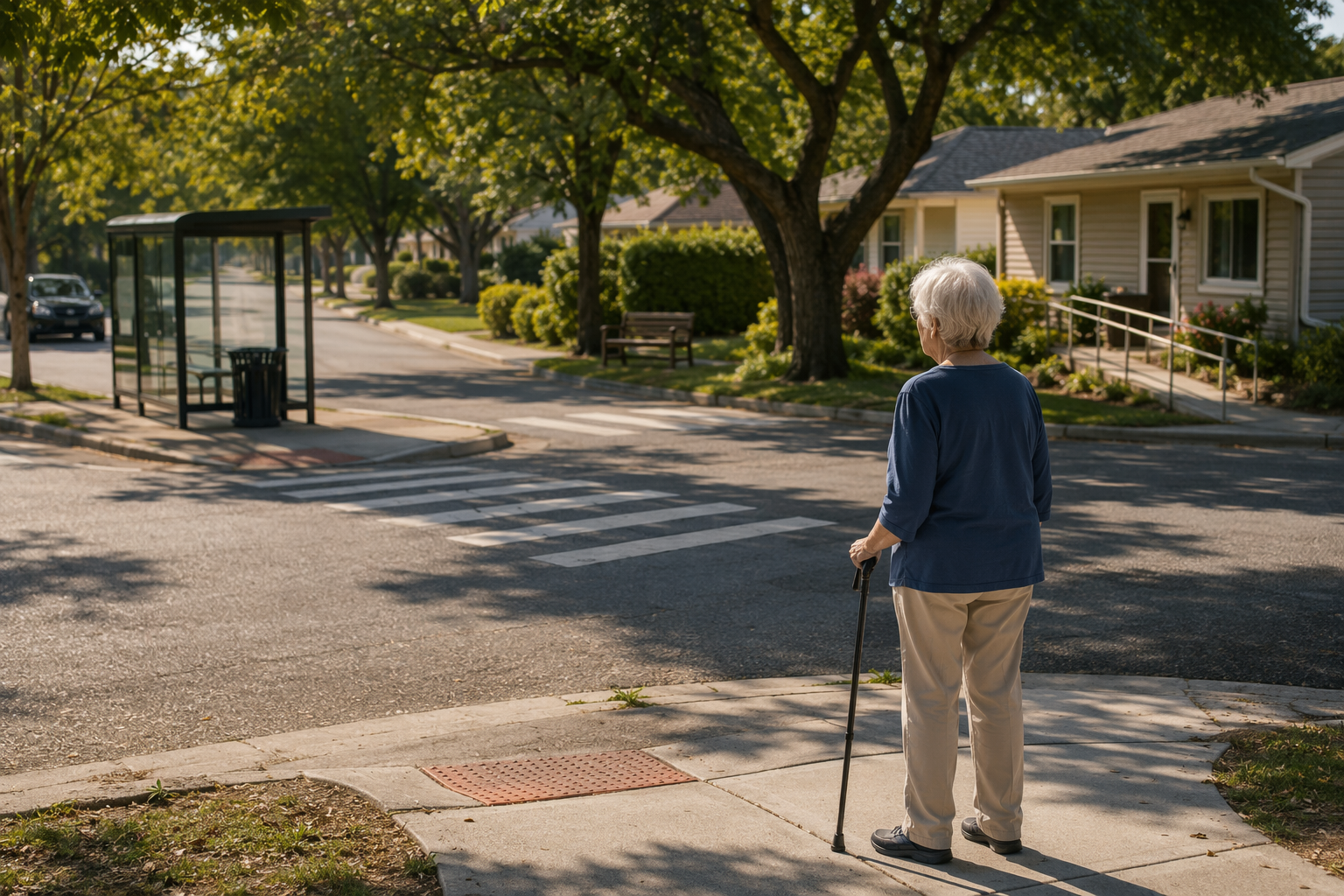
| Walkability and outdoor space | Are crossings timed for slower walking, and do sidewalks have curb cuts, benches, lighting, and shade? | Every short trip depends on a caregiver, ride, or luck. |
| Social participation | Can your parent leave home for something beyond errands or appointments? | The neighborhood has services but no reason to linger or belong. |
| Respect and social inclusion | Do older adults and mobility aids fit comfortably in public spaces and services? | The environment expects speed, standing, or perfect hearing and vision. |
| Civic participation and communication | Are alerts, detours, outage notices, and local updates easy to receive and understand? | Important information arrives too late or in the wrong format. |
| Community support and health services | Are pharmacy, primary care, urgent care, and help at home realistically reachable? | Care is listed nearby but hard to use without a car or long wait. |
| Climate resilience | Is there shade, cooling access, backup power, storm readiness, and neighbor outreach? | Heat or outage can turn a normal week into a health event. |
The range of fixes matters. Toronto's Senior Safety Zones, Seoul's free subway for older residents, Santander's digital twin planning, and Japanese parks with senior exercise equipment all show that age-readiness can show up as a redesigned intersection, a fare policy, a planning model, or a public-space detail [1].
Climate Is the Test Most Guides Still Understate
Heat is the clearest reason to stop treating climate as a side issue. More than 80% of U.S. heat deaths are people over 60 [4]. For older adults, the relevant question is not whether a city publishes a resilience plan, but whether the plan keeps the power on, the indoor temperature survivable, and the route to cooling accessible when the grid fails or the street feels hotter than the home.
That pushes the checklist beyond shade and trees. You want to know whether there is backup power at buildings your parent actually uses, whether cooling centers are open at the right hours, whether transit stops have shelter, whether neighbors or building staff check on people after outages, and whether medications and mobility equipment can be stored and used safely during an emergency.
The housing piece matters here too. ICMA's climate-resilient housing work ties neighborhood form, service access, and housing strategy together, especially where missing-middle options can keep older adults closer to support without isolating them at the edge of town [5].
How to Read the Result
Once the audit is done, the gaps usually fall into three buckets. Some are manageable with home-based adaptations, like a safer entry, better lighting, or a cooling backup. Some are addressable through local services or advocacy, like a bus stop that needs shelter or a crossing that needs more time. Some are serious enough to trigger a relocation conversation, especially when the barriers stack up: no safe crossing, no reliable transport, no nearby support, frequent outages, or repeated heat exposure.
If that conversation starts to point toward a move, a companion guide on senior-friendly cities can help narrow the search. If the weakness is mostly inside the house, the home-modification checklists still matter; if the weakness is outside the door, the neighborhood has to be part of the fix.
The point is not to find a perfect place. It is to see whether the current place can hold an older adult's life together on ordinary days and on bad ones. Aging in place is never only a home modification project; it is a fit between the parent, the house, the neighborhood, the support network, and the community's ability to absorb heat, storms, outages, and slower movement.
References
- How Can Cities Adapt to Aging Urban Populations? — BCG, 2025 — https://www.bcg.com/publications/2025/how-can-cities-adapt-to-aging-urban-populations
- Silver Hues: Building Age-Ready Cities — World Bank, 2022 — https://documents.worldbank.org/en/publication/documents-reports/documentdetail/099915010112231069/silver-hues-building-age-ready-cities
- Creating age-friendly cities and communities — World Health Organization — https://www.who.int/teams/social-determinants-of-health/demographic-change-and-healthy-ageing/age-friendly-cities-and-communities
- Seniors at Risk: Heat and Climate Change — Climate Central, 2026 — https://www.climatecentral.org/climate-matters/seniors-at-risk-heat-and-climate-change
- Climate-resilient Housing Strategies for Our Aging Population — ICMA — https://icma.org/articles/pm-magazine/climate-resilient-housing-strategies-our-aging-population
Questions to bring to a clinician or OT
This is not medical, legal, or a family's final decision — only a framework. Bring these questions to a clinician, occupational therapist, or your local Area Agency on Aging.
Find Local HelpRelated reading
Noticed something outdated or inaccurate on this page? Flag a correction. We review every report against CDC, NIA, and AARP HomeFit guidance before updating a page.