
Caregiver decision guide
How to Write an Obituary for an Elderly Parent
This guide walks you through writing a meaningful obituary for your elderly parent, from gathering information and choosing details to deciding where to publish — without letting grief or cost surprises slow you down.
Writing an obituary for an elderly parent is easier if you stop trying to write the whole life at once. Start with five sections: the announcement, a short biography, family, character, and service details. The first draft can be plain. It can have brackets where a date is missing. It can say “check spelling” next to a cousin’s name. The point is to get the necessary pieces onto the page before you polish anything.
One distinction matters before you write too much: a death notice is a brief factual announcement, while a full obituary usually includes biography, family relationships, service information, and personal detail. The New Hampshire Funeral Directors Association describes the obituary as more than a notice because it records the death, names family, gives service details, and tells something of the person’s life.[1] That distinction can also keep you from paying for a long newspaper placement when a short notice would do the public job.
Before You Draft, Decide What Has To Be Public
There are two different jobs hiding under the word “obituary.” One is public notification: who died, when, where the service is, and how people can reach the memorial page or funeral home. The other is remembrance: what kind of life your parent lived, who mattered to them, and what details make the family recognize them on the page.
If you are placing something in print, keep that public-notice job in mind. Funeral.com’s 2025–2026 pricing guide lists illustrative newspaper obituary ranges of about $50–$200 for some local papers, $300–$1,000+ for some metro papers, and per-line rates around $2.50–$5+ in cited examples.[2] Those numbers are not a national guarantee; the source has a commercial context, and newspaper pricing varies by region, length, photo use, and publication. They are still useful enough to justify one practical question before you write a 900-word print version: what will this cost?
A good default is a two-part plan: use print for a concise notice that reaches the local community, then use the funeral home or memorial website for the fuller tribute. Funeral.com frames this print-short, online-long approach as a way families may save 50–80%, depending on the publication and placement choices.[2] Before paying for any separate online posting, ask the funeral home what is already included. Many funeral homes provide a basic online obituary or memorial page as part of their services; you do not want to buy the same function twice.
The Five Sections Of An Obituary For An Elderly Parent
Use this structure even if you later rearrange the sentences. It gives you a place to put every necessary fact without deciding, while grieving, whether a church committee belongs before a grandchild’s name.
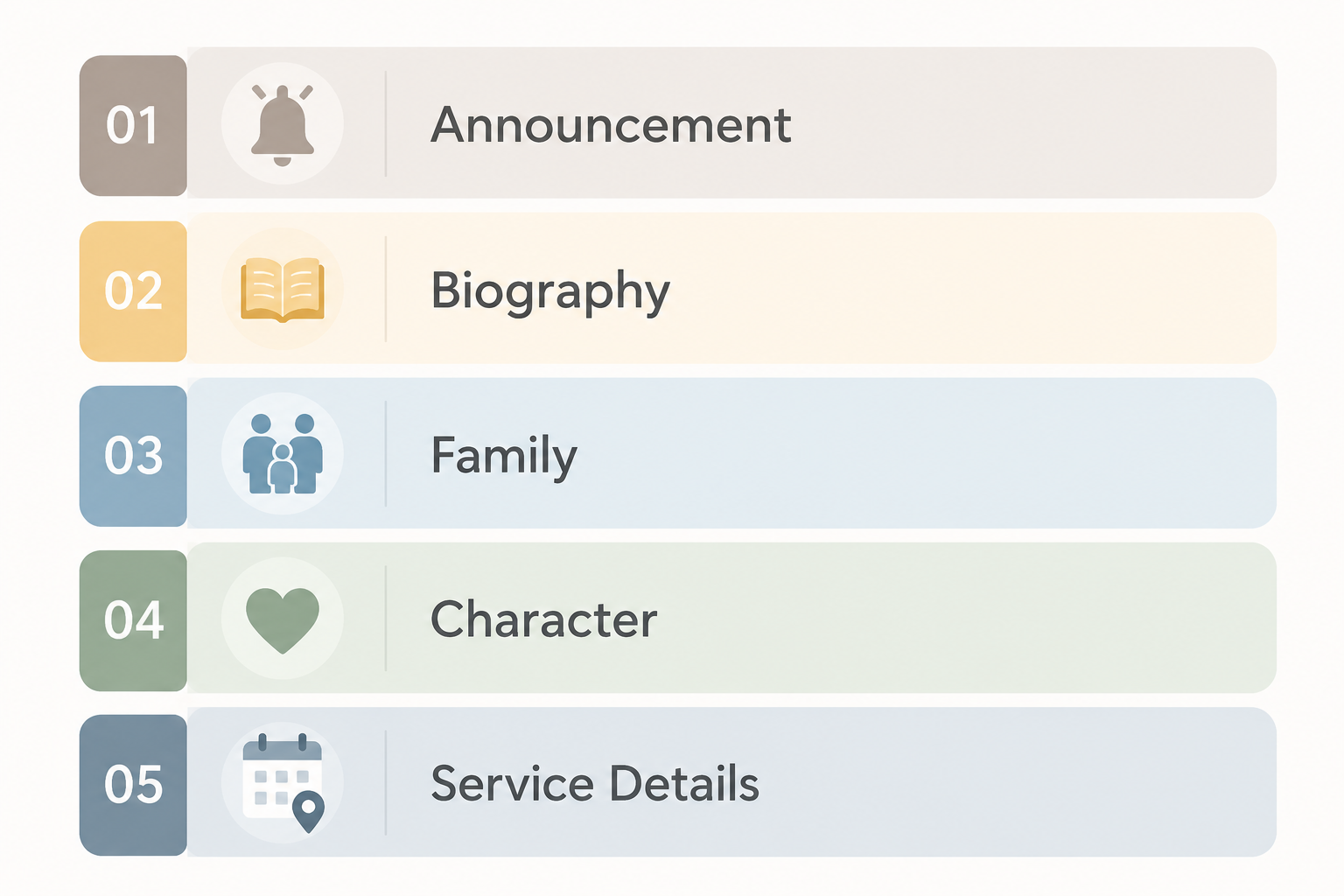
| Section | What it does | What to gather |
|---|---|---|
| Announcement | States the death clearly | Full name, age, date of death, city or place of residence |
| Biography | Gives the shape of the life | Birthplace, parents, education, work, marriage, moves, military service, faith or community ties |
| Family | Names close relatives accurately | Surviving family, predeceased family, spellings, spouses, grandchildren and great-grandchildren |
| Character | Makes the obituary sound like your parent | Habits, loyalties, acts of care, favorite places, ordinary proofs of who they were |
| Service Details | Tells people what to do next | Visitation, funeral or memorial service, burial, livestream, donations, flowers, reception |
1. Announcement
The announcement should be factual and calm. It does not need to carry the emotional weight of the entire obituary. A standard opening includes your parent’s full name, age, city of residence, and date of death. Some families include the place of death; others prefer a gentler phrase such as “died peacefully” if that is accurate. Do not write “peacefully” just because it sounds proper. If the last day was complicated, plain wording is kinder to everyone who knows the truth.
A workable opening looks like this: “Margaret Ellen Harris, 87, of Dayton, Ohio, died on March 4, 2026, surrounded by her family.” If you are unsure about one fact, bracket it: “[confirm age]” or “[confirm city].” The bracket is not a failure. It is how you keep moving without letting one missing detail stop the entire draft.
2. Biography
The biography is the timeline, not the resume in full. For an elderly parent, you may have decades of facts: birth, childhood town, school, military service, marriage, work, moves, caregiving, retirement, church, clubs, volunteer roles, and the late-life years when the family became smaller and more present. You do not have to use all of it.
Choose the facts that explain how your parent’s life was built. If your father worked at the same plant for 38 years and everyone in town knew him by his lunch pail, that belongs. If your mother’s paid work paused while she raised children and later cared for her own aging sister, that belongs too. Obituaries often overvalue formal titles and undervalue unpaid labor, especially in older generations. A life can be accurately described without pretending every meaningful contribution came with a job title.
Death With Dignity’s remembrance framework encourages people to think through life stages, relationships, values, lessons, and messages, which is a useful way to locate the details that matter before turning them into obituary copy.[3] You do not need to answer every reflective question. Use the framework to jog memory, then choose only what serves this obituary.
3. Family
The family section is where errors hurt. Slow down here. Make a separate list before writing the paragraph: surviving spouse or partner, children, children’s spouses or partners, grandchildren, great-grandchildren, siblings, and anyone who was functionally family. Then list the people who died before your parent: spouse, parents, children, siblings, or other close relatives the family expects to see named.
Families differ on how much to name. Some list every grandchild. Some say “11 grandchildren and 6 great-grandchildren.” Some name stepchildren, former spouses, chosen family, longtime caregivers, or a beloved neighbor. The correct choice is the one that is accurate, affordable for the publication format, and unlikely to create a preventable wound. If there is family conflict, use neutral relationship language. An obituary is not the place to settle old disputes in print.
Ask one reliable person to check spellings. Not the person most likely to rewrite the whole thing; the person who will notice that “Katherine” has always used a K, that a son-in-law’s last name changed, or that a grandchild now uses a different name. If gathering details from relatives is difficult, keep the request specific: “Please send the spelling of everyone in your household by 6 p.m.” The broader the request, the more likely you are to receive memories when what you need first is spelling.
4. Character
This is the part that keeps the obituary from sounding as if it could belong to anyone born in the same decade. The mistake is trying to prove character with adjectives alone: loving, kind, generous, hardworking, devoted. Those words may be true. They are also easy to skim past because they do not show the reader anything.
Replace at least one adjective with evidence. Instead of “she was kind,” write that she kept blankets in the car for homeless neighbors. Instead of “he was devoted to his family,” write that he drove across town every Tuesday to take his grandson to breakfast before school. Instead of “she loved gardening,” write that neighbors knew spring had arrived when her porch steps filled with tomato seedlings in paper cups.
After.com’s obituary guidance and examples repeatedly show this difference: the strongest tributes use ordinary, concrete details rather than stacking broad praise.[4] Hospice Basics makes a similar practical point for grieving writers: focus on specific memories, ask others for input when needed, and do not pressure yourself to create a perfect literary tribute.[5]
If you are stuck, make three quick columns on a piece of paper: “What they did every week,” “What people asked them for,” and “What I still picture.” This usually works better than asking, “What was their legacy?” The answer might be card games at the senior center, soup carried across the street, a garage arranged so precisely that every screwdriver had a home, or a phone call every Sunday at 7 p.m. Those are not small things in an obituary. They are the proof.
5. Service Details
Service details should be easy to find and hard to misunderstand. Include the date, time, location name, street address if needed, and whether the event is a visitation, funeral, memorial service, graveside service, reception, or private family gathering. If there is a livestream, say where it will be available. If the burial is private, say so plainly.
This section can also include the family’s preference for flowers, memorial donations, or another form of remembrance. If you name a charity, verify the official name and donation link. If you write “in lieu of flowers,” make sure the immediate family actually agrees. These lines seem minor until a florist, church office, or charity starts receiving calls.
How To Choose Details Without Making The Obituary Too Long
When a parent lived into old age, length becomes its own problem. There may be too many decades, too many places, too many roles, and too many relatives who each know a different version of the person. The answer is not to compress the whole life into a string of labels. It is to choose details that do different kinds of work.
- Use one detail to place them in time: the farm they grew up on, the war years, the first apartment, the factory, the school, the congregation.
- Use one detail to show responsibility: the work they did, the people they cared for, the habit they kept even when no one praised it.
- Use one detail to show affection: the meal, song, saying, garden, chair, porch, road trip, or ritual the family will recognize.
- Use one detail to show community: the church, union, club, volunteer route, neighborhood, veterans group, or lunch table where people knew them.
The detail does not have to impress strangers. It has to be true enough that the right people nod when they see it. “He never missed a Little League game if he could stand at the fence” may say more than “he was supportive.” “She labeled every casserole dish with masking tape before a church supper” may say more than “she served her community.”
Boxwell Brothers’ step-by-step obituary guidance emphasizes gathering facts, identifying meaningful personal details, and organizing the obituary before final review.[6] That sequence is useful because it separates memory collection from sentence polishing. Trying to do both at once is how a tired adult child ends up rewriting the same opening line for an hour.
If writing this while handling caregiving aftermath brings up more than the task itself, it is reasonable to pause and name that. The practical work after a death often lands on the same person who managed appointments, medications, bills, and family updates. For more on that strain, see The Hidden Emotional Toll of Caring for Aging Parents and The Emotional Arc of Helping an Elderly Parent. Then come back to the page. The obituary still only needs its next sentence.
A Simple Obituary Template For A Mother
Use a template as scaffolding, not as a script. QuickFuneral’s elderly-parent template and After.com’s mother-specific examples both support a straightforward pattern: announce the death, give the life outline, name family, add personal detail, and close with service information.[4][7] Replace anything that sounds like a stranger wrote it.
[Full name], [age], of [city/state], died on [date].

Born in [place] to [parents' names], she [brief early-life, education, work, marriage, or major life detail]. Over the years, she [work, caregiving, community, faith, hobbies, or family role].

She is survived by [surviving family]. She was preceded in death by [predeceased family].

Those who knew her will remember [specific habit, act of care, favorite place, phrase, skill, or ordinary loyalty].

A [service type] will be held on [date] at [time] at [location]. In lieu of flowers, the family asks that donations be made to [organization], or [other remembrance preference].
For a mother, watch for the temptation to make the obituary only about sacrifice. If sacrifice was part of her life, say it clearly. But also look for the self that existed alongside duty: the friend who stayed too long at coffee, the nurse who remembered every patient, the woman who knew the box scores, the person who planted irises because her own mother had planted them. A mother’s obituary can honor caregiving without reducing her to usefulness.
A Simple Obituary Template For A Father
A father’s obituary can become a job history very quickly, especially for men from generations where work was the easiest public language for love and responsibility. Beyond the Dash’s father obituary template uses the same basic obituary building blocks while making room for family, personality, and remembrance beyond career facts.[8]
[Full name], [age], of [city/state], died on [date].

He was born in [place] to [parents' names] and [brief early-life, education, military, trade, or work detail]. He spent much of his life [career, family role, community connection, faith, service, or place-based detail].

He is survived by [surviving family]. He was preceded in death by [predeceased family].

His family and friends will remember [specific habit, saying, skill, act of care, favorite pastime, or way he showed up for people].

A [service type] will be held on [date] at [time] at [location]. Memorial contributions may be made to [organization], or [other remembrance preference].
If your father was quiet, do not mistake that for a lack of material. Look for repeated actions. Who did he pick up from the airport? What did he fix without being asked? Where did he sit at family gatherings? What did he teach badly but faithfully? A plain sentence about showing up can be more accurate than a paragraph of ceremonial praise.
Print, Online, Or Both
Choose the publication route before final editing. A print obituary often needs to be shorter because cost may rise with length, line count, photo use, and the newspaper’s pricing model. An online obituary can usually carry the fuller tribute, more family names, more photos, and later updates if the platform allows them.
For print, aim for the facts people need to act on: name, age, city, death date, closest family, service time and location, and where to find the full online obituary. For online, use the five-section version. This is where the story, the photo gallery, the longer family list, and the more personal character details can live.
Before submitting, ask the funeral home three questions: Is an online obituary included? Will you submit the newspaper notice for us, or do we submit directly? What is the deadline for changes? Those questions are not fussy. They prevent duplicate charges, missed publication windows, and last-minute corrections after relatives have already shared the link.
Proofread Like The Error Will Be Public
Grief makes the eye skip. So does fatigue. So does being the person who has already called the funeral home, found the insurance policy, answered the group text, and located the photo where your parent looks like themselves. Hospice Basics recommends asking someone else to review the obituary before publication, a practical safeguard when the writer is grieving.[5]
Use a proofing pass that is only for facts. Do not improve style during that pass. Read every name letter by letter. Check the date of death, age, birth date if included, service time, address, donation organization, and the order of survivors and predeceased relatives. Confirm whether nicknames need quotation marks or parentheses. Make sure the photo matches the version being submitted.
- Full legal name and preferred name are correct.
- Age, date of death, and residence are correct.
- Surviving and predeceased family names are spelled correctly.
- Service date, time, location, address, and livestream details are confirmed.
- Donation instructions, flower preferences, and charity names are accurate.
- Funeral home online posting, newspaper submission deadline, and cost are confirmed.
Then send it to one second reader with clear instructions: “Please check facts and names only.” If you invite a committee to improve the tone, the draft may come back with everyone’s grief attached to it. If a close relative has a necessary correction, take it. If someone wants the whole personality changed because their relationship with your parent was different, decide whether the change improves accuracy or only widens the assignment.
The finished obituary does not have to capture a whole life perfectly. It has to announce the death accurately, honor your parent specifically, guide people to the service, and avoid the cost surprises that make a hard week harder.
References
- How To Write An Obituary, New Hampshire Funeral Directors Association.
- How Much Do Digital and Newspaper Obituaries Cost? 2025–2026 Price Ranges and Ways to Save, Funeral.com.
- Life File: Writing Obituaries and Messages of Remembrance, DeathWithDignity.org.
- How To Write An Obituary For Your Mother: 15 Examples + Tips, After.com.
- Writing a Great Obituary, Hospice Basics.
- How to Write a Meaningful Obituary: A Step-by-Step Guide, Boxwell Brothers.
- Simple Obituary Template for Elderly Parent, QuickFuneral.
- Obituary Template for Father, Beyond the Dash / The Times.
Questions to bring to a clinician or OT
This is not medical, legal, or a family's final decision — only a framework. Bring these questions to a clinician, occupational therapist, or your local Area Agency on Aging.
Find Local HelpRelated reading
Noticed something outdated or inaccurate on this page? Flag a correction. We review every report against CDC, NIA, and AARP HomeFit guidance before updating a page.