
Caregiver decision guide
How to Evaluate Fall Detection Watches for Seniors
Not all fall detection works the same. This guide explains why accuracy claims usually measure hard falls, not the slow, soft falls seniors actually experience, and how to match a device's detection profile to the real risk.
“95% accurate” sounds reassuring until you ask which fall was being tested. A watch has an easier job when someone drops quickly, hits the ground hard, and creates the kind of sharp acceleration spike a sensor is built to notice. It has a much harder job when an older adult stands up, gets lightheaded, leans into a wall, slides down, and ends up on the floor without a dramatic impact.
That distinction matters more than the brand name on the box. The best smartwatch for elderly fall detection and health monitoring is not simply the one with the cleanest app, the most polished screen, or the boldest accuracy claim. It is the one whose detection strengths match the fall the person is actually likely to have, and whose alert path still works when that person is confused, hurt, or unable to speak.
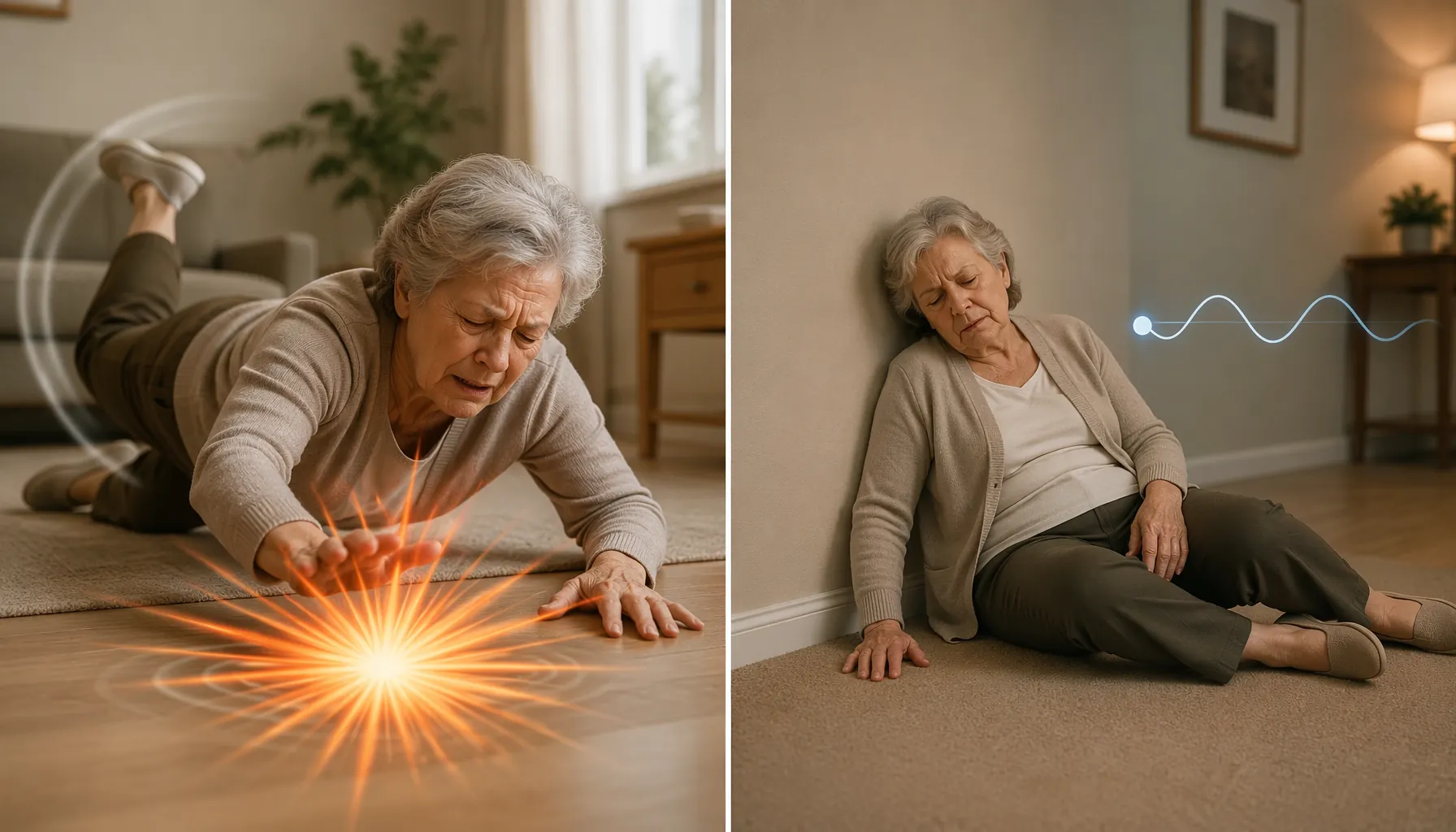
A hard fall and a soft fall are not the same sensor problem
Fall detection watches usually rely on motion sensors that look for acceleration, orientation change, and sometimes rotation. In plain terms, they are trying to decide whether the wrist just moved in a way that looks like a fall rather than a stumble, a quick sit, a dropped arm, or ordinary activity.
A hard fall gives the algorithm cleaner evidence. The body accelerates quickly, the wrist changes angle, and there may be a sudden impact. Clinical-grade personal emergency response systems have used fall criteria such as impact greater than 3.5g with angular velocity above 200 degrees per second, thresholds that describe a fast, forceful event rather than a slow collapse.[1]
A soft fall can look completely different to a wrist sensor. If someone becomes faint from orthostatic hypotension after standing, loses consciousness briefly, or lowers toward the floor because of leg weakness, the wrist may not whip downward. It may brace against furniture, trail along a wall, or move in short, interrupted segments. The person still fell. The watch may see something closer to messy ordinary motion.
That is why broad sensitivity numbers need to be read carefully. NCOA-cited reporting says wrist-based devices may exceed 95% sensitivity for hard falls while missing up to 40% of soft falls that are common among older adults.[2] Those two figures can both be true. They are measuring different kinds of danger.
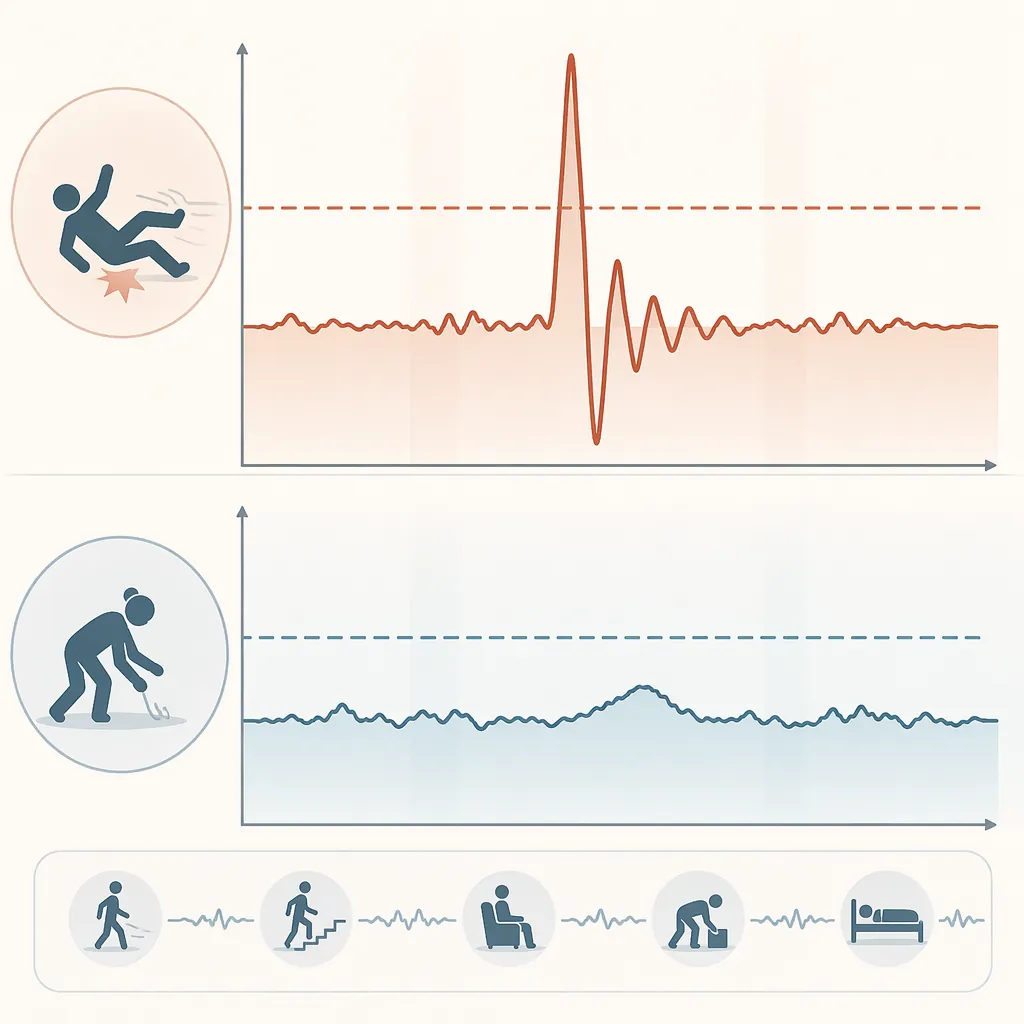
What the accuracy number may be hiding
A fall detection claim is only useful when it tells you what was counted as a fall, who performed the test, and what happened after detection. A controlled drop test, a lab study with instructed movements, and real-life fainting in a bathroom are not interchangeable.
| Question to ask | Why it matters |
|---|---|
| Were hard falls and soft falls tested separately? | A high score on hard impacts does not prove the watch will detect a slow slide or collapse. |
| Was the device worn on the wrist during realistic movement? | Wrist motion may be muted if the person braces, grabs furniture, or lands without swinging the arm. |
| Does the result measure detection or successful help? | A watch can detect a fall yet still fail the safety chain if the alert does not reach someone useful. |
| Who ran the test? | Consumer testing can be helpful for comparison, but it is not the same as a peer-reviewed clinical trial. |
| What happens during false alarms? | Too many false positives can make people cancel alerts, disable the feature, or stop wearing the watch. |
False positives are not just an annoyance. If rapid sitting, vigorous arm movement, or a dropped wrist repeatedly triggers alarms, the older adult may start treating the countdown as a nuisance. Consumer smartwatch false-positive reporting cited in the available lab data puts rapid-sitting misclassification at 15% to 25%, which is enough to affect trust even if many alerts are canceled before help is dispatched.[2]
The opposite problem is quieter: a missed fall produces no alert, no record, and no immediate explanation. That is why soft-fall performance deserves more weight when the person’s risk comes from fainting, blood pressure changes, muscle weakness, or frailty rather than fast outdoor trips.
What device-category testing can and cannot tell you
Once fall type is separated, the category comparison becomes more useful. Dedicated medical alert watches are usually built around emergency response. Consumer smartwatches are broader health and communication devices that add fall detection as one feature among many. Neither category deserves a free pass.
SafeHome.org’s 2026 testing reported that Medical Guardian MGMove detected 9 out of 10 falls, Bay Alarm SOS detected 8 out of 10, Samsung Galaxy Watch 7 detected 8 out of 10, and Apple Watch Series 10 detected 6 out of 10.[3] SeniorLiving.org separately reported Bay Alarm SOS at 8 out of 10 and Samsung Galaxy Watch 7 at 8 out of 10 in its testing.[4]
Those numbers are useful because they compare real devices under observed conditions. They should not be inflated into a universal ranking. The tests come from consumer-testing sites, not large clinical trials across thousands of older adults living with different gait patterns, medications, home layouts, and fall histories. A result of 8 out of 10 in a test environment tells you something; it does not tell you everything.
The peer-reviewed smartwatch evidence is also narrower than shoppers may expect. A 2022 study available through PMC reported 77% sensitivity, 99% specificity, and a 1.7% false-positive rate for a smartwatch fall detection system under controlled conditions.[5] That is valuable because it separates sensitivity from specificity. It also shows why a single “accurate” label can blur two different outcomes: catching real falls and avoiding false alarms.
The practical read is cautious, not dismissive. A consumer smartwatch may be reasonable for someone who wants heart rate trends, activity tracking, medication reminders, messaging, and a device that looks like ordinary technology. A dedicated medical alert watch may be more appropriate when the central concern is fall response, especially if the person is at risk for soft indoor falls or may not be able to manage a phone-like interaction after falling.
Detection is only the first handoff
A fall alert has a sequence. The watch notices motion, decides whether it resembles a fall, asks for confirmation or waits through a countdown, contacts someone, shares location, and allows communication. Weakness in any link changes the real safety value.
Apple Watch uses a countdown approach: after detecting a hard fall, it gives vibration cues and a 30-second window before calling emergency services if the wearer does not respond.[3] That path can work well when the wearer is alone, the watch has service, and calling 911 is the right next step. It is less tailored when the situation needs triage, reassurance, family contact, or repeated attempts to communicate with someone who is frightened or disoriented.
Dedicated medical alert watches usually route alerts through a monitoring center with two-way voice. SafeHome and NCOA materials describe monitored workflows in which trained operators can speak with the wearer, assess what happened, contact caregivers, or dispatch emergency help, with reported response-time ranges of 9 to 29 seconds in the cited material.[1][3]
That distinction is not about lifestyle technology being unserious. It is about what happens when the person on the floor cannot give a clean answer. A watch that calls 911 after a countdown and a watch that opens a monitored two-way conversation are solving different parts of the emergency.
Indoor location can decide how useful the alert is
Location is often treated as a small specification, but it matters when help is trying to find the person. More than 70% of senior falls occur indoors, where GPS alone may not provide enough precision.[6] A fall in a bedroom, bathroom, hallway, or basement needs a response path that does not assume a clear outdoor satellite fix.
Hybrid positioning, using combinations such as GPS, Wi-Fi, and cellular information, can improve the odds that responders or caregivers get usable location context. It still does not replace practical setup: making sure emergency contacts know the home layout, lockbox access is current if used, and the wearer understands when the watch may ask them to speak.
Health monitoring matters, but it should not outrank the fall profile
It is easy to understand why many older adults prefer a consumer smartwatch. It can feel less like a label and more like a normal device. It may offer heart rate monitoring, activity trends, reminders, messaging, maps, and a familiar design. Wearing the device every day is not a minor issue; the best emergency feature is useless if the watch is left on the charger.
Battery life, comfort, water resistance, screen readability, and charging routine deserve a quick but honest check. A watch that requires frequent charging may be off the wrist during a nighttime bathroom trip. A bulky device may be rejected. A small screen may be hard to cancel during a false alarm. These are not glamorous factors, but they decide whether the device is actually worn in the moments that count.
Cost needs the same plain treatment. Original Medicare generally does not cover medical alert watches or consumer smartwatches for fall detection, while Medicare Advantage benefits vary by plan. Anyone counting on insurance support should verify the specific plan rules before treating a device as covered.
A matching framework for choosing
Start with the fall history, not the product category. If there has already been a fainting-related fall, a slow slide, a bathroom collapse, or a fall linked to leg weakness, the buying question should move immediately to soft-fall testing and monitored response. If the main concern is a fast trip while walking outdoors, detection of hard falls, cellular connectivity, and emergency calling may carry more weight.
- For hard outdoor falls plus strong interest in health features: a consumer smartwatch may be a reasonable fit if expectations are clear and the wearer will keep it charged and connected.
- For slow indoor falls, fainting, orthostatic hypotension, syncope, or muscle weakness: tested soft-fall performance and a monitored response workflow should weigh more heavily than app features.
- For someone who may be unable to speak after falling: look closely at what the service does when there is no clear voice response, not just whether the watch can place a call.
- For someone who dislikes senior-specific devices: dignity and daily wearability matter, but they should be balanced against the specific fall type that has already happened or is medically likely.
- For any device: ask whether the published accuracy number separates hard falls from soft falls, and whether the evidence is a clinical study, a consumer test, or a vendor claim.
The category line is also becoming less tidy. As of mid-2026, some dedicated alert watches are adding health features, and consumer smartwatches can sometimes be paired with third-party monitoring services. That makes the old “Apple Watch versus medical alert watch” framing too simple. The better comparison is between detection profiles and response handoffs.
A broad accuracy claim can start the shopping process, but it should not finish it. The question to keep asking is narrower and more useful: will this watch notice the kind of fall this person is most likely to have, and will the next step still work if they cannot manage it themselves?
References
- Best Medical Alert Watches, NCOA.
- Best Fall Detection Watch for Seniors: Key Facts & Trade-Offs, Alibaba.com.
- Best Medical Alert Watches, SafeHome.org, 2026.
- Best Medical Alert Watches, SeniorLiving.org.
- Smartwatch fall detection study, PMC/NCBI, 2022.
- Best Smartwatches with Blood Pressure Monitors, TheSeniorList.
Questions to bring to a clinician or OT
This is not medical, legal, or a family's final decision — only a framework. Bring these questions to a clinician, occupational therapist, or your local Area Agency on Aging.
Find Local HelpRelated reading
Noticed something outdated or inaccurate on this page? Flag a correction. We review every report against CDC, NIA, and AARP HomeFit guidance before updating a page.