
Caregiver decision guide
How Senior Tesla Drivers Can Stay Safe After the Door Defect Recall
Tesla's door-related recalls and investigations create real entrapment risks for older drivers whose manual releases may be hard to find and operate. This guide provides a concrete five-step preparation plan—checking recall status, locating hidden releases, practicing the motion, equipping the vehicle for emergencies, and creating a family communication plan—so seniors and their caregivers can reduce that risk before an emergency happens.
If you or a parent drives a Tesla, the door-defect news should lead to one practical question first: can the person in the car get out if power, panic, smoke, water, or crash damage makes the normal electronic door button useless? The answer depends on the exact vehicle, the seating position, and whether the driver has practiced the manual release before an emergency.
In July 2026, NHTSA granted a rulemaking petition tied to Tesla Model 3 door-release design, opening a process that could lead to new safety requirements but does not itself create a new rule today.[1] That distinction matters. A rulemaking process, a lawsuit, and an investigation may shape future design standards; they do not teach a 78-year-old where the rear-seat release is this afternoon.
There is already enough official and reported activity to take the issue seriously. In 2023, Tesla recalled 120,423 Model S and Model X vehicles in the U.S. because doors could unlock during a crash, with the remedy handled through software.[2] In 2025, NHTSA opened an investigation into 174,290 Model Y vehicles after reports that door handles could become inoperative from outside the vehicle.[3] Another 2025 investigation focused on 179,071 Model 3 vehicles and concerns that manual emergency releases were hidden or unlabeled.[4]
Those facts do not mean every Tesla has the same defect or that every owner should panic. They do mean senior drivers and caregivers should stop treating the manual release as trivia buried in an owner’s manual. It is part of driving independence, along with knowing where the hazard lights are, keeping a charged phone nearby, and making sure someone knows what to do if a drive does not end as expected.
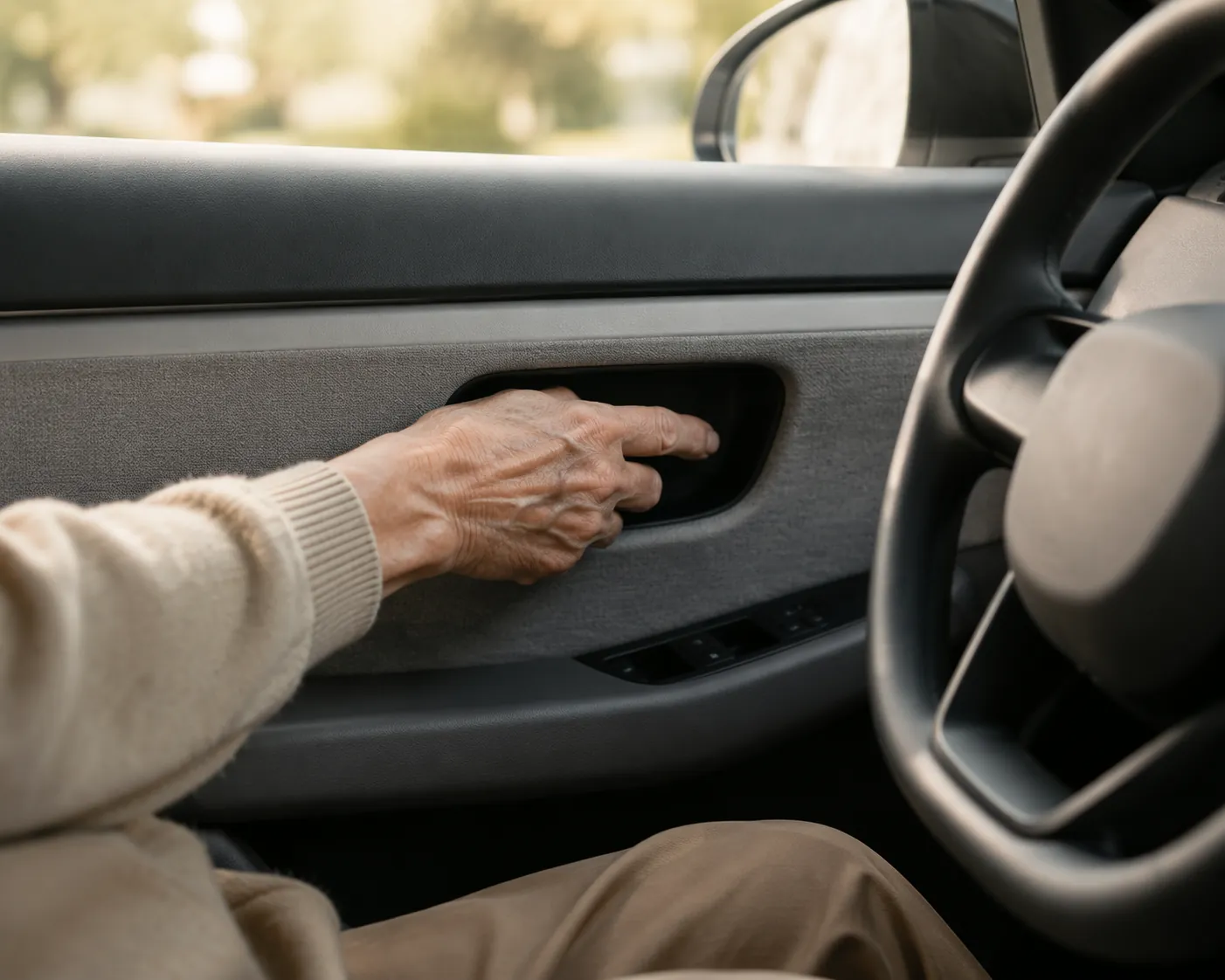
Start With The Specific Car, Not The Headline
The safest first step is boring, official, and worth doing before the next drive: check the VIN. Use the NHTSA recall lookup and Tesla’s VIN recall search. Do not rely on memory, a neighbor’s model year, or a general article that says “Model 3” or “Model Y” without your car’s build details.
- Write down the VIN from the Tesla app, dashboard, registration, or insurance card.
- Run the VIN through both NHTSA and Tesla recall tools.
- Save or print the result if an older driver does not regularly check email or app notifications.
- If a recall is open, schedule service or confirm whether the remedy has already been applied.
- Repeat the lookup periodically, especially after new NHTSA actions or ownership changes.
A closed recall does not end the preparation. Software can address some defects, but it does not replace the physical skill of finding and operating a manual release when the screen is dark, the regular button does not respond, or the driver is shaken.
Find Every Manual Release From The Actual Seat
This is the step most families are tempted to rush. Please do not. Pointing at a diagram is not the same as having the older driver sit in the car, close the door, reach with the hand they would naturally use, and feel the release without coaching.
Tesla manual door releases vary by model, model year, and seating position. In many Model 3 and Model Y front seats, the manual release is near the front of the window-switch area. Rear-seat releases can be less obvious: some are inside a door pocket under a small cover, while other versions use a hidden pocket and pull cable. Model S and Model X arrangements differ again, and the 2023 Model S/X recall was tied to a software remedy rather than one universal physical-release layout.[2]
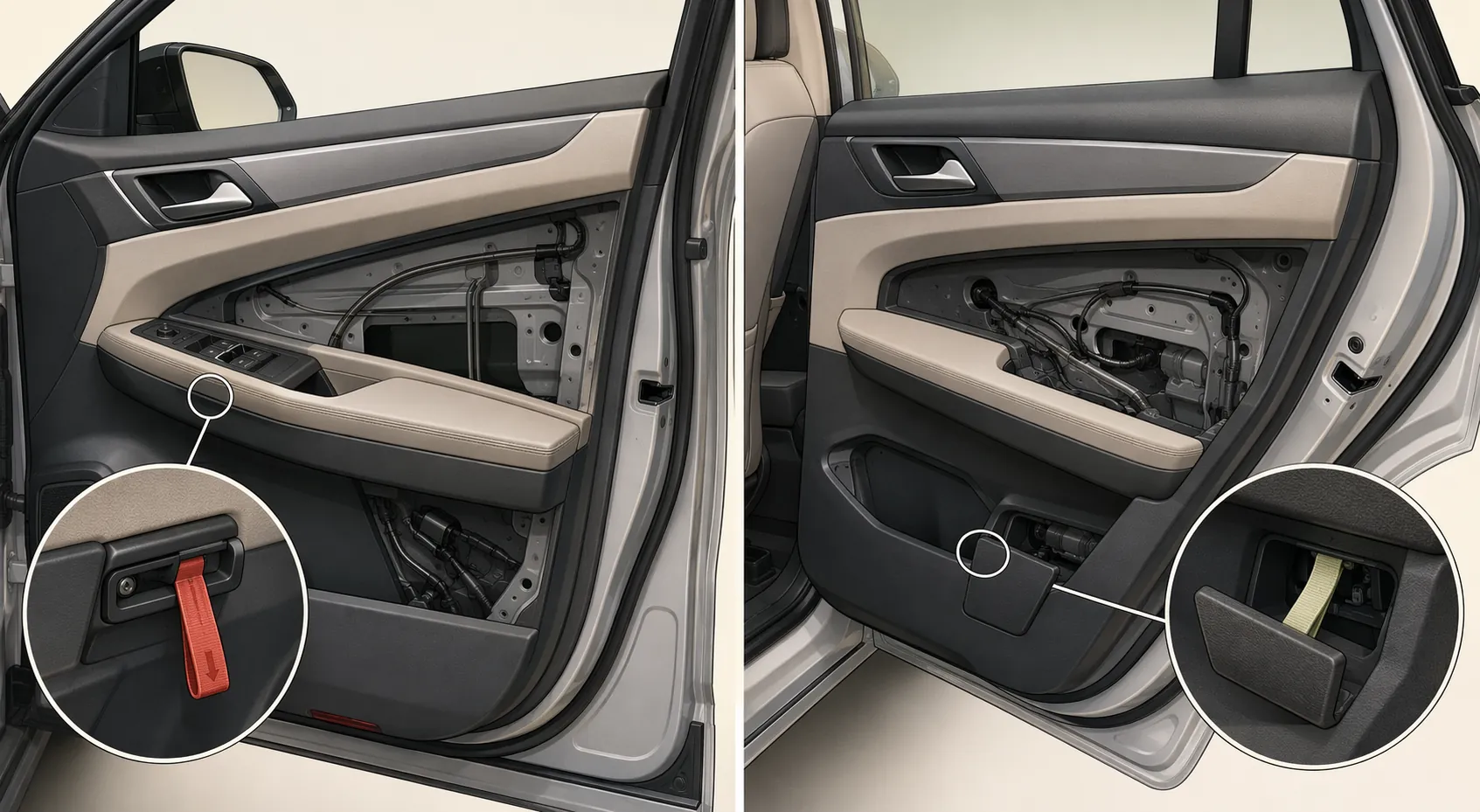
For a senior driver, the rear-seat release still matters. A grandchild, spouse, friend, home health aide, or the driver themselves after a crash could be in a different seat than usual. A family safety check should cover all occupied seating positions, not only the driver’s door.
| Seat Or Area | What To Confirm | Why It Matters For Older Adults |
|---|---|---|
| Driver’s seat | Can the driver find the release by touch while seated and belted? | After a crash or power loss, reaching down, twisting, or using a small lever may be harder than expected. |
| Front passenger seat | Can a spouse or caregiver operate the release without using the touchscreen? | The passenger may need to exit first or help the driver. |
| Rear seats | Is the release hidden under a cover, inside a pocket, or reached by a pull cable? | Hidden rear releases are easy to forget and may require bending or fine finger movement. |
| Owner’s manual and app | Does the instruction match the exact model year and trim? | A refreshed model may move the release, so a generic video can be wrong. |
The proposed Model S class action has not been decided by a court, so its claims should be treated as allegations. Still, the complaint’s wording is useful because it names the people who have the least room for a design that assumes quick recall under stress: pets, children, older adults, and people with disabilities.[5] A hidden release is not merely an aesthetic choice when the person expected to use it may have arthritis, slower reaction time, weaker grip, or panic after an impact.
Practice The Motion Until It Is Boring
Practice should happen with the vehicle parked, powered normally, and in a calm place. The goal is not to create alarm. It is to remove surprise.
- Sit in the driver’s seat with the seat adjusted normally.
- Close the door and keep the seat belt on for the first attempt.
- Find the manual release without looking, then look and confirm the location.
- Use the release gently according to Tesla’s instructions, because manual releases may bypass normal powered window drop behavior on some frameless-door designs.
- Repeat from the front passenger seat and any rear seat that family members use.
A caregiver can make this easier without turning it into a test. Ask the driver to describe the motion in their own words: “I reach forward of the window switch,” or “I lift this cover in the rear pocket and pull.” If the explanation depends on “my son showed me once,” it is not ready yet.
Watch the body mechanics. Does the driver have to bend sharply? Is the cover too tight for arthritic fingers? Can they reach the release with their dominant hand? Can they do it while wearing winter gloves? If the answer is no, the solution may be as simple as assigning that person to a different seat, adding a tactile reminder near the pocket, or reviewing the exact owner’s-manual instruction more often. Do not add anything that blocks airbags, interferes with the door, or modifies the release.
Use A Plain-Language Door Card
For some families, a small printed card in the glove box or center console is more useful than another app screen. Keep it short: model, year, driver release location, passenger release location, rear release location, and emergency contact. Avoid tiny print. A caregiver can also take a phone photo of the release location and store it in a shared album labeled with the car’s model year.
Do Not Overtrust An Escape Hammer
An emergency escape tool can still be worth carrying, but it is not a magic answer to Tesla door concerns. Consumer Reports, citing AAA testing, warns that common escape tools are designed for tempered glass and do not break laminated glass.[6] That is a very practical difference, not a technical footnote.
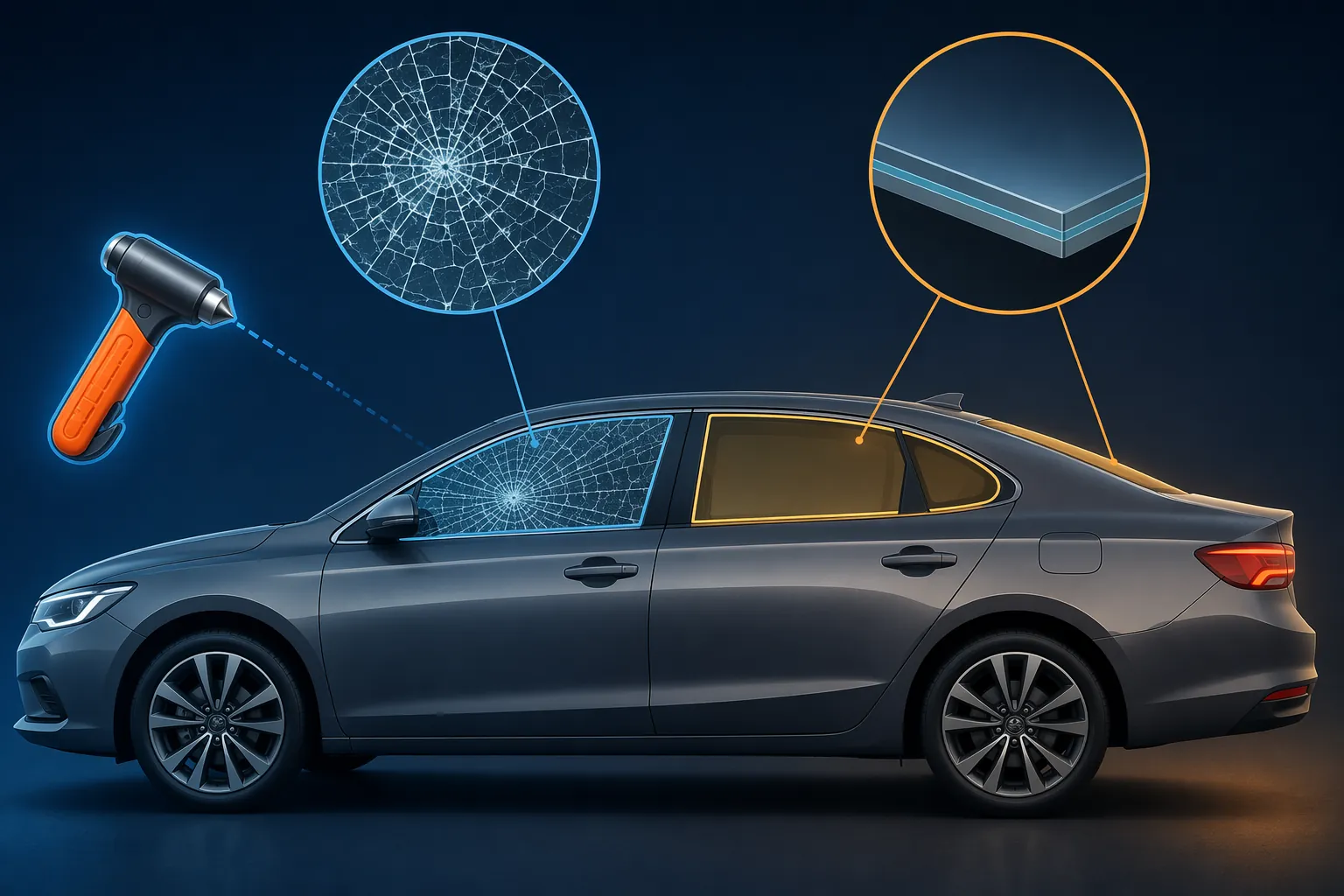
Windshields are laminated, and some newer vehicles also use laminated side glass. If the window next to the driver is laminated, a hammer may not give the escape route the family imagined. Before relying on one, identify which side windows are tempered and which are laminated for the exact car. Look for markings on the glass and confirm with the owner’s manual or Tesla service documentation if the markings are unclear.
- Choose an escape tool with both a seat-belt cutter and a glass-breaking tip.
- Mount or store it where the driver can reach it while belted, not loose in the trunk or a rear cargo bin.
- Confirm which reachable windows are tempered before assuming the tool can break them.
- Do not let the tool replace manual-release practice.
The same measured approach applies to policy news. Consumer Reports has covered the proposed SAFE Exit Act, which would require accessible manual releases, but proposed legislation is not the same as current protection inside a specific car.[7] Until standards change, the family’s job is to know the actual door, actual glass, and actual reach of the person driving.
Set Up Phone And Access Backups
Door entrapment risk is not only about getting out from inside. One 2025 NHTSA investigation concerned Model Y door handles becoming inoperative from outside, which is a different but related problem: someone outside the car may be trying to help and unable to open a door normally.[3]
For senior drivers, access backups should be simple enough to use on a bad day. Make sure the Tesla app is installed, the phone key is set up, and the driver understands which phone is paired. If an adult child or spouse is an approved user in the Tesla app, confirm that access still works after phone upgrades, password changes, or vehicle ownership changes.
- Keep the phone charged before errands, especially in extreme heat or cold.
- Keep a physical key card in a consistent wallet or bag location.
- Show a trusted family member where the key card is kept.
- Review how to call roadside assistance or emergency services without using the vehicle screen.
This is also a good time to remove friction that only shows up when someone is tired or embarrassed. If the driver does not remember an app password, cannot unlock the phone with gloves on, or keeps the key card in a rarely used compartment, fix that now rather than during a parking-lot problem.
Make The Family Plan Specific Enough To Use
A family communication plan does not need to be dramatic. It needs names, phone numbers, and a shared understanding of what happens if the senior driver is delayed, confused, or stuck.
| Situation | Senior Driver’s Action | Caregiver Or Family Action |
|---|---|---|
| Before a routine drive | Take phone, key card, and glasses if needed for reading controls. | Know the destination and expected return window when appropriate. |
| Door button does not work | Try the manual release practiced for that seat. | Remind by phone using the plain-language location: front switch area, rear pocket cover, or pull cable. |
| Driver cannot exit or feels unsafe | Call 911 if there is smoke, water, crash damage, heat danger, medical symptoms, or panic that is escalating. | Call emergency services rather than trying to troubleshoot from a distance. |
| After any door or power problem | Do not ignore it because it resolved once. | Document what happened, check recall status again, and contact Tesla service if needed. |
Location sharing can help, but only if the older driver agrees and the family keeps it respectful. For some families, that means shared phone location during longer solo drives. For others, it is a simple text before leaving and after arriving. The important part is that no one is inventing the plan while the driver is already upset.
After the plan is set, keep the routine simple: check the VIN, find every manual release, practice from the actual seat, understand the glass before trusting an escape tool, keep access backups easy to reach, and recheck official recall status from time to time.
References
- Tesla’s door handles may spur new U.S. safety rules, TechCrunch, 2026-07-23, https://techcrunch.com/2026/07/23/teslas-door-handles-may-spur-new-u-s-safety-rules/
- Tesla recalls over 120,000 vehicles in US, NHTSA says, Reuters, 2023-12-22, https://www.reuters.com/business/autos-transportation/tesla-recall-over-120000-vehicles-us-nhtsa-2023-12-22/
- Tesla door handle investigation, USA Today, 2025-09-16, https://www.usatoday.com/story/cars/recalls/2025/09/16/tesla-door-handle-investigation/86184603007/
- Tesla Under Investigation Over Concerns Model 3 Manual Door Handles Are Hidden, Unlabeled, Forbes, 2025-12-24, https://www.forbes.com/sites/zacharyfolk/2025/12/24/tesla-under-investigation-over-concerns-model-3-manual-door-handles-are-hidden-unlabeled/
- Tesla Door Handle Lawsuit Says Defective Model S Design Poses Unreasonable Safety Risk, ClassAction.org, https://www.classaction.org/blog/tesla-door-handle-lawsuit-says-defective-model-s-design-poses-unreasonable-safety-risk
- How to Escape Your Car, Consumer Reports, https://www.consumerreports.org/cars/car-safety/how-to-escape-your-car-a2323683571/
- Unsafe Electronic Car Door Handles: SAFE Exit Act, Consumer Reports, https://www.consumerreports.org/cars/car-safety/unsafe-electronic-car-door-handles-safe-exit-act-a1099298865/
Questions to bring to a clinician or OT
This is not medical, legal, or a family's final decision — only a framework. Bring these questions to a clinician, occupational therapist, or your local Area Agency on Aging.
Find Local HelpRelated reading
Noticed something outdated or inaccurate on this page? Flag a correction. We review every report against CDC, NIA, and AARP HomeFit guidance before updating a page.