
Caregiver decision guide
How to Create a Flood Evacuation Plan for an Older Adult
This guide walks family caregivers through the specific steps needed to build a flood evacuation plan that accounts for an older adult’s mobility limitations, medical needs, and cognitive challenges — from pre-identifying accessible routes and securing a 30-day medication supply to registering with special-needs shelters and practicing a timed dry run.
A generic emergency kit can look reassuring right up until the real question arrives: can you actually get your parent out, with medications, device power, transportation, shelter access, and help, before flood conditions make the route unsafe?
That is the difference between ordinary preparedness and an emergency evacuation plan for seniors during floods. The plan is not only a box of supplies. It is a tested chain of actions: who lifts, who calls, who drives, which doorway works with a walker, which road floods first, where prescriptions are stored, how oxygen or a power chair stays charged, and whether the shelter or transportation service already knows the older adult exists.
The reason to be this specific is not theoretical. In New Orleans during Hurricane Katrina, people age 75 and older were about 6% of the population but accounted for about 50% of the fatalities, according to AARP's disaster resilience materials.[1] That number should change how a caregiver reads every simple instruction to "evacuate if told to evacuate." For an older adult with limited mobility, chronic illness, cognitive changes, or multiple prescriptions, evacuation is a sequence of physical and medical dependencies. If one link fails, the plan fails.
Start With the Older Adult's Actual Constraints
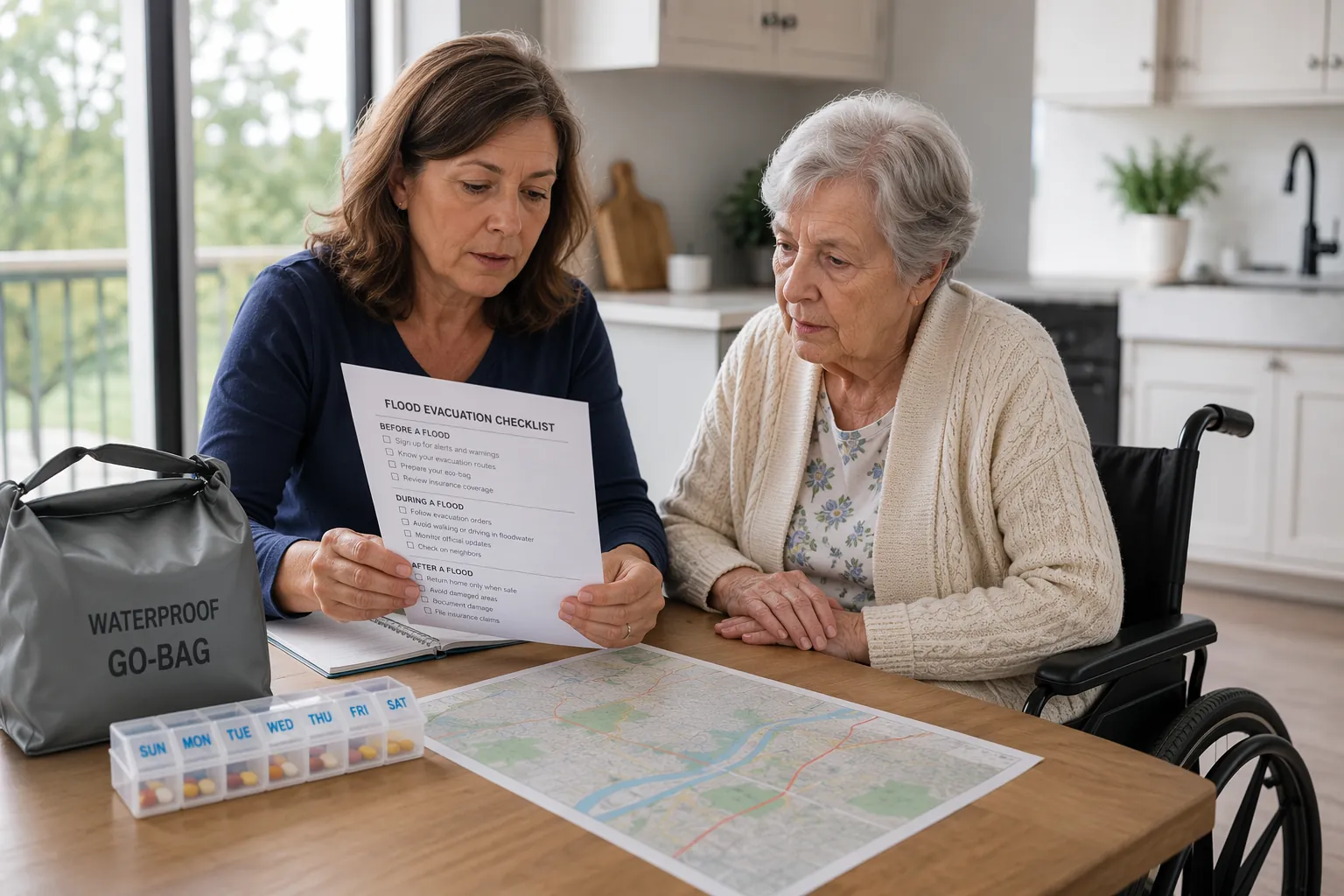
Before routes, bags, or shelter lists, write down what would make leaving hard for this specific person. FEMA's Ready.gov guidance for older adults frames preparedness around assessing needs, creating a plan, and engaging a support network.[2] That sequence is useful because it prevents a caregiver from building a plan around assumptions instead of the person's daily reality.
The assessment should be plain and practical. Can the older adult walk from the bedroom to the car without resting? Do they use a wheelchair, rollator, cane, stair lift, oxygen concentrator, CPAP machine, hearing aids, insulin, refrigerated medication, incontinence supplies, or a medication schedule that cannot be interrupted? Do they become disoriented under stress? Can they transfer from bed to chair with one person helping, or does it take two?
Medical complexity is common enough that it should be assumed until checked. CDC materials have reported that about 80% of older adults have at least one chronic condition, and chronic disease needs can complicate disaster response when medication, transportation, power, food, or routine care is interrupted.[3] That does not mean every older adult is fragile. It means a caregiver should not treat a flood warning as the first time to learn which prescriptions are essential or whether a device has a battery.
- Mobility: walking distance, stairs, transfers, wheelchair width, ramp access, and whether one helper is enough.
- Medical needs: prescriptions, diagnoses, allergies, equipment, device power, oxygen, refrigeration, and physician or pharmacy contacts.
- Cognitive and sensory needs: dementia, confusion under stress, hearing loss, low vision, communication limits, and comfort items that reduce agitation.
- Daily-care needs: continence supplies, wound care, diet restrictions, hydration needs, mobility aids, eyeglasses, dentures, and hearing aid batteries.
- Decision needs: who has authority to speak with clinicians, manage medications, access the home, and approve evacuation support if the primary caregiver is delayed.
If the older adult is able to participate, do this with them, not around them. Ask what they will and will not tolerate, which neighbor they trust, which facility they would refuse, and what makes leaving feel less frightening. A plan that preserves some choice is more likely to be used early, before water and panic narrow the options.
Build the Whole Evacuation Sequence Before You Fill the Bag
A caregiver does not need a complicated binder to begin. The plan can start as one page, as long as it follows the order events will actually happen.
| Part of the plan | What must be decided before a flood warning |
|---|---|
| Needs assessment | Mobility limits, medical dependencies, cognitive concerns, equipment, and decision authority |
| Routes and transportation | Accessible exits, dry routes, pickup points, vehicle fit, backup driver, and water-depth limits |
| Medication and equipment | At least 30 days of medications when possible, medical documents, assistive items, and backup power |
| Shelter and services | Special-needs shelter registration, accessible transportation enrollment, pet or caregiver rules, and destination options |
| Support network | Named people for calls, transport, equipment, home checks, and backup caregiving |
| Timed practice | A dry run that measures how long the plan takes and exposes what does not work |
This order matters. Many families pack flashlights and bottled water first because those supplies are visible. For an older adult in a flood, the less visible items often decide the outcome: registration, transportation, transfer help, route elevation, prescription continuity, and battery life.
Map Routes as a Mobility Test, Not a Line on a Phone
Flood evacuation planning gets more honest when someone walks the route from the bed or favorite chair to the vehicle. Do not begin at the driveway. Begin where the older adult is most likely to be when the warning comes.
Check every threshold, step, rug, narrow hallway, porch, ramp, elevator, garage door, and curb. If a wheelchair is involved, measure whether the chair fits through the exit that would actually be used during a storm. If the home depends on an elevator, write down what happens if power fails before evacuation begins. If the older adult lives in an apartment or assisted-living setting, ask management how evacuation decisions are made and who assists residents who cannot use stairs.
The route outside the home needs the same scrutiny. A path that is manageable in clear weather may become unusable when shallow water hides a curb cut, softens a shoulder, or pushes against wheels. Vantage Mobility's flood-safety guidance for wheelchair users says wheelchair users should never navigate moving water deeper than 3 inches, and caregivers pushing a wheelchair should avoid moving water deeper than 6 inches.[4] Those are not comfort thresholds. They are route-planning limits.
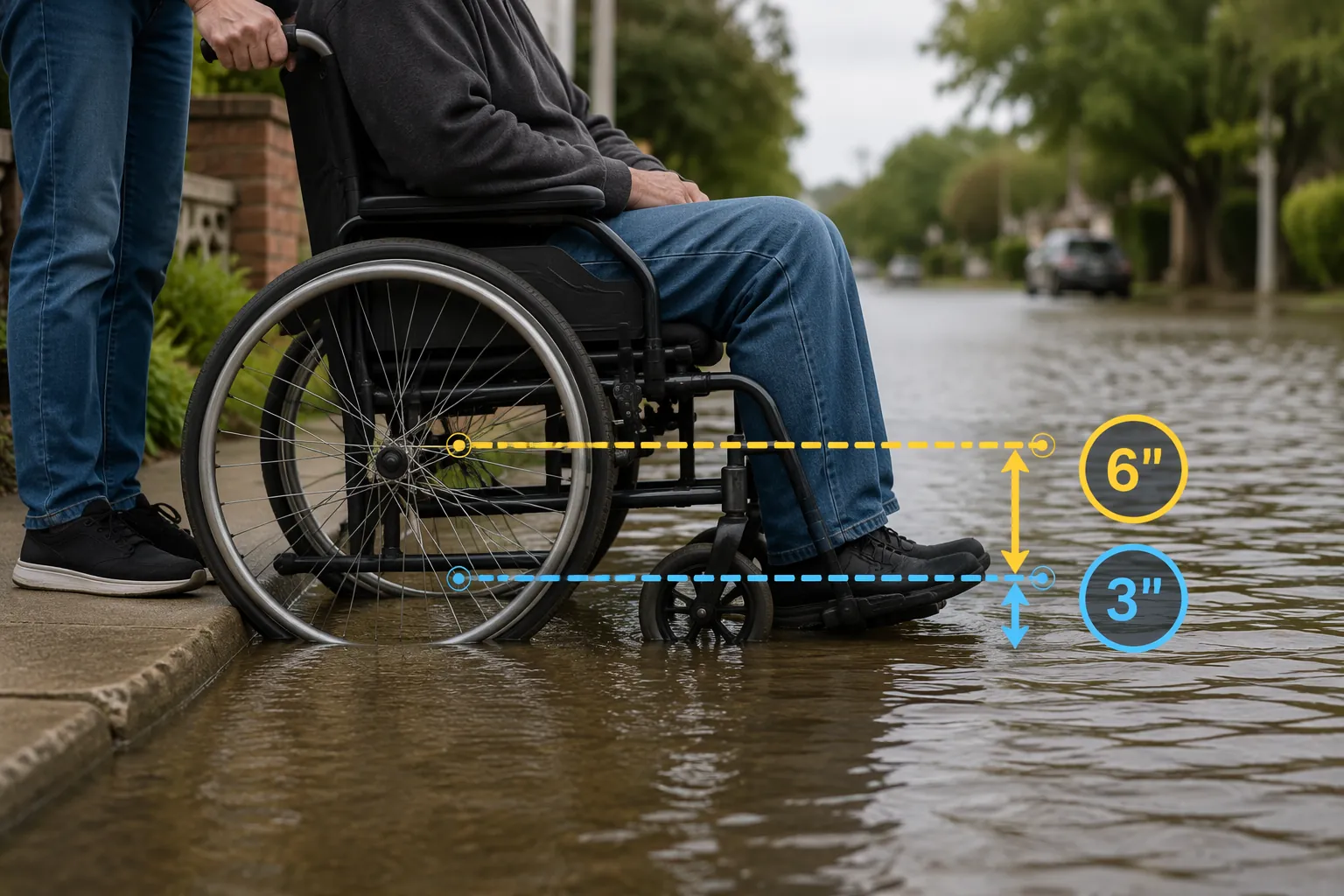
For a caregiver, that means the plan cannot rely on "we will leave once water reaches the street." If water is already moving across the walkway, driveway, or curb cut, the route may have passed the safe point for a wheelchair long before it looks dramatic from a window.
- Choose at least two exits from the home if possible, and note which one works for a walker, wheelchair, or transfer chair.
- Choose at least two driving routes to higher ground, a relative's home, a hotel, or a shelter, favoring roads less likely to collect water.
- Mark low spots, underpasses, creek crossings, drainage ditches, and roads that have flooded before.
- Pick a pickup location that does not require the older adult to cross moving water, soft ground, stairs, or a long exposed distance.
- Decide when to leave based on forecast and official instructions, not on visible water at the door.
Transportation deserves its own check. Does the wheelchair fold? Does the vehicle have room for the chair, walker, oxygen, go-bag, and caregiver? Can the older adult transfer into the seat safely? If not, who provides a wheelchair-accessible van, and how early must it be requested? A name in a phone is not enough; the caregiver needs the provider's eligibility rules, service area, storm procedures, and registration status.
Prepare Medications, Documents, Devices, and Power as One System
The go-bag for an older adult is less about owning every emergency gadget and more about preserving care continuity for the first days after leaving. The American Red Cross recommends that older adults prepare a kit that includes 30 days of medications, along with extra assistive items such as canes, eyeglasses, hearing aid batteries, and wheelchair batteries where applicable.[5]
Thirty days may take work. Insurance refill limits, controlled substances, refrigeration, mail-order timing, and pharmacy closures can all interfere. The caregiver's job is to learn those obstacles before hurricane season or the local flood season, not during a mandatory evacuation. Ask the prescriber and pharmacist what emergency refill options exist, how to label the medications, and whether copies of prescriptions should travel with the older adult.
- Current medication list with dose, timing, reason for use, prescriber, pharmacy, and known allergies.
- Waterproof copies of insurance cards, photo ID, Medicare or Medicaid information, advance directives, power of attorney documents, and emergency contacts.
- Medical equipment instructions, device model numbers, charging cords, backup batteries, and supplier phone numbers.
- Assistive items such as eyeglasses, hearing aid batteries, dentures, cane tips, incontinence supplies, wound-care supplies, and mobility-device accessories.
- A simple care note for shelter staff or relatives: transfer needs, fall risks, communication needs, dementia triggers, diet restrictions, and calming routines.
Power planning should be attached to the medication plan, not treated as a separate household chore. If the older adult uses an electric bed, oxygen concentrator, CPAP machine, nebulizer, power wheelchair, stair lift, refrigerated medication, or phone-based medical alert system, write down how long each device can function without normal power and what backup exists. For utility and outage planning around an aging parent, see how to report a power outage for an elderly parent.
Keep the bag reachable. A perfectly stocked bag in a closet behind stored boxes is not ready for a caregiver who arrives at night in heavy rain. If more than one person may evacuate the older adult, label the bag clearly and tell each person where it is.
Register Before the Storm, Especially for Special-Needs Shelters and Accessible Transportation
A special-needs shelter is not the same thing as a hospital, and a regular public shelter may not be prepared for every medical or mobility need. FEMA's older-adult preparedness guidance directs people to plan for accessible transportation, medical needs, and support networks ahead of disasters.[2] In many communities, that preparation includes advance registration with a local special-needs shelter program, paratransit provider, emergency management office, or health department.
Registration is the part families often postpone because it feels bureaucratic. It is also the part that cannot always be solved at the last minute. A caregiver should confirm who qualifies, whether the older adult's caregiver can stay with them, what medical support is and is not provided, whether pets or service animals are allowed, what supplies must be brought, and how transportation requests are handled when roads begin closing.
If the older adult lives in Florida or another hurricane-prone area, local programs may provide decision tools that help families think through evacuation timing and support needs. First Contact / 211 Tampa Bay Cares offers a disaster-preparedness decision-tree model for older adults and caregivers in a Florida hurricane context.[6] It can be useful as a model for questions to ask, but it should not be treated as a national script. A county emergency manager, local aging agency, or public health department is the authority for local shelter and transportation rules.
- Call the local emergency management office and ask whether a special-needs registry exists.
- Ask the paratransit or accessible-transportation provider whether disaster evacuation rides require separate enrollment.
- Confirm whether the older adult must bring a caregiver, medical supplies, bedding, food, device chargers, or documentation.
- Write down the deadline for requesting pickup before a storm and the number to call if the first line is overloaded.
- Update the registration after a move, new diagnosis, new device, medication change, or change in caregiver contact information.
If the preferred destination is a relative's home or hotel rather than a shelter, verify access the same way. A second-floor guest room is not an evacuation destination for someone who cannot manage stairs. A hotel that says it is accessible should still be asked about roll-in showers, elevator backup plans, power outages, service animals, refrigeration, and whether flood conditions have blocked its approach roads before.
Assign Jobs to People, Not Good Intentions
The support network is where many family plans sound kind and fail quietly. "Neighbors will help" is not a plan unless one neighbor has agreed to knock on the door, another has a key, someone can lift or transfer safely, and someone else knows where the go-bag and medication list are.
FEMA's assess-plan-network framework is useful here because the network is not emotional decoration; it is capacity.[2] A long-distance adult child may be the decision-maker but still unable to arrive before roads close. A spouse may know the routine but be physically unable to manage a transfer alone. A neighbor may be close but unable to drive at night. The plan should respect those limits instead of discovering them under pressure.
| Role | Named person and backup |
|---|---|
| Primary decision contact | Person who receives warnings, decides when to activate the plan, and contacts the older adult |
| Transportation lead | Person who drives or confirms accessible transportation pickup |
| Transfer or mobility helper | Person physically able and trained to help the older adult leave safely |
| Medication and equipment checker | Person who verifies the go-bag, prescriptions, chargers, batteries, and assistive devices |
| Home access contact | Person with a key, alarm code, gate code, and permission to enter if the primary caregiver cannot arrive |
| Out-of-area contact | Person who can relay updates if local phone service is unreliable |
Write the assignments in ordinary language. "If flood watch is issued, Dana calls Mom and confirms the medication bag. If evacuation order is likely, Luis picks up the wheelchair van. If Dana cannot reach Mom within 15 minutes, Mrs. Patel next door knocks and calls Dana." The exact timing will depend on the local risk, but the handoff should be that concrete.
Families already coordinating multiple helpers may want a broader system for tasks, updates, and shared records; building a care coordination system for aging parents can make the flood plan easier to maintain between storms.
Decide When Evacuation Is Safer Than Staying
This guide focuses on evacuation because floods can make rescue impossible or dangerous once roads are underwater. Still, the decision should not be reduced to a reflex. AARP's disaster materials note the difficult tradeoff around moving frail older adults, including research it cites on higher death rates among evacuated nursing home residents compared with those who sheltered in place after several Gulf Coast hurricanes.[1] That finding does not mean families should ignore evacuation orders. It means the safest choice depends on timing, medical fragility, destination, transportation, and the condition of the route.
For a family caregiver, the practical answer is to make the decision earlier than a healthy adult might. If leaving will take two helpers, an accessible vehicle, medication packing, oxygen coordination, and a low-water route, the window closes sooner. Waiting to avoid "overreacting" can turn an orderly evacuation into a risky carry through water.
Flood exposure can also affect older adults beyond the evacuation day. A Columbia Mailman School of Public Health press release about a Columbia/Harvard study published in The Lancet Planetary Health reported increased hospitalization rates among adults 65 and older within four weeks after flood exposure, including skin diseases, nervous system diseases, and injuries.[7] The press release is not a substitute for a caregiver's local medical advice, but it is a useful reminder that contaminated water, falls, interrupted care, and post-flood living conditions belong in the plan.
If local officials order evacuation, follow official instructions. If the family is deciding before an order, use the older adult's constraints as the threshold: leave while the accessible route is still dry, help is still available, medications and devices can still be moved calmly, and transportation services are still operating.
Run a Timed Dry Run and Revise What Fails
The plan is not finished when it is written down. It is finished only after someone times it.
Pick a calm day and practice the first part of the evacuation without creating unnecessary stress. Start where the older adult usually sits or sleeps. Gather the go-bag, medication list, mobility device, chargers, documents, and supplies. Move to the exit. Transfer into the vehicle if that is safe to practice. Load the equipment. Drive the first part of the route or at least inspect the pickup point, curb cuts, and known low spots.
Use a stopwatch, not a guess. The important discovery may be that the wheelchair does not clear the bathroom doorway, the portable ramp takes longer to place than expected, the oxygen tubing catches on furniture, the go-bag is too heavy, the neighbor cannot hear the phone at night, or the accessible van needs more advance notice than the family assumed.
- Record the total time from activation to vehicle-ready.
- Record which tasks required more than one person.
- Record any point where the older adult became tired, confused, frightened, or unsafe.
- Record missing supplies, dead batteries, expired medications, and unclear documents.
- Record any route feature that would become dangerous with even shallow moving water.
Then revise the plan immediately. Move the bag. Replace the battery. Add a second helper. Register for the transportation program. Change the pickup point. Ask the pharmacy about emergency refills. Update the shelter form. Give the neighbor a written role instead of a vague request.
Repeat the dry run when something changes: a new medication, a fall, a hospitalization, a new walker, a changed phone number, a different caregiver schedule, a move, or the start of flood season. For other hazards, flood planning can sit alongside plans for wildfire and home fire emergencies; see protecting an aging parent during wildfire season and protecting seniors from fire emergencies at home. Floods add their own hard limits, especially water depth, contaminated water, transportation cutoff, and post-flood health risks.
A written plan gives the family a starting point. A timed practice shows whether the older adult can actually leave, with the right people, medications, equipment, power, transportation, and shelter access, before the route becomes unsafe.
References
- Disaster Resilience Tool Kit, AARP.
- Older Adults, Ready.gov.
- Disaster Preparedness and the Chronic Disease Needs of Older Adults, CDC.
- Flood Safety Tips for Wheelchair Users, Vantage Mobility.
- Older Adults Emergency Preparedness, American Red Cross.
- Disaster Preparedness for Older Adults & Caregivers, First Contact / 211 Tampa Bay Cares.
- Large Study Uncovers Specific Impacts of Flooding on Older Adult Health, Columbia Mailman School of Public Health.
Questions to bring to a clinician or OT
This is not medical, legal, or a family's final decision — only a framework. Bring these questions to a clinician, occupational therapist, or your local Area Agency on Aging.
Find Local HelpRelated reading
Noticed something outdated or inaccurate on this page? Flag a correction. We review every report against CDC, NIA, and AARP HomeFit guidance before updating a page.