
Caregiver decision guide
How Frontotemporal Dementia Symptoms Create Fall Risks
Learn why frontotemporal dementia produces a unique fall-risk profile that differs from Alzheimer's, combining early motor decline with behavioral disinhibition, and how to adapt your home safety approach accordingly.
The confusing part is often not that an aging parent looks frail. It is that they do not. A person with frontotemporal dementia may still know where the kitchen is, walk to the bathroom without asking, and insist nothing is wrong, then step over a laundry basket near the stairs or reach across a counter with their feet planted badly. That mismatch is one reason frontotemporal dementia symptoms and care for aging adults need a different fall-prevention lens than the one families usually learn from Alzheimer’s materials.
The Alzheimer’s Association describes frontotemporal dementia, or FTD, as a group of disorders that can affect behavior, language, and movement. It also makes a point that matters inside a house: in early FTD, spatial orientation may be relatively preserved compared with Alzheimer’s disease, while judgment, behavior, or motor function can already be changing. In plain household terms, someone may still navigate familiar rooms but make unsafe decisions while moving through them. The same overview notes that FTD can include motor symptoms such as parkinsonism, apraxia, and gait changes, and that behavioral variant FTD accounts for about 60% of cases in its clinical summary.[1]

That is why “remove throw rugs” can be true and still incomplete. A rug is a hazard for many older adults. With FTD, the question is also why the person approached the hazard the way they did: shuffling without lifting the feet, turning too quickly, failing to notice their own instability, reaching for something without planning the body movement, or acting on an impulse before caution has time to appear.
FTD fall risk often starts before the family expects dementia to affect movement
Families often use memory loss as the signal that dementia has become serious. FTD does not always cooperate with that script. When behavior or motor systems are affected early, the first household consequence may be a fall, a near fall, or a dangerous transfer rather than a forgotten appointment.
The movement changes worth watching are not vague “slowing down.” Dementia Care Central’s balance guide lists parkinsonism signs that caregivers can actually look for: tremor, rigidity, bradykinesia, postural instability, and shuffling gait.[2] In a hallway, rigidity may show up as a stiff turn. Bradykinesia may look like taking too long to start walking or failing to adjust quickly when the foot catches. Postural instability may be the frightening backward or sideways sway that appears after a small bump or a rushed reach.
Apraxia adds a different kind of danger. The person may have enough strength to get into the shower but have trouble carrying out the sequence safely: turn, step over the threshold, hold the bar, shift weight, sit or stand. A caregiver watching from outside may think the problem is stubbornness or distraction. Sometimes it is the brain failing to organize a familiar movement at the exact moment the bathroom gives no room for error.
Progressive supranuclear palsy, which the Alzheimer’s Association includes among FTD-related movement disorders, deserves special attention because it can affect gait, balance, and eye movement.[1] Eye-movement impairment changes the way a person judges stairs, curbs, thresholds, and objects on the floor. In that situation, a clear path is not a nicety; it is part of how the person finds the next safe step.
There is also broader dementia research suggesting that motor changes can precede obvious cognitive symptoms. Bridges by EPOCH summarizes a 2016 University of California at Irvine study that correlated poor balance with later dementia onset, reporting that people who developed dementia scored significantly worse on balance tests years earlier.[3] That finding should not be stretched into a home diagnostic test for FTD. It is useful because it supports what caregivers often notice first: the body may be giving warnings before the conversation sounds impaired.
Behavior can turn an ordinary room into a moving target
The other half of FTD fall risk is not weakness. It is unsafe initiative. Behavioral variant FTD can reduce inhibition, judgment, and situational awareness. Northwestern’s Mesulam Institute describes disinhibition with examples such as eating with fingers in public or making inappropriate remarks, and it also describes repetitive behaviors and compulsive overeating, including sweet cravings.[4] Those symptoms sound social on paper. At home, they can become mobility hazards.
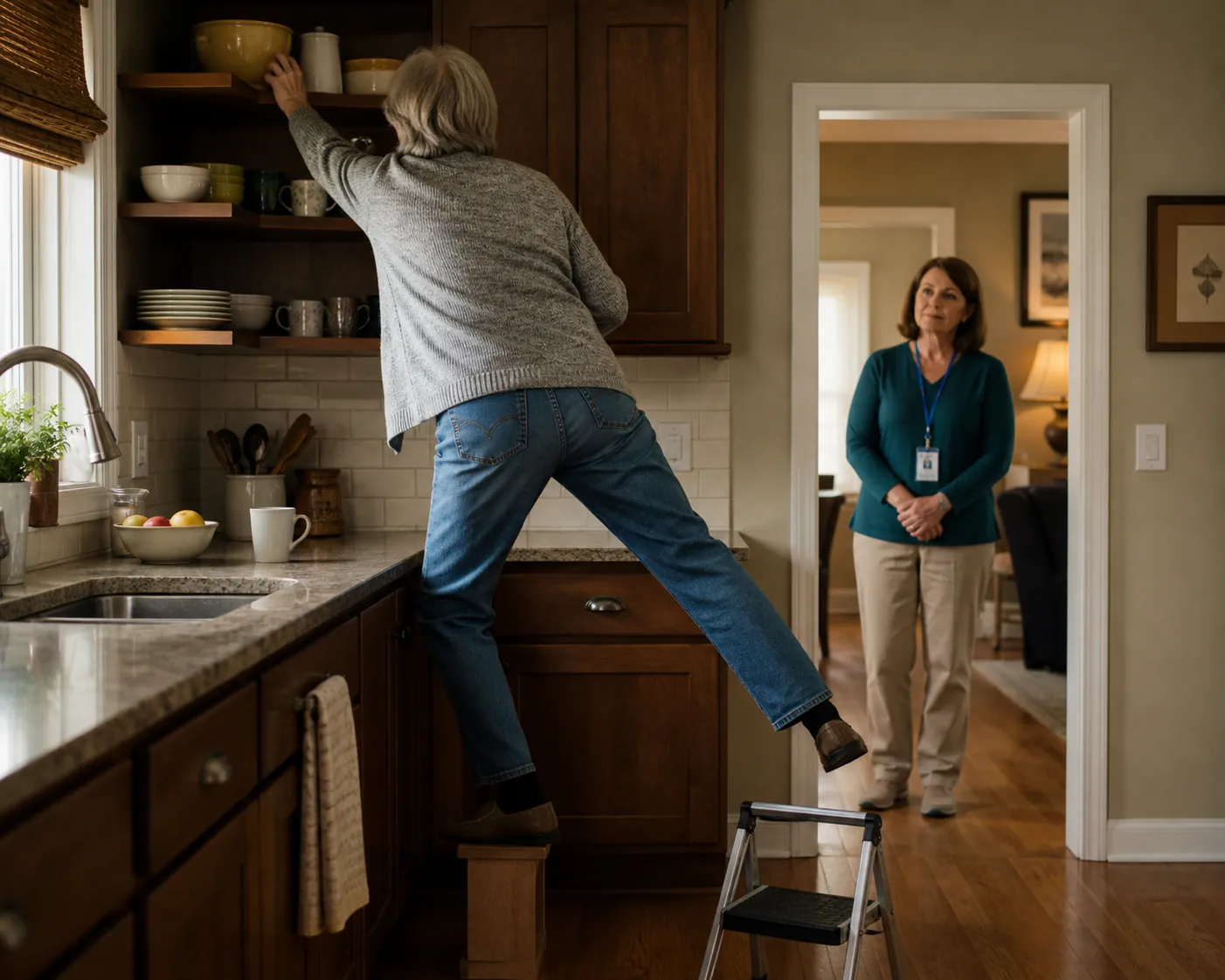
A person who compulsively searches for sweets may open cabinets repeatedly, reach to high shelves, lean into the freezer, or carry food while walking without looking down. A person with disinhibition may climb on a chair instead of waiting for help. A person with repetitive behavior may pace the same route until fatigue changes their balance. These are not exotic scenarios. They are the places where a standard checklist misses the moving part of the risk.
Reduced insight makes persuasion a poor safety system. The parent may understand a sentence in the moment and still repeat the unsafe action later, because the damaged system is not memory alone. When judgment is unreliable, the home has to carry more of the safety load: where tempting items are stored, whether stairs are visible and accessible during impulsive moments, whether the bathroom invites a rushed transfer, and whether the kitchen requires reaching, bending, or climbing to get the things the person wants most.
Apathy can create the opposite problem. If the person stops initiating activity, muscle weakness and deconditioning can creep in. That kind of fall risk is quieter than climbing on a chair, but it is still a household problem: longer sits, harder sit-to-stand transfers, shorter walks, and more fatigue late in the day. Dementia Care Central’s guidance includes exercise and physical therapy as practical supports for balance problems, which matters because the answer to fall risk is not always less movement.[2]
A better home walk-through starts with the pattern, not the object
The usual home safety walk-through asks, “What can someone trip on?” With FTD, the better first question is, “What does this person do when no one is coaching them?” The same laundry basket means one thing for a careful person with poor eyesight and another for someone with impaired judgment who tries to step over it while turning toward the stairs.
| What you observe | What it may change at home |
|---|---|
| Shuffling gait or foot catching | Clear longer walking paths; avoid low clutter, cords, thresholds, and loose mats; ask PT about gait and device fit |
| Stiff turning or slow movement initiation | Add time and space around chairs, toilets, bed edges, and hallway corners; avoid furniture layouts that force tight pivots |
| Postural instability or sudden sway | Prioritize stable handholds, supervised transfers, and evaluation for balance training or mobility aids |
| Unsafe reaching or climbing | Move desired items to waist-to-shoulder height; remove tempting step stools or unstable chairs from reach |
| Compulsive food-seeking | Reorganize the kitchen so frequent targets do not require bending, climbing, or carrying items through obstacles |
| Apathy and reduced walking | Build safe, regular movement into the day instead of relying only on restriction |
This is also where dignity matters. Locking down every room may reduce one hazard while creating agitation, pacing, or loss of useful movement. A safer plan usually starts by lowering the risk built into the person’s real routines: the mug they reach for, the snack they hunt for, the chair they always miss by a few inches, the stair they approach when tired, the bathroom transfer they rush because privacy still matters.
Watch initiation, not just walking
Falls often happen at the start of an action: standing from a chair, turning away from the sink, stepping into the shower, bending for a dropped object, starting down the stairs. During a home walk-through, it helps to watch the first three seconds of movement. Does the person pause and plan, or launch forward? Do they reach before shifting their feet? Do they turn the head and trunk together because the body is stiff? Do they notice when one hand is already full?
Those observations give clinicians better material than a general report that “Dad is falling more.” A physical therapist can assess gait, balance, strength, transfers, and whether a cane or walker helps or creates a new problem. An occupational therapist can look at the shower, kitchen, bed, toilet, lighting, and task sequencing. A neurologist or geriatrician can evaluate whether the movement pattern suggests parkinsonism, PSP-related impairment, medication effects, another medical issue, or progression of FTD.
Look for clusters
One fall can be bad luck. A cluster is information. If near falls happen around food-seeking, the kitchen layout is part of the care plan. If they happen at dusk, fatigue and lighting matter. If they happen after long sitting, sit-to-stand strength and blood pressure deserve attention. If they happen on stairs, eye movement, depth judgment, impulsivity, and handrail use all belong in the same conversation.
Do not assume every behavior change is simply FTD getting worse. The Association for Frontotemporal Degeneration notes that routine physical problems, including issues such as colds or toothaches, can cause behavioral escalations that may look like FTD progression.[5] Pain, infection, constipation, dehydration, poor sleep, medication changes, and dental problems can all change how safely someone moves through a home. When the fall pattern changes suddenly, the medical check is not optional housekeeping; it is part of fall prevention.
Planning urgency depends on subtype, age, and speed of change
FTD is not rare enough to dismiss, but its numbers are not tidy. A 2013 epidemiology review by Onyike and Diehl-Schmid reported prevalence estimates ranging from 2 to 31 per 100,000 people, depending on methodology and diagnostic criteria.[6] The same review reported a 25% late-onset rate, a figure that is useful for remembering that FTD can appear in older adults but should be read with the limits of older criteria and available population data.[6]
Prognosis also affects how aggressively families need to plan. University of Utah Health describes average life expectancy after FTD diagnosis as 8 to 10 years.[7] Onyike and Diehl-Schmid reported a much shorter 2-to-3-year prognosis for FTD with motor neuron disease, a subtype that brings different planning demands.[6] Those numbers do not predict one person’s hallway fall next week, but they do argue against waiting until the house has already become unmanageable.
There is no strong published comparison showing that one specific home-modification package works better for behavioral variant FTD than for Alzheimer’s disease. The practical approach here is a synthesis: use what is known about FTD symptoms, then fit general fall-prevention tools to the person’s actual movement and behavior. That means avoiding both false precision and helplessness. The absence of a perfect FTD home-safety trial does not make unsafe stairs, impulsive reaching, or worsening gait less real.
What to change first
Start where consequence and frequency meet. A rarely used guest room can wait. The bathroom, bedroom path, stairs, kitchen, favorite chair, and entryway usually cannot.
- For stairs: keep the route clear, improve lighting, use secure handrails, and consider whether supervision or access limits are needed during impulsive or fatigued periods.
- For the bathroom: reduce sequencing demands with grab bars, a shower chair when appropriate, non-slip surfaces, reachable supplies, and enough room for a caregiver to cue without crowding.
- For the kitchen: move high-interest foods and daily items to safe heights, remove unstable climbing options, and watch whether food-seeking drives repeated risky trips.
- For transfers: check the height and stability of chairs, bed, and toilet; make sure the person can stand without pulling on furniture that moves.
- For walking routes: widen paths, remove low obstacles, reduce tight turns, and keep the most-used route consistent if change increases unsafe movement.
Then keep watching. FTD fall prevention is not a weekend project that ends after the grab bars go in. A person who was safe reaching for a plate in March may not be safe doing it in July. A walker that helped before may become a tripping hazard if impulsivity or apraxia changes. Apathy may make the person weaker after a month of sitting. The care plan has to move as the disease moves.
The most useful home-safety system is not only a safer floor. It is a loop: observe the exact movement, name the likely symptom pattern, change the environment, bring in clinical help, and revise when the pattern changes. Frontotemporal dementia creates fall risk through early motor decline and unsafe initiative. The house has to answer both.
References
- Frontotemporal Dementia, Alzheimer’s Association
- Balance Issues, Dementia Care Central
- The Correlation Between Balance, Mobility and Dementia, Bridges by EPOCH, March 20, 2019
- Signs and Symptoms, Northwestern Mesulam Center for Cognitive Neurology and Alzheimer’s Disease
- Coordinating Care, The Association for Frontotemporal Degeneration
- The epidemiology of frontotemporal dementia, International Review of Psychiatry, 2013
- The Impact of Frontotemporal Dementia on You and Your Loved Ones, University of Utah Health, February 2023
Questions to bring to a clinician or OT
This is not medical, legal, or a family's final decision — only a framework. Bring these questions to a clinician, occupational therapist, or your local Area Agency on Aging.
Find Local HelpRelated reading
Noticed something outdated or inaccurate on this page? Flag a correction. We review every report against CDC, NIA, and AARP HomeFit guidance before updating a page.