
Caregiver decision guide
What Hair Transplant Results Look Like for Men Over 60
Men over 60 are often told they are too old for a hair transplant, but evidence shows they can achieve excellent, natural-looking results with proper candidacy assessment. This article explains what density to realistically expect, the advantages older patients have, and the key candidacy boundaries to consider before proceeding.
“Am I too old for a hair transplant?” sounds like a medical question, but it often carries an insult inside it. It assumes that after 60, a man should either stop caring how he looks or be embarrassed for asking what can still be done. Age matters in surgery. It affects healing, medication review, blood flow, and expectations. But age by itself is not the deciding line.
The better question is narrower: do your donor hair, scalp health, medical status, and desired hairline support a conservative, natural-looking result? For many men over 60, the answer can be yes. The International Society of Hair Restoration Surgery states that “excellent results are common in men aged 70 and older,” and that older patients should not be dismissed simply because of their age.[1]

There is also a plain mismatch between how common hair loss is and how few older men pursue surgery. One clinical guide, citing ISHRS census data, says up to 80% of men have androgenetic alopecia by age 70, while men over 60 account for only about 7% of hair transplant patients.[2] That 7% figure should be treated as a clinical estimate rather than a hard population statistic, because the exact census year is not independently pinned down in the source. Still, the gap is believable to anyone who has watched older men get waved off before they have had a proper evaluation.
A hair transplant, in basic terms, moves follicles from a donor area—usually the back or sides of the scalp—into thinning or bald areas. Techniques vary, but the practical aim is the same: redistribute limited permanent hair in a way that improves coverage without exhausting the donor supply. NCOA describes the procedure as elective and cosmetic, which matters because the bill usually belongs to the patient.[3]
What Good Results Usually Mean After 60
Hair transplant results for older men should not be judged against a high-school yearbook photo. A good result at 65 or 72 usually means a softened frontal frame, better coverage under normal lighting, and a hairline that belongs on the same face. It should let a man look better groomed, not cosmetically edited.
Older patients can have one real advantage over younger ones: the pattern of hair loss is often more settled. A 32-year-old may still be losing native hair behind the transplant, which can turn a good first surgery into a moving target. A man in his late 60s may have a clearer map of what is gone, what is stable, and what donor hair remains. That can make the long-term plan more predictable, provided the surgeon does not overreach.
That last phrase matters. A transplant is not a way to manufacture unlimited hair. It is a redistribution job. The surgeon is spending a finite resource, and in an older man that resource has to be used with restraint: enough in the front to frame the face, enough behind it to avoid a see-through island, and enough donor hair left alone so the back of the head does not look harvested.
The Density Number That Keeps the Conversation Honest
Density is where marketing language gets expensive. “Fuller” can mean many things. “Restored” can mean too much. The useful numbers are more modest. Natural scalp density is often described as about 80–120 follicular units per square centimeter, while transplant density is commonly around 35–50 follicular units per square centimeter.[2]
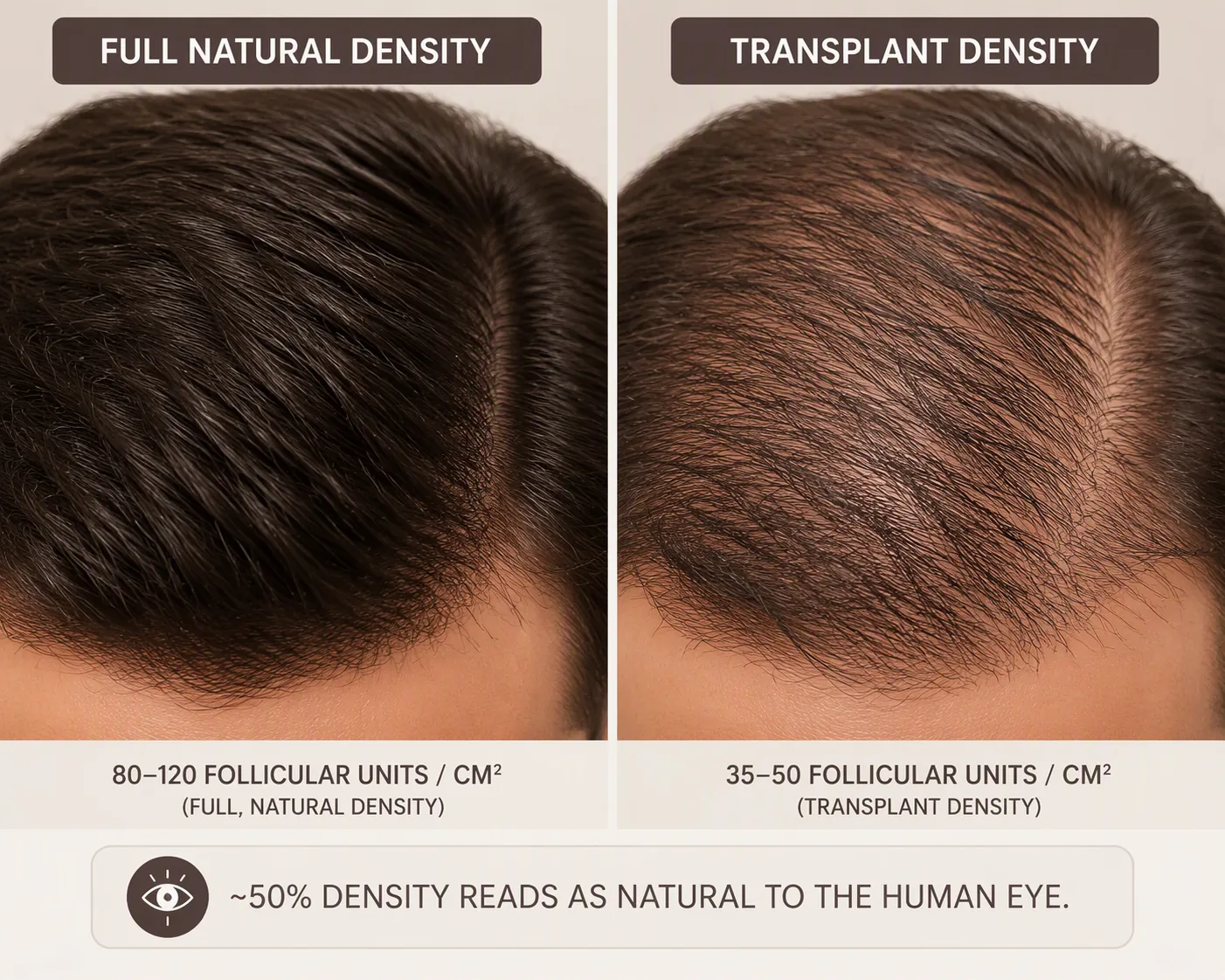
That sounds disappointing until the visual part is understood. The same clinical guide notes that the human eye often cannot distinguish roughly 50% density from full scalp density.[2] In ordinary life, people are not measuring follicular units. They are seeing shadow, direction, contrast, hair caliber, and whether the hairline makes sense.
This is why an older man can sometimes get a very satisfying result without chasing the density of a young adult. Grey hair may create less contrast against the scalp. A mature hairline can sit farther back and still look right. A lightly thinner crown may look normal on a 70-year-old, while an aggressive low hairline with a bare or weak crown can look artificial from across the room.
A sensible plan usually spends grafts where they change the face first. The frontal third and mid-scalp often matter more socially than trying to pack a crown to impossible density. Men who wear their hair short, have strong contrast between scalp and hair color, or stand under harsh overhead lighting may notice thinner areas more. Men with grey, wavy, or coarser hair may get more visual coverage from the same number of grafts. The surgeon should be able to explain this in practical terms, not only show flattering before-and-after photos.
| What the phrase means | What an older patient should hear |
|---|---|
| Natural density: about 80–120 follicular units/cm² | This is the original supply, not the usual transplant target. |
| Transplant density: about 35–50 follicular units/cm² | This can still look natural when placed well and matched to the hairline. |
| Roughly 50% density may read as full to the eye | The goal is visual coverage, not mathematical replacement. |
| Age-appropriate hairline | The result should suit the face now, not recreate a teenage outline. |
Why Older Men Are Not Always Harder Candidates
Some parts of surgery do become more demanding with age. Healing may be slower. Blood pressure, diabetes, blood thinners, cardiac history, and skin quality have to be reviewed without shortcuts. But the hair-loss pattern itself may be easier to read. A man who has been bald in the same areas for years gives the surgeon a more honest map than a younger man whose future loss is still unfolding.
The older patient also may not need as dramatic a change to feel the benefit. He may want to look presentable on video calls, stop wearing a hat to lunch, or feel less exposed at a family wedding. Those are not trivial reasons, and they are not the same as expecting surgery to erase age. A modest improvement can carry real weight when it makes a man more willing to show up.
The surgical plan may need adaptation. A clinical guide for men over 60 emphasizes stable hair-loss pattern, vascular supply changes, grey-hair extraction adjustments, age-appropriate hairline design, and slower healing with comorbidity management as key candidacy factors.[2] In practice, that may mean more conservative graft counts per session, careful punch selection, closer medical coordination, and a willingness to leave some thinning alone rather than chase every bare patch.
The Hairline Is Where Taste and Medicine Meet
A poor hairline can make even good graft survival look wrong. For men over 60, the safest design is usually conservative: mature height, irregular enough to avoid a drawn-on edge, and dense enough in the first few rows to frame the face without stealing grafts from the rest of the scalp.
The warning sign is a clinic that treats the requested hairline as a customer-service order. A low, flat, youthful hairline can use too many grafts, clash with the face, and leave too little reserve for future thinning. On an older man, proportion is not a consolation prize. It is the difference between looking natural and looking like the surgery is announcing itself.
Grey hair adds another practical layer. Extraction and placement may need adjustment because lighter hair can be harder to see and handle during follicular unit extraction. That does not make grey hair a disqualifier. It means the team’s experience with older scalps and grey donor hair is not a minor detail.
When the Answer Should Be No, or at Least Not Yet
The most useful consultation is not the one that says yes quickly. It is the one that can explain why yes, why not yet, or why no. Men over 60 should be especially careful when the donor area is already thin, scarred, or overharvested. If the back and sides cannot spare enough grafts, the surgeon cannot create density by optimism.
- Advanced donor depletion: there may not be enough stable hair to move without creating a new cosmetic problem.
- Uncontrolled blood sugar or blood pressure: one clinical candidacy guide flags HbA1c above 7% and systolic blood pressure above 140 mmHg as thresholds requiring caution or optimization before proceeding.[2]
- Active scalp disease: inflammation, infection, or untreated skin conditions can undermine healing and graft survival.
- Body dysmorphic concerns: if no result will feel acceptable, surgery may worsen distress rather than solve it.
- Expectation of full original density: a transplant can improve coverage, but it cannot usually recreate the original supply.
These boundaries are not meant to shame anyone out of asking. They are there because a bad transplant is not just a bad haircut. It can leave visible scarring, an unnatural pattern, wasted donor hair, and a second bill for repair work that may not fully fix the first decision.
Health Clearance Is Part of the Result
A man in his 60s or 70s should expect a real medical review before surgery. That includes prescription medications, supplements, heart history, diabetes control, blood pressure, bleeding risk, smoking status, and prior scalp procedures. If the consultation treats these as paperwork instead of surgical planning, that is a problem.
Healing time also deserves plain language. Older skin may recover more slowly. Redness can linger. Swelling, crusting, shedding, and the awkward months before visible growth can feel longer when the patient expected a quick cosmetic fix. The transplanted hair typically goes through a shedding and regrowth cycle, so the early weeks are not the final result. This is a procedure for a patient man, not a weekend makeover.
Medical clearance does not remove all risk. It reduces avoidable risk. That distinction matters. The adult child helping a parent should not be asking only, “Is the clinic popular?” Better questions are: who reviews the medication list, who decides whether surgery should be delayed, who performs the extraction and placement, and what happens if healing is slower than expected?
The Cost Belongs in the First Conversation
Cost should not be saved for the end, because it changes the meaning of “worth it.” NCOA lists hair transplant cost at about $4,000–$15,000, depending on factors such as location, procedure type, and number of grafts, and notes that Medicare does not cover elective cosmetic procedures.[3]
That range is wide enough that a serious consultation should give a graft estimate, a price basis, and a clear explanation of what is included. Follow-up visits, medications, platelet-rich plasma if recommended, travel, time off, and possible second sessions can change the real cost. A discount that depends on signing immediately should make an older patient pause, not feel lucky.
The financial test is not whether a man is allowed to spend money on himself. He is. The test is whether the likely improvement is worth the elective cost after the medical and donor limitations are understood. If the budget only makes sense under the assumption of a dramatic, permanent, full-density result, the budget is built on the wrong result.
What Long-Term Results Should and Should Not Promise
Transplanted follicles are often described as permanent because donor hair from the back and sides of the scalp is generally more resistant to androgenetic hair loss. That is a useful principle, not a guarantee of perfect density forever. Native hair can continue thinning. Hair caliber can change with age. Medical conditions and medications can affect shedding. Even a technically successful transplant lives inside an aging body.
One 4-year follow-up study of 112 follicular unit transplant patients found that 8.92% retained full density at 4 years, while 55.35% had moderate density reduction.[4] The important caveat is that the mean patient age in that study was 33.6 years, so it should not be read as older-patient-specific evidence. Its value here is more general: no patient, young or old, should be sold the idea that a transplant freezes density exactly as it looked in the best postoperative photograph.
For an older man, that argues for a plan that still looks acceptable if some density softens over time. A slightly higher, mature hairline ages better than an aggressive one. A balanced distribution ages better than a dense front with no reserves. A result that looks natural at 68 should still make sense at 75.
How to Judge a Consultation Without Being Sold
The right surgeon should be able to talk a man out of the wrong plan. That is especially true after 60, when the best result is usually measured by fit and proportion rather than maximum graft count.
- Ask for a donor-area assessment, not just a recipient-area estimate.
- Ask what density range is realistic for your hair type, color, and scalp contrast.
- Ask why the proposed hairline belongs on your current face.
- Ask who performs each part of the procedure and who supervises technicians.
- Ask what medical findings would delay or cancel surgery.
- Ask to see results in men close to your age, with similar hair color and hair-loss pattern.
Before-and-after photos are useful only if they are honest. Look for consistent lighting, similar hair length, dry hair rather than product-heavy styling, and multiple angles. A wet-hair or harsh-light photo after surgery is not always necessary, but if every result depends on perfect lighting and combing, that says something.
A Practical Decision Standard
A man over 60 can be a strong hair transplant candidate when his hair loss pattern is stable, his donor supply is adequate, his medical conditions are controlled, and his goal is an age-appropriate improvement rather than a full return to earlier density. He is an even stronger candidate when he understands the cost before the sales pitch takes hold.
He is a poor candidate when the donor area is too weak, blood pressure or blood sugar is not controlled, scalp disease is active, or the surgery is being asked to do emotional work it cannot do. Wanting to look better is legitimate. Needing the procedure to erase aging is a warning sign.
The clearest answer to “Am I too old?” is this: not automatically. But the procedure has to be conservative, medically cleared, financially understood, and designed for the man who will actually wear the result.
References
- A Guide to Hair Transplantation After Age 50, ISHRS, https://ishrs.org/hair-transplantation-after-age-50-excellent-results-are-the-rule-in-older-patients/
- Hair Transplant for Men Over 60: The 5-Factor Candidacy & Surgical Adaptation Guide, Ineedmorehair, https://ineedmorehair.com/hair-transplant-for-men-over-60/
- What Is a Hair Transplant? Explanation, Cost, and More, NCOA, https://www.ncoa.org/article/what-is-a-hair-transplant/
- Longevity of Hair Follicles after Follicular Unit Transplant Surgery, PMC, 2020, https://pmc.ncbi.nlm.nih.gov/articles/PMC8061642/
Questions to bring to a clinician or OT
This is not medical, legal, or a family's final decision — only a framework. Bring these questions to a clinician, occupational therapist, or your local Area Agency on Aging.
Find Local HelpRelated reading
Noticed something outdated or inaccurate on this page? Flag a correction. We review every report against CDC, NIA, and AARP HomeFit guidance before updating a page.