
Caregiver decision guide
Brain-Plasticity Habits That Also Prevent Falls
Learn which six daily habits support brain plasticity and also reduce fall risk in older adults, bridging cognitive health and physical stability with practical action steps.
The same older adult who is trying to remember a neighbor’s name may also be trying to turn safely from the stove to the sink. That is why habits for healthy aging brain plasticity should not live in a separate drawer from fall prevention. Memory, balance, gait, attention, reaction time, and confidence all meet in ordinary movement: walking to the mailbox, stepping over a threshold, carrying laundry, or answering a question while crossing a parking lot.
Neuroplasticity means the brain’s ability to form, strengthen, and reorganize connections. In later life, that does not mean the brain becomes young again. It means the brain can still adapt to repeated signals: movement, sleep, learning, food, stress, conversation, and practice. Those signals matter because safe movement is not purely muscular. The brain has to notice the floor, judge distance, shift weight, recover from a stumble, and keep enough attention available for whatever else is happening at the same time.
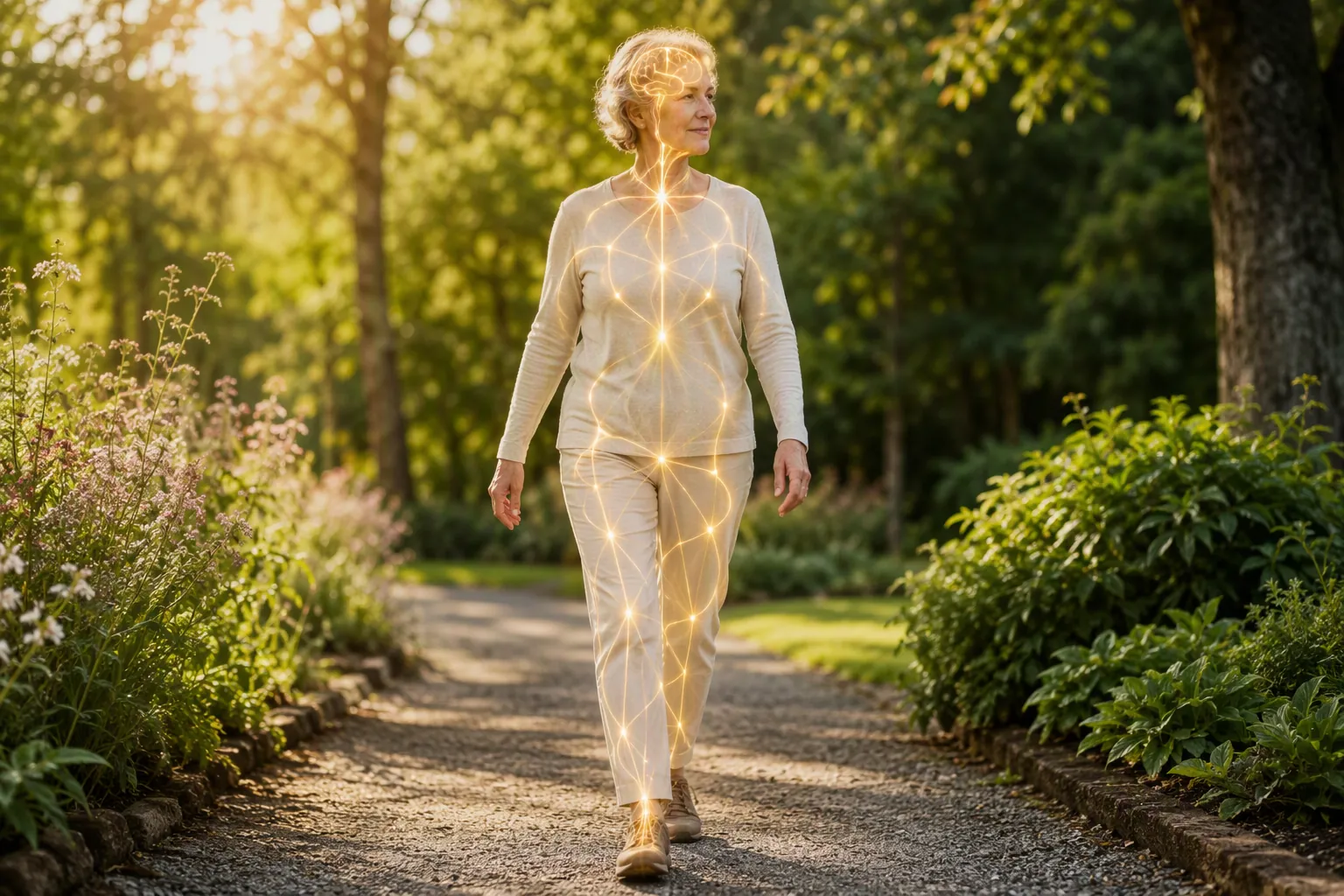
Six habits carry most of the practical work: aerobic exercise, cognitive challenge, quality sleep, stress management, social engagement, and a brain-healthy diet. They do not all have the same strength of evidence for falls. Aerobic exercise and cognitive challenge deserve the most attention because they connect most directly to gait, balance, and fall rates. Sleep and diet are important, but some of the strongest numbers are associations rather than proof of cause. Stress and social connection matter because the brain does not navigate a home well when it is overloaded, isolated, or constantly braced for danger.
Aerobic Exercise Is the Clearest Brain-Body Habit
If one habit has to come first, make it regular aerobic movement: brisk walking, cycling, swimming, water aerobics, dancing, or any steady activity that raises the heart rate safely. Physical activity is linked with better brain health, and one reason is brain-derived neurotrophic factor, or BDNF, a protein involved in neuron growth and maintenance. Harvard Health describes BDNF as one of the mechanisms through which exercise supports neuroplasticity, while the CDC emphasizes that physical activity can improve thinking, learning, problem-solving, and emotional balance as people age.[1][2]
That would be useful even if the benefit stopped at memory. It does not. The same habit trains the systems that keep a person upright: leg strength, cardiovascular endurance, stride rhythm, confidence, and the ability to recover after a small misstep. Meta-analyses report that exercise reduces fall rate by about 23% to 24%.[1][2] That is not a promise that walking prevents every fall. It is a strong enough signal to treat aerobic movement as a fall-prevention habit, not just a heart-health or brain-health habit.
The useful target is not heroic. U.S. public health guidance commonly points adults toward 150 minutes of moderate aerobic activity per week. For many families, the better starting question is smaller: can this become a 20-minute walk most days, done at a pace that allows talking but not singing? If that is too much, begin with shorter bouts and build. The habit works because it is repeated, not because it looks impressive.
For someone already worried about balance, aerobic exercise should be paired with a safe progression: proper shoes, a familiar route, good lighting, and strength or balance practice that matches current ability. Readers who want a structured path can use this fall-prevention exercise progression ladder rather than guessing which exercises are safe to start with.
Cognitive Challenge Shows Up in the Feet
Brain games are often sold as if the goal is a sharper score on a screen. The more useful question is whether the brain can handle real-life divided attention. Older adults rarely walk in perfect laboratory silence. They walk while remembering why they entered a room, answering a spouse, scanning for traffic, carrying a plate, or deciding whether the dog toy on the floor is close enough to step around.
This is where cognitive challenge becomes a mobility issue. Harvard Health, discussing research on cognition and falls, notes that cognitively impaired older adults are more than twice as likely to fall as cognitively intact peers.[3] In a four-year follow-up study, older adults whose brains showed more activity on functional near-infrared spectroscopy while walking and generating words were more likely to fall later.[3] The point is subtle but important: more brain activity during a walking-and-thinking task did not mean better performance. It suggested the brain was working harder, less efficiently, to manage the same demand.

That is the practical reason to train dual-task ability. Not by making walking dangerous, and not by turning every hallway into a test, but by practicing simple combinations under safe conditions: walking while naming vegetables, stepping in place while reciting every other letter, or moving slowly along a clear counter while counting backward. The training principle is to help attention, gait, and balance cooperate.
Clinical dual-task fall-prevention programs have reported meaningful results; the National Council on Aging describes GaitACTIVE trials with up to a 70% fall-rate reduction.[4] That number belongs to a specific program and study context, not to every word game done at home. The broader takeaway is product-neutral: walking safely while thinking is a skill, and skills can be practiced.
- Start seated or standing at a counter before adding walking.
- Use a clear, well-lit path with no rugs, pets, cords, or clutter.
- Choose easy word tasks first, such as naming colors or foods.
- Stop the task if steps shorten, posture stiffens, or the person reaches for support suddenly.
- Keep the goal smooth walking, not winning the mental task.
Families considering a formal class can compare options with this guide to choosing an evidence-based fall prevention program. The important question is not whether a program sounds brainy. It is whether it safely trains the kinds of attention, movement, strength, and confidence that home life actually demands.
Sleep Gives the Brain Time to Clear and the Body Time to React
Sleep evidence needs some care. Poor sleep is not proven to cause every later cognitive problem, and improving sleep is not a guaranteed dementia shield. Still, the relationship is too important to wave away. Mayo Clinic Press reports Dr. Prashanthi Vemuri’s explanation that deep sleep helps clear beta-amyloid toxins from the brain, and that sleep deprivation is associated with roughly twice the risk of developing Alzheimer’s disease.[5]
For fall prevention, the mechanism is easier to see at the kitchen level. A tired brain reacts more slowly. A sleepy person may misjudge a step, stand too quickly, shuffle to the bathroom in the dark, or fail to recover from a small loss of balance. Sleep also affects mood, pain tolerance, and willingness to move the next day. Bad nights often become quieter days, and quieter days can mean weaker legs.
A realistic daily action is to protect the first hour before bed and the first few minutes after waking. Dim the room, reduce late-night news or phone scrolling, keep the walking path to the bathroom clear, and use a night light. In the morning, sit at the edge of the bed before standing if dizziness is common. This is not glamorous brain training. It is the kind of routine that helps the brain reset and gives the body a safer start.
Stress Management Matters Because Navigation Uses Memory
Chronic stress is not just an unpleasant feeling layered on top of aging. Cortisol exposure can affect the hippocampus, a brain region involved in memory and spatial navigation. The Society of Behavioral Medicine includes stress management among healthy habits for older adults to reduce cognitive decline and prevent dementia, and mindfulness practices have been associated with structural brain changes that support plasticity.[6]
Spatial navigation sounds technical until someone has to move safely through a dim hallway, remember where the step-down is, or turn in a crowded store without losing orientation. Anxiety also changes movement. People who are afraid of falling may stiffen, stop going out, rush through uncomfortable spaces, or avoid the exact activities that would keep their strength and balance intact.
The daily action can be short: three slow breaths before standing, a brief seated body scan before a walk, or a planned pause at the doorway instead of hurrying. For someone whose fear has already narrowed life, this fear-of-falling cycle is worth naming early. Fear is not weakness. It is a signal that the plan needs both reassurance and practice.
Social Engagement Trains More Than Conversation
Social contact asks the brain to do several things at once: listen, remember, read facial cues, find words, adjust tone, and respond. That is cognitive work with emotional meaning attached. The Alzheimer’s Association includes staying socially engaged among its healthy habits for the brain and identifies social isolation as a risk factor for cognitive decline and falls.[7]
The fall connection is not as direct as the exercise evidence, and it should not be inflated. Social engagement may help partly because it keeps people moving, scheduled, emotionally steadier, and more visible to others. A person who attends a class, walks with a neighbor, visits a library group, or shares meals is also more likely to have changes noticed: a slower gait, new confusion, dizziness, or fear that has started to shrink the week.
A useful action is to pair one social appointment with one movement habit. Walk with someone. Do chair exercises before a weekly call. Meet a friend at a park with benches. Join a class where attendance creates gentle accountability. If someone has stopped going out because of fear, treat that withdrawal as part of the fall-prevention problem, not just a mood issue.
Diet Supports the Terrain, but the Numbers Need Honest Labels
Food does not work like a helmet for the brain. It works more like terrain: it can make the body’s internal environment more or less supportive over time. The MIND diet, which blends Mediterranean and DASH-style eating patterns, emphasizes leafy greens, berries, nuts, whole grains, beans, fish, poultry, olive oil, and limited butter, cheese, red meat, fried food, and sweets.
The best-known Rush University findings are encouraging but observational. In that study, strict adherence to the MIND diet was associated with a 53% lower Alzheimer’s risk, while moderate adherence was associated with a 35% lower risk.[8] Those numbers do not prove the diet caused the lower risk. They do suggest that a brain-supportive eating pattern is worth taking seriously, especially because moderate adherence still showed an association.
Newer observational reporting has kept the diet in view. A 2026 CNN report described findings in which each 3-point increase in MIND diet adherence was associated with 20% less gray-matter shrinkage, described as equivalent to a 2.5-year delay in brain aging.[9] Again, this is an association, not a kitchen-table guarantee. But gray matter is not an abstract concern when it supports processing, movement planning, and attention.
For fall prevention, the practical diet question is simpler: does the person eat in a way that supports muscle, nerves, energy, and steadiness? Berries and leafy greens are helpful targets, but so are adequate protein, hydration, and regular meals. A skipped lunch can show up later as dizziness, weakness, or a rushed snack eaten while standing at the counter.
A Weekly Tracker That Pairs Brain and Balance
The easiest way to use these habits is not to build a separate brain-health routine and a separate fall-prevention routine. Pair one cognitive target with one mobility or stability target. Keep the plan visible, modest, and repeatable.
| Day | Brain-plasticity target | Mobility or fall-prevention target |
|---|---|---|
| Monday | 10 minutes of a new word, number, or memory game | 20-minute moderate walk on a familiar, safe route |
| Tuesday | Name animals, foods, or cities while moving slowly | Dual-task walking or stepping near a counter for 10 to 15 minutes |
| Wednesday | Protect the last hour before bed from stressful media | Clear the bedroom-to-bathroom path and use a night light |
| Thursday | Five minutes of breathing or mindfulness before activity | Practice sit-to-stand movements slowly with stable support |
| Friday | Call, visit, or attend a group activity | Walk with another person or do a class that includes balance work |
| Saturday | Add berries, leafy greens, beans, fish, nuts, or olive oil to meals | Check hydration and eat before longer errands or walks |
| Sunday | Review what felt easier or harder this week | Choose one route, room, or exercise to make safer next week |
A companion home plan still matters: lighting, footwear, medication review, vision care, strength, and hazards underfoot. For that side of the work, use a broader evidence-based home safety framework. But the weekly habit tracker catches something many home checklists miss: the brain and body are always training each other. A steadier walk gives the brain more confident input. A better-rested, better-fed, more engaged brain gives the body faster, cleaner instructions. That is the useful promise of brain plasticity in daily aging.
References
- Physical Activity Boosts Brain Health, CDC
- Tips to leverage neuroplasticity to maintain cognitive fitness as you age, Harvard Health
- The role of our minds in the avoidance of falls, Harvard Health
- Evidence-Based Programs: GaitACTIVE, National Council on Aging
- The power of neuroplasticity: How your brain adapts and grows as you age, Mayo Clinic Press
- Four Healthy Habits for Seniors to Reduce Cognitive Decline and Prevent Dementia, Society of Behavioral Medicine
- 10 Healthy Habits for Your Brain, Alzheimer’s Association
- New MIND diet may significantly protect against Alzheimer’s disease, Rush
- MIND diet associated with less gray matter shrinkage, CNN, March 17, 2026
Questions to bring to a clinician or OT
This is not medical, legal, or a family's final decision — only a framework. Bring these questions to a clinician, occupational therapist, or your local Area Agency on Aging.
Find Local HelpRelated reading
Noticed something outdated or inaccurate on this page? Flag a correction. We review every report against CDC, NIA, and AARP HomeFit guidance before updating a page.