
Glossary entry
When Assisted Living Is Still Too Expensive: 5 Affordable Alternatives for Senior Care
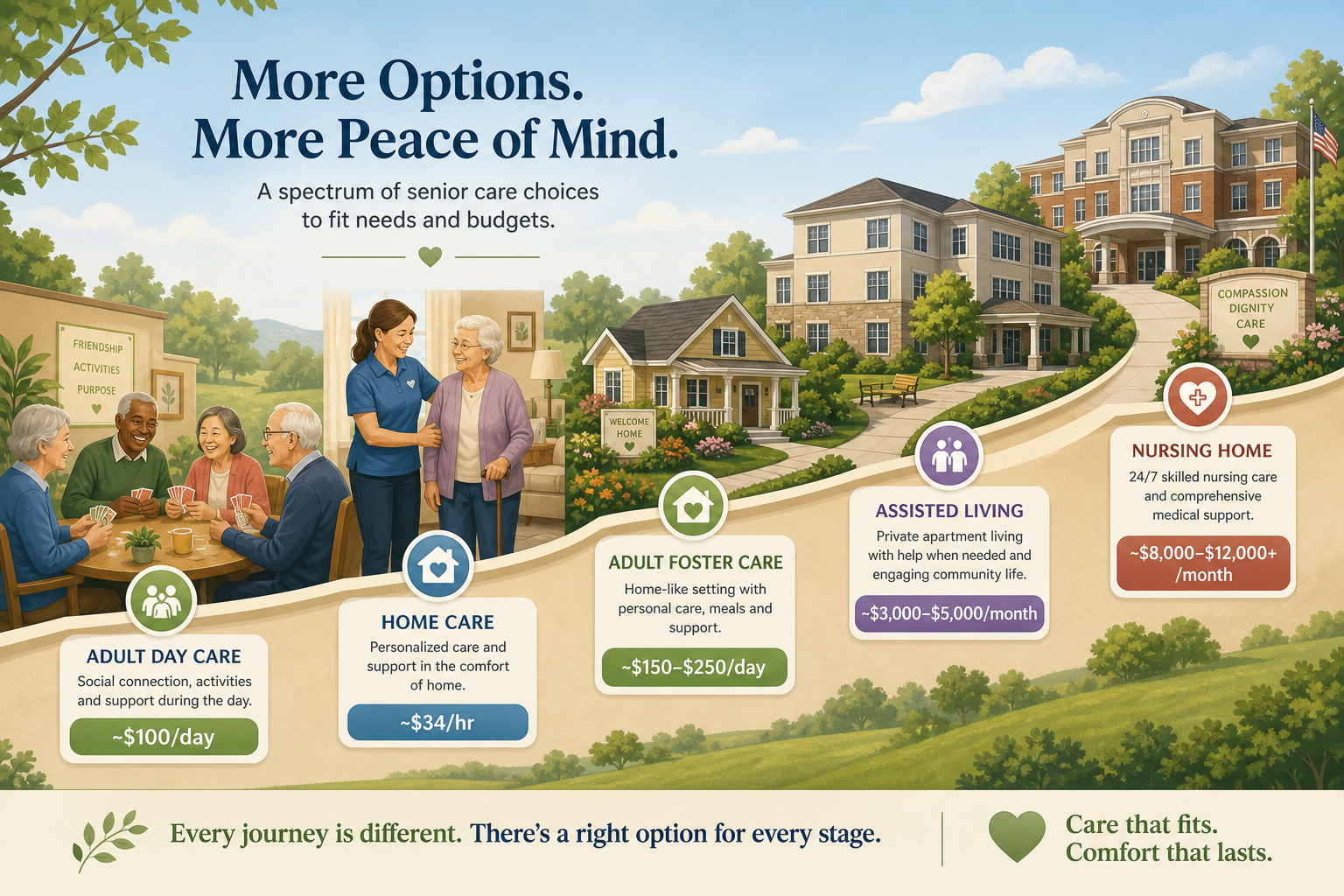
The Affordability Gap: Why Assisted Living Is Out of Reach for Many Families
The national median cost of assisted living in 2026 is $5,419 per month, according to data from A Place for Mom's proprietary database of more than 24,000 residents. That figure represents a national average; the range is wide, from a low of roughly $3,983 per month in Louisiana to a high of $8,960 per month in Washington, D.C. For a family whose older adult needs help with daily tasks but does not require 24/7 skilled nursing, that monthly price tag can feel like a wall.
The problem is compounded by a simple structural reality: Medicare does not cover the cost of assisted living, and Medicaid coverage for assisted living is limited to specific waiver programs that vary dramatically by state. Meanwhile, the number of older adults who are cost-burdened — spending more than 30% of their income on housing — is substantial. More than 34% of senior homeowners and 58% of senior renters fall into this category, according to SeniorLiving.org's 2026 analysis. For these families, the standard advice to "look into assisted living" is not helpful; it is financially impossible.
The good news is that at least five viable care models exist that cost 40% to 80% less than assisted living. None of them are perfect for every situation, but each serves a specific level of care need. The key is matching the right model to your loved one's functional status, not to a facility type. This guide walks through each option with concrete costs, eligibility criteria, and practical steps for finding them locally.
Option 1: Adult Day Care — Structured Support at ~$100/Day
Adult day care is the lowest-cost structured care option available. The national median cost is $100 per day, which translates to roughly $2,123 per month based on a typical 21-day attendance schedule. That is less than 40% of the median assisted living cost. State-level figures vary considerably: Texas averages $1,300 per month, Alabama $1,517 per month, and Maine $3,467 per month, according to SeniorLiving.org's 2026 pricing guide.
Adult day care centers provide supervision, social activities, meals, and some health services during daytime hours. They are best suited for seniors who:
- Need supervision and structured activity during the day but have a caregiver available in the evenings and on weekends
- Are socially isolated at home and would benefit from peer interaction
- Have mild to moderate cognitive impairment but are not prone to wandering or aggressive behavior
- Need medication management or help with meals during the day
For family caregivers who work during the day, adult day care can be the difference between keeping a job and leaving the workforce. It can also delay or prevent the need for facility placement by providing the caregiver with a daily break and the senior with a structured, engaging environment.
How to Pay for Adult Day Care
- Medicaid HCBS waivers cover adult day care in most states for eligible seniors (income ≤ $2,982/month, assets ≤ $2,000 in most states)
- VA benefits may cover adult day care with a copay for eligible veterans
- Medicare generally does not cover adult day care
- Private pay is the default option for those who do not qualify for assistance
Option 2: Adult Foster Care Homes — Personalized Care in a Home Setting
Adult foster care homes — also called adult family homes or residential care homes — are small, licensed residences that house 2 to 6 residents. They provide personal care services (bathing, dressing, medication reminders), meals, and supervision in a home-like environment. The cost typically ranges from $3,000 to $4,500 per month, which is 20% to 45% less than the median assisted living cost. In some lower-cost states, the price can be even lower.
The key advantage of adult foster care is the low resident-to-caregiver ratio. With only a handful of residents, the caregiver can provide more individualized attention than in a large assisted living facility. This model works well for seniors who:
- Need help with personal care but do not require 24/7 skilled nursing
- Prefer a quiet, home-like setting over a larger institutional environment
- Have stable medical conditions that do not require daily licensed medical oversight
- Would benefit from consistent, familiar caregivers rather than rotating staff
For a deeper dive into this option, including how to find and vet homes in your area, see our dedicated guide: Residential Care Homes: The Overlooked Senior Living Option Families Need to Know About in 2026.
Option 3: PACE Programs — Comprehensive Care, Often at $0 Copay for Dual-Eligible Seniors
The Program of All-Inclusive Care for the Elderly (PACE) is one of the most comprehensive — and most overlooked — alternatives to assisted living. PACE serves individuals aged 55 and older who are certified by their state as needing a nursing home level of care but who can live safely in the community with support. The program provides:
- Medical care, including primary care, specialist visits, and hospital coordination
- Dental, vision, and hearing services
- Physical, occupational, and speech therapy
- Adult day center attendance with meals, activities, and social engagement
- In-home personal care and homemaker services
- Transportation to and from the PACE center and medical appointments
- Prescription drug coverage
All services are coordinated by an interdisciplinary team that includes a primary care provider, nurse, social worker, therapist, and other specialists. The goal is to keep the participant living at home for as long as it is safe and feasible.
Cost and Eligibility
Most PACE participants are dually eligible for Medicare and Medicaid. For these individuals, the program is available at $0 out-of-pocket cost — no copays, no deductibles, no monthly premiums beyond what Medicaid already covers. For Medicare-only participants who do not qualify for Medicaid, there is a monthly premium for the PACE benefit, but it is typically far less than the cost of assisted living or nursing home care.
For families whose loved one qualifies, PACE can replace the need for assisted living entirely. The combination of adult day center attendance, in-home support, and comprehensive medical coordination often allows seniors to remain at home safely even with significant functional limitations.
Option 4: Shared Housing and Co-ops — Reducing Costs by $750–850/Month
Shared housing models — home-sharing through platforms like Silvernest, senior co-ops, and shared apartments — address the single largest expense for most older adults: housing. By splitting rent and utilities with a roommate, seniors can reduce their monthly housing costs significantly. According to SeniorLiving.org's 2026 analysis, hosts on home-sharing platforms earn an average of $850 per month, and renters save an average of $750 per month compared to market-rate rent.
Shared housing is not a care model on its own — it is a housing strategy. But when combined with in-home services (paid through a Medicaid waiver or private pay), it can function as a complete alternative to assisted living. A senior who lives in a shared home and receives 10 to 15 hours per week of personal care assistance may have a total monthly cost of $2,000 to $3,000, which is 45% to 65% less than assisted living.
HUD Section 202: Another Housing Option
For seniors aged 62 and older with very low incomes, HUD's Section 202 Supportive Housing for the Elderly program offers subsidized apartments where rent is capped at 30% of adjusted income. When combined with in-home care services (covered by a Medicaid HCBS waiver or other funding), this arrangement can cost 50% to 70% less than assisted living. The challenge is availability: Section 202 properties often have multi-year waitlists, and new construction has been limited in recent years.
Option 5: In-Home Care with Medicaid Waivers — Staying at Home at Reduced or No Cost
For many families, the most natural alternative to assisted living is to bring care into the home. The challenge is cost: at the national median rate of roughly $34 per hour for a home health aide, 20 hours per week of care costs approximately $2,944 per month, according to A Place for Mom's 2026 pricing data. That is still less than assisted living, but it adds up quickly if more hours are needed.
The game-changer is the Medicaid Home and Community-Based Services (HCBS) waiver program. Available in 44+ states as of 2022, HCBS waivers allow eligible seniors to receive personal care, homemaker services, respite care, and other supports in their own homes rather than in a facility. For those who qualify — typically with income at or below $2,982 per month and assets at or below $2,000 in most states — the cost of in-home care can be $0 or significantly reduced.
The strategic move for many families is to combine in-home care with subsidized housing. A senior living in a HUD Section 202 apartment (rent at 30% of income) who receives personal care through a Medicaid HCBS waiver may have total monthly costs of $500 to $1,500 — a fraction of the $5,419 median for assisted living.
Decision Matrix: Matching Care Needs to the Right Alternative
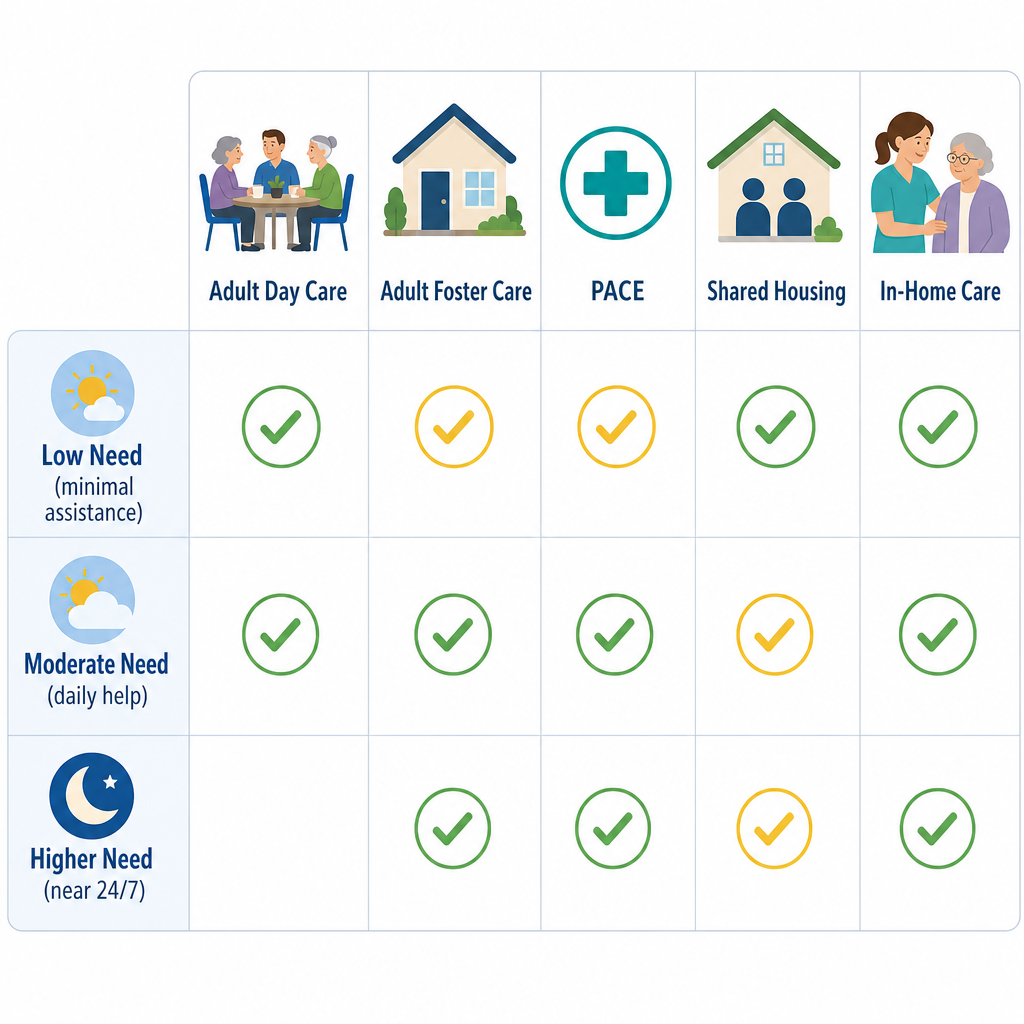
Not every alternative works for every level of care need. The table below maps each option against three care need levels — Low (supervision and socialization), Moderate (personal care assistance), and Higher (some medical oversight) — to help you narrow down the best fit.
| Care Need Level | Adult Day Care | Adult Foster Care | PACE | Shared Housing + Services | In-Home Care (Waiver) |
|---|---|---|---|---|---|
| Low: Supervision, socialization, meals | ✓ Strong fit | ✓ Strong fit | ✓ Strong fit | ✓ Strong fit | ✓ Strong fit |
| Moderate: Personal care (bathing, dressing, toileting) | Partial fit (daytime only) | ✓ Strong fit | ✓ Strong fit | Partial fit (needs in-home services) | ✓ Strong fit |
| Higher: Some medical oversight, medication management | Partial fit (limited health services) | Partial fit (varies by state license) | ✓ Strong fit | Partial fit (needs skilled in-home care) | Partial fit (varies by waiver scope) |
Before using this matrix, it is important to have a clear picture of your loved one's functional status. An ADL (Activities of Daily Living) assessment can help you determine which care needs are present and how severe they are. For a broader framework that includes all care options — not just the affordable alternatives — see our Elderly Care Options: A Complete Decision Framework for Families.
How to Find Each Option Locally — A Step-by-Step Guide
Knowing that an option exists is one thing; finding it in your community is another. Here is where to start for each alternative:
- Adult day care: Search your state's department of aging website or use the Eldercare Locator (eldercare.acl.gov) to find licensed centers in your area.
- Adult foster care homes: Contact your state's licensing agency for adult foster care or residential care homes. Your local Area Agency on Aging can also provide a list of licensed homes.
- PACE programs: Use the CMS PACE finder tool at cms.gov/medicare/medicaid-coordination/about/pace or call your state Medicaid office to ask whether PACE operates in your county.
- Shared housing: Explore platforms like Silvernest, check with local senior centers for bulletin board listings, or contact a nonprofit home-sharing program in your city.
- In-home care with Medicaid waivers: Apply through your state Medicaid office. Ask specifically about HCBS waivers for home-based care. A social worker or case manager can help with the application.
When These Alternatives Aren't Appropriate — Know the Limits
The five alternatives described in this guide are not suitable for every situation. There are specific circumstances where a higher level of care — such as assisted living memory care or a skilled nursing facility — may be medically necessary, even if the cost is a significant burden.
- Advanced dementia with severe behavioral symptoms: If your loved one is wandering frequently, exhibiting aggression toward caregivers or other residents, or is at high risk of elopement, a secure memory care unit may be the only safe option. Adult day care centers and adult foster care homes are generally not equipped to manage these behaviors.
- Complex medical needs requiring 24/7 skilled nursing: Conditions that require daily licensed medical oversight — such as ventilator dependence, complex wound care, or unstable chronic conditions — cannot be managed in an adult foster care home or through intermittent in-home care. A skilled nursing facility is the appropriate setting.
- Conditions requiring daily licensed medical oversight: If a registered nurse or licensed practical nurse must be present at all times, none of the five alternatives listed here will meet that requirement.
Reader Checklist: Evaluating Each Option for Your Family
Use this checklist alongside the decision matrix above to evaluate each alternative for your specific situation. Not every question will apply to every option, but working through the list will help you avoid surprises.
- Does this option meet my loved one's current care needs? Use the ADL assessment to confirm.
- What is the total monthly cost, including any hidden fees (transportation, meals, supplies)?
- Is my loved one eligible? Check age, income, asset, and clinical criteria for each option.
- Is this option available in my area? Some programs (PACE, Section 202) are not available everywhere.
- What is the waitlist situation? If there is a waitlist, what can we do in the meantime?
- Can we visit or trial the option before committing? Most adult day care centers and adult foster care homes welcome visits.
- What happens if care needs increase? Does the option have a pathway to more intensive care, or would we need to start over with a new provider?
Browse more in the Glossary.