
Caregiver decision guide
How Humanoid Robots Can (and Can't) Prevent Falls
Humanoid robots cannot yet catch a falling senior at home, but they can reduce fall risk through companionship, gait monitoring, and medication reminders. This article helps families decide when a robot might help their parent stay safer.
The question families usually mean by humanoid robots for elderly care: benefits and challenges is much less futuristic than it sounds: can a robot keep my mother or father from falling?
In 2026, the answer needs a hard boundary. A robot you can buy for a normal home cannot reliably catch an older adult who is falling. It cannot replace hands-on help with bathing, dressing, toileting, or safe transfers from bed to chair. It should not be treated as a substitute for grab bars, medication review, gait assessment, physical therapy, or a person who can physically assist when transfers are already unsafe.
That does not make eldercare robots useless. It means their most credible role is indirect: helping reduce the conditions that make a fall more likely in the first place. A companion robot that gets someone moving, reminds them to take medication, notices a change in routine, or supports safer outdoor walking is operating in a different category from the fantasy of a machine diving across a bathroom to catch a fall.
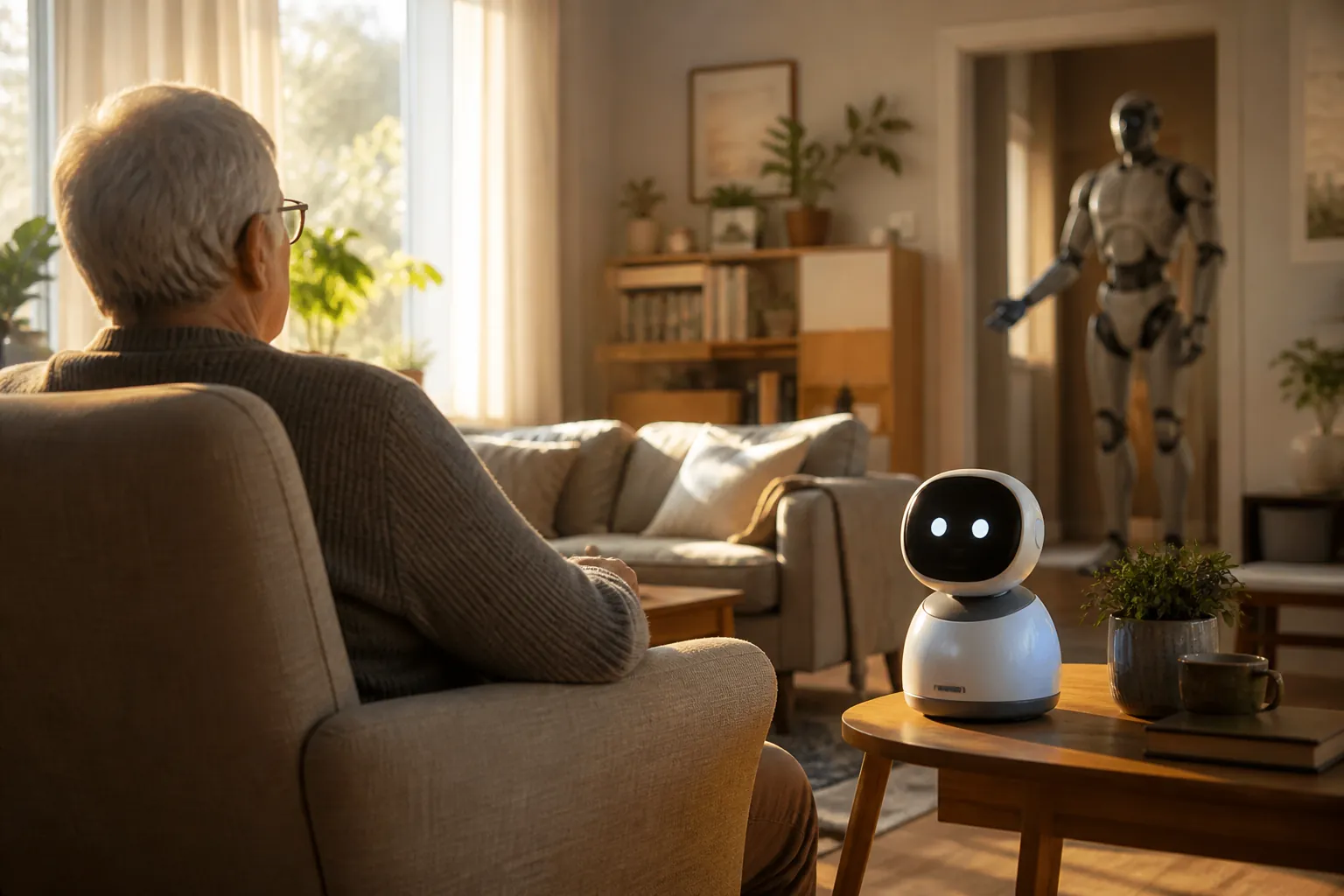
The fall-catching robot is still in the lab
MIT’s E-BAR is worth taking seriously because it is aimed at the exact physical problem families worry about: sitting, standing, walking support, and catching a person during a fall. In May 2025, MIT described E-BAR as the first robot to demonstrate fall catching without a harness. The same report also gives the limits that matter for home decisions: E-BAR was remote-controlled, weighed 220 pounds, and remained a lab prototype rather than a product families could place in a hallway or bathroom.[1]
That distinction is not nitpicking. A daughter who lives three states away does not need to know only that a fall-catching robot exists somewhere in a laboratory. She needs to know whether it can be installed, maintained, trusted at 2 a.m., and used by a parent who may not position themselves correctly or wait for help before standing.
The same boundary applies to physical care. No commercially available robot today can safely perform the personal-care tasks most tied to immediate fall danger: bathing, dressing, toileting, and transferring someone whose legs may buckle. If your parent already needs another person’s hands to get out of bed safely, a companion robot is not the missing safety device.
Where robots may actually reduce fall risk
Falls are the leading cause of injury for adults 65 and older, but the risk does not begin only at the instant someone slips. Stanford’s SOAR project describes a familiar cascade: fear of falling can lead older adults to walk less, lose strength, become more isolated, and then become more vulnerable to future falls.[2]
That pathway is where robots become more interesting. If a device can help someone keep a routine, go for a safer walk, answer check-ins, or accept care with less distress, it may reduce fall risk without ever touching the person.
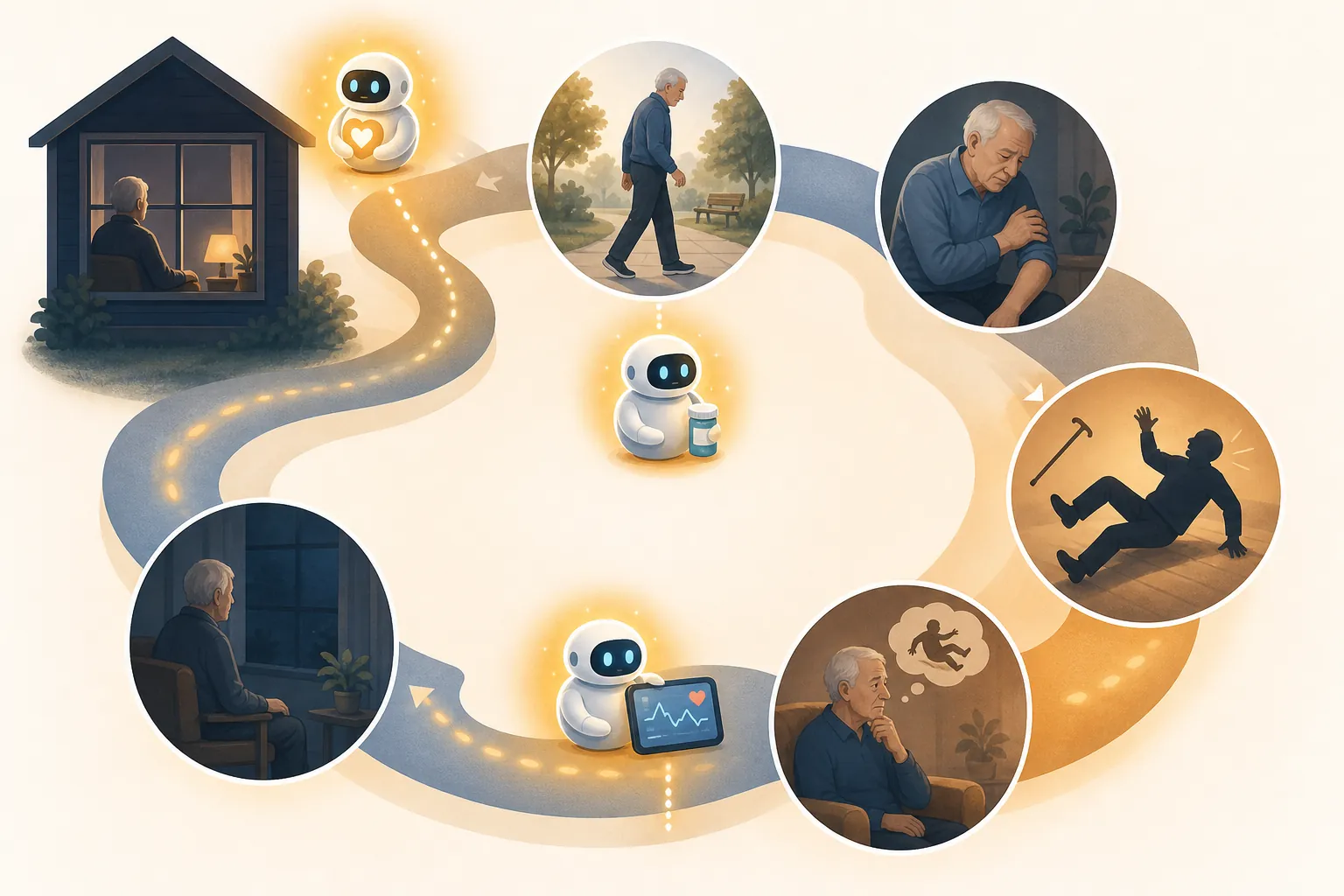
Companionship is not just mood support
Loneliness and inactivity often travel together. A person who stops going downstairs, stops taking short walks, or stops answering calls may not look like a fall emergency yet. But the body keeps score: less movement means less strength, less balance practice, and less confidence.
Companion robots such as ElliQ, Hyodol, PARO, Pepper, NAO, and newer humanoid companions belong in this prevention conversation only when they change a real behavior. A robot that says good morning, asks about meals, offers reminders, or encourages a brief activity is not preventing falls because it is cute or conversational. It may help if the older adult responds by moving more, keeping medication routines, accepting care, or staying connected enough for another human to notice decline.
PARO, the robotic seal used in dementia care, is a good example of indirect usefulness. A 29-study review from the University of British Columbia reported that PARO can reduce agitation, which matters because a calmer person may be more willing to accept bathing, dressing, or supervision. That is not the same as proving PARO prevents falls at home; it is a narrower but still meaningful benefit.
Hyodol shows another pathway. More than 12,000 units have been deployed in South Korea, where the robot can alert social workers to emergencies. That kind of check-in system may help remote caregivers learn sooner that something is wrong. It still does not lift a person from the floor or make an unsafe bathroom safe.
Medication reminders can matter, but only for the right problem
Medication habits are a plausible fall-risk pathway because missed doses, duplicate doses, sedating medications, and poorly timed pills can all affect alertness, blood pressure, or steadiness. A robot like ElliQ that offers medication reminders and check-ins may help when the actual problem is routine: the person forgets, loses track of time, or benefits from a prompt that feels less nagging than a call from an adult child.
It is much less useful when the problem is clinical judgment. A robot cannot decide that a blood pressure medication is contributing to dizziness, that a sleep aid is increasing nighttime fall risk, or that a parent needs a pharmacist or physician to review the full medication list. Reminders support adherence; they do not make the regimen safe.
Outdoor walking support may be more realistic than indoor rescue
Stanford’s Rosie is aimed at a quieter but more believable prevention task. The robot uses lidar and 360-degree cameras to warn about cracks, curbs, and uneven pavement during walks. Stanford described commercialization as possible “within a few years,” which means Rosie is not a product to buy for a parent this summer, but the use case is well matched to fall prevention: help someone keep walking while reducing avoidable outdoor hazards.[2]
That matters because families often imagine the most dramatic robot job first. A walking companion that notices a curb may do more good than a humanoid assistant that promises emotional comfort but never gets the person out the door. The safer-walking pathway is not glamorous, but it fits the fear-of-falling cascade more closely.
Monitoring is useful only if someone acts on it
Mobility monitoring can help a family spot decline earlier: shorter walks, more time sitting, fewer kitchen visits, missed routines, or a change in gait. The practical question is not whether a device can collect a signal. It is who receives it, who reviews it, and what happens next.
A remote caregiver who gets a notice that Dad has stopped taking his usual morning walk still has to decide whether to call, visit, arrange a medical appointment, ask a neighbor to check in, or start home care. Monitoring without an escalation plan becomes another dashboard nobody has time to read.
A practical fit test for families
The useful question is not “Are robots good or bad for eldercare?” It is “Which fall-risk pathway are we trying to change?” A robot is more plausible when the risk comes from isolation, routine breakdown, low activity, missed check-ins, or early changes in mobility. It is much less plausible when the risk comes from unsafe transfers, severe balance loss, advanced dementia with resistance, or a home environment that still has obvious hazards.
| Family situation | Robot may help when | Robot probably will not help when |
|---|---|---|
| Parent lives alone | The robot supports check-ins, reminders, social contact, and activity prompts. | No one is assigned to respond when alerts or behavior changes appear. |
| Early cognitive decline | The parent still accepts prompts and can follow simple routines. | The parent becomes frightened, suspicious, or repeatedly disables the device. |
| Remote adult-child caregiver | The robot fills small daily gaps between calls and visits. | The family expects the robot to replace local emergency help or paid care. |
| Fear of falling | The robot encourages safe movement, outdoor walking, or confidence-building routines. | The person needs hands-on balance support or supervised transfers. |
| Medication routine problems | Reminders reduce forgotten doses or missed timing. | The medication list itself may be causing dizziness, sedation, or low blood pressure. |
| Tight fixed income | The family can afford the device without delaying proven safety changes. | The purchase competes with grab bars, lighting, physical therapy, home care, or medical review. |
When a robot might be worth considering
The best-fit scenario is a parent who lives alone, has mild or early cognitive changes, is lonely or underactive, and is still open to interacting with technology. The adult child may live far away but remains involved enough to respond to check-ins, review changes, and coordinate care.
In that situation, a robot is not being asked to perform a rescue. It is being used as a routine scaffold: remind, prompt, encourage, observe, and connect. Those are modest verbs, but they are closer to what current devices can actually do.
- Choose a device for a specific pathway: medication reminders, social check-ins, activity prompts, or mobility monitoring.
- Test whether the parent will use it after the novelty wears off, not only during the first demonstration.
- Assign a person to receive alerts and decide what action follows.
- Keep the fall-prevention basics in place: lighting, footwear, grab bars, medication review, vision care, gait assessment, and strength work.
When a robot is the wrong answer
A robot is a poor primary safety plan when an older adult already needs physical transfer assistance. If Mom cannot rise from the toilet safely, if Dad has fallen during bathing, or if standing from bed requires another person’s arm, the family is dealing with a hands-on care problem. The next step is home modification, clinical evaluation, rehabilitation, personal care support, or a different living arrangement — not a companion robot on the counter.
Advanced dementia can also change the calculation. Some people are comforted by robotic companions. Others become agitated, suspicious, or uninterested. A device that depends on cooperation cannot protect someone who refuses to engage with it, unplugs it, hides it, or becomes distressed by its voice.
The same caution applies to an unwilling user. Families sometimes buy technology to soothe their own fear, then discover that the parent sees it as surveillance, clutter, or a symbol of lost independence. If the device will sit unused in a corner, it is not part of a fall-prevention plan.
Evidence is promising, but still thin
The 2026 evidence base for companion and humanoid robots is not strong enough to treat them like established fall-prevention interventions. A JMIR Aging scoping review of 59 studies found a “striking lack of RCTs,” and many studies remain limited by small samples, short durations, and self-reported outcomes. That does not erase promising findings, but it should slow down expensive decisions.
The UC Davis yearlong study launched in May 2026 is important for that reason. It is described as the first U.S. nursing-led long-term trial of a humanoid companion, Abi, in dementia care. The results are still pending, so Abi belongs in the “watch carefully” category rather than the “proven fall-prevention tool” category.
Families should also remember that robot products are not just clinical tools; they are manufactured devices with companies behind them. Aldebaran, the maker associated with Pepper and NAO, filed for bankruptcy in February 2025. That does not mean every robot company is unstable, but it does show why support, repairs, software updates, and long-term availability belong in the buying decision.
Cost and coverage are not small details
Medicare does not classify care robots as durable medical equipment, and U.S. private insurers do not cover companion robots. Families should not build a fall-prevention plan around reimbursement that is not currently available.
That matters most when money is tight. If buying a robot delays installing bathroom grab bars, improving stair lighting, replacing unsafe rugs, arranging a medication review, or paying for therapy after a fall, the purchase may make the overall plan weaker. The boring interventions often have the clearest connection to the hazard in front of the person.
The safest answer is usually a layered plan
A robot can be one support in a broader fall-prevention plan when the target is isolation, routine, reminders, activity, or caregiver awareness. It is most defensible when the older adult likes the interaction, the family has a response plan, and the purchase does not crowd out proven safety work.
It cannot be the plan when the risk is physical assistance. If transfers, bathing, toileting, or dressing are unsafe, the family needs human help and home safety changes. If medication side effects or sudden weakness are suspected, the family needs clinical review. If a fall has already happened, the next question is rehabilitation and recovery, not whether a friendly device can make everyone feel less afraid.
The real benefit of humanoid and companion robots in elderly care is not that they make caregiving disappear. It is that, in the right home, they may keep small problems from becoming invisible: the missed walk, the skipped pill, the unanswered check-in, the growing fear that quietly shrinks a person’s world.
References
- Eldercare robot helps people sit, stand, and catches them if they fall, MIT News, May 2025.
- Domestic robots could support aging population, Stanford Report, April 2026.
Questions to bring to a clinician or OT
This is not medical, legal, or a family's final decision — only a framework. Bring these questions to a clinician, occupational therapist, or your local Area Agency on Aging.
Find Local HelpRelated reading
Noticed something outdated or inaccurate on this page? Flag a correction. We review every report against CDC, NIA, and AARP HomeFit guidance before updating a page.