Home care costs have risen 39% since 2021, far outpacing inflation and Social Security COLAs, leaving most families without a payment plan. This article explains the 2026 national and state median costs, the affordability gap, and five payment pathways ranked by accessibility, plus a tax strategy and the surprising assisted-living cost crossover.
By Editorial Team
new caregiver
experienced caregiver
long-distance caregiving
spousal caregiver
working caregiver
daily routines
medication management
personal hygiene
care coordination
first steps
ADLs
IADLs
Start with the hourly rate, because that is where the promise of home care for senior citizens either holds together or starts to split. In 2026, the national median cost of in-home care is $34 an hour, with state medians running from $25 an hour in Mississippi to $44 an hour in South Dakota.[1] That range matters more than any national average if your parent lives in a high-cost state, because a few dollars per hour becomes a large monthly difference once care stops being occasional.
The first arithmetic is plain: multiply the hourly rate by the number of hours your parent actually needs, then multiply that by a full month. At the 2026 national median, 7 hours a week is about $1,031 a month. Fifteen hours a week is about $2,208 a month. Forty-four hours a week is about $6,478 a month.[1] Those are care hours only. They do not include rent, property taxes, utilities, groceries, home repairs, transportation, medications, or the daughter taking unpaid time off work because the agency shift ends before dinner.
Weekly home care hours
What that may look like
Approximate monthly cost at $34/hour
7 hours
One hour a day, or two to three short visits a week
$1,031
15 hours
Help most weekdays with bathing, meals, errands, or supervision
$2,208
30 hours
Six hours a day, five days a week
$4,290
44 hours
A near full-time weekly schedule
$6,478
This is why families can feel fine after the first agency call and frightened after the first calendar draft. Seven hours a week is a supplement. Thirty hours a week is a second household bill. At 30 hours a week, annual home care comes to about $51,480, while the average Social Security benefit is about $23,700 a year.[2] Even before taxes, housing, and food, the care bill alone is more than twice that income.
The direction of travel is not gentle. AARP reported in June 2026 that home care costs rose at a 7.9% annual rate over the prior five years, nearly twice overall inflation and more than triple medical inflation.[2] A family that priced help in 2021 and put the folder away is not working from a stale estimate; it is working from a different era of the bill.
The affordability gap is not a budgeting failure
It is tempting, especially around a kitchen table, to hunt for the mistake: the house that should have been sold sooner, the policy nobody bought, the sibling who did not help enough. Some families did miss chances. Many had no real chance to begin with. An ASPE and Urban Institute analysis found that only 22% of older adults with severe long-term services and supports needs could cover home care from monthly income alone.[3]
The same analysis found that among adults 65 and older who were not on Medicaid, 68% could fund at least two years of home care using income and financial assets, but that share fell to 49% for those with severe long-term care needs.[3] The important distinction is that the study is not saying most families can comfortably pay. It is measuring whether income and assets could cover a defined period of care under the study’s assumptions. Selling investments, spending down savings, or using home equity may technically make care possible while still leaving the family exposed.
The ASPE/Urban Institute figures also rely on older underlying survey and cost data, including 2013–2014 Health and Retirement Study data and 2016 cost assumptions.[3] The exact dollar amounts are dated. The structure is not: home care becomes hardest to fund when need is severe, income is fixed, and the person still must pay for the home itself.
Put the parent’s real month on one page
Before choosing a payment source, build the month. Not the hopeful month, where a neighbor checks in and no one falls. The likely month.
Care hours: bathing, dressing, toileting, transfers, meals, medication reminders, errands, supervision, and respite for the family caregiver.
Home costs: rent or mortgage, property tax, insurance, utilities, maintenance, groceries, supplies, and transportation.
Parent income: Social Security, pension, annuity payments, required minimum distributions, and any predictable family contribution.
Assets that can actually be used: cash, brokerage accounts, home equity, life insurance cash value, and any long-term care insurance benefit.
Time limits: how many months the plan works before savings fall below a level the family is not willing, or not allowed, to cross.
For a deeper state-by-state estimate, a dedicated in-home senior care cost guide can be useful, but do not wait for perfect precision before doing the first pass. The first pass tells you whether the family is solving a $1,000-a-month gap or a $4,000-a-month gap. Those are different conversations.
The payment paths, ranked by practical access
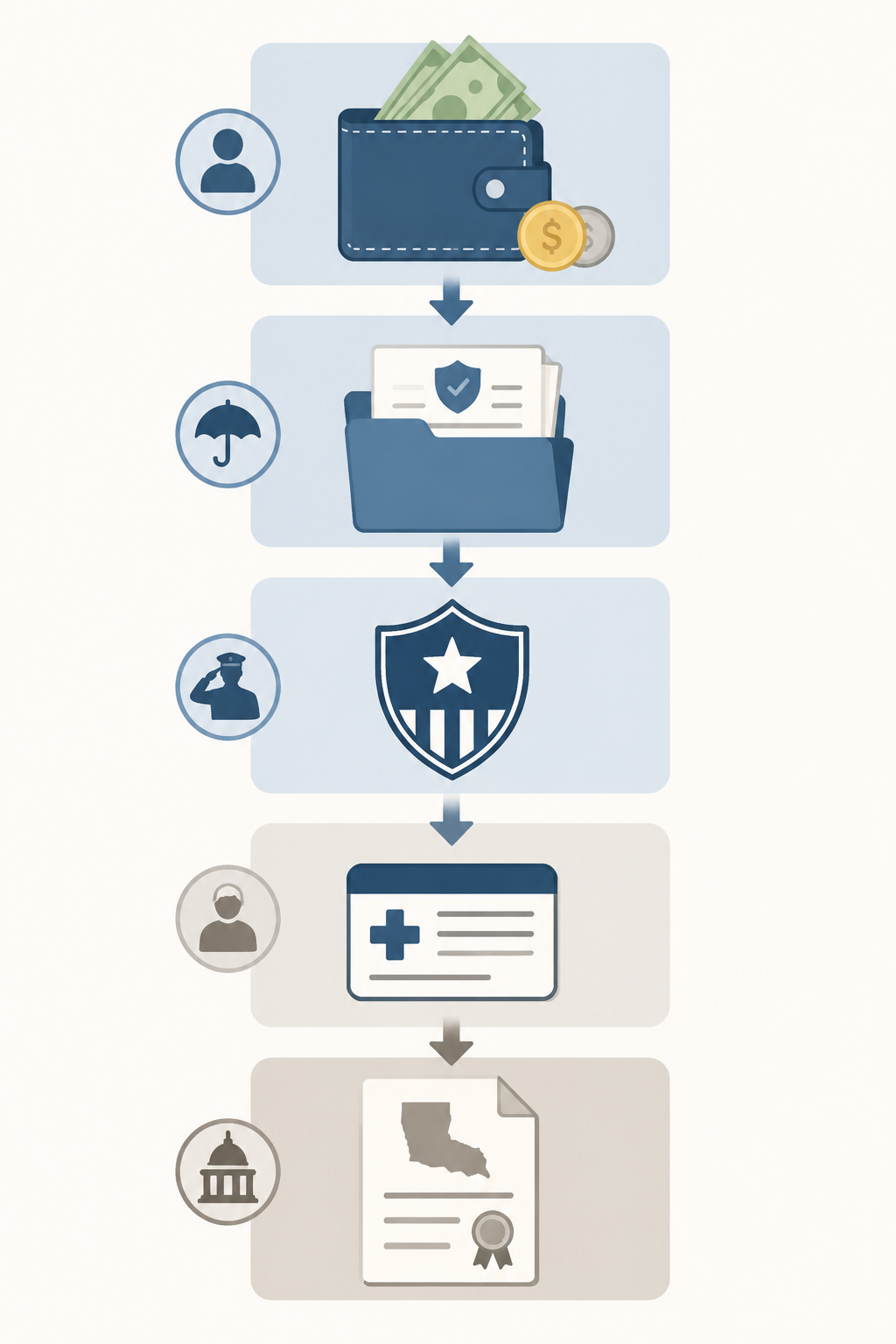
Most families do not use one clean source. They stack sources: a parent’s income, some savings, a few family-paid hours, maybe insurance, maybe a public benefit after eligibility is confirmed. Still, the order matters. Some money can be used tomorrow. Some requires a policy that had to be bought years ago. Some exists only if income, assets, service history, medical need, and state rules line up.
1. Private pay: the most available and the most exposed
Private pay is first because it is the path families can usually start using fastest. The parent pays the agency or caregiver from Social Security, pension income, savings, investments, home equity, or help from adult children. A Place for Mom lists private pay among the common ways families pay for home care, alongside insurance and public programs.[4]
Its advantage is control. The family can choose more hours, fewer hours, a preferred agency, or a privately hired caregiver if they are comfortable handling the legal and payroll responsibilities. Its danger is that there is no built-in stop sign. A parent with $80,000 in liquid savings may look secure until 30 hours a week starts drawing down more than $4,000 a month before the regular cost of living is paid.
Private pay needs a written limit. That limit can be a dollar amount, a date, or a care-hour threshold. For example: the family will pay privately for up to 15 hours a week while applying for benefits; if the need reaches 30 hours a week, they will compare home care against assisted living; if savings fall below a chosen reserve, they will not keep quietly spending as if the next month will be cheaper.
2. Long-term care insurance: useful if it already exists
Long-term care insurance can be a strong source of help for families whose parent already owns a policy. It may cover some in-home care costs, depending on the policy’s benefit amount, elimination period, daily or monthly cap, covered services, and trigger rules. It is not a quick rescue for a parent who already needs substantial help; buying coverage late is often expensive, medically difficult, or unavailable.
The practical step is not to ask, “Does Mom have long-term care insurance?” and stop at yes. Pull the policy. Find the benefit trigger. Many policies require that the insured need help with a certain number of activities of daily living or have a cognitive impairment. Check whether home care must be provided by a licensed agency, whether family caregivers can be paid, how long the elimination period lasts, and whether the benefit is reimbursement-based or cash-based.
If the policy exists, file early. If the policy does not exist, do not let a salesperson’s general explanation of long-term care insurance distract from this month’s invoice. For a family already in care mode, the policy either exists and can be decoded, or it does not exist as a current payment source.
3. VA benefits: meaningful, but only for eligible veterans and survivors
VA benefits deserve a serious look when the older adult is a veteran or surviving spouse, but they should not be treated as a general home-care subsidy. Aid & Attendance can increase a VA pension for eligible wartime veterans or surviving spouses who meet medical and financial requirements, and VA Homemaker/Home Health Aide services may help eligible veterans receive support at home through VA-connected care arrangements.[4]
The two are often discussed together, but they are not the same thing. Aid & Attendance is an added pension benefit that can help pay for care. Homemaker/Home Health Aide support is a VA health care service for eligible veterans who need personal care and help with daily activities. Eligibility can depend on service history, wartime service, clinical need, income and asset rules, enrollment, and local availability.
Families should verify eligibility through the VA or an accredited veterans service officer before building the care budget around it. If the parent qualifies, the benefit can change the math. If the parent does not qualify, no amount of need turns it into a universal program.
4. Medicare: important for skilled home health, not ongoing custodial care
Medicare is where families most often get false comfort. Medicare may cover home health services when the person meets program rules, such as needing skilled care under a physician-directed plan. That is different from paying for ongoing custodial help with bathing, dressing, meal preparation, laundry, and supervision when those are the main needs.[4]
So if the parent is coming home after a hospitalization and needs skilled nursing or therapy, Medicare may be relevant. If the parent needs someone every morning to help with toileting, breakfast, and safe transfers, Medicare is not the long-term payment plan. A more detailed explanation of Medicare and custodial home care alternatives can help separate those two categories before the discharge planner’s short-term services end.
5. Medicaid HCBS waivers: potentially crucial, but state-specific and conditional
For lower-income families, Medicaid home- and community-based services waivers may be the most important public pathway. These programs can help eligible older adults receive long-term services at home instead of in an institution, but they are not a single national benefit with one application, one income limit, and one answer. Rules vary by state, and programs can have medical eligibility standards, income and asset limits, service caps, provider networks, and waitlists.[4]
This is where families need state-specific help, not internet optimism. Contact the state Medicaid office, the local Area Agency on Aging, or a SHIP counselor. Ask which waiver or long-term services program covers in-home personal care, whether there is a waitlist, what financial documentation is required, whether a spouse’s income is treated differently, and whether the parent can receive care while the application is pending.
Medicaid planning is also timing-sensitive. Spending down assets casually can create problems, and transferring money to relatives can backfire. Families with a home, a spouse, or mixed income sources should get qualified advice before rearranging accounts. A broader guide to government benefit programs for seniors can help identify other programs that might sit beside Medicaid, but the waiver question itself belongs with the state.
Use tax deductions as a secondary layer, not the foundation
Some home care expenses may be treated as medical expenses for tax purposes when they qualify, and medical expenses are generally deductible only to the extent they exceed 7.5% of adjusted gross income.[4] That threshold makes the deduction potentially valuable for some families and irrelevant for others, depending on income, itemization, and the nature of the care.
The tax file should start before tax season. Keep agency invoices, care plans, physician notes when relevant, mileage records, and proof of who paid. If an adult child pays the bill, dependency and deduction rules may matter. If the parent pays, the deduction belongs in the parent’s return if the other requirements are met. Families dealing with dementia-related supervision should be especially careful about documentation; hidden costs can pile up beyond the obvious hourly invoice, and a dementia cost guide may help identify what else needs tracking.
Still, a tax deduction does not pay the agency on Friday. It may reduce tax later. It may help a family recover part of the cost. It does not turn a $4,290 monthly care bill into something a $1,975 monthly Social Security check can carry by itself.
The assisted-living comparison belongs in the middle of the decision, not after the crisis
Families often compare home care and assisted living emotionally first: home means dignity, continuity, the familiar chair, the neighbor across the street. Assisted living sounds like surrender. But the financial comparison is not home care versus rent-free living. It is home care plus the full cost of keeping the home versus a residential setting where room, board, and some care are bundled.
That housing-cost blind spot is why higher-hour home care can become less affordable than assisted living. The ASPE/Urban Institute analysis found that 87% of adults 65 and older not on Medicaid could fund at least two years of assisted living, compared with 74% who could fund at least two years of home care when home equity was included.[3] The exact cost figures in that analysis are dated, but the lesson is current: at higher care hours, paying separately for the home and the caregiver can be more expensive than paying one bundled residential bill.
The crossover point is personal. It depends on the local assisted-living rate, whether the parent owns the home outright, whether the home can be sold or rented, how many care hours are needed, and whether family caregivers are filling unpaid gaps. But the comparison should usually begin once paid care moves beyond light support into a recurring weekday schedule. At 15 hours a week, home care may still preserve independence at a manageable cost. At 30 or 44 hours, the family should put assisted living on the same page before savings disappear.
A more detailed home care versus assisted living cost crossover guide can help with the side-by-side math. The point here is simpler: do not compare the agency invoice to the assisted-living invoice unless the parent’s housing, food, utilities, transportation, and home maintenance costs are also on the home-care side of the ledger.
A decision framework for the next family meeting
A useful family meeting does not begin with “Can Mom stay home?” It begins with the number of care hours. Then it asks what those hours cost in the parent’s state, what the parent can pay from income, what savings can responsibly cover, and which benefits are realistic rather than merely possible.
Price the likely care schedule using the state median or actual agency quotes, not a national average alone.
Separate care costs from ordinary household costs so the family can see the full monthly burn rate.
Use private pay only with a written spending limit and a date to revisit the plan.
Check existing long-term care insurance before assuming what it covers or when benefits start.
Screen for VA and Medicaid eligibility early, because both can take time and both have conditions.
Compare assisted living once care hours become frequent enough that home care is no longer a small add-on.
Home can still be the right answer. It can be the humane answer, the practical answer, and sometimes even the less expensive answer. But in 2026, it is not an answer that can be protected by hope alone. The care-hours math, income, assets, benefit eligibility, tax treatment, and assisted-living comparison all need to sit on the same page before the invoice arrives and everyone starts making promises they cannot afford to keep.


Comments
Join the discussion with an anonymous comment.