
Caregiver decision guide
Manual vs. Power Wheelchair for Elderly Adults: A Stage-Based Decision Guide
Choosing between a manual and power wheelchair for an elderly parent isn't a one-time decision. This guide helps adult children evaluate current upper-body strength, daily independence needs, and the likely trajectory of their parent's condition to make a choice that supports safety and independence now — and plans for what's ahead.

Why the Manual vs. Power Decision Isn't Static
Most wheelchair guides present the choice between a manual and power wheelchair as a simple, one-time comparison: if your parent has upper-body strength, buy a manual chair; if they don't, buy a power chair. That framing is misleading, and for families managing a progressive condition, it can be costly.
The reality is that a manual wheelchair that works well today — say, for a 78-year-old who still has moderate arm strength and lives in a single-story home — may become unsafe or impractical within twelve months as strength declines, endurance drops, or the underlying condition progresses. Conversely, purchasing a power wheelchair prematurely means investing thousands of dollars in a device your parent may not yet need, while also dealing with the logistics of charging, vehicle lifts, and wider doorways.
This guide is written for adult children who need to make a decision that works for their parent's current situation and also accounts for the likely trajectory of their condition. The goal is not to pick a chair type and be done. The goal is to build a mobility plan that adapts as needs change.
Three Key Determinants: Strength, Independence, and Trajectory
Before looking at specific wheelchair models, focus on three factors that should drive every decision. These apply regardless of whether you are buying, renting, or seeking insurance coverage.
- Upper-body strength and endurance for self-propulsion. A manual wheelchair requires the user to grip the push rims and propel themselves forward repeatedly throughout the day. This is not a one-time effort — it demands sustained shoulder and arm strength to move across rooms, up gentle inclines, and over thresholds. About 50% of wheelchair users experience musculoskeletal pain, with shoulder pain being the most common complaint, and older age is a significant risk factor. If your parent already has shoulder arthritis, rotator cuff issues, or general arm weakness, a manual chair may cause pain or be abandoned entirely.
- Daily need for independent mobility. Does your parent need to move independently around the home to use the bathroom, prepare meals, or reach the bedroom? Or is a caregiver available to push them most of the time? If independent mobility is essential for safety and dignity, a power wheelchair may be the right choice even if some upper-body strength remains. If a caregiver is present and the senior only needs the chair for occasional outings, a manual chair or a lighter transport chair may suffice.
- The likely trajectory of the underlying condition. This is the factor most guides overlook. A senior with early-stage Parkinson's disease may have adequate strength today, but the condition is progressive. A senior recovering from a hip replacement may need a chair for only a few weeks. A stroke survivor may regain strength over months of rehabilitation. A person with progressive multiple sclerosis (MS) will almost certainly need a power chair eventually. Matching the wheelchair type to the condition's trajectory — not just today's symptoms — is what separates a good decision from an expensive mistake.
Manual Wheelchair: When It Works and What to Look For
A manual wheelchair is the right choice when your parent has sufficient upper-body strength and endurance to self-propel safely throughout the day, and when the home environment is already accessible — no stairs to navigate, doorways wide enough, and floors that allow smooth rolling.
Key Specifications
| Feature | Typical Range | Notes |
|---|---|---|
| Weight | 15–40 lbs | Ultralightweight models (14–18 lbs) are easier to lift and transport but cost more. |
| Cost | $100–$800 | Basic models start around $100; lightweight and custom-fit models cost $400–$800. |
| Weight capacity | Up to 250 lbs standard | Heavy-duty models available for 300–850 lbs. |
| Frame type | Folding or rigid | Folding frames are easier to store and transport; rigid frames are lighter and more efficient to propel. |
| Key features | Push rims, swing-away footrests, armrests, brake locks | Push rims are essential for self-propulsion; swing-away footrests make transfers easier. |
| Best for | Active seniors with moderate upper-body strength | Short-term recovery or daily use when a caregiver is available to assist. |
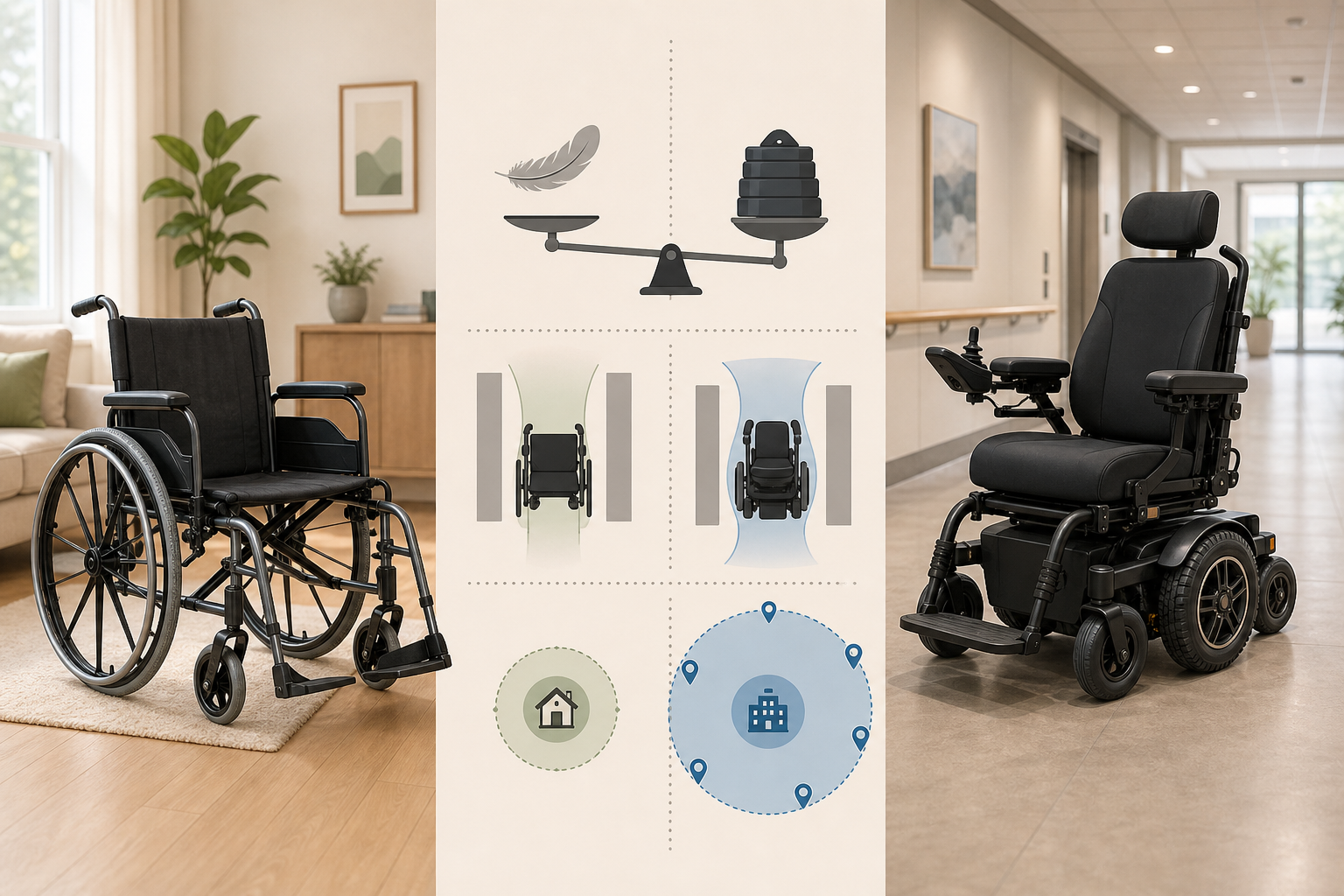
When to choose a lightweight or ultralightweight model: Standard manual wheelchairs weigh 35–40 lbs and are designed for use less than four hours per day. If your parent will be in the chair for longer periods, or if they need to self-propel frequently, a lightweight model (28–34 lbs) or an ultralightweight model (as little as 14 lbs) is worth the investment. Lighter chairs reduce shoulder strain and make it easier for the user to maneuver independently.
Transport chairs vs. manual wheelchairs: A transport chair has small wheels on all four corners and must be pushed by a caregiver. It is intended for temporary or short-term use — navigating an airport, getting to a medical appointment, or moving from a car to a building. Transport chairs weigh 15–25 lbs and cost $80–$300, but they do not allow self-propulsion. If your parent needs any degree of independent mobility, choose a manual wheelchair with large rear wheels and push rims.
Power Wheelchair: When Upper-Body Strength Isn't Enough
A power wheelchair becomes necessary when your parent cannot safely or comfortably self-propel a manual chair. This includes seniors with significant shoulder or arm weakness, advanced arthritis, Parkinson's disease, stroke-related hemiparesis, or any condition that limits endurance to the point where self-propulsion is exhausting or impossible.
Key Specifications
| Feature | Typical Range | Notes |
|---|---|---|
| Weight | 50–300+ lbs | Heavier chairs offer more features but require a vehicle lift for transport. |
| Cost | $1,500–$15,000 | Basic models start around $800; customized models with tilt, recline, and specialty seating exceed $5,000. |
| Battery range | 15–20 miles per charge | Actual range depends on terrain, user weight, and battery age. |
| Battery replacement | $200–$600 every 12–18 months | Batteries are a recurring cost that must be factored into the total cost of ownership. |
| Control type | Joystick (standard) | Requires adequate hand dexterity and cognitive ability to operate safely. |
| Best for | Seniors who cannot self-propel safely | Long-term daily use, outdoor mobility, and progressive conditions. |
Joystick control requirements: Power wheelchairs are typically controlled by a joystick that requires adequate hand dexterity, coordination, and cognitive ability. For seniors with advanced arthritis, tremors, or cognitive decline, a standard joystick may be difficult to use. Alternative control options — such as head arrays, sip-and-puff systems, or touch pads — exist but require a specialized evaluation by an occupational therapist.
Medicare Coverage: What You Need to Document for a Power Chair
Medicare Part B covers wheelchairs and power-operated vehicles (scooters) as durable medical equipment (DME) if certain conditions are met. Understanding these requirements before you start shopping can save months of frustration.
Coverage Basics
- Medicare Part B covers 80% of the Medicare-approved amount after you meet the Part B deductible.
- The 2026 Part B deductible is $283 (verify with official Medicare.gov documentation at the time of publication).
- You pay 20% of the Medicare-approved amount for the wheelchair.
- The DME supplier must be enrolled in Medicare and accept assignment — meaning they agree to charge only the coinsurance and deductible.
Documentation Requirements for a Power Wheelchair
Medicare does not cover a power wheelchair simply because your parent prefers one. The program requires specific documentation demonstrating medical necessity. The key requirements are:
- A face-to-face examination with a treating provider (physician, nurse practitioner, or physician assistant).
- A written prescription from the treating provider specifying the type of power wheelchair and the medical necessity.
- Evidence that a cane, walker, or manual wheelchair cannot be used safely at home. This is the most common hurdle. Medicare requires documentation that a less complex device is insufficient for the patient's needs. If your parent can safely use a manual wheelchair for their daily activities, Medicare will not cover a power chair.
- A comprehensive wheelchair assessment by an occupational therapist or physical therapist is often required to support the documentation. The assessment covers daily routines, home environment, physical examination (upper/lower extremity strength, ability to propel, postural endurance, sitting balance), precise measurements, and trial fitting.
Condition-Specific Guidance: Parkinson's, Stroke, MS, and Post-Hip Replacement
The right wheelchair choice depends heavily on the underlying condition and its expected progression. A one-size-fits-all recommendation does not work. Below is guidance for four common scenarios.
| Condition | Typical Trajectory | Wheelchair Recommendation | Key Considerations |
|---|---|---|---|
| Early-stage Parkinson's disease | Progressive; motor symptoms worsen over time | Plan for a power wheelchair within 12–18 months, even if a manual chair works today | A senior with early-stage Parkinson's may need a power wheelchair within a year. Buying a manual chair now and a power chair later costs more than planning ahead. |
| Stroke recovery | Variable; significant improvement possible in first 6–12 months | Start with a manual wheelchair; transition to power if recovery plateaus | Many stroke survivors regain strength and coordination over months of rehabilitation. A manual chair supports active participation in therapy. Reassess at 6 months. |
| Progressive multiple sclerosis (MS) | Progressive; mobility declines steadily | Power wheelchair from the start | Progressive MS almost always requires a power chair eventually. Starting with a power chair avoids the cost of an interim manual chair and supports independence longer. |
| Post-hip replacement or knee replacement | Temporary; recovery typically 6–12 weeks | Manual wheelchair or transport chair for short-term use | A manual chair or transport chair is usually sufficient for the recovery period. Renting is often more cost-effective than buying. |
The progression question: If your parent has a progressive condition, ask their neurologist or physiatrist: "Based on the typical progression of this condition, how long do you expect a manual wheelchair to be a safe and effective option?" The answer may surprise you — and it will help you budget and plan accordingly.

Total Cost of Ownership and Funding Options
The purchase price of a wheelchair is only part of the financial picture. A power wheelchair, in particular, comes with ongoing costs that can add up significantly over time.
Cost of Ownership Comparison
| Cost Category | Manual Wheelchair | Power Wheelchair |
|---|---|---|
| Initial purchase | $100–$800 | $1,500–$15,000 |
| Battery replacement | N/A | $200–$600 every 12–18 months |
| Maintenance (annual) | $50–$100 (tire pressure, brake adjustments, cleaning) | $200–$500 (battery, motors, joystick, electronics) |
| Vehicle lift or ramp | Not typically needed (fits in most trunks) | $1,000–$3,000 (required for transport) |
| Home modifications | Minimal (doorways usually fine) | May require widening doorways ($500–$2,000 per doorway) |
| 5-year total (estimated) | $350–$1,300 | $5,000–$25,000+ |
Funding Sources
- Medicare Part B: Covers 80% of the approved amount for manual and power wheelchairs after the deductible, with the documentation requirements described above.
- VA benefits: Eligible veterans may receive up to 100% coverage for a wheelchair, including customization, fitting, and ongoing maintenance.
- Christopher & Dana Reeve Foundation Quality of Life grants: Grants range from $500 to $5,000 for power wheelchairs. Applications are reviewed on a rolling basis.
- FODAC (Friends of Disabled Adults and Children): Provides refurbished wheelchairs at no or low cost to individuals in need.
- State Assistive Technology (AT) programs: Many states offer refurbished power wheelchairs at 50–80% below retail cost. Programs vary by state.
- Medicaid and HCBS waivers: Standard Medicaid covers basic power wheelchairs. Home and Community-Based Services (HCBS) waivers may cover additional features like power tilt or recline.
- Crowdfunding: GoFundMe campaigns for wheelchairs raise an average of $2,000–$5,000, according to available data.
Decision Matrix: Scoring Your Parent's Current and Future Needs
Use the following matrix to combine the key factors — current function, likely progression, home environment, and budget — into a clear recommendation. Score each factor on a scale of 1 to 5, then add the scores to see which category your situation falls into.
| Factor | Score 1 | Score 2 | Score 3 | Score 4 | Score 5 |
|---|---|---|---|---|---|
| Upper-body strength | Strong; can self-propel for hours | Moderate; self-propels for short distances | Limited; self-propels only indoors on flat surfaces | Minimal; cannot self-propel safely | None; cannot use push rims at all |
| Condition trajectory | Temporary (e.g., post-surgery recovery) | Stable; no expected decline | Slowly progressive (e.g., early Parkinson's) | Moderately progressive (e.g., MS) | Rapidly progressive or already advanced |
| Home environment | Single-story, wide doorways, no thresholds | Single-story, standard doorways, low thresholds | Multi-story with bedroom on main floor | Multi-story with stairs used daily | Narrow doorways, multiple steps, no ramp access |
| Budget | Can afford power chair + modifications + lift | Can afford power chair with some assistance | Can afford manual chair; power chair would require grants | Limited budget; seeking grants or refurbished options | Very limited; relying entirely on Medicare or Medicaid |
Interpreting the score:
- 4–8: Manual wheelchair is likely sufficient for now. Reassess every 6 months.
- 9–13: Manual wheelchair for now, but begin planning for a power chair. Start the Medicare documentation process and explore funding options.
- 14–17: Power wheelchair is recommended now. Begin the OT assessment and Medicare documentation process immediately.
- 18–20: Power wheelchair is essential. Prioritize funding and home modifications.
Safety and Fit: Getting the Measurements Right
A wheelchair that does not fit properly is not just uncomfortable — it is unsafe. Poor fit increases the risk of pressure ulcers, musculoskeletal pain, and falls. About 50% of wheelchair users experience musculoskeletal pain, with shoulder pain being the most common, and older age is a significant risk factor. Proper fit can reduce these risks significantly.
The Six Key Measurements
All measurements should be taken while the person is seated on a firm, flat surface with their back against a wall or chair back, hips at 90 degrees, and feet flat on the floor.
| Measurement | How to Measure | Formula / Standard Sizing |
|---|---|---|
| Seat width | Measure across the widest point of the hips | Body width + 2 inches. Standard sizes: 16" (narrow), 18" (standard), 20" (wide), 22"+ (extra wide). |
| Seat depth | Measure from the back of the hip to the back of the knee | Thigh length minus 2–3 inches. Standard sizes: 16" (short), 18" (standard), 20" (deep). |
| Seat height | Measure from the floor to the back of the knee | Should allow feet to rest flat on the floor with knees at 90 degrees. Adjustable on most chairs. |
| Armrest height | Measure from the seat surface to the elbow | Measurement plus 1 inch. Arms should rest comfortably without shoulder elevation. |
| Back height | Measure from the seat surface to the desired back support point | 16" (active), 18" (standard), 20"+ (high support). Lower back allows more freedom of movement; higher back provides more support. |
| Leg rest length | Measure from the back of the knee to the heel | Leg length with 1–2 inches of clearance between the footplate and the floor. |
Safety Considerations
- Pressure relief: Wheelchair users should perform pressure relief every 15–30 minutes by leaning forward, leaning to each side, or using a power tilt/recline function. Prolonged sitting without pressure relief increases the risk of pressure ulcers, particularly around the sacrum, heels, and ischial tuberosities.
- Anti-tip wheels: Install anti-tip wheels on the back of the wheelchair to prevent tipping backward, especially when going up inclines or over thresholds.
- Brake locks: Always lock both brakes before transferring in or out of the wheelchair. Most wheelchair-related injuries occur from tipping over or falling out during transfers.
- Caregiver body mechanics: If you assist your parent with transfers, maintain a stable stance with feet shoulder-width apart, keep your back straight, bend at the hips and knees, and use your leg strength — not your back — to lift. Avoid twisting your torso during the transfer.
- Annual evaluation: A wheelchair should be evaluated at least annually, or whenever there is a significant change in the user's condition, weight, or functional ability. Fit that was correct a year ago may no longer be appropriate.
Questions to bring to a clinician or OT
This is not medical, legal, or a family's final decision — only a framework. Bring these questions to a clinician, occupational therapist, or your local Area Agency on Aging.
Find Local HelpRelated reading
Noticed something outdated or inaccurate on this page? Flag a correction. We review every report against CDC, NIA, and AARP HomeFit guidance before updating a page.