
Caregiver decision guide
Which Northern Lights Tour Format Fits Seniors?
A format-by-format comparison of northern lights tours for older travelers, weighing walking distance, cold exposure, bathroom access, and boarding demands across coach, minibus, adapted van, lodge, and cruise options. Includes the operator questions that confirm whether a tour truly fits a senior's mobility level before a deposit is paid.
A senior who gets around fine at home can still be the wrong fit for the wrong aurora tour. The problem is rarely the northern lights themselves. It is the chain of small physical demands between hotel pickup and return: stepping up into a vehicle, sitting late into the night, getting out on snow or gravel, standing in cold darkness, wondering about the next bathroom, then doing it again when the guide changes viewing spots.
That is why the useful question is not simply “where are the best northern lights tours for seniors?” It is “which tour format matches this traveler’s body at 11:30 p.m. in winter?” A three-hour coach tour, a five-hour minibus chase, a private adapted van, a lodge stay, and a cruise can all be sold under the same aurora promise. They do not ask the same things of knees, balance, bladder timing, cold tolerance, or pride.
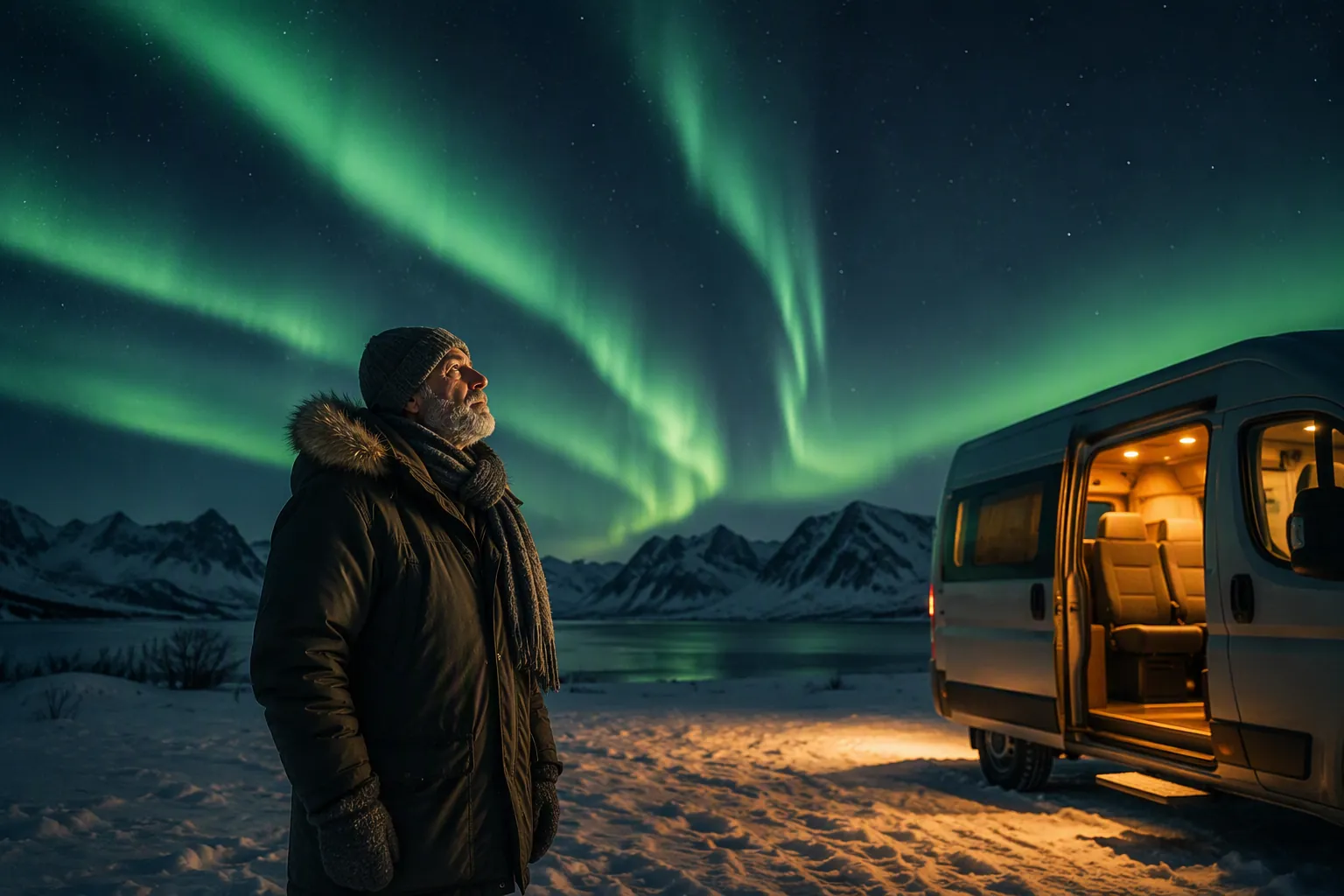
Start with the format, not the postcard
Aurora timing matters, but only enough to set expectations before the mobility planning begins. Common guidance places the main northern lights travel season roughly from September through March, with late evening to early morning as the usual viewing period; Road Scholar describes 10 p.m. to 2 a.m. as a prime window for northern lights viewing trips.[1] The Geophysical Institute’s aurora guidance is also careful about certainty: several clear nights improve the odds, but sightings are never guaranteed.[2]
For an older traveler, that uncertainty has a practical consequence. You may be asking someone to stay out late, board and reboard, and wait in freezing air without any promise that the sky will cooperate. The tour must be worth it even if the lights are faint, brief, or absent.
| Tour format | What it usually improves | What still needs checking |
|---|---|---|
| Large coach or standard bus aurora tour | Shorter outing, lower price pressure, less need to self-drive; Reykjavik aurora bus tours listed by Guide to Iceland run about 3–3.5 hours and are rated easy.[3] | Coach steps, distance from pickup point, bathroom stops, ability to stay seated, crowding at viewing stops |
| Small-group minibus or super-jeep chase | Smaller group, more flexible route, less crowd handling; Guide to Iceland listings include small-group minibus tours around 5 hours and super-jeep tours around 4 hours.[3] | Vehicle step height, outdoor waiting time, whether “minimal walking” means paved ground or snow, late return time |
| Private adapted van | Best chance of matching wheelchair or very limited walking needs to the vehicle and pace | Toilet availability, ramp or lift details, transfer expectations, whether the guide can assist physically |
| Lodge, cabin, or glass-dome stay | Reduces repeated boarding and roadside waiting; may allow viewing from or near the accommodation | Path from room to dining, bathroom layout, icy walkways, whether aurora wake-up service or warm indoor viewing is actually included |
| Aurora cruise or coastal ship | Warm public spaces, onboard bathrooms, less night driving, step-free areas on some ships | Accessible cabin supply, gangways, shore excursion limits, bus ramps, and whether crew can help with lifting |
Large coach tours: short can still be tiring
A standard bus tour can be the right choice for an older traveler who walks independently, tolerates stairs, and wants a shorter night. The appeal is obvious: hotel pickup may reduce navigation, the tour is structured, and some Reykjavik northern lights bus tours are listed at about 3 to 3.5 hours with an easy difficulty rating.[3]
But “easy” does not answer the questions that matter at the curb. How high is the first bus step? Is the pickup at the hotel door or a nearby bus stop? If the first viewing place is cloudy, will the group drive again and repeat the boarding process? Can someone who feels unsteady remain on the bus and still see anything, or does the viewing depend on walking away from the vehicle?
The bathroom question deserves to be asked plainly. A short advertised duration is not the same as a predictable toilet stop, especially when pickup, waiting, rerouting, and drop-off stretch the night. For a traveler who plans medication, fluid intake, or continence products carefully, this is not a fussy detail. It can decide whether the trip feels manageable or humiliating.
Small-group minibus and super-jeep tours: fewer people, not automatically accessible
Small-group tours often sound better for seniors because there are fewer people to keep up with and less time lost to loading a full coach. That can be true. Guide to Iceland listings include small-group minibus northern lights tours around 5 hours and super-jeep tours around 4 hours.[3] A smaller vehicle can also mean the guide has more room to adjust the route.
The trap is assuming that small group means adapted. A minibus may still have a high step. A super-jeep may be harder to climb into than a coach. A flexible chase may mean more stops, more standing, and a later night. For a cane user, the hard part may not be distance; it may be stepping down from a vehicle onto packed snow in the dark while trying not to rush the group.
Some operators do describe the comfort supports that make a real difference. Arctic GM says its Lapland northern lights tours take a maximum of 8 guests, involve minimal walking, and provide warm vehicles, winter overalls, and hot drinks, while noting that boots and hats are not included.[4] Those details are more useful than a broad “senior-friendly” label because they tell you where warmth is coming from and what the traveler still has to bring.
Treat any “guaranteed aurora” or high success-rate language as operator-stated marketing unless an independent source verifies it. Arctic GM, for example, presents a guarantee policy and success claims on its own site.[4] That may help you understand the company’s rebooking offer, but it should not replace the more important fit questions: can the traveler board safely, stay warm, sit when needed, and manage the toilet timing?
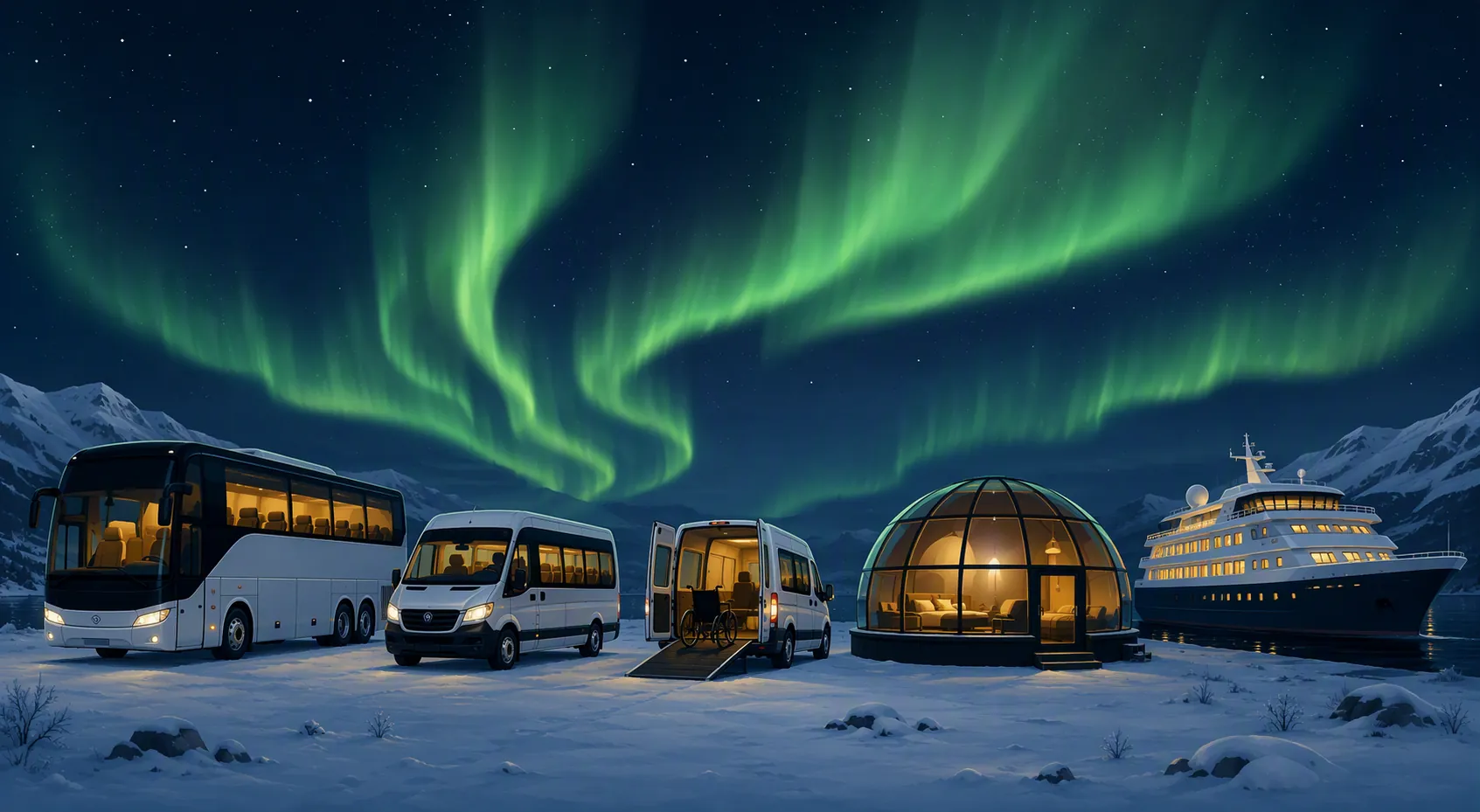
Private adapted van tours: often the best mobility match, with one serious caveat
For a wheelchair user, a walker user, or someone who can transfer only with careful setup, a private adapted tour is usually the first format to investigate. The value is not just the ramp or lift. It is the control: door-to-door timing, fewer strangers waiting, a pace built around one traveler, and a better chance of staying inside the vehicle during part of the viewing.
The Tromsø private wheelchair-accessible northern lights tour listed by Disabled Accessible Travel is a good example of why the details matter. It runs 6 to 8 hours door-to-door, uses a wheelchair-accessible vehicle, and includes electric blankets. The same listing also states that there is no toilet along the route, though a toilet chair can be requested.[5]
That combination is exactly the kind of tradeoff families need to see before paying. Electric blankets and a private vehicle solve part of the night. A 6- to 8-hour outing with no route toilet creates another problem. For one traveler, a toilet chair on request may be a workable accommodation. For another, it may be a reason to choose a lodge, cruise, or shorter tour instead.
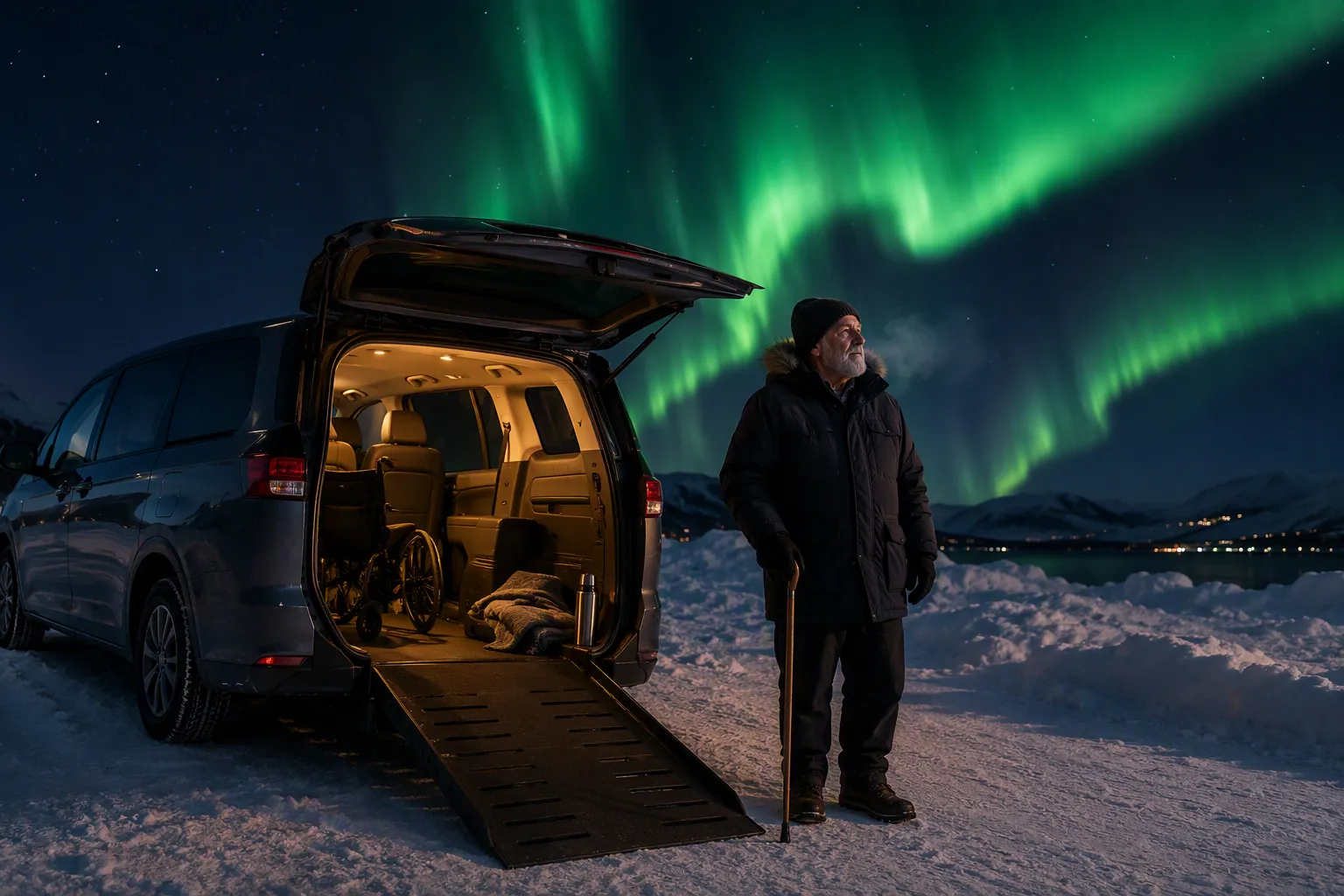
Ask about assistance boundaries with no embarrassment. Can the driver push a wheelchair over snow? Can staff steady someone on a step? Can they help with transfers, or are they prohibited from lifting? “Accessible vehicle” may mean the equipment exists; it does not always mean staff can provide hands-on physical assistance.
Lodges and glass domes reduce the chase, but they do not remove mobility planning
A lodge, cabin, or glass-dome stay can be a smart choice when the biggest risk is the night chase itself. Instead of repeatedly boarding a vehicle and waiting beside a road, the traveler may be able to rest indoors and step outside only if the aurora appears. For someone who is cold-averse, fatigues after dinner, or becomes unsteady after a long day, that change in format can matter more than the destination.
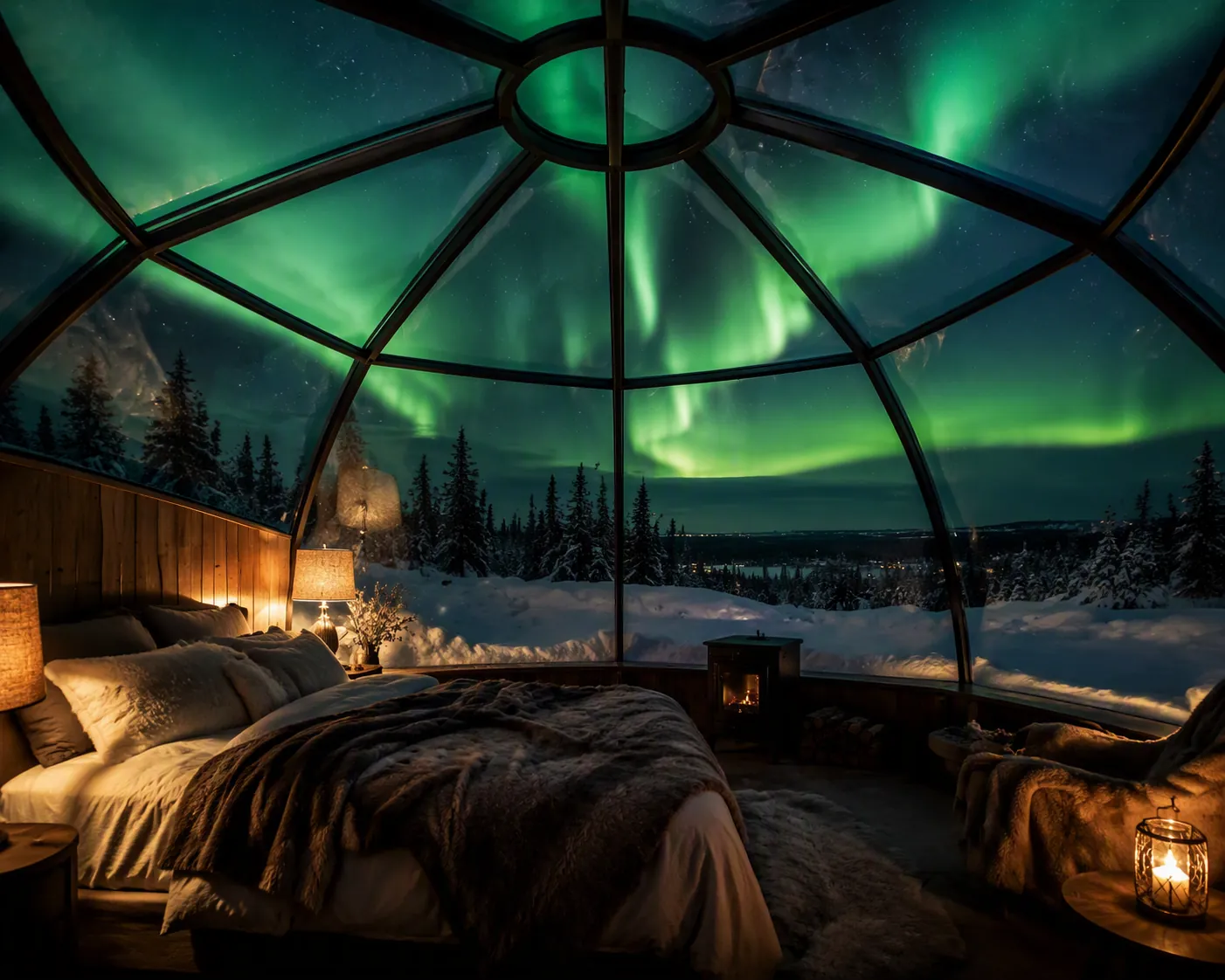
Still, a warm bed under glass is not the same thing as an accessible trip. The questions move from vehicle logistics to property logistics: how far is the room from the dining area, is the path cleared and lit, are there steps into the unit, can a walker fit around the bed, is the bathroom safe at night, and can the traveler see the sky without standing outside for long?
Senior-oriented multi-day Iceland packages show the same pattern. Guide to Iceland describes senior tours and vacation packages ranging from 4 to 15 days, with groups of roughly 8 to 19 people, mostly short walks on paved paths, and advice to disclose mobility needs at booking.[3] That is useful, but “short walks” still needs translation. A short paved walk in daylight is not the same as a short icy walk after a late aurora alert.
Cruises: accessible ship does not mean accessible whole trip
An aurora cruise can be attractive for seniors because the base is warm, bathrooms are nearby, meals are onboard, and there is less late-night road travel. For a traveler who struggles with long bus rides or remote toilet uncertainty, that can be a major improvement.
The limits show up around cabins, ports, and excursions. Hurtigruten says its ships have wheelchair-accessible public areas such as lounges, bars, and restaurants, but accessible cabins are limited and should be booked early. Its accessibility FAQ also notes that only some Level 1 shore excursions are suitable for travelers with reduced mobility, buses are not guaranteed to have ramps, and crew cannot assist with lifting.[6]
That distinction is important. A traveler may be comfortable onboard and still unable to join the shore activity everyone else is excited about. If the aurora plan depends on a nighttime excursion off the ship, ask about the exact transfer: gangway slope, bus steps, ramp availability, walking surface, distance from bus to viewing point, and what happens if weather changes.
The booking questions that matter before a deposit
Operators are used to questions. A careful email is not an imposition; it is how you find out whether “easy” means easy for this traveler. The answer should be concrete enough that you can picture the night from pickup to return.
- Boarding: How many steps are there into the vehicle, van, bus, boat, or cabin area? Is there a handrail, ramp, lift, or low step?
- Pickup: Is pickup at the hotel door, a lobby, a cruise terminal, or a nearby meeting point? How far must the traveler walk before boarding?
- Walking surface: At the viewing stop, is the ground paved, gravel, packed snow, deep snow, ice, slope, steps, or an unlit path?
- Distance: What is the typical distance from vehicle to viewing spot? Can the traveler watch from inside or immediately beside the vehicle?
- Standing time: How long might guests stand outside at one stop? Is there a place to sit outside, or only in the vehicle?
- Warmth: Is the vehicle kept warm while waiting? Are blankets, overalls, hot drinks, or indoor waiting areas provided? What winter gear is not provided?
- Bathrooms: Is there a toilet before departure, during the route, at the viewing place, or only after return? If there is no toilet, what accommodation is available?
- Mobility aids: Can the tour take a cane, walker, rollator, folding wheelchair, or power wheelchair? Where is it stored?
- Assistance: Can staff steady a traveler, push a wheelchair, operate a lift, or help with transfers? Are they unable to lift guests?
- Schedule: What is the latest likely return time if the guide chases clearer skies? Is there an option to end early on a private tour?
- Cancellation or rebooking: If the tour is canceled for weather or the traveler has a health flare, what happens to the deposit?
- Written confirmation: Can the operator confirm these details by email before payment?
If you are also planning the broader trip around steps, curbs, wet surfaces, and fatigue, the same “control the awkward moments” approach applies beyond aurora tours. Our Thailand vs. Vietnam senior travel comparison uses a similar lens: the trip is only as easy as its hardest boarding moment.
Match the format to the traveler
There is no single best northern lights tour for seniors. There is a best-fit format for a particular body, in a particular season, with particular limits.
| Traveler profile | Formats to investigate first | Main deal-breakers to confirm |
|---|---|---|
| No mobility aid, but cold-averse or easily fatigued | Short coach tour, warm small-group minibus, lodge or glass-dome stay | Heated waiting, ability to remain seated, total night length, how long guests stand outside |
| Cane user | Short coach only if steps are manageable; small-group minibus if step height and surfaces are clear; lodge if paths are well maintained | Vehicle step height, handrails, icy ground, walking distance from vehicle, lighting at stops |
| Walker or rollator user | Private tour, lodge stay, or cruise with confirmed accessible routes | Storage space, surface firmness, steps into vehicle or room, whether staff can help with doors and ramps |
| Wheelchair user | Private adapted van or cruise with accessible cabin confirmed early | Ramp or lift specifications, transfer expectations, accessible toilet availability, no-lifting policies, shore excursion limits |
| Traveler who needs predictable bathrooms | Cruise, lodge-based stay, or shorter tour with confirmed toilet stops | Long remote routes without toilets, late return times, whether any requested toilet chair or accommodation is acceptable to the traveler |
One family may choose a standard bus because the parent walks well, dislikes fuss, and wants the shortest possible outing. Another may spend more on a private adapted van because the wheelchair access and flexible pace are worth more than the destination. A third may skip the chase and book a lodge because repeated boarding in the dark is the weak point.
The safest booking move is to ignore vague comfort labels until they have been translated into steps, surfaces, sitting time, toilet timing, warmth, and assistance boundaries. Get those answers in writing before the deposit. Then the trip is being planned around the traveler, not around a brochure word like “easy.”
References
- Northern Lights Travel Tips and Packing Essentials Guide — Road Scholar
- Aurora Forecast FAQ — Geophysical Institute
- The Best Tours & Vacation Packages for Seniors in Iceland — Guide to Iceland
- Guaranteed Northern Lights Tours in Lapland — Arctic GM
- Wheelchair Accessible Private Northern Lights Tour (Tromsø) — Disabled Accessible Travel
- Accessibility FAQs — Hurtigruten US
Questions to bring to a clinician or OT
This is not medical, legal, or a family's final decision — only a framework. Bring these questions to a clinician, occupational therapist, or your local Area Agency on Aging.
Find Local HelpRelated reading
Noticed something outdated or inaccurate on this page? Flag a correction. We review every report against CDC, NIA, and AARP HomeFit guidance before updating a page.