
Caregiver decision guide
Which Is Safer for Seniors, Thailand or Vietnam?
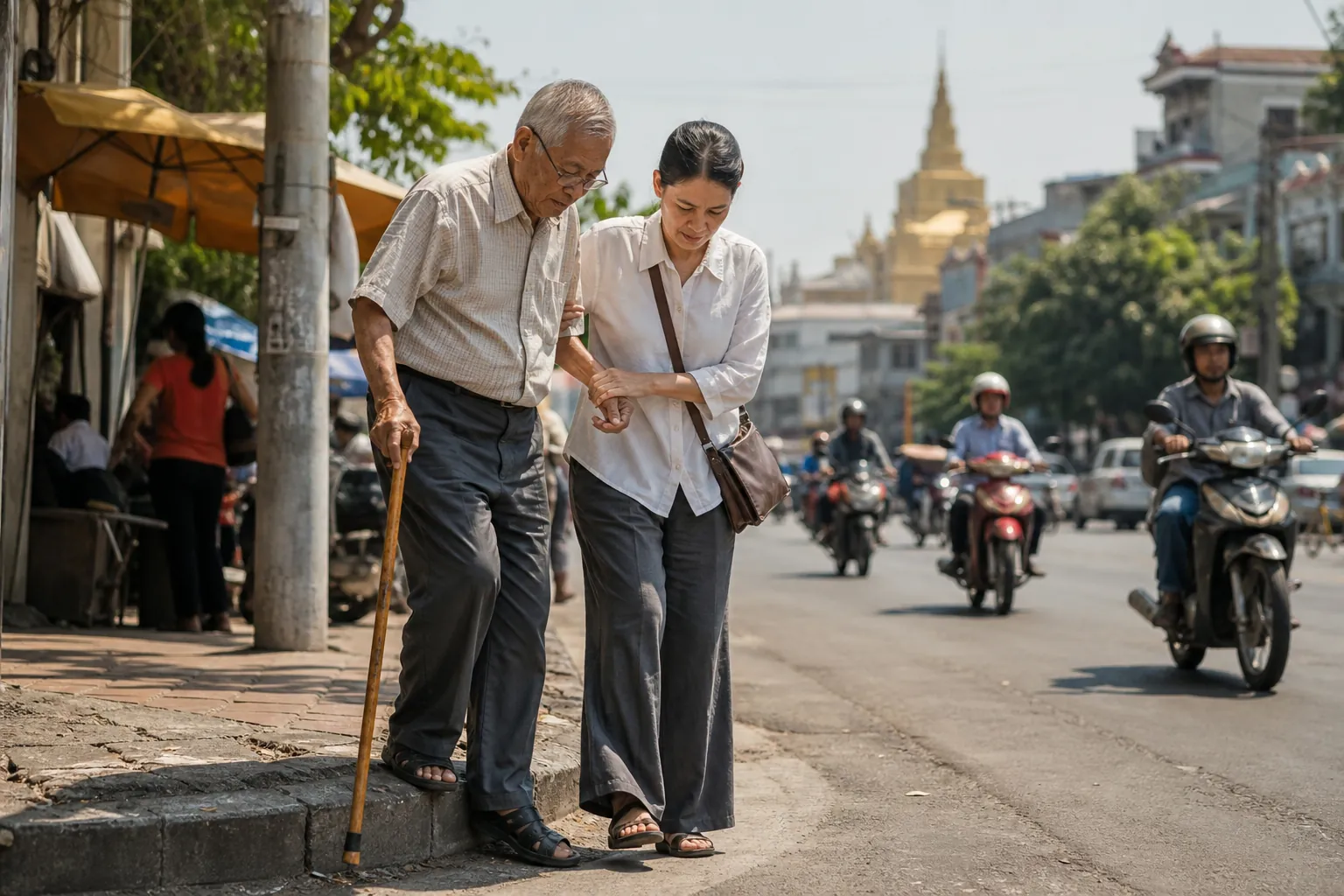
Neither country is objectively more senior-friendly: the safest choice depends on a parent's mobility level, medical needs, and budget. This comparison scores Thailand and Vietnam on fall risk, heat management, medical access, and ground transport, then matches each profile to routes like Bangkok's accessible rail network or the low-walking Da Nang–Hoi An corridor.
Choosing between Thailand and Vietnam for a senior-friendly vacation is not really a country contest. It is a control contest: how many stairs, hot walks, uncertain curbs, boarding moments, and medical unknowns can you remove before your parent ever leaves home? Thailand can be the safer-feeling plan for a parent with medical complexity or a strong need for urban transport options. Vietnam can be the calmer plan for a medically stable parent when the route is kept tight, especially around Da Nang and Hoi An, and the money saved is spent on better hotels, private cars, and rest time.
The unhelpful answer is “both are senior-friendly.” The useful answer is: neither is automatically safer. The safer choice is the itinerary with fewer uncontrolled moments for this parent.
| Safety axis | Thailand | Vietnam | Planning judgment |
|---|---|---|---|
| Walking-surface fall risk | Bangkok temple areas and older city spaces can involve uneven paths, stairs, heat exposure, and busy crossings; older-traveler itineraries often build in slower pacing and driver support for that reason.[1][2] | Sidewalk and street conditions vary sharply by city and neighborhood. The strongest senior case is not “all Vietnam,” but a narrowed Da Nang–Hoi An plan with flatter walking and shorter transfers.[3] | Treat uneven pavement, curbs, cluttered sidewalks, temple grounds, and crossings as baseline risks in both countries. The question is where you can reduce walking most reliably. |
| Stairs and site workarounds | Chiang Mai’s Doi Suthep has a funicular option for travelers who cannot manage the stairs; Khao Lak is favored in some older-traveler itineraries because mainland beaches can avoid boat transfers.[2] | Da Nang is often the most workable Vietnam base for older travelers because Ba Na Hills uses cable cars, Marble Mountains has elevator access, and Hoi An is comparatively flat and walkable.[3] | A destination with one famous staircase is not off-limits if the workaround is real, operating, and suitable for the parent’s mobility level. |
| Heat management | The more comfortable regional window is generally November–February, and senior-oriented guidance emphasizes early starts, indoor midday breaks, hydration, and shade.[1][2][4] | The same heat rules apply. Vietnam’s appeal improves when the schedule avoids long midday walks and keeps transfers short, especially around the central coast.[3][4] | Heat is not a Thailand-vs-Vietnam tiebreaker. It is a daily operating constraint. |
| Medical access | Travel and expat sources point to Thailand’s stronger concentration of internationally oriented private hospitals, including Bangkok, Chiang Mai, and Phuket facilities such as Bumrungrad, Samitivej, and Bangkok Hospital; reported JCI status should be re-verified close to booking.[5] | Vietnam has leading private facilities such as FV, Vinmec, and Family Medical Practice, but sources describe stronger clustering in Hanoi and Ho Chi Minh City, with more complex cases sometimes prompting travel to Thailand or Singapore.[5][6] | For a medically complex parent, Thailand usually gives more room to build the trip around hospital access. This is planning guidance, not medical advice. |
| Ground transport | Bangkok’s BTS/MRT network is reported at about 140 km in 2025, but senior-travel guidance still warns that rail access is only partial, with elevators at some stations; private transfers or wheelchair-accessible taxis may be more reliable.[5][7] | Ho Chi Minh City had a single operating metro line as of early 2025, so road transport remains central; that makes private cars, hotel location, and transfer timing more important.[5] | Transit exists on paper; the safety question is the door-to-door chain from airport curb to hotel room to restaurant table and back. |
| Cost | Thailand is described in one 2026 expat comparison as generally 20–35% more expensive than Vietnam, with the premium linked to smoother transit and more developed international healthcare; backpacker-style budgets are cited around $20–60 per day.[5][8] | Vietnam is generally cheaper in the cited comparisons, with backpacker-style budgets around $15–50 per day and some 5-star hotel ranges cited around $100–150 per night, depending on style and season.[8] | Lower cost helps only if it buys safety: better elevator hotels, private transfers, travel insurance, and rest days rather than a busier itinerary. |
When Thailand is the easier plan to control
Thailand becomes the more reassuring choice when a parent’s trip needs to orbit around medical access, predictable urban services, and fewer improvised transport decisions. That does not mean every Thai beach town or temple route is easy. It means Bangkok, and to a lesser extent places such as Chiang Mai and Phuket, give a planner more infrastructure to work with when health history is part of the trip.

The hospital map comes before the sightseeing map
For an older traveler with heart disease, diabetes complications, significant respiratory issues, a recent surgery, or a medication routine that cannot be casually disrupted, Thailand’s advantage is not abstract. Travel and expat sources consistently describe its private-hospital infrastructure as more developed for international patients, with well-known Bangkok hospitals and additional private-hospital options in Chiang Mai and Phuket.[5]
That advantage still has to be verified. Hospital names in an article are not a plan. Before booking, check the current accreditation and services of the specific hospital closest to the hotel, not just the reputation of the country. Confirm whether the facility has the relevant specialty, English-language support, 24-hour emergency capacity, and a practical route from the hotel in normal traffic. If the parent may need dialysis, oxygen support, anticoagulation management, cardiac follow-up, or specialist review, that conversation belongs with the treating clinician before tickets are purchased.
Vietnam should not be dismissed as medically unsafe. Hanoi and Ho Chi Minh City have respected private facilities, and central Vietnam has growing private care. The difference is margin. If a case becomes complicated, sources aimed at retirees and expats describe more frequent reliance on Thailand or Singapore for higher-complexity care.[6] That does not make Vietnam a poor choice for a stable parent. It does make a loose, multi-city Vietnam itinerary harder to justify for someone whose medical plan needs backup options at every stop.
Bangkok rail helps, but it does not solve the curb
Bangkok’s rail scale matters. A city with roughly 140 km of BTS/MRT service offers more chances to choose a hotel near useful stations, avoid some traffic, and reduce long car rides.[5] For a senior who can walk short distances, manage escalators or elevators when available, and tolerate busy stations, that can make Bangkok more workable than cities where road travel dominates nearly every movement.
But rail is not the same as fully accessible travel. Senior-travel guidance notes that Bangkok transit is only partially accessible, with elevators at some stations, and suggests wheelchair-accessible taxis or private transfers as more reliable for travelers with stronger mobility limitations.[7] The risky part may be the station entrance, the broken elevator, the last curb outside the restaurant, or the five-minute walk that becomes fifteen in heat.
For Bangkok, the safer plan is usually built around one well-located hotel, a short list of nearby restaurants, pre-booked cars for temple days, and rail only where the station access has been checked. The same door-to-door thinking applies before the international flight, too; airport transitions are often where fatigue and fall risk start, so a nonstop-flight safety checklist for seniors can be as important as the destination choice.
When Vietnam makes sense: keep the route narrow
Vietnam’s strongest senior-friendly argument is not a grand north-to-south tour. It is the opposite: choose one gentle corridor and stop trying to see everything. For many older travelers, the Da Nang–Hoi An area is the most defensible version of that plan.

Da Nang gives the plan a working airport, resort-style hotels, coastal rest days, and short drives. Senior-focused Vietnam guidance describes some resorts as about 15 minutes from the airport and highlights Ba Na Hills cable cars, Marble Mountains elevator access, and Hoi An’s flat old-town walking environment as practical reasons the area works better for older travelers than more ambitious routes.[3]
This is where Vietnam’s lower cost can matter in the right way. If the budget difference means a better hotel with elevators, a room close to the lift, private airport pickup, cars between Da Nang and Hoi An, and a slower pace, the savings are not just financial. They reduce fatigue. They reduce unplanned walking. They make it easier to leave a lantern walk after twenty minutes instead of pushing through because the bus is not coming for another hour.
The cited cost ranges should not be treated as promises. They come from different travel styles and publication contexts. Still, the pattern is consistent enough for planning: Thailand generally costs more, while Vietnam can leave more room in the budget for comfort upgrades if the itinerary is disciplined.[5][8]
The mistake is using Vietnam’s affordability to add more cities. Hanoi, Ha Long, Hue, Ho Chi Minh City, Mekong Delta excursions, and beach time may look reasonable on a map. For a parent with balance issues, every added hotel and transfer adds another lobby step, curb, vehicle climb, bathroom uncertainty, and heat exposure. Vietnam is most senior-friendly when it is edited.
Heat is not a tiebreaker; it is the schedule
Both countries can punish overconfident plans. The more comfortable window for many senior itineraries is November through February, and senior tour booking patterns for Thailand and Vietnam also cluster in that period; the same source cites Hanoi conditions around 20–25°C, or 68–77°F, in that cooler season.[4]
The practical day often looks less like a travel brochure and more like a medication schedule: sightseeing starts early, the harder walking is finished before late morning, lunch is near the hotel or indoors, and the 11:30 AM to 2:30 PM window is treated as recovery time rather than opportunity. Senior-oriented Thailand and Vietnam guidance repeatedly favors early starts, shade, hydration, and indoor midday breaks.[1][2][3]
For a heat-sensitive parent, Thailand versus Vietnam matters less than the calendar, hotel location, room quality, and willingness to cancel afternoon plans. A beautiful temple at 1:00 PM can be a poor decision. A short indoor museum, hotel poolside rest in shade, or nap may be the safer sightseeing plan.
Walking surfaces and transfers are where the trip usually fails
Falls rarely announce themselves as a major itinerary issue. They hide inside small words: nearby, easy, short walk, local crossing, charming lane, traditional boat. Both Thailand and Vietnam can involve uneven pavement, high curbs, temple steps, missing curb cuts, narrow sidewalks, motorbikes, wet surfaces, and dim evening walking. The useful comparison is not which country has perfect pedestrian conditions. Neither does. The useful comparison is where the route lets you avoid the most bad moments.
That is why a private transfer can be a safety intervention, not a luxury. A verified car from the airport, with the driver meeting inside or at a known point, can remove the first tired curb negotiation after a long flight. A hotel entrance with a level drop-off can matter more than a prettier courtyard. A restaurant five minutes away on a broken sidewalk may be less senior-friendly than one ten minutes away by car.
Boat boarding deserves special suspicion. Thailand beach itineraries sometimes lean on longtail boats or speedboats, and senior guidance warns against longtail boats unless the operator can show photographic evidence of ramps and boarding assistance.[7] That caution travels well. Any uncertain boat, pier, floating platform, wet step, or beach landing should be treated as a mobility task, not a scenic detail.
If the trip includes a cane, walker, wheelchair, recent fall history, or a parent who freezes at busy crossings, use the same standard you would use for a cruise cabin or excursion: verify the actual route, not the marketing phrase. A broader mobility-focused cruise safety checklist is written for a different setting, but the pre-booking logic is similar: boarding, bathrooms, thresholds, distance, and backup help decide whether an outing is realistic.
Match the country to the parent, not the parent to the country
| Parent profile | Safer-leaning plan | Why |
|---|---|---|
| Medically complex parent | Thailand, usually Bangkok first; consider Chiang Mai or Phuket only after hospital mapping | Thailand offers a stronger concentration of internationally oriented private hospitals and more room to plan around known facilities. Re-verify hospital services and accreditation close to booking. |
| Mobility-limited but medically stable parent | Either country, but only in accessible pockets: Bangkok with checked station and car access, or Da Nang–Hoi An with private transfers | The deciding factor is not the flag. It is whether the route removes stairs, long walks, uncertain crossings, and difficult vehicle boarding. |
| Budget-constrained parent | Vietnam, especially a narrowed Da Nang–Hoi An itinerary | Vietnam’s lower indicative costs can improve safety if the savings buy elevator hotels, private cars, insurance, and rest days instead of more cities. |
| Heat-sensitive parent | Either country in the cooler season, with early sightseeing and indoor midday recovery | November–February is the more comfortable window, but daily pacing matters more than country choice. |
| Traveler using a cane, walker, or wheelchair | Do not choose by country alone; choose by verified door-to-door access | Bangkok rail is useful but only partially accessible. Vietnam’s low-walking central-coast plan may be easier if transfers, hotel entrances, elevators, and bathrooms are confirmed in writing. |
Ordinary travel preferences still count, just not first. A parent may care deeply about Thai food, Vietnamese coffee, Buddhist temples, lantern streets, resort beaches, markets, or family memories. Those are good reasons to travel. They are not, by themselves, safety reasons. Once two routes are equally workable, choose the one your parent will enjoy more. Before that point, let mobility, heat, transport, and medical backup narrow the field.
Before booking, make the safety plan visible
Ask hotels for written confirmation of elevator access, step-free or low-step entrance routes, bathroom layout, shower threshold, grab-bar availability if needed, and the distance from the room to the lobby or restaurant. For transfers, ask where the driver will meet the traveler, what vehicle type will be used, whether luggage assistance is included, and whether a walker or folded wheelchair will fit. If an operator says a site is accessible, ask for recent photos of the ramp, elevator, boarding area, or vehicle step.
Map hospitals before booking the hotel, not after. Save the hospital name, address, phone number, specialties if relevant, and travel time from the hotel. If medical risk is significant, ask the parent’s clinician what kind of facility would be appropriate in an emergency and whether the itinerary should be limited to cities with that level of care. This article can help structure the travel decision, but it is not medical advice.
Build the trip around heat before anyone is tired: early sightseeing, indoor lunch, no essential outdoor plans in the hottest part of the day, water available before thirst, shade gear, and permission to skip the afternoon. Avoid uncertain boat boarding unless assistance is documented. Choose hotels by elevator, curb access, bathroom safety, and nearby services before charm.
Complete travel-health preparation early. The CDC recommends a travel-health appointment 4–6 weeks before departure, routine vaccines, enough medication for the trip plus delays, and insurance that covers medical care and emergency evacuation, noting that older travelers usually pay out of pocket abroad.[9] A geriatrician-authored travel checklist from Bumrungrad also advises a fall-risk review before travel for older adults with a fall history or elevated risk.[10]
If the parent is medically complex and the trip needs stronger hospital backup, start with Thailand and build tightly around Bangkok or another well-supported city. If the parent is medically stable, budget matters, and the goal is a beautiful trip with fewer long walking days, start with Vietnam’s Da Nang–Hoi An corridor. In either country, the safer vacation is the one where the curbs, transfers, heat, stairs, and hospital plan have already been handled before the brochure begins.
References
- Bangkok Tour for Senior Citizens: A Gentler Way to Meet the City — GoWithGuide
- Itinerary Ideas: Thailand for older travellers — Fan Club Thailand / Tourism Authority of Thailand
- 2026 Ultimate Guide: Traveling to Vietnam with Elderly Parents — Lanytrip
- 10 Best Tours of Thailand and Vietnam for Seniors and Over 50s — TourRadar
- Thailand Vs Vietnam For Expats: Cost, Visas, And Lifestyle Comparison For 2026 — Asia Lifestyle Magazine
- Vietnam vs Thailand for UK Retirees — Benjamin Sharvell IFA
- Visiting Thailand as a Senior: What to Know Before You Go — Pickyourtrail
- Thailand vs Vietnam — South East Asia Backpacker
- Older Adults and Healthy Travel — CDC
- Essential Health Tips for Older Adults Before Traveling — Bumrungrad International Hospital, Apr 2025
Questions to bring to a clinician or OT
This is not medical, legal, or a family's final decision — only a framework. Bring these questions to a clinician, occupational therapist, or your local Area Agency on Aging.
Find Local HelpRelated reading
Noticed something outdated or inaccurate on this page? Flag a correction. We review every report against CDC, NIA, and AARP HomeFit guidance before updating a page.