
Caregiver decision guide
Find Stylish, Fall-Proof Shoes for Women Over 50
Discover how women over 50 can choose fall-resistant footwear that doesn't sacrifice style, with expert-backed tips on traction, support, and fit from tested brands like Ryka, Kizik, and Vionic.
The old dressing-room bargain used to be painfully simple: choose the shoe that looks good, then hope it does not pinch, slide, wobble, or make you bend in half to get it on. For women over 50, that bargain was never fair. A shoe is not just an accessory when it decides whether lunch with friends feels easy, whether a museum day is possible, or whether a wet sidewalk makes you hesitate before leaving the house.
The better news is that style inspiration for women over 50 no longer has to stop at “comfortable enough.” A safer shoe can look polished, modern, even quietly elegant. But “fall-proof” needs translating. No shoe can promise that a fall will never happen. What a well-chosen shoe can do is give you better traction, a steadier base, real arch support, a secure fit, and an easier way in and out.

Those details matter more than the label on the box. Look first for sturdy rubber outsoles, multidirectional tread, a wider base, enough cushioning to reduce impact, and uppers that hold the heel without squeezing the forefoot. Then ask the question that too many shoe displays avoid: can you actually put them on, walk in them, and wear them with the clothes you already like?
What “Fall-Proof” Can Honestly Mean
The strongest available evidence here is not a single clinical study proving that one stylish shoe prevents falls. It is product testing and expert footwear guidance. Verywell Fit’s walking-shoe testing program evaluated more than 80 pairs, and its 2026 senior walking-shoe review gave the Ryka Jumpstart Lace Slip-On top marks for senior women, specifically noting support, style, and ease of entry.[1]
That combination is worth noticing because it reflects the real test. A shoe that grips well but looks like medical equipment may stay in the closet. A shoe that looks lovely but has a slick sole is not doing the job. The useful middle is where design details cooperate: the sole grips, the base feels stable, the arch is not left hanging, and the shoe goes on without a wrestling match.
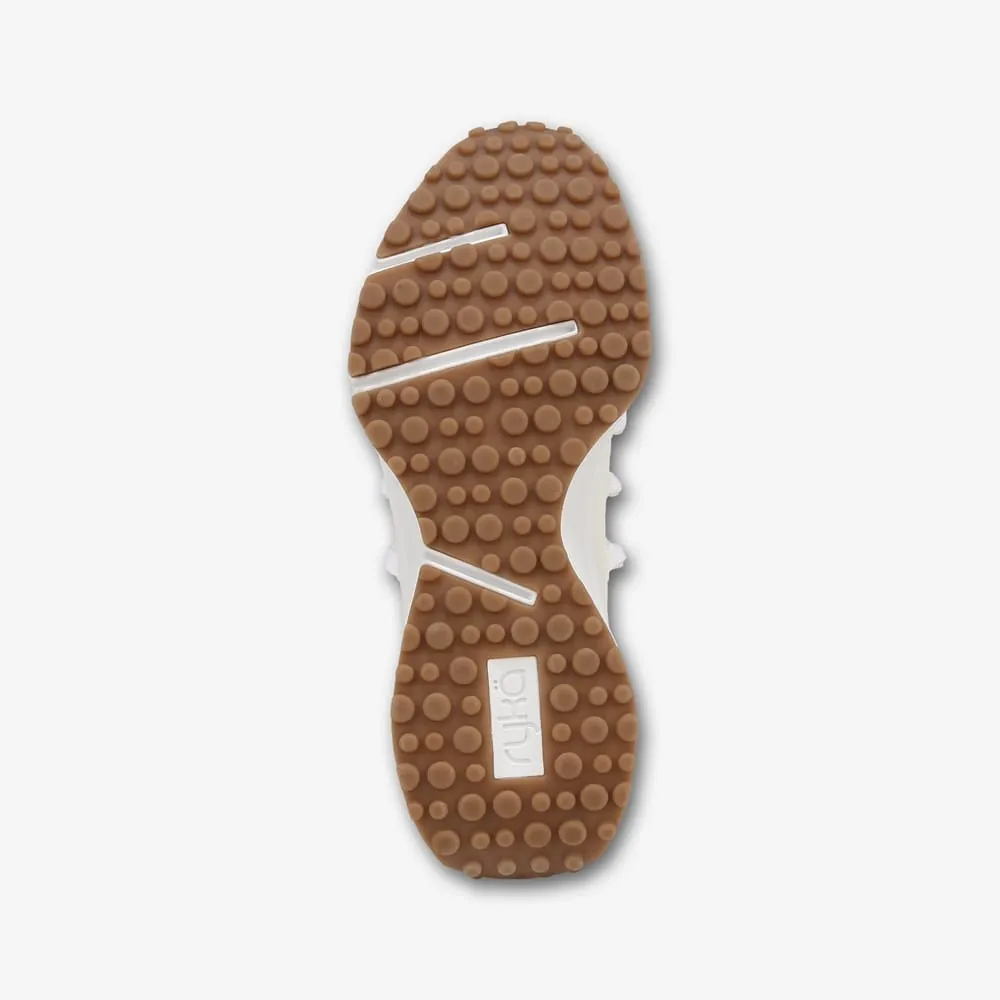
The underside tells more truth than the pretty upper. Podiatrists and physical therapists cited in Verywell Fit emphasize sturdy rubber outsoles, multidirectional tread, and wider bases for balance and traction.[1] A vague “anti-slip” tag is not enough. Turn the shoe over. If the outsole is smooth, narrow, hard, or polished-looking, the shoe is asking the floor to be perfect. Floors are rarely that considerate.
Start With the Foot Problem You Actually Have
Most bad shoe purchases begin with a fantasy foot: slimmer, less swollen, less tender, more willing to tolerate pressure. That is how bunions end up in shoes bought half a size too large, heels slip, and toes still ache. A safer, more stylish choice starts with the real foot you walk on.
| If this is your main concern | Prioritize this first | Be cautious about |
|---|---|---|
| Plantar fasciitis or heel pain | Arch support, cushioning, and a stable heel | Flat ballet shoes with thin soles |
| Bunions | Forefoot room, soft or forgiving uppers, and width options | Pointed toe boxes and stiff seams over the joint |
| Balance concerns | Rubber outsole, multidirectional tread, and a wider base | Narrow soles, slick bottoms, and high or unstable heels |
| Swollen feet | Adjustability, forgiving slip-on construction, and multiple widths | Rigid uppers that only fit in the morning |
| Arthritis in hands, hips, knees, or back | Hands-free or easy-entry design | Tiny buckles, tight laces, and shoes that collapse when you step in |
For Plantar Fasciitis, Do Not Let the Arch Be an Afterthought
If heel pain is the problem, the prettiest upper in the store will not compensate for a flimsy base. Plantar fasciitis usually pushes the decision toward sneakers, supportive walking shoes, structured loafers, or flats with built-in arch support. Vionic is often discussed in this category because the brand centers orthotic-style support in everyday shoes, but the useful lesson is broader: the shoe should meet the arch instead of leaving the foot to collapse inward.
Try the shoe late enough in the day that your foot is telling the truth. Walk on a hard surface if possible. If the heel feels bruised after a few minutes, or if the arch support hits in the wrong place, do not talk yourself into it because the color is perfect. A painful shoe changes how you walk, and a changed gait can create its own risk.
For Bunions, Width Is Not the Same as Sloppiness
Bunions have a way of exposing lazy shoe design. Many women solve the pressure by sizing up, then spend the day with a heel that slips. That is not comfort; it is a trade of one problem for another. The better target is a shoe that gives room across the forefoot while still holding the midfoot and heel.
This is where brands with serious size and width ranges matter. Margaux, for example, offers sizes 3 through 14 in narrow, medium, and wide widths, which directly challenges the usual “cute but doesn’t fit” excuse built into many dress flats.[2] A supportive ballet flat or polished loafer can be reasonable if the toe box respects the joint and the shoe does not slide at the back.
For a bunion, inspect seams as carefully as shape. A soft upper is not enough if a raised seam crosses the tender spot. Leather loafers, flexible knit sneakers, and well-made flats can all work, but only if the widest part of the shoe matches the widest part of your foot.
For Balance Concerns, Turn the Shoe Over
When balance is the concern, the outsole earns its place before the style does. Rubber matters. Tread direction matters. A base that flares slightly wider than the upper can feel steadier than a narrow fashion sole. Merrell, Skechers, Ecco, Ryka, and similar walking-oriented brands often give shoppers more to inspect here than delicate fashion shoes do, but the brand name should not do the judging for you.
- Press the outsole with your thumb; it should not feel like hard plastic.
- Look for tread that runs in more than one direction, not just decorative grooves.
- Set both shoes on the floor and check whether they sit flat without rocking.
- Avoid tall wedges or narrow soles if you already feel unsteady.
- Walk, stop, turn, and step backward before deciding; straight-line comfort is only part of daily life.
For Swollen Feet, Morning Fit Can Lie
Feet that swell by late afternoon need more than a hopeful stretch. They need either adjustability, a forgiving upper, a true wide width, or a slip-on design that does not become tight as the day goes on. This is one reason clogs and easy-entry sneakers have stayed in women’s closets for decades: they solve a timing problem fashion editors often ignore.
The Easy Spirit Traveltime Clog is not proof that one shoe fits everyone, but its unusually large comfort footprint is still telling: editorial reviews report more than 12 million pairs sold and more than 7,500 five-star reviews, with comfort appeal across widths.[3] Popularity should not replace your own fit test, yet it does show how many women have been asking for the same thing: easy entry, room, cushioning, and a shoe that does not punish the foot for changing during the day.
Easy-On Shoes Are Not a Luxury Detail
A shoe can be stable once it is on and still be a problem if putting it on requires bending too far, tugging too hard, or balancing on one leg. For women with arthritis, hip stiffness, knee pain, back pain, or hand weakness, entry is part of safety.
Verywell Fit’s testing highlighted Kizik’s hands-free slip-on design, including a bendable heel that helps reduce the need to bend for people with back, knee, or hip issues.[1] That is the sort of design detail that earns respect because it removes a small daily indignity. The shoe should open to the foot, recover its shape, and hold the heel after entry. If the heel collapses permanently or the foot slides around once inside, convenience has gone too far.
The best easy-entry shoes do not announce themselves as adaptive. They simply let a person leave the house faster, with less strain and less fuss. That can mean a bendable heel, a stretch panel, a side zipper, elastic laces, or a slip-on collar firm enough to guide the foot without folding under it.
The Stylish Forms That Deserve a Second Look
The useful style question is not “Which shoe is fashionable?” It is “Which form gives me the safety features I need without making every outfit look like I gave up?” A few categories are doing more work now than they used to.
Sleek Sneakers
A clean sneaker in taupe, cream, navy, black, or soft metallic can carry jeans, travel pants, casual dresses, and wide-leg trousers without looking like gym gear. Ryka’s Jumpstart Lace Slip-On is a useful example because it sits at the intersection of walking support, senior-friendly entry, and everyday style in Verywell Fit’s testing.[1] The lesson is not that every woman needs that exact shoe. The lesson is that a sneaker can look intentional while still giving you traction and structure.
Leather Loafers
Loafers can be excellent grown-up shoes when they are not too stiff, too narrow, or too slick. Styles in the neighborhood of the Sam Edelman Loraine or Birdies loafers show why women keep reaching for this shape: it looks finished with trousers and dark denim. The safety inspection is simple. Check the outsole, test heel hold, and make sure the vamp does not press painfully over bunions or high insteps.
Washable Slip-Ons
Washable slip-ons, including styles like the Ilse Jacobsen Tulip, appeal because they are light, unfussy, and easy to pack. They can be charming with cropped pants or summer dresses. They also deserve scrutiny. Some lightweight shoes have less structure than a cautious walker needs. If the shoe twists too easily in your hands or the sole feels thin and smooth, save it for low-risk settings rather than long city days or wet pavement.
Supportive Ballet Flats
A ballet flat can be graceful, but many traditional versions are little more than fabric over pavement. The safer version has a real sole, enough cushioning, and enough width choice to fit the foot instead of squeezing it into a pretty outline. This is where Margaux’s broad sizing and width approach is relevant: a flat has a better chance of being both attractive and wearable when fit is treated as design, not an afterthought.[2]
Clogs
Clogs are divisive, and that is fair. Some look too casual for the wearer’s taste; others are exactly what a swollen or sensitive foot needs. The key is heel security. A backless clog may be easy to enter, but if it makes you grip with your toes or shuffle to keep it on, it is not serving you. For home, errands, and travel days, a cushioned clog with appropriate width and a grippy outsole can be practical. For fast walking or uneven ground, many women will do better with a closed heel.
A Five-Minute Shoe Audit Before You Buy
The dressing-room test should be more demanding than a mirror check. A shoe that will protect your independence has to pass through your hands, your feet, and your daily routine.
- Turn it over: look for rubber, visible tread, and grip in more than one direction.
- Check the base: a wider, stable platform is usually kinder to balance than a narrow sole.
- Test entry: put it on the way you would at home, not with heroic effort in the store.
- Walk and turn: include a pivot, a stop, and a few steps on the hardest floor available.
- Notice heel hold: your heel should not lift, slap, or require toe gripping.
- Ask whether it fits your life: stairs, sidewalks, restaurants, travel, errands, and the clothes you actually wear.
If you use orthotics, bring them. If one foot is larger, fit the larger foot. If your feet swell, shop later in the day when possible. If your hands hurt, do not accept tiny buckles or laces that turn getting dressed into a negotiation.
One more test matters: wear the shoe with your normal pants hem or dress length. A shoe can be safe on its own and still become awkward if a wide-leg pant catches under the heel or a long hem brushes the floor. Fall prevention is often made of small frictions removed before they become incidents.
Use Brand Examples Without Letting Them Decide for You
Ryka, Kizik, Vionic, Merrell, Skechers, Ecco, Easy Spirit, Margaux, Sam Edelman, Birdies, and Ilse Jacobsen all point to useful shifts in the market: more slip-ons, more supportive sneakers, more width options, more polished comfort shoes. That does not make any one brand a universal answer. Feet are too particular for that.
Treat brands as clues. Ryka may lead you toward tested walking-sneaker structure. Kizik may remind you to value hands-free entry. Vionic may put arch support higher on the list. Margaux may prove that size range and style can belong in the same sentence. Easy Spirit may show why easy comfort remains popular. The purchase still has to pass your outsole, support, width, heel-hold, and entry tests.
Footwear Is One Layer of Staying Steady
Shoes matter because they are with you at the exact moment a floor changes, a curb appears, a rug edge catches, or a parking lot is slick. They are not the whole fall-prevention plan. Lighting, medications, vision checks, strength, balance, rugs, stairs, weather, hydration, and household layout all share the responsibility.
That is why footwear belongs beside broader daily-safety tools, not instead of them. CareWise Guide’s fall prevention checklist, room-by-room safety guidance, and fall prevention FAQ can help with the rest of the risk picture. Start with the shoes already by your door: turn them over, check the tread, test the heel, notice where your foot hurts, and ask whether they still give you traction, support, fit, and easy entry. Color and trend can come after that. They do not have to disappear; they just should not be asked to do the safety work.
References
- The 12 Best Walking Shoes for Seniors of 2026, Tested, Verywell Fit
- Margaux size and width information, Margaux
- Easy Spirit Traveltime Clog editorial reviews, multiple editorial reviews
Questions to bring to a clinician or OT
This is not medical, legal, or a family's final decision — only a framework. Bring these questions to a clinician, occupational therapist, or your local Area Agency on Aging.
Find Local HelpRelated reading
Noticed something outdated or inaccurate on this page? Flag a correction. We review every report against CDC, NIA, and AARP HomeFit guidance before updating a page.