
Caregiver decision guide
PGA Tour Champions 2027 rookies: mobility lessons after 50
The 2027 PGA Tour Champions rookie class — including Jason Dufner, Ben Curtis, and Luke Donald — demonstrates how the golf swing's core biomechanics can be adapted into simple home exercises that improve balance, leg strength, and spinal mobility, directly targeting the main fall risk factors in older adults. This article explains three key movements and how to practice them safely without a club.
The projected PGA Tour Champions rookie season 2027 has the kind of names that make golfers look twice: Jason Dufner, Ben Curtis, Geoff Ogilvy, Carl Pettersson, Jim Herman, Robert Garrigus, and Luke Donald are all expected to become eligible after turning 50 in 2027. Together, that group carries 31 PGA Tour wins and 3 major championships, with Curtis, Ogilvy, and Dufner accounting for the majors.[1]
That is enough résumé for a doorway. The more useful question is quieter: what does golf keep asking of a body after 50? Not heroic distance, not a perfect backswing, and certainly not the ability to walk a private course three times a week. At its most useful, the swing asks a person to rotate, shift weight, and stay upright while the body is moving.
Those are not just golf skills. They are household skills. They show up when someone turns to reach a cabinet, steps around a dog bowl, carries laundry, or catches themselves after a toe clips the edge of a rug.
The rookie list is timely; the movement lesson is the point
As of July 2026, these players should be described carefully: projected to become eligible, not already confirmed as 2027 PGA Tour Champions rookies. Their birthdays create the timing. Dufner turns 50 on March 24, Curtis on May 26, Ogilvy on June 11, Pettersson on June 21, Garrigus on August 22, Herman on November 3, and Donald on December 7.[1]
Senior professional golf is already arranged around a different physical reality than regular tour golf. PGA Tour Champions events are typically 54 holes, use 81-player fields, have no cuts, and allow carts in most events outside the senior majors. That does not make the golf easy. It does make the adaptation visible: serious play after 50 is still serious, but it does not pretend stamina and recovery are unchanged.
For ordinary older adults and families trying to prevent falls at home, the useful piece is not the tournament schedule. It is the stripped-down movement pattern hiding inside the swing.
Why golf belongs in a fall-prevention conversation, with limits
A 2021 NIH-indexed review concluded that regularly playing golf can lower fall risk in community-dwelling older adults, including people with Parkinson’s disease.[2] That conclusion matters, but it should not be stretched into “golf prevents falls” or “everyone should take up golf.” Courses cost money. Transportation matters. Some people cannot safely manage uneven turf, heat, long walks, or twisting with speed.
The same review cites a study by Tsang and Hui-Chan in which golfers ages 65–79 showed significantly better static and dynamic balance than non-golfing peers of the same age.[2] Static balance is the ability to hold steady. Dynamic balance is the ability to stay controlled while weight is moving. Golf asks for both, over and over, even before a ball is struck well.
The Parkinson’s evidence is especially interesting, and especially easy to overstate. In a clinical trial discussed in the NIH review, golf was associated with greater improvements in balance and mobility than Tai Chi for people with moderate Parkinson’s disease, and adherence was 86% for golf compared with 33% for Tai Chi.[2] That does not prove the same result for every healthy older adult. It does suggest that when people enjoy a movement practice, they may be more likely to keep doing it. Adherence is not decoration; it is the part where the exercise actually happens.
The home version does not need a tee time. It needs a clear bit of floor, a counter or sturdy chair if balance is uncertain, and permission to make the movement small.
Three swing mechanics worth borrowing
| Golf-swing mechanic | Plain-language version | Aging issue it can address | Home practice idea |
|---|---|---|---|
| Axial rotation | Turning the trunk while staying tall | Reduced spinal mobility and turning control | Small, slow trunk turns with feet planted |
| Dynamic weight shift | Moving pressure from one foot to the other | Leg weakness and impaired balance during movement | Supported foot-to-foot transfers |
| Postural muscle engagement | Staying upright without stiffening | Poor balance recovery and weak stabilizing muscles | Gentle upright hold or small hip hinge with support |
Before trying any of these, a person with prior falls, joint replacements, a balance disorder, dizziness, new pain, neurological symptoms, or other medical concerns should check with a doctor or physical therapist. That is not a formality. A safe movement for one 68-year-old can be the wrong movement for another.
1. Controlled trunk turn: rotate without forcing the spine
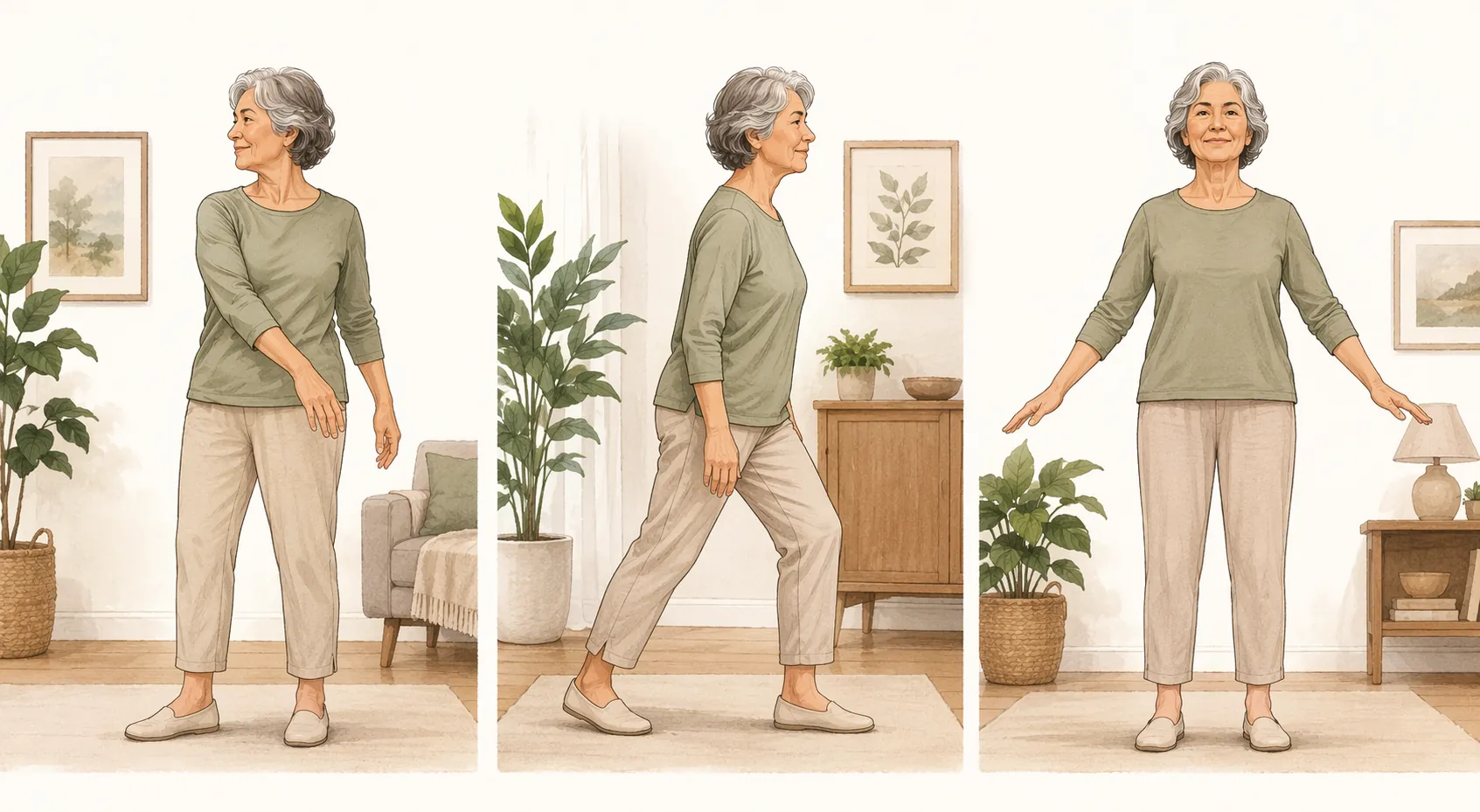
A golf swing begins with rotation, but the home version should not look like someone trying to copy a tour player. Stand with both feet planted about hip-width apart, knees soft, and one hand near a counter or the back of a sturdy chair if support would make the movement calmer. Let the arms rest across the ribs or hang loosely. Then turn the chest a little to one side, return to center, and turn a little to the other side.
The feeling should be a controlled trunk turn, not a forced twist. The head can follow the chest gently, as if looking toward a window rather than snapping around to check traffic. The feet stay quiet. The hips may come along slightly, but they do not need to be locked in place. Locking the hips and cranking the shoulders is exactly the kind of tidy-looking movement that can irritate an older back.
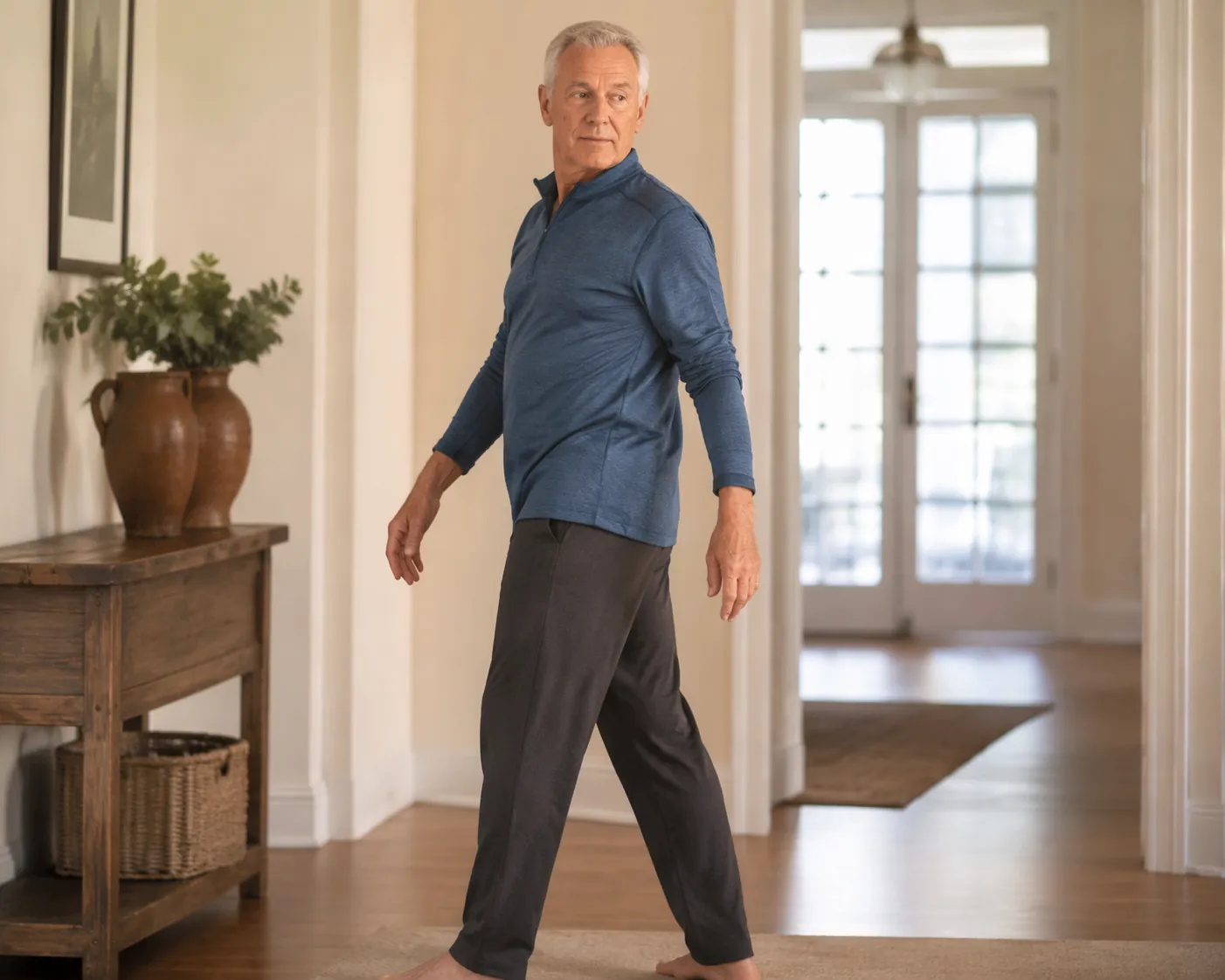
This movement matters because many near-falls happen while turning. A person pivots from refrigerator to counter, turns to answer a voice behind them, or rotates while carrying something. If the trunk no longer turns comfortably, the feet may rush to make up the difference. Rushed feet are not usually elegant feet.
Keep the range small enough that breathing stays easy. Stop if there is pain, dizziness, a sense of the room moving, or pressure that feels sharp rather than muscular. For some people, the safest first version is seated: sit tall near the front of a firm chair, feet flat, and turn the chest slightly side to side without leaning.
2. Foot-to-foot transfer: shift weight without lunging
The golf swing is full of weight transfer. Pressure moves into one side, then through the body and toward the other side. At home, this can be reduced to a simple standing drill: place one or both hands lightly on a counter, stand with feet comfortable and parallel, and slowly move body weight toward the right foot. Return to center. Then move weight toward the left foot.
This is not a side lunge. The knees stay soft, the torso stays upright, and the feet stay on the floor. The useful sensation is pressure changing under the soles: a little more under one foot, then a little more under the other. Someone watching should barely see drama. The person doing it should feel the legs wake up.
Leg weakness and impaired balance often show themselves during transitions, not while standing still for a photograph. Getting out of a car, stepping around furniture, or recovering after a small trip all require the body to accept weight on one leg and then the other. A slow foot-to-foot transfer gives that skill a safer rehearsal.
If the movement feels too easy, the answer is not to make it fast. A safer progression is to reduce hand pressure on the counter while keeping the fingertips close enough to catch balance. If one side feels unreliable, painful, or unusually weak, that is information for a clinician, not a dare.
3. Upright postural engagement: stay tall without bracing
A good golf address position has a quiet athletic quality: feet grounded, spine long, hips slightly back, chest open enough to breathe. The home version can be done without a club and without pretending to be on a range. Stand near support, soften the knees, let the hips move just slightly back, and keep the spine long rather than collapsed.
The mistake is to turn posture into stiffness. Bracing the belly, clenching the jaw, and pinning the shoulders down may look disciplined, but it makes balance less adaptable. Postural engagement should feel more like being ready than being frozen. The feet press into the floor. The crown of the head lifts. The ribs do not flare. The breath still moves.
This is the part of the swing that often gets ignored because it is not flashy. It is also the part that keeps the body from folding forward during a turn or wobbling during a weight shift. Stronger postural control helps the trunk, hips, and legs work together instead of negotiating separately every time the floor changes.
For a gentle practice, move between standing tall and a very small hip hinge, as if preparing to place both hands on a kitchen counter. The spine stays long. The eyes stay level enough to avoid dropping the head. Return to standing by pressing through the feet and letting the hips come under the body. Stop for back pain, lightheadedness, or any sense that balance is becoming less reliable as the practice continues.
A home routine should feel almost too modest
The safest version of these golf-derived movements is not a workout that leaves someone proud and tired. It is a small practice that can be repeated without dread. A kitchen counter, a hallway wall, or the back of a heavy chair is enough. Slippery socks, cluttered floors, and rushing are not.
- Start near support, especially if balance confidence is low.
- Move slowly enough that the feet never have to scramble.
- Keep the range small; comfort matters more than distance.
- Stop for pain, dizziness, unusual shortness of breath, or a new sense of unsteadiness.
- Ask a doctor or physical therapist before starting if there has been a fall, surgery, joint replacement, balance diagnosis, or significant medical change.
One practical sequence is simple: turn the trunk gently, shift weight from foot to foot, then stand tall in a small athletic posture. Some people will only do one of those on a given day. That still counts. The body does not need a full swing to practice the ingredients of steadier movement.
The projected 2027 PGA Tour Champions rookies are an attention-grabbing example of skill carrying into the next category of life. They are not medical evidence by themselves. Golf is not a fall-prevention cure. But the swing’s basic mechanics line up unusually well with what aging bodies need at home: enough spinal mobility to turn, enough leg strength to transfer weight, and enough postural control to stay upright while doing both.
References
- PGA Tour Champions next to turn 50 eligible, Golfweek, March 22, 2026.
- Golf as a Physical Activity to Potentially Reduce the Risk of Falls in Older Adults with Parkinson’s Disease, PubMed Central, 2021.
Questions to bring to a clinician or OT
This is not medical, legal, or a family's final decision — only a framework. Bring these questions to a clinician, occupational therapist, or your local Area Agency on Aging.
Find Local HelpRelated reading
Noticed something outdated or inaccurate on this page? Flag a correction. We review every report against CDC, NIA, and AARP HomeFit guidance before updating a page.