
Caregiver decision guide
Senior Golf Comebacks Inspire Mobility and Strength After 50
The 2026 senior major golf season features remarkable comebacks by players over 50 who overcame suspensions, prison time, injury, and career disruptions. Their physical rebuilding offers practical evidence that balance, lower-body strength, and walking endurance can be regained at any age to prevent falls and preserve independence at home.
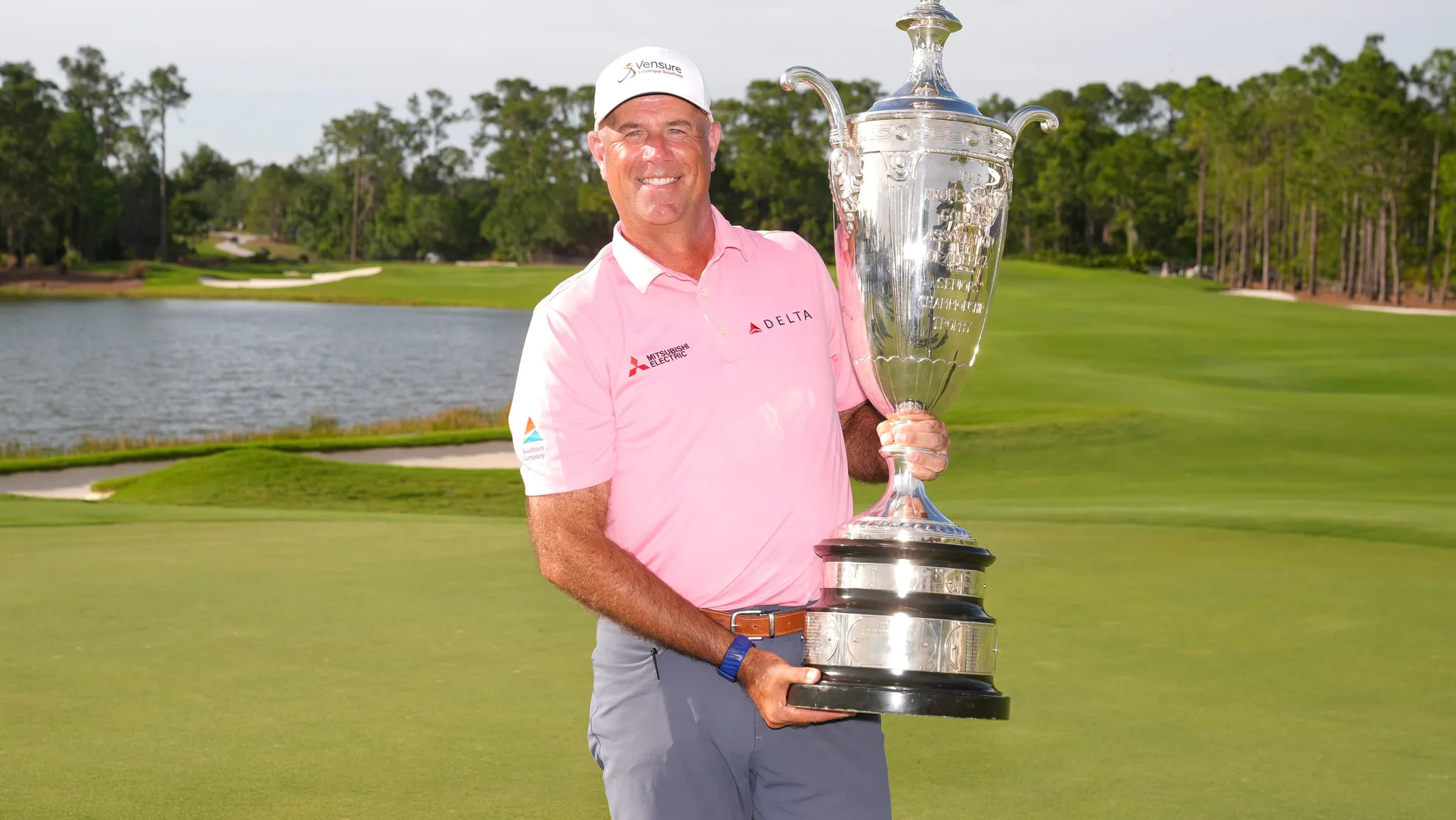
The 2026 senior major golf season has been unusually crowded with older bodies proving, in public, that capacity after 50 is not a fixed line. Stewart Cink, 52, came into the U.S. Senior Open with two senior major titles already won in the same month and a Champions Tour driving-distance lead that made his power impossible to treat as a nostalgic detail.[1] His Senior PGA Championship victory at The Concession was his first senior major, and it arrived in a season where the leaderboard kept circling back to the same theme: who had rebuilt enough to stand here again?[2]
Pat Perez, newly eligible at 50, played three senior majors while serving a one-year PGA Tour suspension tied to his LIV move, finishing T5 at the Senior PGA Championship and T8 at the U.S. Senior Open.[3] Ángel Cabrera returned to senior competition after a 30-month prison sentence and won the 2025 Regions Tradition, a physically striking return that still has to be discussed without softening the seriousness of his domestic violence conviction.[4] Tiger Woods, who turned 50 in December 2025, registered for the 2026 U.S. Senior Open, then withdrew amid a recovery context that included back surgery and a March DUI/car-crash episode; his senior eligibility remains real, but his future starts are not something the facts support predicting.[5][6]
The entry points widened, too. Henrik Stenson made his senior debut at the Senior PGA Championship after LIV Golf relegation, in a field that included 21 major champions.[7] Ian Poulter finished fourth in his senior major debut at the U.S. Senior Open.[8] The Senior PGA Championship itself returned to Florida for the first time since 2000, with The Concession Golf Club committed as host through 2028.[9]
Why Cink is the cleanest physical signal
Cink’s season matters here because it is easy to see the body work without having to untangle a moral or disciplinary story first. Two senior majors in a month, two other 2026 wins in nine starts, and a driving-distance lead at 52 are not vague evidence of “still having it.” They point to specific capacities: leg drive, trunk rotation, balance through the strike, walking tolerance, and the ability to repeat those demands over multiple competitive days.[1]
Driving distance is especially useful for ordinary readers because it is not just arm speed. A powerful golf swing starts from the ground. The player loads into the feet, transfers force through the legs and hips, rotates the trunk, and finishes without falling out of posture. That is athletic language, but the same ingredients show up in a kitchen, bathroom, hallway, and front step: can the person stand from a chair, turn without grabbing a counter, recover from a small stumble, and keep walking when the surface changes?
For a caregiver, that is the useful part of a senior major comeback. The trophy is less transferable than the capacities behind it. A 52-year-old elite golfer does not prove that every older adult should play 18 holes. He does make it harder to talk as if the over-50 body can only be protected by shrinking its world.
The golf skills that look a lot like independence at home
A full round of golf can involve roughly 4 to 6 miles of walking, depending on the course and how the player moves through it.[10] That number is not a prescription. It is a reminder that golf asks for endurance in a way many daily routines no longer do. A person who has been inactive after surgery, hospitalization, grief, or a fall may not need a fairway. They may need a safer version of the same progression: walk to the mailbox, then around the block, then through a store without rushing or leaning on a cart the whole time.
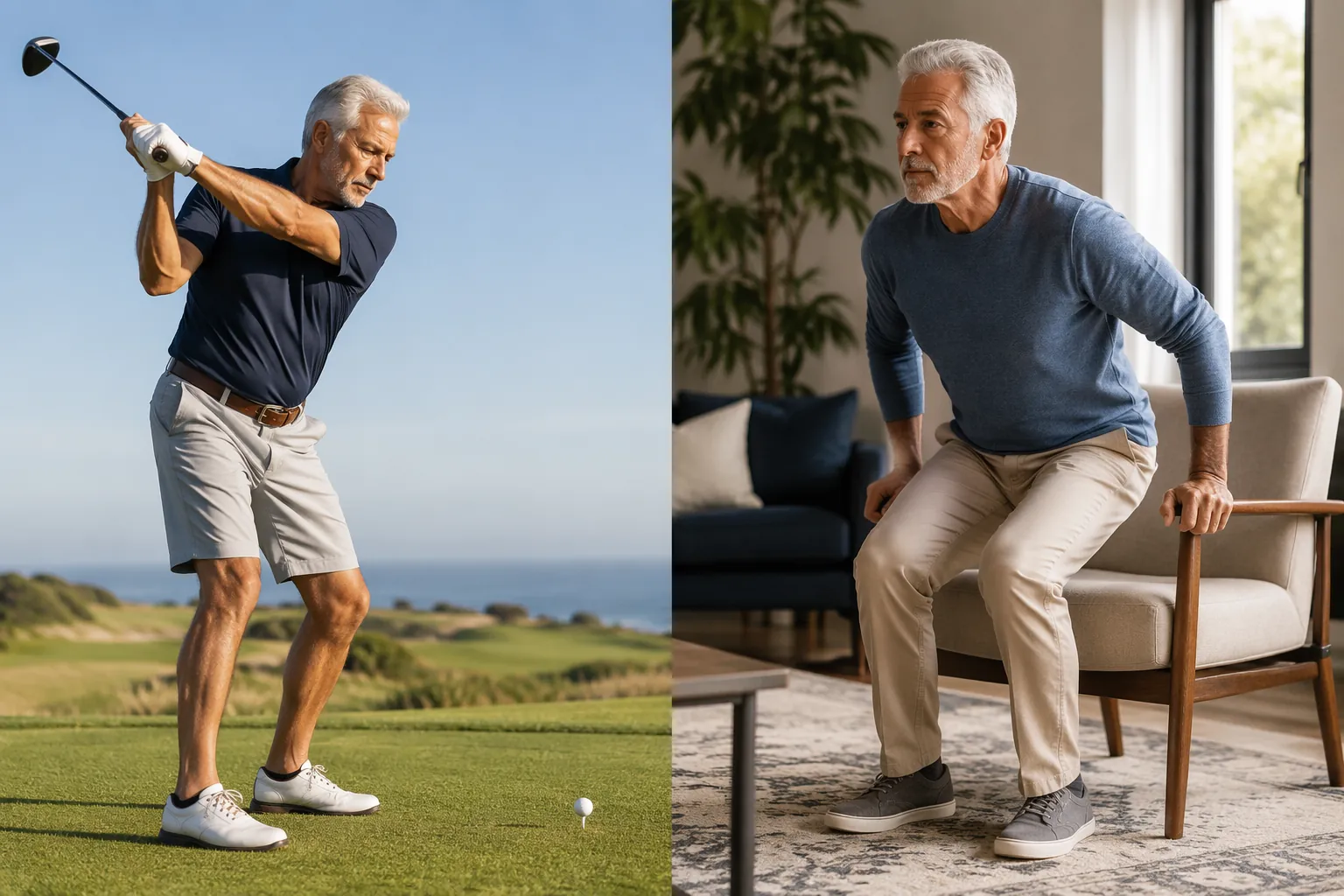
The swing adds another layer. Golf demands controlled rotation, not just brute strength. The player turns the shoulders and trunk while the feet stay organized underneath. For older adults, that maps closely to turning to reach a cabinet, rotating to get out of a car, or looking behind while walking. When rotation disappears, people often compensate by twisting through the knees, shuffling the feet, or avoiding movement altogether. Avoidance can feel safe in the short term while quietly reducing the body’s options.
| Golf demand | Everyday mobility equivalent | Why it matters for independence |
|---|---|---|
| Walking several miles over varied terrain | Walking through a store, parking lot, hallway, or neighborhood | Builds tolerance for errands, appointments, and social activity |
| Rotating through the trunk during the swing | Turning to reach, dress, cook, bathe, and get in or out of a car | Reduces reliance on awkward compensations and rushed movements |
| Balancing on uneven lies | Managing thresholds, grass, curbs, rugs, and sloped driveways | Supports fall recovery and confidence outside perfectly flat floors |
| Generating force from the legs and hips | Standing from a chair, climbing steps, rising from a low toilet | Protects one of the most practical markers of daily function |
Uneven lies are another underappreciated part of the sport. Golfers constantly adjust their stance because the ball is above the feet, below the feet, on an upslope, on a downslope, or sitting in grass that changes the feedback under the shoe. That is not so different from the real world. Homes and neighborhoods are full of little balance tests: a wet bathroom floor, a curled rug edge, a sloped driveway, a curb cut, a patch of grass between the car and the sidewalk.
This is where golf becomes more than a pleasant senior sport. Its movement menu overlaps with the same balance and strength work that shows up in a sensible fall-prevention exercise progression: supported standing, controlled weight shifts, sit-to-stand practice, step work, and eventually more dynamic balance challenges. The course is glamorous; the home version is usually quieter. Both are built from the same human problem: can the legs, trunk, feet, and eyes cooperate before balance is lost?
What the research supports—and what it does not
The research bridge is encouraging, but it needs clean edges. Golf.Fitness, summarizing work by Sorbie et al. and Wilson et al., reports that golfers in small cohorts showed better balance, mobility, and lower-body strength than non-golfing peers, and that a 12-week golf fitness program in older veterans improved chair-stand performance by 16%.[10] Golf in Society also frames golf as a form of active ageing because it combines walking, coordination, balance, outdoor time, and social contact.[11]
Those findings are useful because chair-stand performance is not an abstract gym statistic. It resembles the repeated daily task of getting up from a dining chair, toilet, bed edge, waiting-room chair, or car seat. When that movement becomes slow or uncertain, a person’s world narrows quickly. They may decline invitations, avoid bathrooms outside the home, or stop walking enough to maintain endurance.
Still, small golf-related cohorts do not prove that playing golf is a guaranteed fall-prevention treatment. The narrower conclusion is better and more honest: golf-like movement patterns—walking, rotating, balancing, and producing lower-body force—are aligned with capacities that matter for fall prevention and independent living. Some older adults may build those capacities through golf. Others may use physical therapy, chair-stand progressions, tai chi, supervised strength training, aquatic exercise, or even less expected options like pole dancing for seniors when the activity is appropriately modified and safely taught.
Not every return means the same thing
Perez’s 2026 senior-major run is a different kind of return from Cink’s. His story is not primarily about recovering lost power or proving a damaged body can still compete. It is about a temporary competitive doorway opening while another one is closed. His one-year PGA Tour suspension tied to LIV meant he was not simply resuming his old schedule, but his T5 and T8 finishes showed that senior major golf can function as a second arena rather than a consolation bracket.[3]
That distinction matters for older adults, too. A return after disruption does not always mean going back to the exact life that existed before. After a fall, a knee replacement, a long illness, or caregiving burnout, the old version of activity may be unavailable or unwise. The better question is what doorway is open now. Nine holes instead of 18. A cart-path walk instead of a full course. A supervised strength class instead of solitary exercise. Supported walking before unaided walking.
Cabrera’s case requires more caution. Athletically, returning to win the 2025 Regions Tradition after a 30-month prison sentence is remarkable.[4] Morally, it is not a clean redemption tale, and it should not be sold as one. A domestic violence conviction is not erased by a scorecard. The only lesson worth carrying into a mobility article is narrower: even after a long enforced absence, elite physical skills can be rebuilt enough for competition. That observation does not absolve the conduct that interrupted the career.
Woods sits in still another category. His 2026 senior story is registration, eligibility, withdrawal, and recovery context—not prophecy. He registered for the U.S. Senior Open, was not in the early field, and later withdrew after months away from golf.[5][6] For ordinary people, the useful piece may be the least dramatic one: sometimes a target on the calendar helps organize rehab, medical decisions, and daily training even if the target eventually has to move.
Stenson and Poulter show the softer edge of the same season. Turning 50 can be less an ending than a reclassification. Stenson’s Senior PGA debut and Poulter’s fourth-place finish in his senior major debut suggest that senior competition can reward players who still have enough movement quality, precision, and stamina to make the age category newly meaningful.[7][8] The Florida return of the Senior PGA Championship gives the season a neat institutional echo, but it is not the heart of the matter. The human question is still whether the body can keep answering.
Borrow the capacities, not the tour schedule
Caregivers often hear “active again” as if it means one leap from frailty to full independence. Golf suggests a more staged way to think. A player does not start with the trophy. He starts with the ability to stand, shift weight, rotate, walk, recover, and repeat. An older adult coming back from a fall or surgery may need the same sequence at a safer scale.
- Start with sit-to-stand strength if rising from a chair is slow, painful, or dependent on both arms.
- Add supported balance work before expecting confident movement across grass, curbs, or uneven flooring.
- Build walking tolerance gradually, using short, repeatable routes rather than one exhausting outing.
- Practice gentle trunk rotation only within a pain-free range, especially after spine, hip, or abdominal surgery.
- Use professional guidance when there has been a recent fall, dizziness, new weakness, neurological change, major surgery, or fear that is causing avoidance.
For some families, the bridge back to walking may include a mobility aid rather than a vow to “walk normally” right away. A properly fitted rollator can allow practice without turning every outing into a test of fear, but height, braking, posture, and turning space matter. If supported walking is part of the plan, a simple rollator fit check is more practical than guessing from the showroom floor.
The best use of senior golf comeback news is not to pretend that elite athletes and ordinary older adults face the same circumstances. They do not. Tour players have coaches, medical teams, equipment support, and decades of skill. But the body problems underneath the spectacle are familiar: power fades if it is never trained, balance gets less reliable if every challenge is removed, and endurance disappears when walking stops.
The 2026 senior major season is not a prescription. It is credible, visible evidence that physical capacity after 50 can be rebuilt, protected, and adapted toward the kind of independence that matters most at home.
References
- Stewart Cink arrives with 2 senior majors, but U.S. Senior Open demands precision over power — NBC Sports
- Stewart Cink wins 2026 Senior PGA Championship, his first senior major — Golfweek
- 'It's so nice to be back': Suspended ex-LIV pro shines (again) at Senior Open — Golf.com
- Ángel Cabrera's return to golf continues with win at Regions Tradition — Golf Digest
- Tiger Woods registered for U.S. Senior Open, not listed in early field — Golf Digest
- Tiger Woods makes decision on U.S. Senior Open after months away from golf — GolfMagic
- Henrik Stenson Makes Senior Tour Debut With Invitation-Only Golf Ball — Forbes
- US Senior Open: Padraig Harrington defends title as Ian Poulter finishes fourth on debut — Sky Sports
- Senior PGA Championship returns to Florida at Concession Golf Club — MySunCoast, April 16, 2026
- The Hidden Health Benefits of Golf — Golf.Fitness
- How Golf Promotes Active Ageing — Golf in Society, October 10, 2024
Questions to bring to a clinician or OT
This is not medical, legal, or a family's final decision — only a framework. Bring these questions to a clinician, occupational therapist, or your local Area Agency on Aging.
Find Local HelpRelated reading
Noticed something outdated or inaccurate on this page? Flag a correction. We review every report against CDC, NIA, and AARP HomeFit guidance before updating a page.