
Caregiver decision guide
How to Plan Accessible Stadium Parking for Seniors
What to sort out before game day so accessible stadium parking works for an older adult: placard and reciprocity checks, a call to guest services, arrival timing, accessible lots and drop-off zones, and a plan for leaving. Accessible spaces are typically first-come, first-served, so pre-game preparation decides how close and safe the spot is.
The accessible parking plan for a stadium game should be settled before the car leaves the driveway. The close spaces may exist, but that does not mean they will still be open when you arrive. SoFi Stadium, for example, states that accessible parking is first-come, first-served for vehicles with a valid state-issued placard or license plate, and it advises guests to arrive when parking gates open for the best availability.[1]
That changes the job. You are not just “finding ADA parking.” You are checking the placard, confirming the venue’s current rules, deciding whether parking or drop-off is safer, timing arrival, and making sure the exit does not strand an older adult in a crowd after the game.
- Confirm the placard or accessible plate is valid, belongs to the older adult, and will be displayed before entering the lot.
- If traveling out of state, confirm the venue and local rules for recognizing the placard.
- Call guest services or the venue accessibility office for the specific event, not just the stadium in general.
- Identify the accessible lot, the closest practical gate, and the ADA drop-off and pickup zone.
- Plan to arrive near parking-gate opening if you need an accessible space close to the entrance.
- Decide how the older adult will get from car to seat and from seat back to car after the game.
Start with the placard, because the lot attendant will
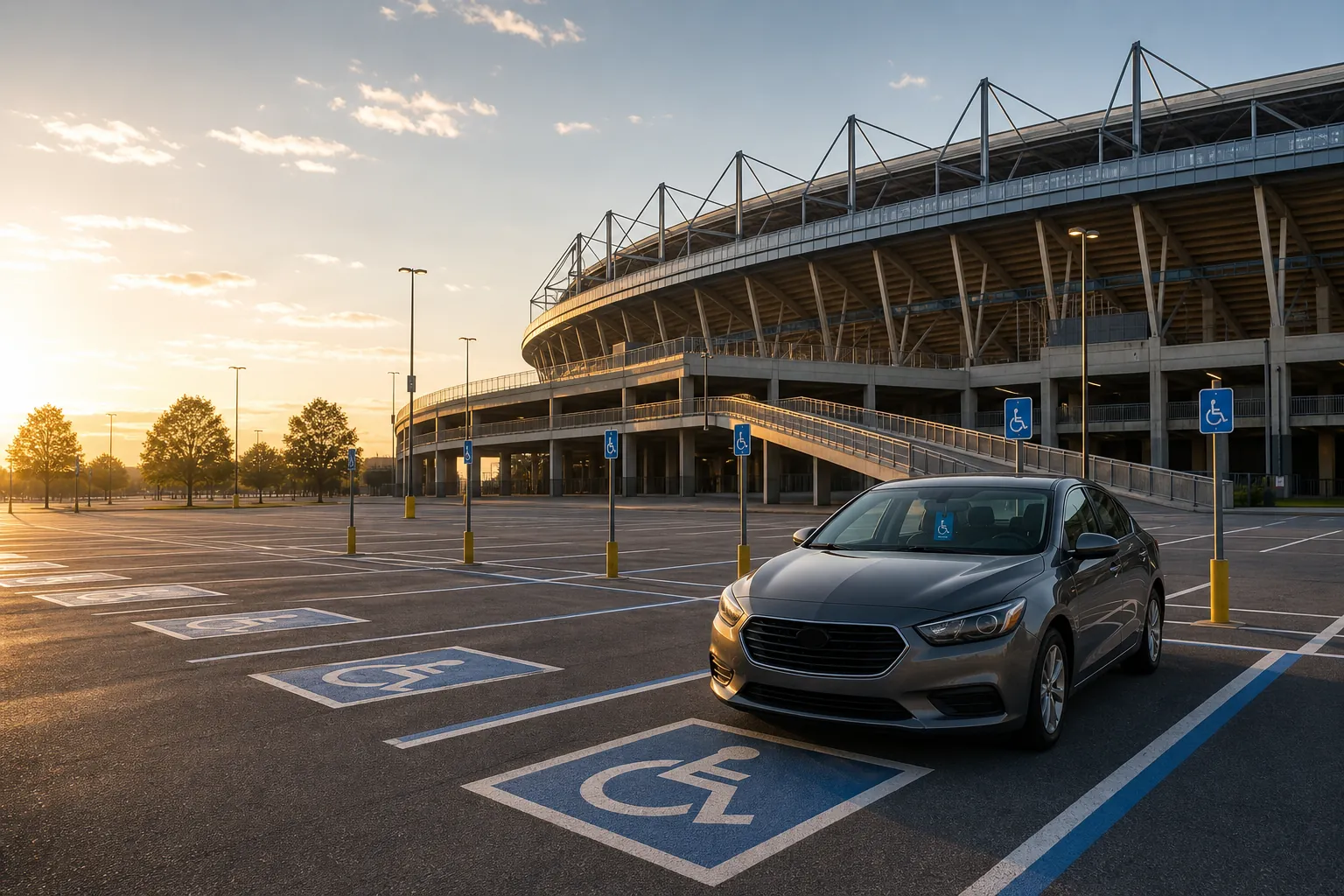
The placard is not a family shortcut. It belongs to the eligible person, that person must be in the vehicle when the accessible parking privilege is used, and it should not be lent to someone else.[2] For a stadium trip, check the expiration date, make sure the placard is in the car before you leave, and display it where an attendant can see it before you reach the decision point at the lot entrance.
If the older adult uses an accessible license plate instead of a hanging placard, ask the venue whether any additional documentation is needed at that event. Some lots move fast, and the wrong moment to discover a display requirement is while cars are stacking up behind you.
For out-of-state games, the practical rule is reassuring but not unlimited. Valid disability placards are generally recognized across all 50 states under the federal Uniform System for Parking for Persons with Disabilities, but privileges such as free-meter parking can vary by state and local enforcement practice.[3] At a stadium, the safer assumption is simple: the placard may be recognized, but the venue still controls which lot, which entrance, which price, and which event-day procedure applies.
The venue call is the hinge of the whole plan
The most useful guidance is not a general rule. It is a venue-specific answer. A baseball park, an NFL stadium, a concert setup, and a playoff event can send cars to different entrances or close streets that were open last month.
Call guest services, the box office accessibility line, or the parking operator before game day. If the website has an accessibility page, use it as your script, not as your final answer. The person on the phone should help you translate “accessible parking available” into a route your parent can actually use.
Ask these questions before you buy parking or choose a departure time
- Are accessible spaces pre-purchased, reserved, or first-come, first-served for this event?
- Which accessible lots serve the gate nearest our seats?
- What placard, plate, or parking pass must be shown at the lot entrance?
- Does the placard need to remain displayed and visible after parking?
- If the close accessible spaces fill, is there an overflow lot, courtesy shuttle, cart service, or staff-directed alternative?
- Where exactly is ADA drop-off, and what street or entrance should the driver use?
- Where is postgame pickup, and does the pickup driver need to return by a specific time?
- If using a van, roof carrier, wheelchair ramp, or raised vehicle, what is the garage clearance?
- Is the route from the lot to the gate level, ramped, staffed, and open after the game?
The details vary. Levi’s Stadium says a valid placard or license plate must be displayed and visible at all times, and it identifies courtesy shuttle service from specific lots when accessible spaces are full.[4] T-Mobile Park says accessible parking in its garage cannot be pre-purchased and names ADA drop-off and pickup locations on surrounding streets.[5] SoFi Stadium’s NFL pickup rule is even more specific: pickup drivers for guests with disabilities are instructed to arrive no later than the end of the 3rd quarter.[1]
Those examples are not a national template. They are reminders of the kinds of facts that decide the day: first-come spaces, visible placards, shuttle fallbacks, named streets, pickup deadlines, and whether a garage can physically accept the vehicle.
Do not assume “accessible” means your vehicle fits
This is easy to miss if the older adult uses a wheelchair van, a ramp, a lift, or a taller vehicle. The ADA parking guidance lists a 98-inch minimum vertical clearance for van-accessible parking along the vehicular route, at the parking space, and at the access aisle.[6] T-Mobile Park, by contrast, lists a 7-foot vertical clearance for its garage.[5] Seven feet is 84 inches, so a vehicle that depends on the ADA van clearance standard may still need a different plan at that venue.
The question for guest services is not just “Do you have ADA parking?” It is “Will our specific vehicle clear the garage, and if not, where should we go instead?” Ask before you are in a line of cars with nowhere easy to turn around.
Choose between accessible parking and drop-off
Parking in an accessible lot and using an ADA drop-off zone solve different problems. The closest parking space may still require a slow walk across pavement. A drop-off may shorten the walk but create a waiting problem after the game. Neither option is automatically more respectful or safer; the right answer depends on how the older adult moves, waits, and handles crowds.
| Option | Works better when | Watch for |
|---|---|---|
| Accessible parking | The older adult can walk or roll from the lot to the gate with manageable pauses, and the driver will stay for the game. | First-come availability, distance from lot to assigned gate, curbs, ramps, heat, postgame crowd flow. |
| ADA drop-off | The driver can leave and return, and the older adult can wait comfortably with another person or staff nearby. | Exact drop-off street, where the driver may legally stop, pickup timing, whether the postgame pickup zone is farther away. |
| Parking plus wheelchair, walker, or shuttle help | The lot is not close enough for the full walk, but the older adult can transfer and use a mobility aid or venue shuttle. | Whether shuttles run after the game, whether the aid fits in the car, and whether staff can direct you to the accessible route. |
Include the older adult in this choice. Some people would rather walk slowly from a parked car than be dropped at a curb and wait while everyone else manages logistics around them. Others would gladly skip a long parking-lot crossing if there is a reliable curbside plan. The point is to avoid deciding at the most stressful moment, with an attendant waving you forward and your parent already tired.
Arrive for the parking reality, not just the first pitch
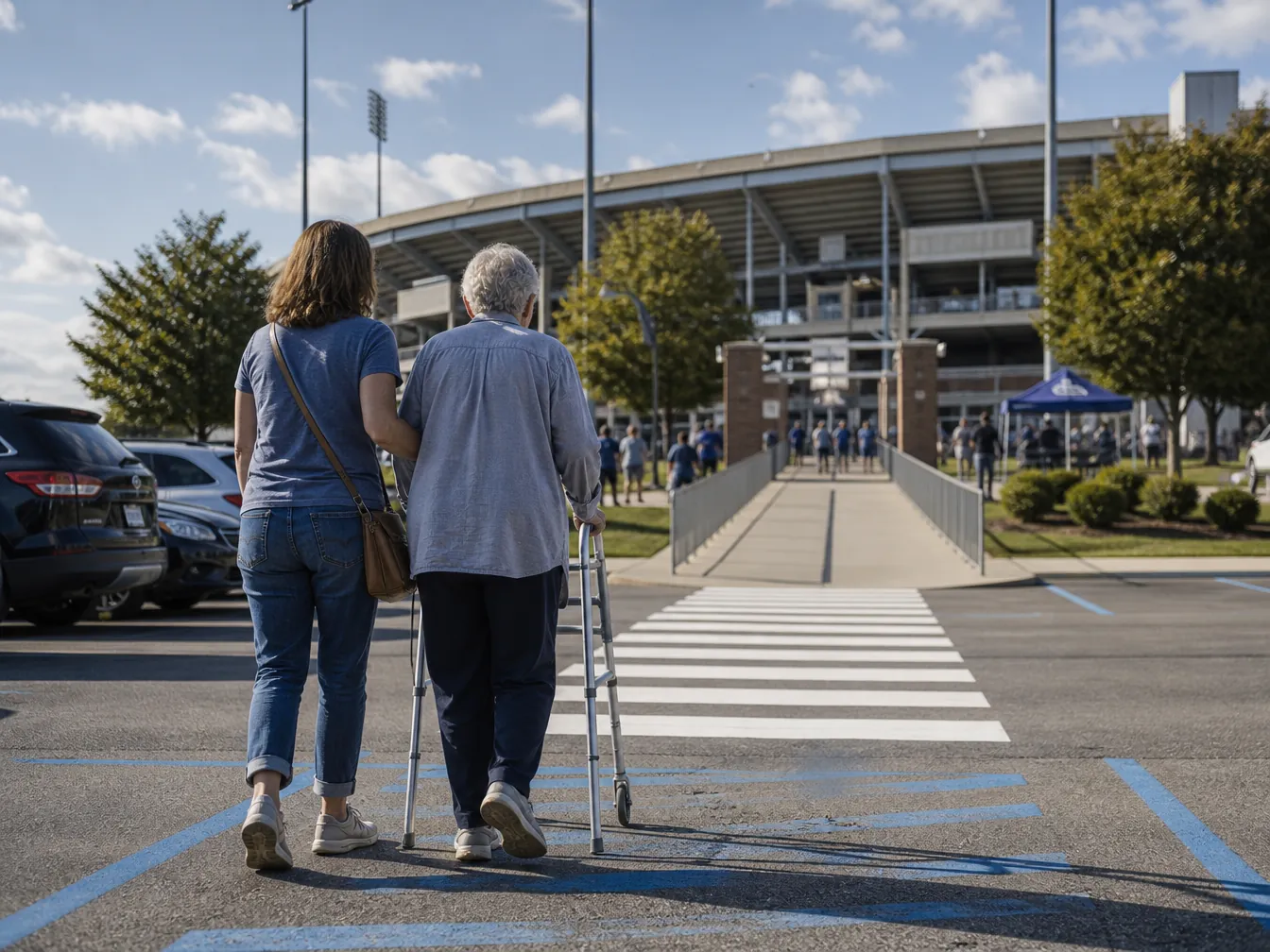
If the accessible spaces are first-come, first-served, your real arrival target is not the anthem, kickoff, or first pitch. It is parking-gate opening, or as close to it as the older adult can comfortably manage. SoFi Stadium makes that point directly by recommending arrival when parking gates open for the best accessible parking availability.[1]
Build the schedule backward. Add time for a bathroom stop before leaving home, slower transfers into and out of the car, traffic near the stadium, the conversation with the lot attendant, and the walk from the space to security. If the older adult uses a walker, cane, portable oxygen, or wheelchair, load it last so it comes out first.
The car should also be set up for a calm arrival. Put the parking pass, placard, tickets, phone charger, water, seat cushion, mobility aid, and any medical essentials where the driver or companion can reach them without unpacking the trunk in traffic. If the stadium uses mobile tickets, open them before you enter the parking approach, not while standing at the gate.
Treat the car-to-gate route as part of fall prevention
An accessible space is only the start of the route. The older adult still has to cross pavement, handle curb cuts, follow crowd movement, pass through security, and reach the seat. On a hot day, even a short delay can turn into standing on asphalt while the driver asks where to go next.
Before game day, look at the venue map and decide which gate you are actually aiming for. The closest gate on the map may not be the best gate if it requires stairs, a steep ramp, a long security line, or a crowded plaza. Ask whether the accessible entrance closest to your seats is open for that event and whether staff can direct you to elevators, ramps, or accessible seating routes once inside.
On game day, match the pace to the older adult, not to the crowd behind you. Stop before fatigue shows up as shuffling, leaning, or rushing. If your parent uses a cane or walker, keep both hands free of bags as much as possible. The companion’s job is not to hurry the person through the lot; it is to keep the route predictable.
Make the exit plan before everyone is tired
Leaving is where many good arrival plans fall apart. After the game, legs are tired, crowds are denser, lighting may be worse, rideshare areas may be farther than expected, and the driver may be stuck in postgame traffic while the older adult waits at a curb.
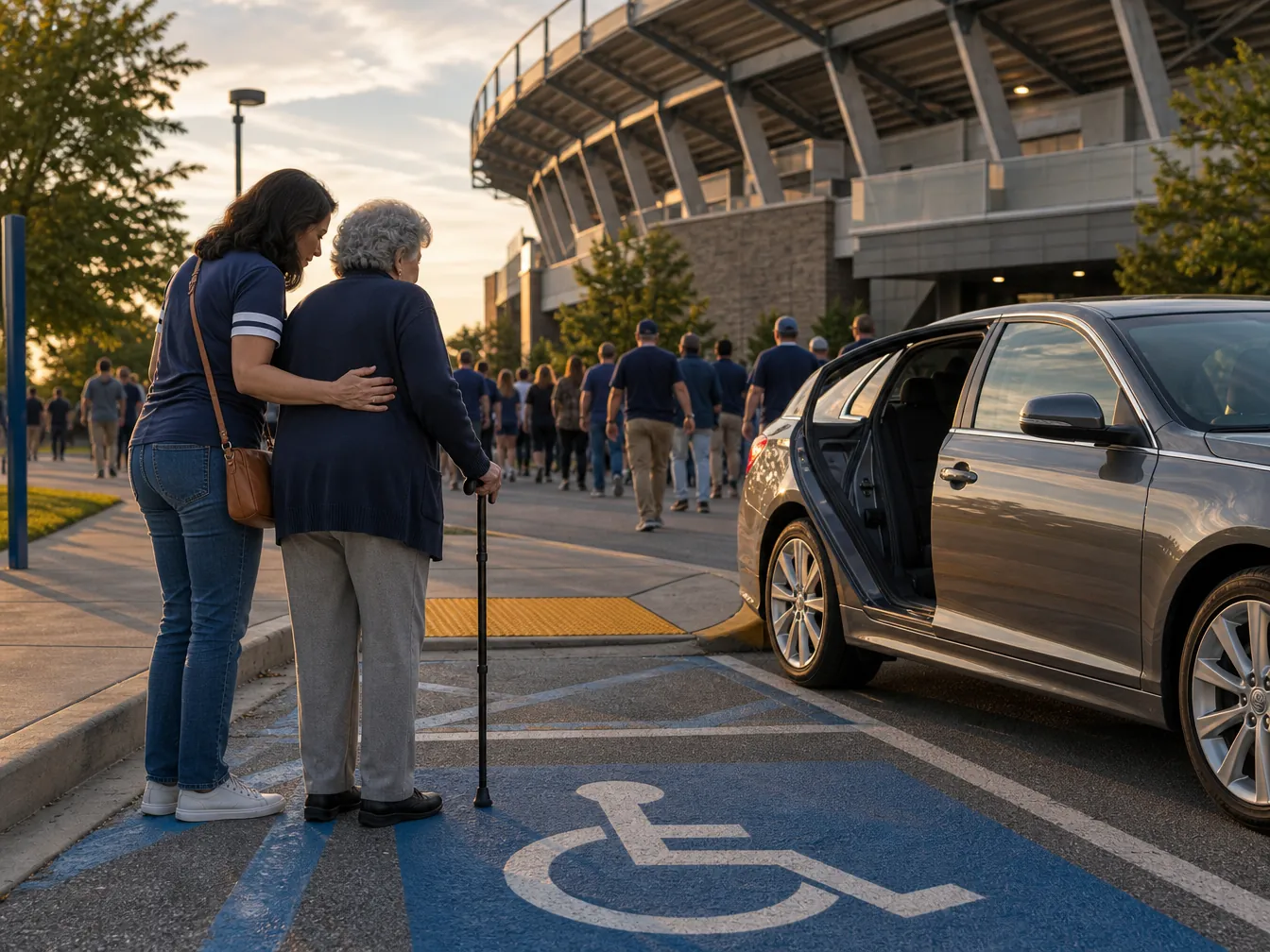
If you parked in an accessible space, decide whether to leave a few minutes early, wait in the seat until the first crowd clears, or use a less crowded accessible route back to the lot. If you used drop-off, decide exactly where the older adult will wait and who stays with them. A pickup zone that works beautifully before the game may operate differently afterward.
This is why pickup windows matter. SoFi Stadium’s NFL guidance tells pickup drivers for guests with disabilities to arrive by the end of the 3rd quarter.[1] T-Mobile Park publishes specific ADA drop-off and pickup street locations.[5] Those are the kinds of rules to write down in the plan, because they affect whether the older adult waits five minutes near the curb or stands there while a driver circles closed streets.
Before you go inside, agree on three things: the postgame meeting point, the backup meeting point, and what happens if phones are hard to hear or the network is overloaded. If one person is driving and another is accompanying the older adult, put the pickup location in a shared text before the game starts. Do not rely on “same place as drop-off” unless the venue has confirmed that pickup uses the same place after the event.
A verified game-day parking plan
By the night before the game, the plan should be specific enough that another family member could follow it without guessing. It does not need to be elaborate. It does need to name the lot or drop-off street, the gate, the arrival time, the placard requirement, the walking route, and the exit plan.
- Placard or plate: valid, packed, and displayed as required.
- Venue confirmation: accessible parking rule verified for this event.
- Primary plan: accessible lot, garage, or ADA drop-off location identified.
- Backup plan: overflow lot, shuttle, alternate drop-off, or staff-directed route known.
- Vehicle check: clearance confirmed if using a van, lift, roof carrier, or taller vehicle.
- Arrival time: based on parking-gate opening, not just event start.
- Car-to-gate route: accessible entrance, ramps, elevators, and rest stops considered.
- Exit: pickup timing, meeting point, and backup communication plan set.
None of this guarantees the closest space. It does make the preventable problems less likely: the full accessible lot, the hidden placard, the van that cannot clear the garage, the curbside pickup that moved after the game, and the older adult left waiting while everyone else tries to improvise.
References
- Accessible Parking, SoFi Stadium
- Handicap Parking Rules, BraunAbility
- Handicap Parking Permit Reciprocity, ParkingMD
- ADA Parking, Levi’s Stadium
- Disability Access Guide, Seattle Mariners / T-Mobile Park
- Parking, ADA National Network
Questions to bring to a clinician or OT
This is not medical, legal, or a family's final decision — only a framework. Bring these questions to a clinician, occupational therapist, or your local Area Agency on Aging.
Find Local HelpRelated reading
Noticed something outdated or inaccurate on this page? Flag a correction. We review every report against CDC, NIA, and AARP HomeFit guidance before updating a page.