
Caregiver decision guide
How Accessible Is the Wrigley Field Tour for Seniors?
Wondering whether you or your parent can handle the Wrigley Field tour with a cane, walker, or wheelchair? Feasibility comes down to matching mobility level to the tour's 75–90 minutes of walking, stairs, and ramps and to the ballpark's real accommodations — giving you a clear yes, no, or with-help answer before you book.
Before you buy the tour tickets, the useful question is not “Is the Wrigley Field tour accessible for seniors?” It is: “Accessible for this person, with this mobility level, for 75 to 90 minutes, outdoors, moving with a group?”
The official Cubs tour page says Wrigley Field tours run about 75 to 90 minutes, include walking through the ballpark, operate rain or shine, begin and end at the Gallagher Way Gate, require guests to arrive 10 to 15 minutes early, and use mobile tickets through the MLB Ballpark app. The same page also says tours are wheelchair accessible, but that wheelchair users may have limited or no access to the Cubs dugout during certain tours. That last sentence matters because it turns a cheerful “yes” into a more honest “yes, with one important limitation.” [1]
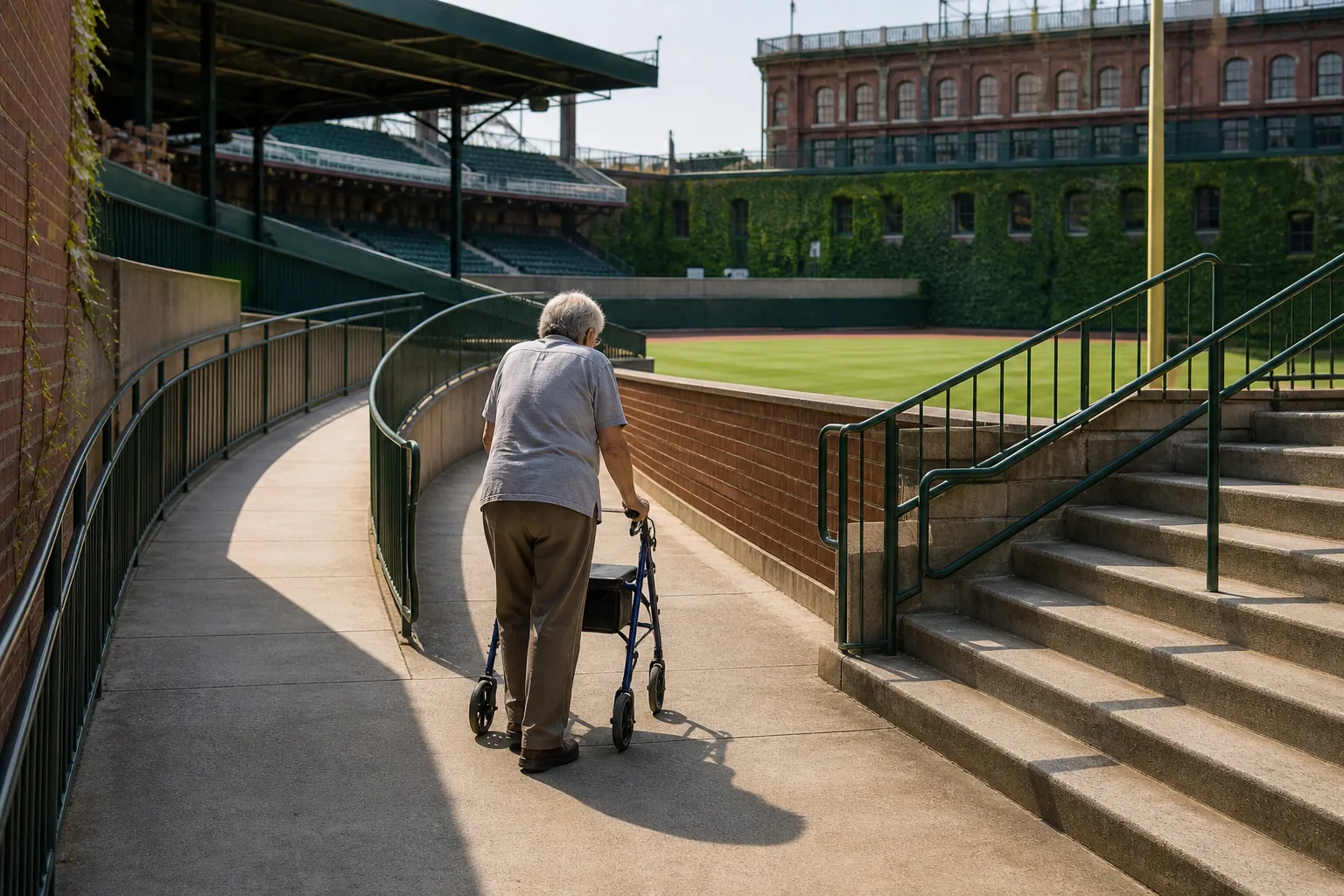
Visitor comments about the tour’s walking load tend to sound blunter than official language: a lot of walking, stairs, and ramps. Treat those as anecdotal, not as a formal accessibility audit, but do not dismiss them. They are the kind of practical warning families need before deciding whether a cane, walker, wheelchair, or extra rest time changes the plan.
The short answer by mobility level
| Mobility level | Feasibility | What to arrange before arrival | Mid-tour fatigue plan |
|---|---|---|---|
| Walks independently, handles stairs slowly | Usually yes | Choose a day with manageable weather, arrive early, wear stable shoes, and avoid stacking another long outing immediately after the tour. | Tell the guide early if the pace is too fast; use natural pauses, benches, concourse edges, or a staff-directed rest point. |
| Uses a cane or walker | Yes with planning | Call or email Fan Services before booking if stairs, ramps, standing time, or restroom distance may be a problem. Ask how the current tour route is being handled that day. | Decide in advance whether the person will sit out a stop, use an elevator route, or request a wheelchair at tour check-in. |
| Uses a wheelchair or cannot manage stairs | Only with confirmed help | Confirm tour-specific wheelchair access with Fan Services before booking, and remember that the Cubs dugout may have limited or no wheelchair access. | At check-in, tell the tour guide about the wheelchair need immediately. Ask where the elevator route, accessible restroom, and best stopping point will be before the group moves. |
This is not medical clearance. If the real issue is recent falls, dizziness, heat sensitivity, pain flare-ups, shortness of breath, or whether a parent can safely stand and walk for more than an hour, a clinician who knows that person’s health should help make the call. The ballpark can provide access routes and some assistance; it cannot turn a tiring day into a low-exertion appointment.
If your parent walks independently
For an older adult who walks independently, the Wrigley Field tour is usually realistic. The main question is not whether they can walk into the ballpark; it is whether they can keep moving with a group for up to 90 minutes, with outdoor stops and possible stairs or ramps, without becoming exhausted halfway through.
Plan the day as if the tour itself is the outing. Arrive 10 to 15 minutes early as instructed, but do not turn that into a rushed walk from a distant parking spot or restaurant. Make sure the mobile ticket is already loaded before you reach the Gallagher Way Gate, because troubleshooting an app while someone is standing in sun, wind, or rain is a bad way to start a mobility-sensitive outing. [1]
The best fatigue plan for an independent walker is simple: say something early. If your parent is starting to slow down, tell the guide before the group has moved to a tighter space or a stair-heavy stop. Older adults often try to be agreeable until the situation is already embarrassing. A quiet “We may need the easiest route from here” gives staff a chance to help before the moment becomes public.
If your parent uses a cane or walker
A cane or walker changes the decision from “probably fine” to “fine if the route and pace are confirmed.” The person may be able to do the distance, but ramps, stairs, wet surfaces, crowd movement, and standing during guide commentary all matter. A walker also needs space; it is not just a slower pair of legs.
Before booking, contact Fan Services and ask tour-specific questions rather than general accessibility questions. The safest wording is practical: “My parent uses a walker and cannot do repeated stairs. For the tour date we are considering, can the guide route us by elevator if needed, and where should we check in?” The Cubs list Fan Services at 773-388-8270 and [email protected]. [2]
On arrival, do not wait for the guide to notice the walker. Say it directly at check-in: “We can walk, but stairs are a problem. If there is an elevator route, we need it.” That is not being difficult; it is giving staff the information they need before the group is already moving.
For a cane or walker user, the mid-tour backup plan should be decided before the tour starts. It may be as modest as skipping one stop, pausing near a concourse wall, or asking the guide where the next accessible restroom is. It may also mean requesting a wheelchair if the person can transfer safely but cannot keep walking. The official tour page says guests who require wheelchair assistance should notify the tour guide upon arrival. [1]
This same pre-booking habit applies to other senior travel settings, too: match the mobility aid to the actual route, then call the venue before money is spent. The logic is similar to the planning approach in room-by-room cruise safety for elderly passengers, where “accessible” only becomes useful after someone asks what happens at doorways, bathrooms, gangways, and rest stops.
If your parent uses a wheelchair or cannot manage stairs
For wheelchair users and seniors who cannot manage stairs, the Wrigley Field tour may still be doable, but this is the level where you should confirm before booking. Not because the ballpark lacks accommodations — it has several — but because the tour route, the group’s movement, and the Cubs dugout limitation all need to be understood before the day arrives.
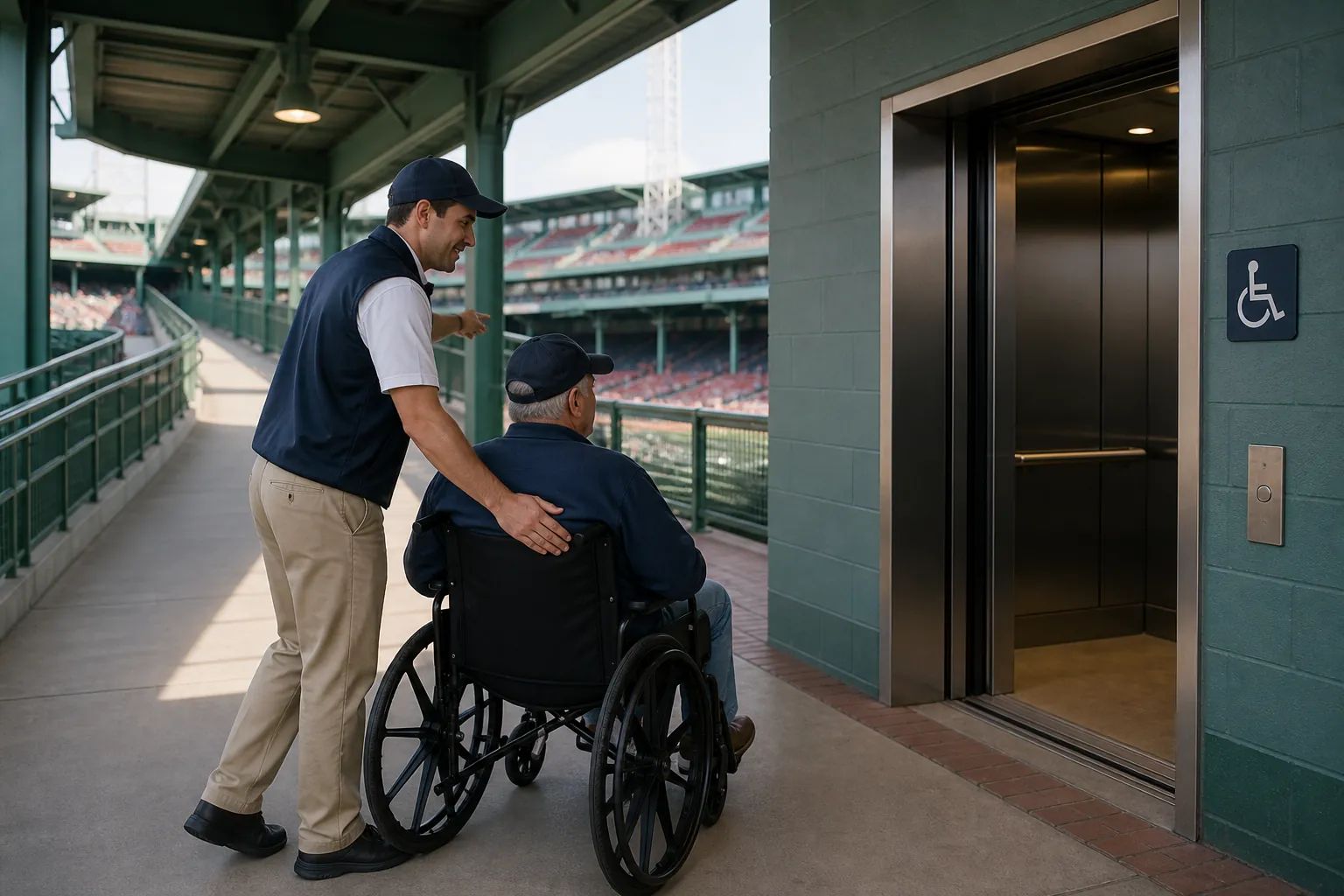
The official tour page gives two important instructions for wheelchair users: tours are wheelchair accessible, and guests who need wheelchair assistance should tell the tour guide upon arrival. It also states that, due to the natural configuration of the ballpark, wheelchair users may have limited or no access to the Cubs dugout. [1]
That dugout caveat should be said plainly inside the family before anyone gets excited about photos. If the dugout is the emotional centerpiece of the tour for your parent, call first and ask what wheelchair access will look like on the specific tour you are considering. If the tour is still worth it for the press box, seating areas, concourses, history, and being inside Wrigley, then the limitation may be acceptable. What is not acceptable is discovering it after everyone is already there.
Wrigley Field’s accessibility guide lists elevators at the Marquee Gate, Left Field Gate, Wintrust Right Field Gate, Budweiser Bleacher Gate, and the bleacher concourse. It also says all restrooms are accessible and that single-occupancy restrooms are available. [2]
Those details are much more useful than a generic accessible label. A family can plan around named gates, elevator locations, and restroom options. A daughter pushing a wheelchair cannot plan around “don’t worry, it should be fine.”
Tour help and gameday help are not the same thing
This is where families can get tripped up. Wrigley Field does offer complimentary wheelchair assistance from the gate to seats on a first-come, first-served basis, with no reservations. That is a gameday-style service described in the ballpark accessibility guide, not a guarantee that the same process automatically applies to a non-gameday tour. [2]
For a tour, follow the tour instruction: tell the tour guide upon arrival if wheelchair assistance is needed. If you are trying to decide whether to bring your own wheelchair, use a transport chair, or request help at the ballpark, confirm with Fan Services before booking. [1][2]
The same caution applies to transportation extras. If you see references to a golf cart shuttle connected to gamedays, do not assume it will be operating for a tour morning or non-gameday visit. Confirm the exact date, time, entrance, and service with Fan Services rather than planning the whole outing around a service that may not apply.
What to ask Fan Services before booking
A good pre-booking call is not long, but it should be specific. Have the tour date or time in front of you, and describe the person’s mobility in plain language: “walks slowly and uses a cane,” “uses a rollator and avoids stairs,” “uses a wheelchair full time,” or “can walk short distances but cannot do ramps repeatedly.”
- For a cane user: “How much of the current tour route involves stairs or ramps, and can we use elevators if needed?”
- For a walker user: “Will there be enough space for a walker during the tour stops, and where should we position ourselves at check-in?”
- For a wheelchair user: “Is the full route wheelchair accessible on this tour, and which stops will be limited or skipped?”
- For someone who tires suddenly: “If we need to stop mid-tour, where can staff direct us?”
- For restroom planning: “Where are the accessible and single-occupancy restrooms closest to the tour path?”
If price matters, confirm it on the official booking path rather than relying on an older article, discount page, or copied figure. The more important accessibility point is that tickets are mobile-only through the MLB Ballpark app, so the person managing the outing should have the tickets loaded before arrival. [1]
How to handle arrival without creating a scene
Arrive early, but not so early that the older adult is standing around for half an hour. The official instruction is 10 to 15 minutes before the tour. Use that window to get through the mobile-ticket moment, find the guide, and say what needs to be said before the group starts moving. [1]
The check-in script can be short:
- “My dad walks with a cane and cannot do many stairs.”
- “My mom uses a walker and may need the elevator route.”
- “We need wheelchair assistance today.”
- “If she needs to stop, where should we go?”
No one has to explain a diagnosis at the gate. Staff need functional information: stairs, distance, standing, wheelchair, restroom, fatigue. That is enough.
Use older accessibility accounts carefully
Older firsthand accessibility accounts can still be useful because they describe the feeling of navigating a historic ballpark: elevators, ramps, stairs, concourses, and the difference between a technically accessible route and an easy one. A 2016 Wheelchair Travel account of a Cubs gameday at Wrigley Field is useful in that limited sense. It should not be treated as current authority for today’s tour conditions, especially after later facility and legal changes. [3]
For a current decision, use current Cubs tour instructions and the current Cubs accessibility guide, then confirm tour-specific details with Fan Services. That order matters: official page, current accessibility guide, direct confirmation.
Pre-booking checklist
- Decide the mobility category honestly: independent walker, cane or walker user, wheelchair user, or unable to manage stairs.
- Confirm tour-specific help with Fan Services at 773-388-8270 or [email protected].
- Ask about stairs, ramps, elevator routing, restroom locations, and what happens if the person needs to stop mid-tour.
- If wheelchair assistance is needed, tell the tour guide upon arrival, as the Cubs instruct.
- Remember that the Cubs dugout may have limited or no wheelchair access.
- Arrive 10 to 15 minutes early at the Gallagher Way Gate, with mobile tickets already ready in the MLB Ballpark app.
- Treat gameday services, including gate-to-seat assistance or shuttle references, as separate from tour assistance unless Fan Services confirms they apply.
- Make the final call before booking: yes, yes with confirmed help, or not this trip.
References
- Tours of Wrigley Field | Chicago Cubs — Chicago Cubs
- Wrigley Field Accessibility Guide | Ballpark | Chicago Cubs — Chicago Cubs
- Accessible Gameday: Chicago Cubs Baseball at Wrigley Field — WheelchairTravel.org, 2016
Questions to bring to a clinician or OT
This is not medical, legal, or a family's final decision — only a framework. Bring these questions to a clinician, occupational therapist, or your local Area Agency on Aging.
Find Local HelpRelated reading
Noticed something outdated or inaccurate on this page? Flag a correction. We review every report against CDC, NIA, and AARP HomeFit guidance before updating a page.