
Caregiver decision guide
How to Prevent Falls When Your Spouse Has Cancer
Room-by-room fall prevention for spouse-caregivers of a partner with cancer — what chemo side effects do to fall risk, what to fix at home, and when to report unsteadiness to the care team.
If your spouse is in active cancer treatment, fall prevention is not something you finish once by removing a rug. Risk can change across treatment cycles. Research on chemotherapy-induced peripheral neuropathy has found fall risk rising across chemotherapy cycles, with taxane therapy flagged as a possible higher-risk context [1].
That matters at home because the early warning often looks ordinary: a hand on the wall after standing, a wider stance on the way to the bathroom, hesitation at the shower edge, or a new complaint that the feet feel numb or “not quite there.” A fall that looks minor can carry more consequence for someone with cancer, including higher concern for bleeding and infection-related complications because of bleeding risk and a weakened immune system [2].
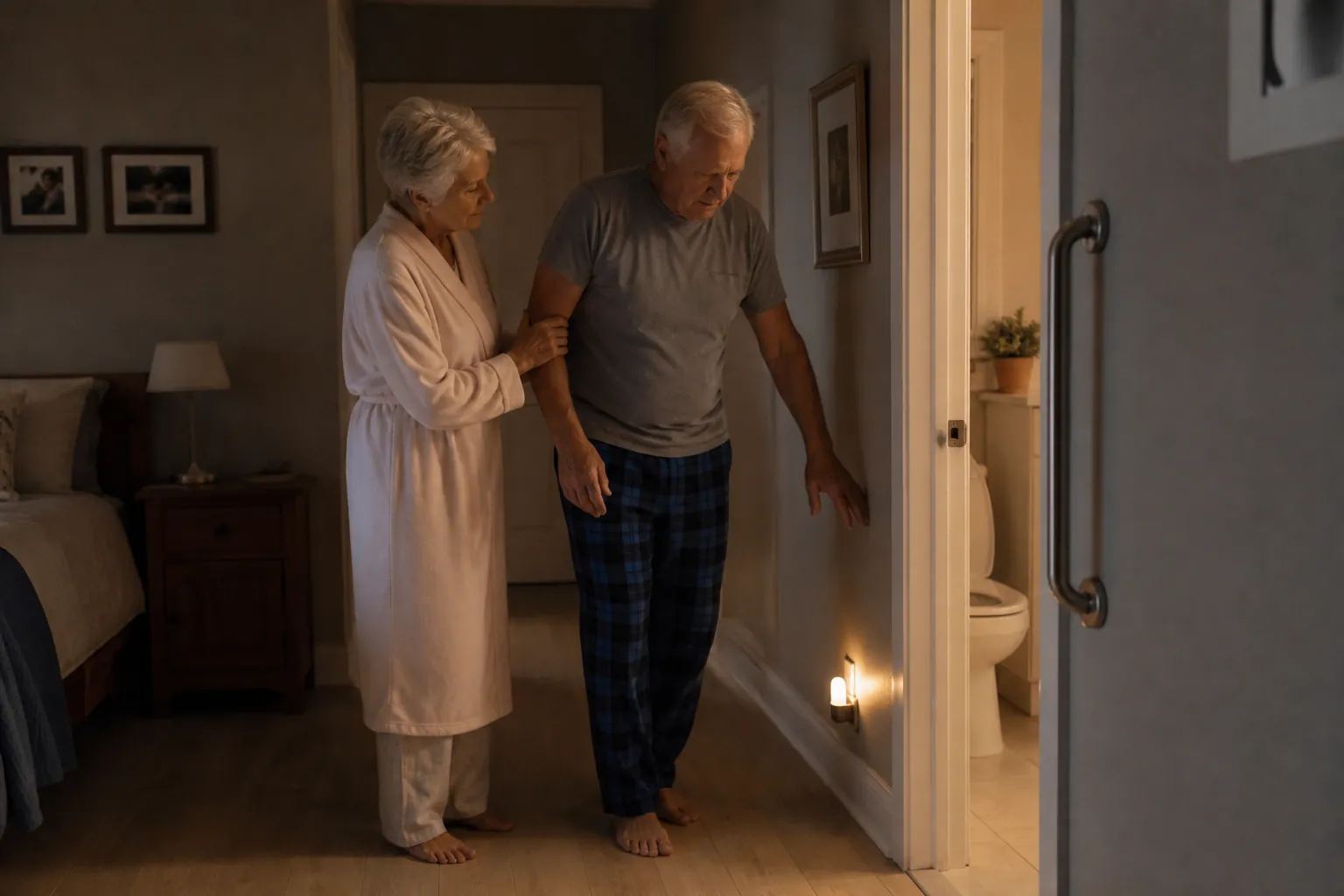
So the first rule is simple: report new unsteadiness before there is a fall. Cancer Today’s guidance from Sandi Vonnes, a geriatric oncology nurse practitioner at Moffitt Cancer Center, is direct on this point: even minor unsteadiness should be reported to the care team because the cause may be something they need to evaluate, such as low blood pressure, anemia, or infection [3]. Your job at home is not to diagnose which one it is. Your job is to notice the change, reduce the immediate fall hazard, and call it in.
This guide is educational and is not a substitute for medical advice from your spouse’s oncology team, primary care clinician, pharmacist, physical therapist, or emergency services. If a fall has already happened, use the urgent instructions you were given by the care team or call emergency services when needed; the focus here is prevention before the crisis.
Start with the body signals, not the furniture
A safe house can become unsafe when the body using it changes. Before you walk room by room, take one minute to name what has changed since the last treatment cycle, medication change, infection, transfusion discussion, or day of poor fluid intake.
| What you notice | Why it matters for falls | What to do |
|---|---|---|
| Numbness, tingling, burning, or reduced feeling in the feet | The foot may not read the floor well, especially at night or on tile | Remove tripping hazards, change footwear, and report the symptom to the oncology team |
| New weakness in the legs or needing to push harder from a chair | Transfers from bed, toilet, and shower become less predictable | Add stable supports and ask whether physical therapy evaluation is appropriate |
| Dizziness, lightheadedness, or feeling faint after standing | The dangerous moment may be the first few steps, not the whole walk | Have your spouse pause after standing and report the pattern, especially if it is new |
| Unusual fatigue, shortness of breath with usual activity, or looking wiped out after a short walk | The person may rush, lean, or stop using good judgment because every movement costs more | Shorten walking distances at home and tell the care team what you are seeing |
| Pain, medication sleepiness, or confusion | Balance, reaction time, and attention can all be affected | Check timing against medication changes and ask the clinician or pharmacist what should be reviewed |
Weakness, pain, and numbness in the legs and feet are specifically named in home-safety guidance for cancer caregivers as contributors to falls [4]. In real life, they rarely arrive alone. A spouse may have numb toes, poor sleep, a new pain medicine, and a bathroom trip at 2 a.m. That combination deserves more attention than any single loose rug.
The bedroom-to-bathroom route is the first route to fix
Nighttime is where many careful daytime plans fail. The room is dim. Both of you are tired. Your spouse may be trying not to wake you, may stand too quickly, or may avoid using a walker because the bathroom is “just right there.” That short distance deserves the most boring, practical attention in the house.
- Clear a direct path from the side of the bed to the bathroom. No laundry basket, shoes, oxygen tubing loops, cords, throw rugs, pet beds, or low stools in the walking line.
- Use night lighting that shows the floor, not just the wall. A small light at the baseboard or along the route helps more than a bright lamp that causes glare.
- Keep the needed device where the first step happens. If your spouse uses a cane, walker, or rollator, it belongs within safe reach of the bed, not folded in the hallway.
- Make the bed exit predictable. Move clutter from the bedside, keep the floor dry, and avoid slippery socks for standing.
- If nighttime bathroom trips are frequent or the walk is no longer safe, ask whether a bedside commode is appropriate. Cancer caregiver home-safety guidance includes a bedside commode as an option for nighttime use [4].
The commode question can feel like a loss of independence, so it is worth framing honestly: this may be temporary. Treatment weeks are not all the same. A safer setup during the rough part of a cycle can prevent a fall that takes away far more independence than a piece of equipment ever could.
Make the bathroom less dependent on strength and balance
The bathroom is not dangerous because people are careless. It is dangerous because it asks for strength, balance, turning, reaching, clothing management, and wet-floor judgment in a small space. A spouse with numb feet or weak legs may be fine in the hallway and still unsafe at the toilet or tub.
Toilet transfers
Watch the sit-to-stand movement, not just the walk into the room. If your spouse drops onto the toilet, rocks several times before standing, reaches for a towel bar, or grabs the sink edge with both hands, the setup is doing too much of the work by luck.
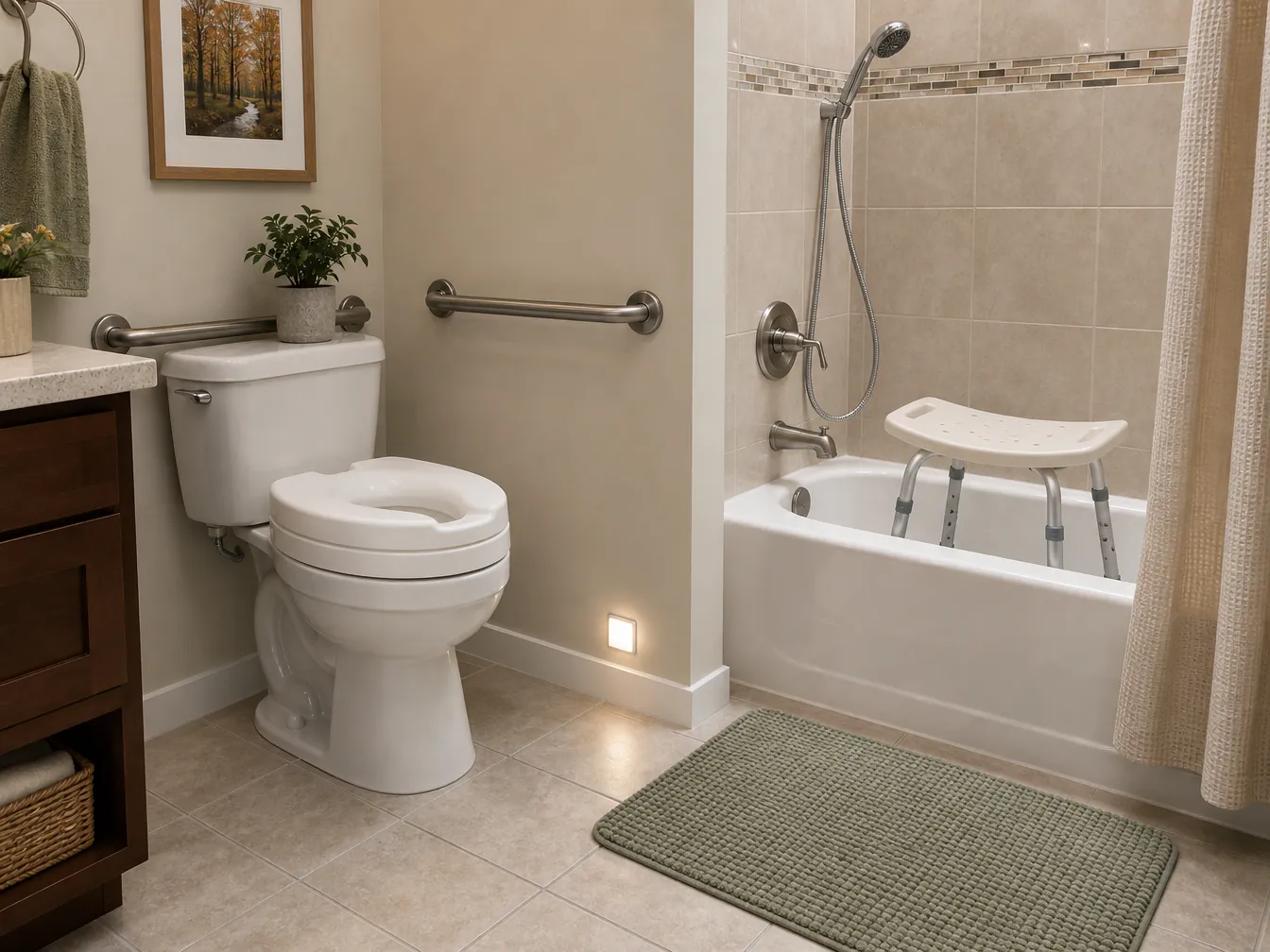
- Install grab bars near the toilet where the hand naturally reaches during sitting and standing. Towel bars are not grab bars.
- Consider a raised toilet seat if low sitting makes standing difficult. Raised toilet seats are included in cancer caregiver home-safety recommendations [4].
- Keep the floor around the toilet dry and uncluttered. A bathmat that slides is a fall hazard, even if it looks softer.
- Place toilet paper, wipes, and hygiene supplies within easy reach so your spouse does not twist or lean far while seated.
Bathing and showering
Bathing is where pride, privacy, and risk collide. A partner may not want help. A spouse may not want to hover. The compromise is to make the bathroom support the person before either of you has to negotiate rescue from a wet floor.
- Use a shower stool or shower chair when standing through the whole shower is tiring or unsteady.
- Install grab bars near the tub or shower entry and inside the bathing area.
- Use nonskid mats or nonskid strips on slippery surfaces.
- Add a hand-held shower head so bathing can happen while seated instead of requiring turning and reaching.
- Set towels, clothing, and toiletries where they can be reached without stepping out wet, bending deeply, or turning quickly.
These are not fancy renovations. Shower stools, nonskid mats, hand-held shower heads, and grab bars are specifically named in home-safety guidance for cancer caregivers [4]. The important part is placement. A grab bar across the room is decoration; a grab bar where the hand reaches during the dangerous movement is equipment.
Footwear matters more when the feet are numb
Peripheral neuropathy changes the rules. If your spouse cannot fully feel the floor, the shoe has to do more of the safety work. Vonnes’s advice for neuropathy is blunt: avoid flip-flops and slip-on shoes [3].
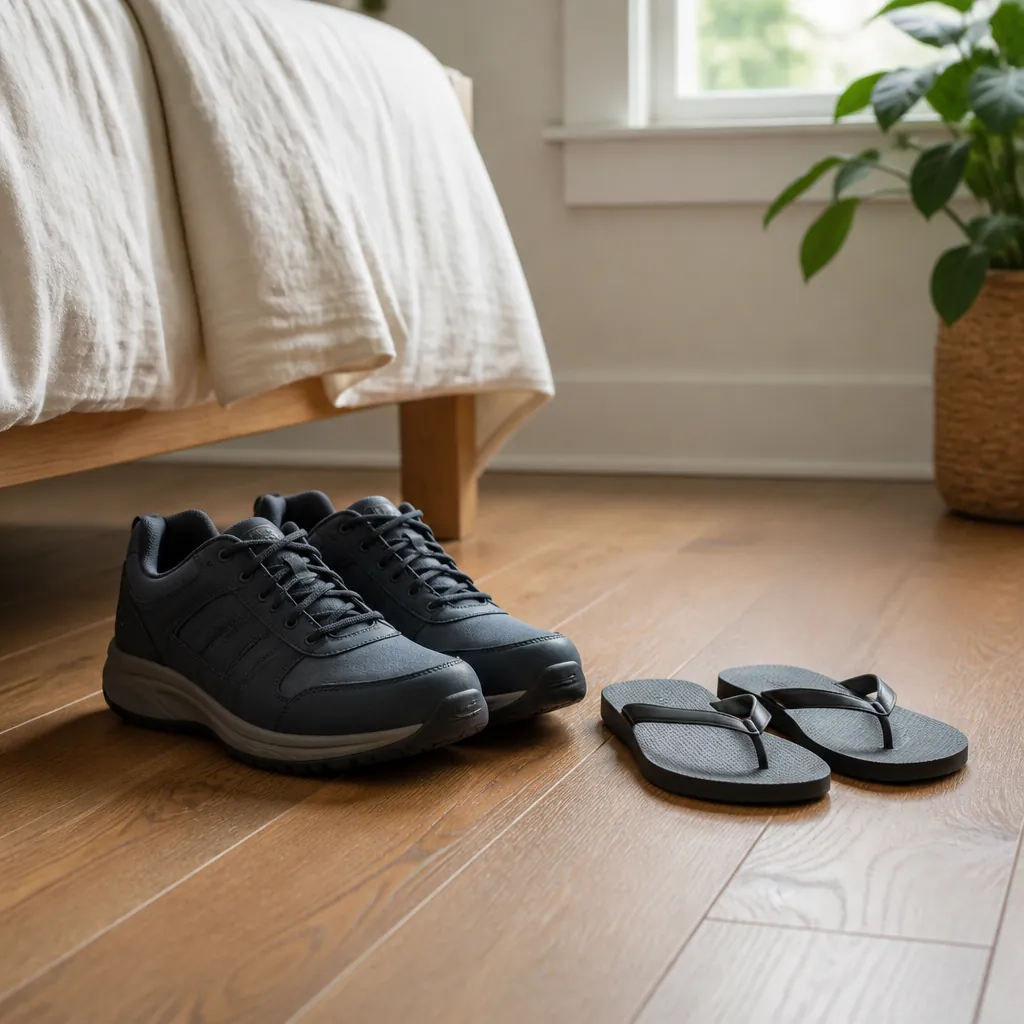
Look for closed-toe shoes or slippers with backs, non-slip soles, and enough structure that the foot does not slide around inside. Avoid loose slippers, floppy sandals, socks on smooth floors, and shoes that require your spouse to shuffle to keep them on.
Then look down at the walking surfaces with numb feet in mind. Thresholds, rug edges, curled bathmats, glossy tile, and uneven outdoor steps are less forgiving when sensation is reduced. The question is not whether you notice the hazard. The question is whether tired, numb feet will notice it in time.
Ask about physical therapy and assistive devices before guessing
A cane, walker, rollator, shower chair, raised toilet seat, or bedside commode can help only if it matches the person, the home, and the way your spouse actually moves. Cancer Today’s guidance notes that a physical therapy evaluation can help with assistive devices and with staying active safely [3].
Bring specifics to the appointment or phone call. “He nearly fell last night” is useful, but “he stood from bed, took two steps, grabbed the dresser, and said his feet felt numb” gives the team something clearer to work with. The care team may want to review symptoms, blood pressure concerns, anemia, infection risk, medication effects, neuropathy, pain, hydration, or other factors. Let them decide what needs medical evaluation.
- Ask whether your spouse should have a physical therapy evaluation for balance, strength, gait, and device training.
- Ask whether the current cane or walker is the right height and type.
- Ask whether showering, toilet transfers, stairs, or car transfers should be practiced with professional guidance.
- Ask which symptoms should trigger a same-day call versus a routine update.
- Ask whether any medication timing could be contributing to dizziness, sleepiness, or unsteadiness.
What to check in the rest of the home
After the bedroom-to-bathroom route and bathroom are addressed, widen the circle. You are looking for places where your spouse has to turn, reach, step over something, hurry, or walk without a steady handhold.
| Area | Check today | Safer adjustment |
|---|---|---|
| Bedroom | Does your spouse stand into darkness, step over slippers, or reach far for a lamp? | Put a lamp, phone, glasses, water, and assistive device within easy reach; clear the first few steps from bed |
| Hallway | Are there cords, rugs, baskets, pets, or furniture narrowing the route? | Keep a wide, predictable walking path and add night lighting |
| Living room | Does your spouse sink into a low chair or push off unstable furniture? | Use a firm chair with arms and keep pathways between chair, bathroom, and kitchen clear |
| Kitchen | Are often-used items high, low, or across the room? | Move daily items to waist-to-shoulder height and reduce carrying while walking |
| Entryway | Is there a step, loose mat, poor lighting, or no place to sit for shoes? | Add lighting, remove loose mats, and provide a stable seat for footwear changes |
| Stairs | Is your spouse carrying items, rushing, or using stairs during weak parts of the cycle? | Use handrails, keep steps clear, and ask the care team whether stairs should be limited during high-risk days |
If you feel as if you are the only one worrying about this, you are not. In a 2016 National Alliance for Caregiving report focused on cancer caregiving, 33% of cancer caregivers said they needed help keeping the person safe at home [5]. That figure is older and should be read as population-specific, not as a current national rate for every caregiver. It still names a common problem plainly: home safety becomes part of cancer care whether families were prepared for it or not.
A simple call-in rule for spouse-caregivers
Call the oncology team or the clinician number you were given when unsteadiness is new, worsening, or tied to other concerning symptoms. Do not wait until your spouse is on the floor to prove the risk was real.
- Report new numbness, tingling, burning, or loss of feeling in the feet.
- Report dizziness, lightheadedness, near-fainting, or feeling weak after standing.
- Report a new need to hold walls, furniture, or another person to walk.
- Report a near fall, even if your spouse caught themselves.
- Report changes that cluster after chemotherapy, medication changes, poor intake, fever concerns, bleeding concerns, or unusual fatigue.
For the call, describe what happened, when it started, where it happens in the house, what your spouse says they feel, and whether anything changed recently in treatment, medications, appetite, fluids, sleep, pain, or fever symptoms. Keep the home changes moving while the team evaluates the symptom: lights on the route, clear floor, safer shoes, grab bars, shower seating, and shorter nighttime distances.
The practical standard is not a perfect house. It is a house that changes when treatment changes. If your spouse is newly unsteady, treat that as a symptom worth reporting and a reason to revise the setup today.
References
- Falls in persons with chemotherapy-induced peripheral neuropathy, PubMed, 2012.
- Cancer Patients at Risk: Tips for Preventing Falls in the Hospital and at Home, Roswell Park Comprehensive Cancer Center, September 2020.
- How Can I Help Protect a Loved One With Cancer From Falling?, Cancer Today, Winter 2024–2025.
- Cancer Caregivers: Home Safety, Caregiver Action Network.
- Cancer Caregiving in the U.S.: An Intense, Episodic, and Challenging Care Experience, National Alliance for Caregiving, 2016.
Questions to bring to a clinician or OT
This is not medical, legal, or a family's final decision — only a framework. Bring these questions to a clinician, occupational therapist, or your local Area Agency on Aging.
Find Local HelpRelated reading
Noticed something outdated or inaccurate on this page? Flag a correction. We review every report against CDC, NIA, and AARP HomeFit guidance before updating a page.