
Caregiver decision guide
Recalled lettuce poses serious risks for older adults
Lettuce recalls are not just a general food safety concern—for older adults, age-related immune decline, reduced stomach acid, and slower digestion make infections from Listeria and E. coli far more likely to turn severe. This guide explains the specific risks and what caregivers should watch for.
A lettuce recall becomes a different kind of notice when the bag is already open in the refrigerator and the person eating from it is 78, recovering from surgery, taking immune-suppressing medication, or simply more fragile than they used to be. The question is not whether lettuce is usually healthy. It is whether recalled lettuce should still be treated as a small risk once an older adult may have eaten it.
For older adults, the practical answer is no: recalled lettuce deserves prompt attention. Listeria and E. coli O157:H7 are not just stomach bugs in this age group. Aging changes the defenses that normally keep contaminated food from becoming a serious infection, and those changes can turn a quiet exposure at lunch into dehydration, bloodstream infection, meningitis, kidney injury, hospitalization, or worse.
Why recalled lettuce is more serious after 65
The danger starts before anyone feels sick. A recalled lettuce product may have been exposed to a pathogen somewhere before it reached the kitchen. If that lettuce is eaten by a younger, healthy adult, the body may clear the organism or contain the illness. In an older adult, several protective barriers are often weaker at the same time.
The immune system becomes less quick and less coordinated with age. This immune senescence is noticeable beginning between ages 50 and 60 and becomes sharper after 75, which helps explain why infections that seem manageable in one household member can become severe in another. Stomach acid may also be lower, removing some of the acid barrier that helps kill microbes before they move farther into the digestive tract. Slower digestive transit gives organisms more time in the gut, where they can multiply, irritate the intestinal lining, or cross into places they should not be.

That is why national food safety agencies put older adults in a higher-risk group. CDC says adults 65 and older are four times more likely than younger adults to get a Listeria infection, and more than half of U.S. Listeria infections occur in this age group.[1] CDC also reports that nearly half of adults 65 and older with laboratory-confirmed foodborne illness from major pathogens are hospitalized.[2]
Those figures are not meant to frighten people away from vegetables. They are meant to change what happens after a recall notice. If the product matches the recall, the caregiver should not wait to see whether the older adult feels fine after dinner.
The household sequence that matters
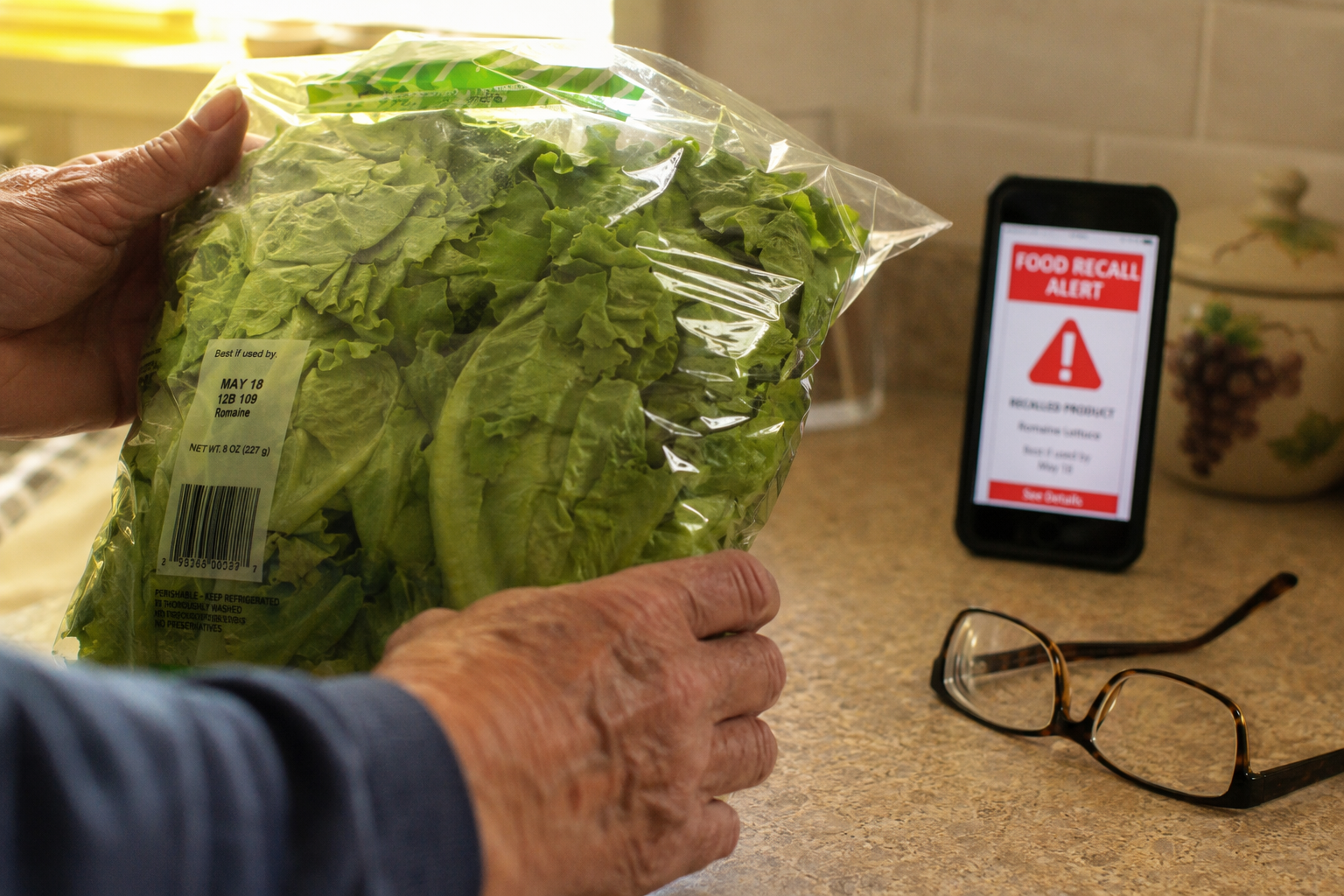
In a home kitchen, the risk usually unfolds in a plain, easy-to-miss order: the lettuce is bought, opened, served, stored, and maybe served again. A recall notice may arrive after the first salad has already been eaten. Someone checks the brand but misses the lot code. A parent says they feel fine. The bag goes back into the crisper because wasting food feels wrong.
For an older adult, that is the point where caution should take over. The useful question is not “Did it make anyone sick yet?” The useful question is “Could this exact product be part of the recall?” If yes, do not serve it. Follow the recall instructions for discarding or returning it, and clean refrigerator drawers, cutting boards, bowls, utensils, and counters that may have touched the lettuce or its juices.
This is especially important because symptom timing can mislead families. Many caregivers are used to thinking about food poisoning as something that shows up quickly. Listeria breaks that habit.
Listeria is the pathogen that changes the timeline
Listeria monocytogenes deserves special attention in older adults because it can move beyond the digestive tract. Invasive listeriosis can lead to sepsis and meningitis, and CDC reports that about 1 in 6 older adults with invasive listeriosis dies.[3] That is a very different risk profile from a short, unpleasant stomach illness.
It also has a long memory. CDC says symptoms of invasive Listeria infection usually start within 2 weeks after eating contaminated food, but they can begin as soon as the same day or as late as 10 weeks after exposure.[4] That long window matters in real caregiving life. By the time fever, confusion, stiff neck, worsening balance, or unusual weakness appears, the recalled lettuce may be long gone from the refrigerator and no one may remember which meals included it.
In an older adult, early illness may not look dramatic. A parent may not report nausea clearly. They may say they are tired, skip a meal, sleep more, or seem “off.” Fever may be absent or modest. A caregiver who knows there was a recalled lettuce exposure should keep that fact available for the healthcare professional, even if the timing feels stretched.
- Call promptly for fever, severe headache, stiff neck, confusion, loss of balance, unusual sleepiness, or new weakness after a possible Listeria exposure.
- Mention the recalled lettuce specifically, including brand, lot code, purchase location, and date eaten if known.
- Do not dismiss symptoms because the lettuce was eaten days or weeks earlier.
- Be more cautious if the older adult is immunocompromised, has cancer, diabetes, kidney disease, takes immune-suppressing drugs, or has recently been hospitalized.
FDA’s food safety guidance also places older adults and people with conditions such as cancer, diabetes, HIV/AIDS, organ transplants, and autoimmune disease among those at higher risk from foodborne illness.[5] USDA FSIS gives the same practical reason for extra care: older adults are an at-risk population because their immune systems and gastrointestinal defenses are less able to handle contaminated food.[6]
E. coli O157:H7 can move fast in a frail body
E. coli O157:H7 tends to worry caregivers for a different reason. It is known for severe gastrointestinal illness, often with abdominal cramps and diarrhea that may become bloody. In an older adult, the diarrhea itself can become dangerous quickly because dehydration strains the kidneys, worsens dizziness and fall risk, and can destabilize existing heart, kidney, or blood pressure problems.
The complication caregivers most need to recognize is hemolytic uremic syndrome, often shortened to HUS. It is a serious condition involving destruction of red blood cells and kidney injury. Older adults are not the only group at risk, but they may have less reserve when dehydration and kidney stress begin to build.
- Seek medical advice quickly for bloody diarrhea, severe abdominal pain, repeated vomiting, signs of dehydration, decreased urination, unusual bruising, marked fatigue, or confusion.
- Do not assume diarrhea is minor if the older adult is frail, lives alone, has kidney disease, or is already taking medications that affect fluid balance.
- Tell the clinician about the recall exposure before asking whether home care is enough.
The caregiver’s job is not to diagnose E. coli or Listeria at the kitchen table. It is to connect the dots early enough that the clinician has the exposure history while decisions about testing, fluids, monitoring, or treatment still have time to matter.
Lettuce contamination is not imaginary, but the recall details matter
Leafy greens have a documented outbreak history. CDC reported 78 foodborne disease outbreaks linked to leafy greens between 2014 and 2021, according to Consumer Reports’ review of lettuce safety.[7] A more recent example involved romaine lettuce and E. coli O157:H7 in November 2024, with NBC News reporting 89 cases across 15 states, 1 death, and 7 cases of HUS based on an internal FDA report.[8]
That does not mean every bag of lettuce is unsafe, and no specific 2026 lettuce recall was identified in the materials used for this article. It means that when an actual recall names a product in the refrigerator, a caregiver should treat the match as meaningful. Recalls are not issued because someone dislikes salad. They are issued because a specific product, producer, batch, facility, or distribution pattern has raised enough concern to warn the public.
Washing is not the answer to a recalled product. If lettuce has been recalled because of possible contamination, rinsing it at home cannot reliably make it safe for a higher-risk older adult. The decision is simpler than the debate about ordinary produce washing: recalled lettuce should not be served.
What to do when the recalled lettuce may already have been eaten
Start with the bag, not with reassurance. Check the recall notice against the product name, brand, package size, best-by date, lot code, store, and purchase date. If your parent cannot read the code or does not remember when it was bought, do not make them responsible for sorting it out alone. Take a photo of the label if you need to compare it with the notice or share it with another family member.
| Caregiver task | Why it matters |
|---|---|
| Remove the lettuce from meals immediately | Prevents a second exposure while you confirm recall details |
| Discard or return it according to the recall notice | Keeps a higher-risk older adult from eating a product already under warning |
| Clean refrigerator drawers, counters, cutting boards, bowls, and utensils | Reduces the chance that residue or juices contaminate other foods |
| Write down when it may have been eaten | Helps a clinician interpret symptoms, especially with the long Listeria window |
| Monitor for gastrointestinal, neurological, and dehydration symptoms | Keeps attention on the complications most likely to harm an older adult |
If the older adult feels well, that is good news, but it is not proof that the exposure is harmless. With Listeria, the possible delay means a caregiver may need to stay alert beyond the first day or two. With E. coli, the concern is often whether diarrhea, vomiting, or poor intake starts a decline that the older adult cannot easily absorb.
This is also where caregiving systems matter. If several people help with meals, everyone needs the same instruction: do not use the recalled lettuce, even if it looks fresh. If an older adult receives paid help at home, meal preparation should include checking recall notices, removing unsafe food, and documenting possible exposures when there is a known risk. Broader home care planning often treats meal prep as a routine task, but food safety is part of that task when a person’s age or health status raises the stakes.
When to call for help
For an older adult who may have eaten recalled lettuce, it is reasonable to contact a healthcare professional promptly if symptoms appear, and sooner if the person is medically fragile. The call should include the recall exposure, the suspected pathogen if the notice names one, the date or range of dates the lettuce may have been eaten, and any symptoms that are new for that person.
- For possible Listeria: fever, muscle aches, headache, stiff neck, confusion, loss of balance, seizure, unusual weakness, or a sudden change in alertness.
- For possible E. coli O157:H7: severe stomach cramps, diarrhea that becomes bloody, repeated vomiting, poor fluid intake, decreased urination, dizziness, confusion, or unusual bruising.
- For any pathogen: worsening frailty, inability to keep fluids down, signs of dehydration, or symptoms that are mild but not normal for that older adult.
The calm standard is straightforward: if lettuce is recalled, do not serve it to an older adult. Remove it, follow the recall instructions, clean what it touched, and keep the exposure history in mind if symptoms develop. That is not panic. It is the practical response to a body with less margin for a foodborne infection.
References
- Older Adults Are at Higher Risk for Listeria Infection, Centers for Disease Control and Prevention, https://www.cdc.gov/listeria/risk-groups/elderly.html
- People With a Higher Risk of Food Poisoning, Centers for Disease Control and Prevention, https://www.cdc.gov/food-safety/risk-factors/index.html
- Clinical Overview of Listeriosis, Centers for Disease Control and Prevention, https://www.cdc.gov/listeria/hcp/clinical-overview/index.html
- Signs and Symptoms of Listeria Infection, Centers for Disease Control and Prevention, https://www.cdc.gov/listeria/signs-symptoms/index.html
- Food Safety for Older Adults and People with Cancer, Diabetes, HIV/AIDS, Organ Transplants, and Autoimmune Diseases, U.S. Food and Drug Administration, https://www.fda.gov/food/people-risk-foodborne-illness/food-safety-older-adults-and-people-cancer-diabetes-hivaids-organ-transplants-and-autoimmune
- Adults 65 and Older: An At-Risk Population - Why?, USDA Food Safety and Inspection Service, http://www.fsis.usda.gov/news-events/news-press-releases/adults-65-and-older-risk-population-why
- Your Guide to Safer Lettuce, Consumer Reports, https://www.consumerreports.org/health/food-safety/your-guide-to-safer-lettuce-a6363195657/
- E. coli bacteria linked to romaine lettuce outbreak sickened 89 people in 15 states, FDA report says, NBC News, https://www.nbcnews.com/news/us-news/ecoli-bacteria-lettuce-outbreak-rcna200236
Questions to bring to a clinician or OT
This is not medical, legal, or a family's final decision — only a framework. Bring these questions to a clinician, occupational therapist, or your local Area Agency on Aging.
Find Local HelpRelated reading
Noticed something outdated or inaccurate on this page? Flag a correction. We review every report against CDC, NIA, and AARP HomeFit guidance before updating a page.