
Caregiver decision guide
A Week-by-Week Recovery Timeline for Older Adults After Hospital
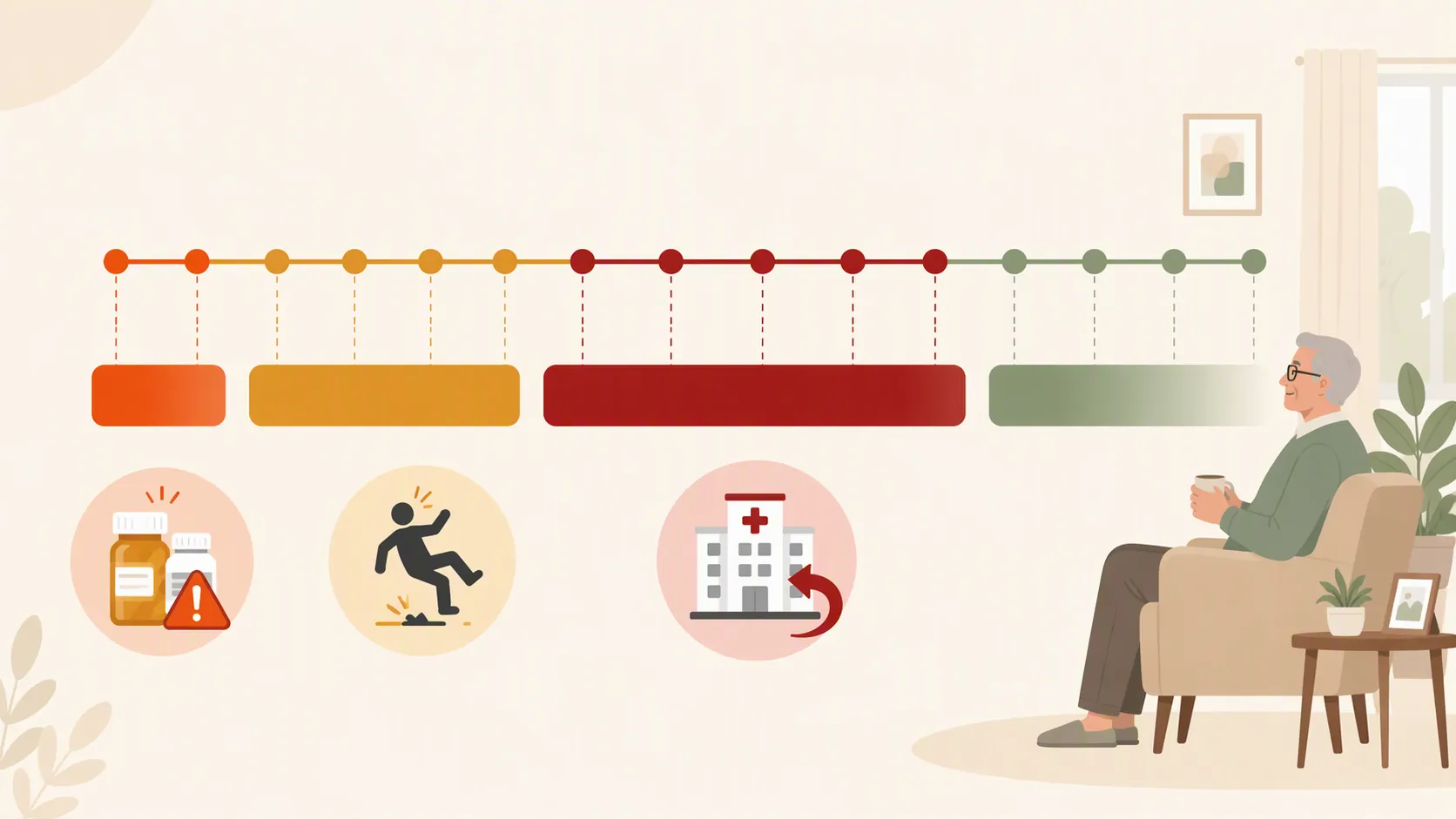
This guide breaks down the first year of recovery after hospitalization into four distinct phases, from the first 72 hours through months 3–12, with specific risk windows, functional milestones, and actionable steps for caregivers to prevent falls, medication errors, and readmission.
The first evening home usually looks calmer than it feels. The discharge folder is on the kitchen table. The older adult says they are fine. Someone is looking for the new blood pressure pill, someone else is trying to remember whether the walker came out of the trunk, and everyone is tired enough to accept “recover at home” as if it were a plan.
For an older adult, the recovery timeline after hospitalization is not just “rest for a few weeks.” The first 72 hours are medication- and fall-sensitive; days 4–14 are when readmission risk can rise; weeks 3–4 often bring a functional plateau and caregiver fatigue; months 1–3 carry a large share of measurable recovery in daily activities; and months 3–12 are slower movement toward a new normal.
This guide is for caregiver planning, not medical diagnosis. If your parent has new chest pain, trouble breathing, fainting, one-sided weakness, severe confusion, uncontrolled bleeding, signs of stroke, or any symptom the discharge team told you was urgent, call emergency services or the discharging clinician’s after-hours line rather than trying to fit it into a timeline.

| Recovery phase | What often misleads families | Main caregiver job |
|---|---|---|
| Days 1–3 | The house feels safer than the hospital, so everyone relaxes too soon. | Reconcile medications, watch dizziness and confusion, make bathroom trips safe, and keep mobility realistic. |
| Days 4–14 | The first few days went well, so new symptoms are dismissed as normal tiredness. | Track changes, keep follow-up appointments, prevent overexertion, and call early when the plan is not working. |
| Weeks 3–4 | Recovery seems stalled, and both parent and caregiver may feel discouraged. | Measure function in daily tasks, not mood alone; adjust help before burnout drives mistakes. |
| Months 1–3 | Progress is slower than expected, so families assume improvement is over. | Support therapy, nutrition, sleep, and daily practice while watching for avoidable setbacks. |
| Months 3–12 | The old baseline may not return exactly, or it may return more slowly than promised. | Reassess mobility, home setup, medications, and caregiving load around the person’s actual abilities. |
Days 1–3: the deceptively manageable window
The first three days after coming home are not a grace period. They are the handoff. A care-transition source reports that nearly 50% of patients experience a medication error within 30 days of discharge, with errors peaking within the first 48 hours; because that source is a home-care organization citing Medicare and CDC data, the exact figure is best treated as a warning signal rather than a personalized prediction, but the timing is useful: the medication list deserves attention before the first full night home, not after a problem appears.[1]
Start with the discharge medication list, the old pill bottles, and the new prescriptions in one place. The dangerous mistakes are often ordinary-looking: an old blood pressure pill continued after the hospital stopped it, a pain medication taken too close to a sleep aid, a blood thinner restarted at the wrong dose, or an antibiotic missed because the bottle was still in the pharmacy bag. If there is any mismatch between the written list and the bottles at home, call the discharging unit, primary care office, or pharmacist. Do not let “we’ll sort it out tomorrow” become the medication plan.
- Ask: Which medications are new, stopped, changed, or temporary?
- Separate old medications that are no longer on the discharge list.
- Write down the next dose time for each essential medication.
- Confirm whether over-the-counter sleep aids, pain relievers, supplements, or “as needed” pills are allowed.
- Keep one phone number visible for medication questions after hours.
The second assignment is the bathroom plan. Falls after discharge are common enough to plan for without turning the house into a panic zone: a review on post-discharge fall prevention reported that about 14% of older adults fall within one month of discharge and 40% fall within six months.[2] The first trips to the bathroom are especially revealing because they combine several risks at once: standing up from bed, dim lighting, urgency, new medications, possible dehydration, and an older adult who may be embarrassed to ask for help.
A parent may say, “I can do it,” and still need someone nearby the first night. That is not a judgment on their independence. It is a test of whether the body that left the hospital can safely do what the pre-hospital body did automatically.
The first walk across the room tells you more than the discharge phrase “medically stable”
Older adults can lose strength quickly during bed rest. Mayo Clinic Press describes muscle loss during bed rest at about 2% to 5% per day, and Harvard Health notes that 10 days of bed rest in adults over 80 can lead to a 14% loss of muscle mass, an amount compared with roughly 10 years of muscle aging.[3][4] That helps explain the confusing mismatch many families see: the infection is treated, the surgery is over, the labs look better, and yet walking from the bedroom to the kitchen is suddenly a major event.
For the first 72 hours, treat mobility as observed activity, not a verbal report. Watch how your parent stands up, whether they grab furniture, whether they pause from dizziness, whether they can turn safely, and whether they remember to use the walker or cane. The walker in the trunk is not helping anyone. Put it where the first steps will happen.
Dizziness after standing deserves special attention because it can be tied to dehydration, blood pressure changes, medication changes, anemia, infection, or simple deconditioning. If your parent feels lightheaded when moving from lying to sitting or sitting to standing, slow the transition and call the clinician if it is new, severe, recurrent, or paired with falls, fainting, chest symptoms, shortness of breath, or confusion.
Confusion, sleep, food, and fluids belong in the same safety check
Hospitalization itself can leave an older person vulnerable. Harvard Health describes post-hospital syndrome as a period of generalized health vulnerability lasting up to seven weeks after discharge, influenced by sleep disruption, deconditioning, nutritional depletion, medication changes, and delirium risk.[4] Those factors show up at home as a parent who naps all day and wanders at night, forgets instructions, eats two bites and says they are full, or seems “off” in a way the discharge paperwork did not prepare the family for.
Delirium is not just hospital confusion that politely ends at the front door. Mayo Clinic Press notes that delirium affects up to 50% of older adults in certain hospital settings, and that bundles using reorientation, sleep hygiene, early mobility, and sensory support can reduce delirium by 30% to 40%.[3] At home, the caregiver version is simple: keep glasses and hearing aids available, reorient gently, protect nighttime sleep when possible, get daylight during the day, encourage safe movement, and report sudden confusion rather than explaining it away as stubbornness.
Food and fluids matter here because they change the risk picture. Poor intake can worsen weakness, dizziness, constipation, medication side effects, and confusion. The goal in the first few days is not a perfect diet; it is enough fluid and enough protein or calories to support healing, unless the discharge instructions restrict fluids, salt, sugar, potassium, or another part of the diet.
Days 4–14: why the danger zone can start after everyone relaxes
The first few days home can trick a family. People visit. The parent is relieved. The caregiver is running on adrenaline. Then the house gets quiet, the follow-up appointment has not happened yet, new medications start showing their real side effects, and the older adult begins doing more because they are tired of being watched.
This is where readmission risk becomes more than a vague warning. In a 2024 Yale News report on a JAMA Network Open study of older Americans after major surgery, nearly one in five Medicare beneficiaries were readmitted within 30 days, and readmissions peaked between days 7 and 10 after discharge.[5] That study was surgical, so it should not be stretched to every hospital stay as if the rate is identical. But the timing matches what caregivers need to respect: the second week can be more dangerous than the first because problems have had time to evolve.
The question during days 4–14 is not “Is my parent back to normal?” They probably are not. The better question is “Are they moving in the right direction, or are we seeing a new decline?” A little fatigue after activity may fit recovery. New shortness of breath walking to the bathroom, worsening swelling, fever, increasing pain, repeated vomiting or diarrhea, new confusion, inability to keep fluids down, a fall, or a medication that cannot be taken as prescribed should move from observation to a call.
| What changes in days 4–14 | Why it matters | Caregiver response |
|---|---|---|
| Pain medication use changes | Too much can increase sleepiness, constipation, confusion, and fall risk; too little can stop movement and sleep. | Track dose times and pain level; ask the clinician how to taper or adjust if the plan is not working. |
| Antibiotics, diuretics, blood pressure pills, or diabetes medications settle in | Side effects may not be obvious on day one. | Watch dizziness, appetite, urination, glucose instructions if relevant, and hydration limits if prescribed. |
| The older adult tries to resume normal routines | Confidence can return faster than strength. | Keep the walker, grab bars, raised toilet seat, shower chair, or supervision in place even if they complain. |
| Follow-up care is still pending | A medication mismatch, wound issue, lab concern, or symptom change may not yet have been reviewed. | Schedule and keep follow-up appointments; bring the medication list and a short symptom log. |
| Caregiver vigilance drops | The household assumes the crisis is over. | Use a simple daily check: eating, drinking, bathroom, walking, pain, sleep, mood, breathing, swelling, medication. |
Falls in week two often come from negotiation, not ignorance
Many older adults understand the fall instructions and still resist them. The shower chair feels humiliating. The walker makes them look old. A daughter hovering outside the bathroom feels like surveillance. The caregiver’s job is not to win an argument about identity; it is to make the safest option the easiest one to accept.
That means placing equipment before it is needed, not after a scare. Put night-lights along the bathroom path. Remove throw rugs and cords from the walking route. Keep shoes or non-slip socks within reach. Set the walker at the side of the bed, not across the room. If your parent is dizzy when standing, treat nighttime bathroom trips as assisted trips until a clinician has clarified the cause.
Language matters. “You are not allowed to walk alone” often becomes a fight. “For this week, let’s use the walker every time so we do not lose ground” gives the restriction an end point and a purpose. If resistance is intense, ask the physical therapist or clinician to reinforce the plan; some parents accept safety limits better from someone who is not their child.
Do not wait for the perfect follow-up visit to call
By the second week, a caregiver may worry about “bothering” the doctor. That politeness can be expensive. The discharging team needs to know if the plan is failing in real life: the prescription was not filled, the parent cannot climb the stairs to the only shower, the wound dressing cannot be changed safely, the home oxygen instructions are unclear, the parent is too weak to get to the toilet, or the family cannot provide the level of supervision implied by the discharge instructions.
Bring facts, not a speech: temperature readings, blood pressure if you were told to monitor it, oxygen level if prescribed, blood sugar if relevant, weight if heart failure or fluid status was discussed, pain score, bowel movements, food and fluid intake, walking distance, falls or near-falls, and missed medication doses. A two-minute log can change the quality of the call.
Weeks 3–4: the plateau that feels like failure

Around weeks three and four, the emergency energy fades. The older adult may be angry that they still need help. The caregiver may be back at work, sleeping badly, or quietly counting how many times they have answered the same question. This is often when recovery starts to feel stalled, even if the body is still healing.
A plateau is not automatically bad. It becomes dangerous when frustration leads people to drop the supports that are still preventing setbacks: medication supervision, the walker, help with bathing, meal support, transportation to therapy, or someone checking whether the parent is actually drinking enough.
This is the point to measure recovery in activities of daily living, not in optimism. Can your parent bathe safely? Dress without losing balance? Get on and off the toilet? Prepare something to eat? Walk to the mailbox or just to the kitchen? Hebrew SeniorLife notes that more than half of older adults need help with daily activities such as bathing or dressing after discharge.[6] That kind of help is not a character flaw. It is part of the recovery workload.
- If bathing is still unsafe, switch to seated sponge bathing or supervised showers rather than pretending independence has returned.
- If dressing causes exhaustion, lay out clothes and allow more time instead of rushing.
- If stairs are still too hard, move essential items to one level temporarily.
- If the caregiver is making medication decisions from memory, rebuild the written schedule.
- If appointments, meals, toileting, and sleep are all depending on one person, bring in another family member, paid help, respite care, or community support before resentment turns into missed care.
Some families use the rule of thumb that recovery may take about one week for each day spent in the hospital. The National Council on Aging presents that as a practical way to set expectations after acute illness, but it should stay in the category of rough planning, not prophecy.[7] A three-day hospital stay does not guarantee three neat weeks of recovery, and a longer stay does not mean improvement stops when the calendar says it should.
If the hospitalization was tied to cancer treatment, the logistics can be heavier because appointments, fatigue, nutrition issues, infection precautions, and medication changes may overlap. The same recovery questions still apply: what can the person do safely today, what has changed since last week, and which task is quietly exceeding the caregiver’s capacity?
Months 1–3: meaningful recovery can still be happening
After the first month, families often expect a cleaner answer: recovered or not recovered. Older adults rarely move that neatly. A study of recovery in activities of daily living among older adults after hospitalization found that 22% of ADL recovery occurred between one and three months after discharge, and the authors described recovery as prolonged and non-linear.[8]
That 22% does not mean your parent will recover 22% of what they lost during that exact window. It means that, in the study’s recovery pattern, a meaningful share of measurable improvement happened after the first month. For caregivers, the practical message is to keep building the day around function: safe walking, therapy exercises if prescribed, meals that actually get eaten, sleep routines, follow-up visits, and medication reviews.
This is also when small changes become easier to miss. A parent who could walk to the kitchen last week but now stops halfway needs attention. A parent who was eating breakfast but now skips it most days needs a question, not a shrug. A parent who stopped using the walker because they “graduated” from it but now holds the wall is giving you useful information.
| By months 1–3, ask | Why the answer matters |
|---|---|
| Can they manage basic self-care without unsafe shortcuts? | Bathing, dressing, toileting, and transfers are where independence and fall risk meet. |
| Are they walking more, less, or just differently? | A change in gait, endurance, or balance may signal deconditioning, pain, medication effects, or a new medical issue. |
| Have all medications been reviewed since discharge? | Temporary prescriptions sometimes linger, and old medications sometimes reappear. |
| Is sleep improving? | Poor sleep can worsen confusion, mood, appetite, and daytime mobility. |
| Is the caregiver schedule sustainable? | A recovery plan that depends on one exhausted person is fragile. |
If therapy was ordered, this is the period to take it seriously even when the exercises look too simple. Sit-to-stand practice, walking intervals, balance work, and safe transfers may be the difference between needing help with every bathroom trip and needing help only outside the home. If therapy was not ordered but your parent is still much weaker than before hospitalization, ask whether a physical or occupational therapy evaluation is appropriate.
Months 3–12: slower gains, reassessment, and the new normal
Recovery after three months is usually quieter. It may still be real. The same ADL recovery study found that 16% of recovery occurred after three months, which is why it is too early to assume that every limitation at month three is permanent.[8]
Still, the focus changes. In the first two weeks, you are trying to prevent the obvious crash: medication mistakes, falls, dehydration, unmanaged symptoms, readmission. By months three to twelve, the better work is reassessment. Does the home still fit the person’s mobility? Are the stairs still realistic? Is driving safe? Is the cane enough, or is the person using furniture as unofficial equipment? Are medications still aligned with current blood pressure, kidney function, cognition, appetite, and fall risk?
The “new normal” should not be declared by exhaustion. It should be named after a clinician has reviewed the recovery, the family has compared current function with the pre-hospital baseline, and the older adult has had a fair chance to regain strength. Sometimes the new normal is close to the old one. Sometimes it includes a walker, home modifications, more help with bathing, fewer stairs, or a different living arrangement. None of those decisions should be made from one bad week alone.
A difficult recovery does not become safe because everyone wants it to be over. It becomes safer when the family watches the right risk at the right time: medication in the first 48 hours, falls and dizziness in the first month, readmission signals around the second week, caregiver strain near the plateau, and daily-function gains across the months that follow.
References
- Why the First 30 Days After Discharge Are Critical. Care Plan Inc.
- Barriers and Facilitators to Fall Prevention After Transitioning Home. PMC.
- The Risks of Hospital Stays. Mayo Clinic Press.
- Post-Hospital Syndrome. Harvard Health.
- Risk of Hospital Readmission After Surgery. Yale News. February 28, 2024.
- How to Improve Recovery After a Hospital Stay. Hebrew SeniorLife.
- Recovering After a Hospital Stay. National Council on Aging.
- Recovery in ADL Among Older Adults Following Hospitalization. J Am Geriatr Soc.
Questions to bring to a clinician or OT
This is not medical, legal, or a family's final decision — only a framework. Bring these questions to a clinician, occupational therapist, or your local Area Agency on Aging.
Find Local HelpRelated reading
Noticed something outdated or inaccurate on this page? Flag a correction. We review every report against CDC, NIA, and AARP HomeFit guidance before updating a page.