
Caregiver decision guide
Safety Lapses Can Be Early Signs of Cognitive Decline
Cognitive decline in elderly parents often first appears as safety slips — a fall, a driving near-miss, an unpaid bill, a phone scam — before memory problems become obvious. Knowing which red flags warrant a doctor's visit, and writing down what you observe, gives a clinician concrete evidence to evaluate.
The first signs of cognitive decline in elderly parents do not always look like forgetting a grandchild’s name or repeating the same story. Sometimes they look like a bruised hip after a fall no one can quite explain, a scraped bumper after a familiar drive, a utility bill paid twice, or a long phone call with someone who should have sounded suspicious.
One incident may have a simple explanation. Everyone trips. Everyone misplaces a bill. Anyone can be rattled by a convincing scammer. The concern rises when the event is new for that parent, repeats, clusters with other changes, causes injury, or shows that judgment and attention are not working the way they used to.
That is the practical threshold families often need: not enough evidence to diagnose dementia at home, but enough evidence to stop explaining everything away. Safety slips are observable. They leave consequences. They are worth writing down and bringing to a clinician, especially when memory complaints have not yet become obvious.
Safety changes that deserve attention
A useful watch list starts with changes that affect independence. The question is not “Did Dad have a normal aging moment?” It is “Did something happen that put him, someone else, his money, or his daily care at risk?”
| Area of safety | What may be worth documenting |
|---|---|
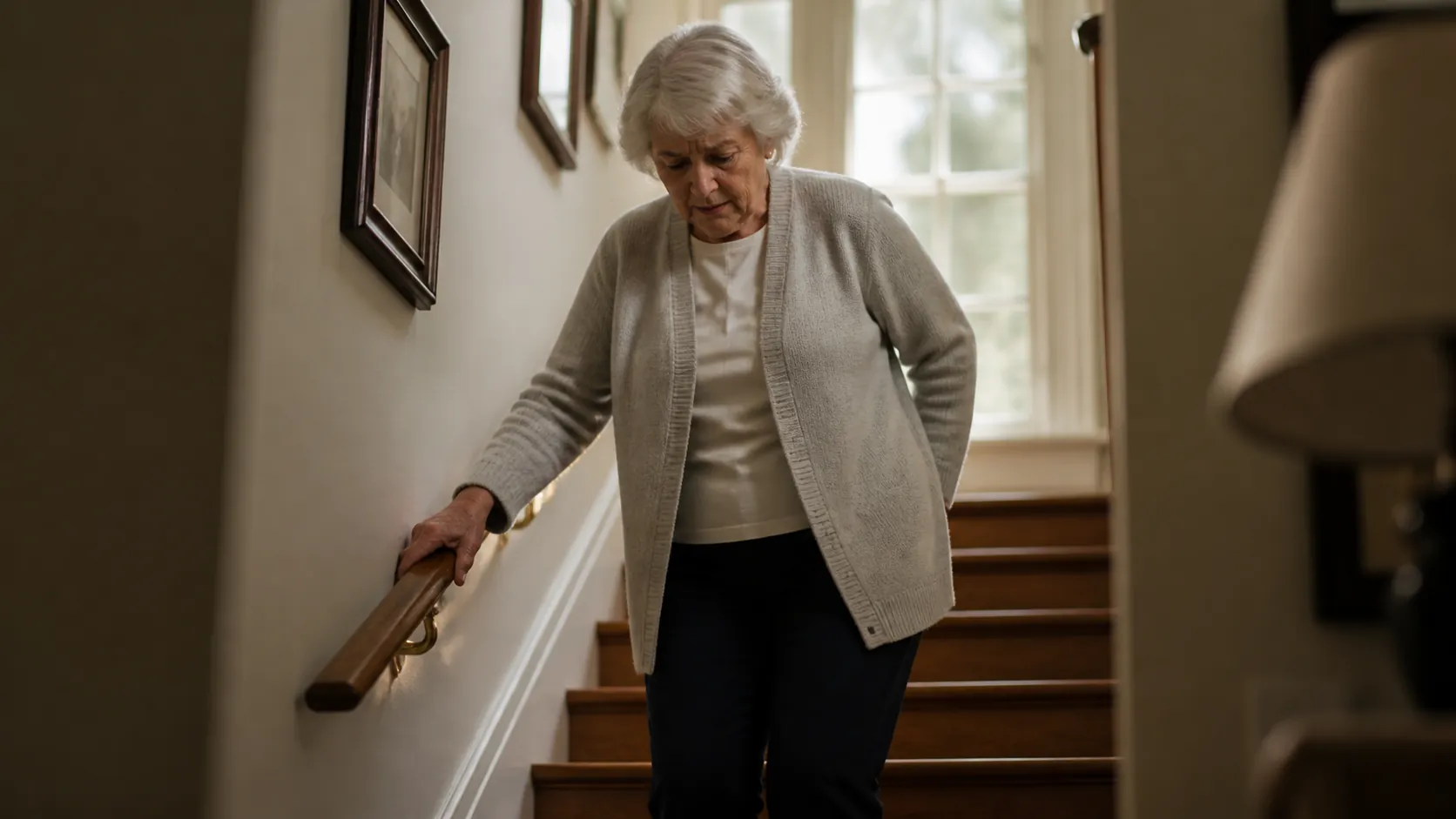
| Falls and mobility | A fall with no clear trip hazard; repeated stumbles; trouble judging a step, curb, or doorway; new hesitation on stairs; unexplained bruises. |
| Driving | Clipping a curb; drifting lanes; getting confused on a familiar route; new dents; near-misses; delayed reactions at intersections. |
| Money and bills | Paying the wrong bill; paying the same bill twice; missing a routine payment; unusual withdrawals; confusion over accounts that used to be familiar. |
| Scam vulnerability | Staying on the phone with a suspicious caller; sharing information too freely; making unusual purchases; seeming unable to stop an interaction that feels wrong. |
| Self-care | Skipping medications without noticing; wearing inappropriate clothing for the weather; spoiled food left in the refrigerator; noticeable decline in hygiene or meals. |
The pattern matters more than any single item on the list. A parent who has always hated paperwork may miss a bill without that saying much. A parent who managed every payment for decades and suddenly cannot keep the electric bill straight is a different situation. A cautious driver who has one scraped wheel may simply have misjudged a tight turn. A cautious driver who has new dents, a recent near-miss, and confusion on familiar roads has created a pattern that should not be left to family debate alone.
A fall is not just a fall when it marks a change
Falls deserve special care in this conversation because they are easy to file under “physical problems” and move on. Poor lighting, medication side effects, pain, vision changes, dizziness, neuropathy, weak muscles, and hazards in the home can all contribute to a fall. None of that disappears just because the family is also worried about cognition.
Still, an injurious fall can be a serious clue. In a JAMA Network Open cohort study of 2,453,655 Medicare beneficiaries age 66 and older, 10.6% of older adults with an injurious fall were diagnosed with dementia within one year, compared with 6.1% of older adults injured by other mechanisms. The study reported a 21% increased risk of a new dementia diagnosis after an injurious fall compared with other injury mechanisms [1].
That finding should be read carefully. It does not mean a fall proves dementia. It does not mean the fall caused dementia. It also does not mean that every older adult who falls is on the same path. The study measured new dementia diagnoses after injury among Medicare beneficiaries, and an association like that can reflect several realities at once: early cognitive changes may raise fall risk, a fall may bring someone into medical care where previously unnoticed symptoms are evaluated, or the people who fall may differ from those injured in other ways.
For a family, the practical meaning is narrower and more useful: after an injurious fall, especially one that is hard to explain or followed by other safety lapses, it is reasonable to ask for cognitive concerns to be considered along with the physical fall workup. A hip bruise, wrist fracture, or head injury may be the visible consequence. The question behind it is whether attention, judgment, balance, perception, medication management, or problem-solving has changed.
Driving lapses are often the clue families dread naming
Driving is where independence, identity, and public safety collide. Families may avoid the topic because it feels like an accusation. But if a parent is having repeated trouble behind the wheel, the issue is not personality. It is risk.
The most useful observations are concrete. “She clipped the curb turning into the grocery store lot.” “He missed the exit to the pharmacy he has used for years.” “There is a new scrape on the passenger side and he cannot explain where it came from.” “She stopped in the middle of a green-light turn because she seemed unsure what the oncoming car would do.”
Those details help more than a general statement like “I’m worried about her driving.” A clinician cannot reconstruct a pattern from family tension alone. Specific events show what changed: navigation, reaction time, judgment, attention, vision, confidence, or the ability to manage several pieces of information at once.
Money mistakes can reveal judgment changes before memory complaints do
Financial errors are easy to hide and easy to rationalize. A parent may be embarrassed. A spouse may quietly fix the problem. An adult child may discover the issue only after a late notice, a strange subscription, or a bank statement that does not match the parent’s usual habits.
The red flag is not that an older person dislikes online banking or asks for help with a password. The red flag is a change in capacity. Someone who always kept careful records starts missing routine payments. Someone who never donated over the phone begins giving card information to callers. Someone who understood the household budget suddenly cannot explain large withdrawals or duplicate payments.
If money is involved, the family may need to act on two tracks at once: protect the parent from immediate harm and document the cognitive concern for medical evaluation. The first track may involve practical safeguards within the family’s legal and financial situation. The second track requires a clear description of what happened, because “Mom is bad with money now” is too vague to be useful.
Scam vulnerability is a safety issue, not a character flaw
A parent who stays on the phone with a scammer may not look “confused” in the classic way. They may sound polite, anxious, trusting, or overwhelmed. The concerning part is the shift in judgment: they do not hang up, do not verify, do not call a family member, or do not recognize pressure tactics that they would have rejected in the past.
Families sometimes treat this as gullibility, loneliness, or stubbornness. Any of those may play a role. But if scam vulnerability appears alongside missed bills, driving confusion, falls, medication mix-ups, or trouble following ordinary household routines, it belongs on the same observation list. It is another sign that the parent may be struggling to judge risk in real time.
Self-care changes are easy to miss until they become unsafe
Self-care decline often arrives quietly. The house is a little less orderly. Food is past its date. Prescriptions are scattered across the counter. The same outfit is worn for days. A parent who used to prepare meals now seems to snack randomly or skip eating. These changes can have many causes, including pain, depression, grief, medication problems, vision loss, fatigue, or reduced mobility. They still deserve attention when they are new or worsening.
The useful question is whether the parent can still manage the sequence of everyday care. Buying groceries, storing food, taking medication, bathing, dressing for the weather, and keeping appointments all require planning and follow-through. When those steps start breaking down, the result may look like neglect, but the underlying issue may be cognitive, physical, emotional, medical, or some combination. That is exactly why a clinician needs specifics rather than family guesses.

Write down the incident before the family starts debating it
Families lose important evidence by arguing too early. One person says the parent is unsafe. Another says everyone is overreacting. The parent feels accused. By the time anyone calls the doctor, the story has become emotional and blurry.
A short incident log gives everyone something calmer to work from. It does not need medical language. In fact, it is usually better without it. Describe what happened in ordinary, observable terms.
- Date or approximate time: “Last Tuesday morning,” “twice this month,” or “after dinner on Sunday.”
- What happened: “Fell going from the bedroom to the bathroom,” “paid the cable bill twice,” “got lost driving home from church.”
- What was different from usual: “This route is familiar,” “she has managed this bill for years,” “he normally uses the handrail.”
- Consequences: “Bruised hip,” “late fee,” “new dent,” “gave caller bank information,” “missed medication doses.”
- Possible contributing factors: “New medication,” “poor sleep,” “recent illness,” “pain flare,” “bad lighting,” “rushing to answer the phone.”
- Who observed it: “Daughter saw it,” “neighbor called,” “spouse found the notice,” “parent reported it later.”
That last point matters. A clinician will weigh a witnessed fall differently from a story pieced together from a bruise and a guess. A bank statement, a pharmacy refill pattern, or a neighbor’s account may also clarify what changed. The goal is not to build a case against the parent. The goal is to make the concern specific enough that someone qualified can evaluate it.
Helpful wording is factual, not diagnostic
Instead of “I think Mom has dementia,” try: “Mom has had two falls in the last month, both in familiar parts of the house. She also paid the same bill twice and seemed unable to explain why. This is new for her. Could we evaluate whether there are medical, medication, balance, vision, or cognitive factors involved?”
Instead of “Dad can’t drive anymore,” try: “Dad has had three recent driving incidents that are unusual for him: a curb strike, confusion on a familiar route, and a near-miss at an intersection. I’m worried about safety and would like guidance on evaluation.”
This kind of wording leaves room for other explanations. It also keeps the focus on function. A parent may argue with a label. It is harder, and often more useful, to discuss a documented change in what happened.
When to call a clinician
A medical evaluation is especially reasonable when safety events are new, repeated, injurious, unexplained, or linked to more than one area of daily life. A single fall followed by normal function may lead to one kind of conversation. A fall plus missed medications, driving confusion, and unusual financial decisions calls for a broader one.
The clinician may consider many possible causes. Cognitive decline is one possibility, but so are medication effects, infection, dehydration, sleep problems, depression, pain, vision or hearing changes, balance disorders, and other medical issues. Families do not need to sort that out alone before asking for help. They need to notice the change clearly enough to bring it forward.
Safety lapses are not proof of dementia. They are evidence that something in daily functioning may have changed. Treating them as seriously as memory complaints gives the family a better path than arguing over whether a parent is “just getting older.” Write down what happened, describe the consequences, and bring the pattern to a doctor or qualified clinician for evaluation.
References
- Risk of Dementia Diagnosis After Injurious Falls in Older Adults. JAMA Network Open via PubMed. 2024.
Questions to bring to a clinician or OT
This is not medical, legal, or a family's final decision — only a framework. Bring these questions to a clinician, occupational therapist, or your local Area Agency on Aging.
Find Local HelpRelated reading
Noticed something outdated or inaccurate on this page? Flag a correction. We review every report against CDC, NIA, and AARP HomeFit guidance before updating a page.